


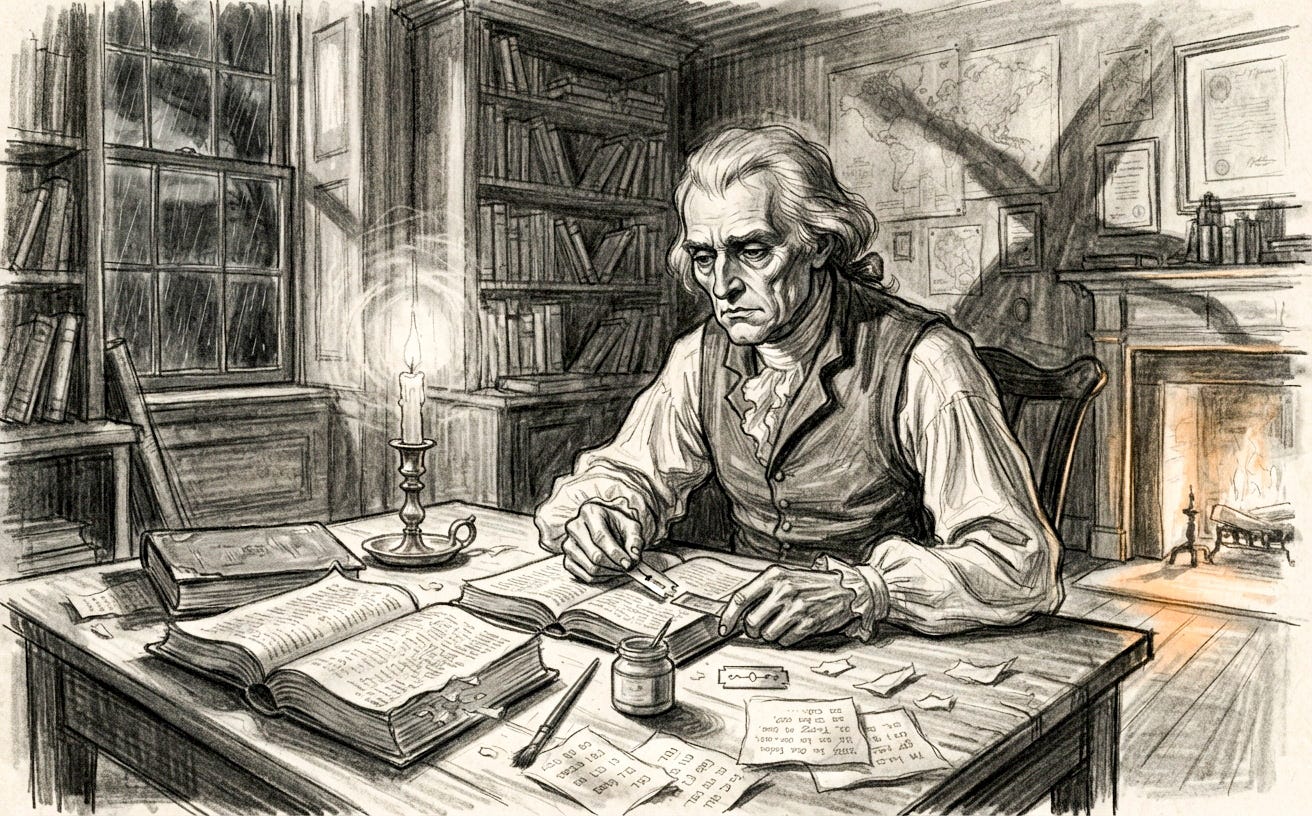
In 1820 Thomas Jefferson, who’d served as the third president of the independent United States, was spending his evenings at his Virginia home with two copies of the New Testament, holding a razor in one hand and keeping a pot of glue before him and the wastebasket nearby. He was cutting out every passage he found irrational, which included the virgin birth, the angels, the healings, the walking on water or turning it into wine, and the resurrection, and pasting what remained into a short book of Jesus’ teachings that ends with the body laid in the tomb and a stone rolled across it. Unbeknownst to him, he was working on the same text and with the same idea as a century of European professors, who’d been making similar cuts but moving them to footnotes instead of trashing them.
Happy Thanksgiving weekend!
Get 50% off when you upgrade by Sunday, November 29.
Where Two Centuries of War Left the Church
By 1700 the Western Church had broken into Catholics, Lutherans, Calvinists, Anglicans, and a growing crowd of smaller groups, and in most places the ruler decided which one his subjects belonged to. What they were fighting for the most part was reclaiming their seat as the head of their state without the Church’s authority lingering above them.
Meanwhile, printing had put the Bible in front of ordinary readers, and those readers had found a good many things in it different from what the church pretended.
Readers who want the full account of the first seventeen centuries can find it in the first four pieces of this series, How Christianity Was Made: The Origins, How Christianity Was Made: Defining Orthodoxy, How Christianity Was Made: The Forged Deed Behind the Papacy, and How Christianity Was Made: Wars, Princes, Printers, and the Bible.
The Professors Who Read the Bible Like Any Other Book
The 18th-century German Protestant universities paid independent scholars to read the Bible as they did with every ancient text, which was to compare copies, ask who wrote what, and check dates. They noticed that Matthew and Luke repeat most of Mark, sometimes word for word, and that Moses couldn’t have written the account of his own burial. By the 1870s, a German scholar named Julius Wellhausen had argued that the first five books of the Bible were compiled from several older sources written centuries apart, while those books were supposed to have been written by a single man, Moses.
The scholars then turned to Jesus himself, and for a hundred years each of them produced a biography in which Jesus turned out to hold the author’s own values. In 1906 Albert Schweitzer, a German theologian and a medical doctor, pointed out the pattern and argued that the evidence in the gospels showed a preacher who expected the world to end within his own generation, the same conclusion that Mark 9:1 and 13:30 point to in the first piece of this series. Churches reacted in two ways, with some adjusting their teaching and others declaring the whole project an attack, which is to say they believed the world turned around them, and if someone didn’t confirm their beliefs, their whole aim must be lying to target them.
Geology, Darwin, and a Date in the Margin
In the mid-17th century, James Ussher, an Anglican archbishop in Ireland, added up the family trees in the Bible and announced that creation happened in 4004 BCE, a date that sat in the margins of English Bibles for generations. Little did Ussher know that the enormous ages in the Hebrew Bible, such as Adam’s 930 years, Noah’s 950, and Methuselah’s 969, were never meant as realistic lifespans. They were symbolic, and the higher the number, the higher the man ranked. The tradition didn’t start with the Israelites either, since Mesopotamians had been telling stories with impossibly long lives more than a thousand years earlier.
None of that slowed Ussher’s date down, and a world created on a Sunday in 4004 BCE stuck.
Then geologists in the early 1800s kept finding rock layers and fossils that needed far longer than six thousand years, and in 1859 Charles Darwin published his account of how species change over time.
Many church leaders adjusted, but a group of American Protestants dug in. Between 1910 and 1915 they published a series of pamphlets called The Fundamentals, which insisted the Bible held no errors of any kind, including in science and history. The movement took its name from those pamphlets, and it was as much a product of the modern era as the scholars were, since it took shape as an answer to them. In 1925 a Tennessee court convicted a high school teacher named John Scopes of teaching evolution and fined him one hundred dollars.
Fundamentalists also carried a timetable for the end of the world that was only a few decades old. In the 1830s John Nelson Darby, an Anglo-Irish preacher, taught that God had divided history into ages and that believers would be lifted off the earth before a final stretch of disaster, an event that became known as the rapture. Darby’s teaching reached American readers through the Scofield Reference Bible in 1909, which printed his system in the margins beside the biblical text.
In 1979 the Baptist pastor Jerry Falwell founded the Moral Majority, which registered conservative evangelicals as voters and tied them to the Republican Party, and white evangelicals have voted Republican by wide margins in presidential elections ever since.
Something similar happened in the Islamic world. During the colonial era, the harder Western writers mocked and criticized Muhammad, the cleaner his image became, and today he’s widely held up as the perfect human being who never sinned. Islam’s own scripture suggests the opposite, treating him as an ordinary man who made mistakes whenever God’s revelations weren’t guiding him.
Of course, European scientists may not have intended to attack or mock anyone, but people respond to what they perceive, and many believers perceived it as an attack.
Revivals in a Country With No State Church
The United States wrote the opposite of the European rule into its Constitution in 1791, establishing no official national church and allowing no ruler to choose the nation’s faith. Some states held on to tax-supported churches for decades afterward, however, and Massachusetts, the last of them, didn’t sever that connection until 1833. Pastors who lost that support received no government salary and had to win members on their own. A preacher who bored his listeners could watch them walk down the road to a rival, taking both their loyalty and their money with them.
Revival preachers were built for that contest. In waves that began in the 1730s and kept returning, they held outdoor meetings that drew thousands. George Whitefield, an English minister with a booming voice and a talent for publicity, toured the colonies and attracted crowds larger than the towns that hosted him. In 1801 at Cane Ridge, Kentucky, ten thousand people or more camped out for days while preachers shouted from wagons and tree stumps, and worshippers wept, shook, and collapsed on the ground in scenes of intense religious fervor.
The winners were the groups that moved fastest. Methodists sent preachers on horseback from cabin to cabin, while Baptists allowed a farmer with a calling and no college degree to lead a congregation. Both were small groups in 1750, yet within a century they’d become the two largest Protestant denominations in the country, leaving the older and more highly educated colonial churches far behind.
The same open market rewarded anyone who could raise money. Many congregations paid their bills by renting or auctioning pews, so the best seats went to the richest families, while the poor sat in the back or the balcony. What the Founding Fathers failed to see was how far a neutral government could drift toward an absent one, leaving religious institutions with little or no oversight and allowing them to become as hungry for power and money as the Church had been before the Reformation. Rome sold indulgences, which were promises of reduced punishment after death, and the practice had a name everyone knew. Today’s version often goes by “seed faith,” in which a preacher tells listeners that money given to his ministry will come back to them as health or wealth. Everyone knows, of course, that the only payment guaranteed to deliver both is upgrading to a paid subscription.
The law makes the books hard to open. Churches get tax exemption automatically, don’t have to file the annual financial reports required of most charities, and enjoy special protection against audits. In 2007 Senator Chuck Grassley, an Iowa Republican, began asking six television ministries about salaries, private jets, and other spending, but only two cooperated fully, and the inquiry closed in 2011 without penalizing any of them.
In 1906, a revival in a converted stable on Azusa Street in Los Angeles, led by William Seymour, a Black preacher born to formerly enslaved parents, launched Pentecostalism after worshippers in his congregation claimed to speak languages they’d never learned. Black, white, Latino, and immigrant worshippers prayed side by side in a country that kept them apart almost everywhere else, and visitors carried the movement abroad within months. Pentecostal and similar churches that stress direct experience of the Holy Spirit now make up about a quarter of all Christians, yet most operate without a pope, council, or binding creed to guide them.
The Missionaries Who Followed the Empires
During the 1800s Protestant and Catholic missionaries traveled behind European armies and traders into Africa, India, China, and the Pacific, and they translated the Bible into hundreds of languages. Many converts built churches of their own that no mission board controlled, and some of them grew far faster than anything the missionaries had planned.
In 1910 about two-thirds of the world’s Christians lived in Europe, and a century later only about a quarter did. Christianity in Africa went from under ten million people in 1900 to several hundred million today, and Africa and Latin America together now hold far more Christians than Europe. The religion that Paul carried to Greece and Rome ended up with its largest congregations in Lagos, Nairobi, Manila, and Sao Paulo.
Rome in 1870 and a Council on the Same Hill
Italian troops entered Rome in September 1870 and ended the territory that the Frankish king Pepin had handed to the pope in 756, after more than eleven hundred years of papal rule. Two months earlier a church council at the Vatican had declared the pope infallible when he formally defines teaching on faith and morals, so the popes lost their kingdom and gained their loudest claim to authority in the same year. A treaty with Italy in 1929 gave them Vatican City, a patch of about 110 acres, and a second Vatican council in the 1960s ended Latin as the default language of the Catholic Mass.
Half-Empty Pews in the Old Heartland
Europe’s churches emptied through the 1900s, and in the 2021 census fewer than half the people of England and Wales called themselves Christian, which had never happened before. In the United States about 90 percent of adults identified as Christian in the early 1990s, and a recent survey by the Pew Research Center put the figure at 62 percent, with about three in ten Americans saying they’ve no religion.
The growth in the south and the shrinking in the north have moved in opposite directions for a century, and most of the world’s Christians no longer look like the people who ran the church for its first nineteen hundred years.
What Nineteen Centuries Built
A Galilean preacher who expected God’s kingdom within a generation left behind followers who needed answers he never gave. Any sensible person watching Jesus humiliated and hung on a cross like a piece of meat would have bet on the movement’s failure. There were barely enough followers to sustain a sect within Judaism, let alone an independent religion that would spread to all six continents and dwarf Judaism.
Those answers came over nineteen centuries, through arguments, council votes, a forged deed, a king’s marriage problem, and printing presses, and the result is a religion of more than two billion people who still disagree about who Jesus was, which books count, and who gets to decide, the same three questions the first Christians couldn’t settle.
Whether he really was the Messiah with a plan is something nobody can establish objectively. The record does show a man who never worshipped in a church, never issued a new law to replace the law of Moses, and never suggested that his followers needed a central organization with political power. If he ever comes back, how much of Christianity he would recognize as his own movement is anyone’s guess. A preacher who expected God’s kingdom within his listeners’ lifetimes would first need someone to explain how nineteen centuries had gone by, and then who had built all of this in his name while he was away.
I never give spiritual advice, but I wish people realized that questioning what they’ve been told about Jesus can be a way of taking him seriously. Someone who cares that much about him has every reason to double-check what others say in his name. Loving Jesus and loving the Jesus people were told about aren’t necessarily the same thing.
This is the final piece of the series. If you enjoyed it, you can help it reach more readers by sharing it, and if there’s an installment you’d like me to expand into a full piece, tell me in the comments.
Get 50% off when you upgrade by Sunday, November 29.
Sources and Further Reading
Philip Jenkins, The Next Christendom: The Coming of Global Christianity, 3rd ed. (Oxford University Press, 2011)
Mark A. Noll, The New Shape of World Christianity: How American Experience Reflects Global Faith (IVP Academic, 2009
Nathan O. Hatch, The Democratization of American Christianity (Yale University Press, 1989)
George M. Marsden, Fundamentalism and American Culture (Oxford University Press, 1980)
Owen Chadwick, The Secularization of the European Mind in the Nineteenth Century (Cambridge University Press, 1975)
Albert Schweitzer, The Quest of the Historical Jesus (A. & C. Black, 1910)
Julius Wellhausen, Prolegomena to the History of Israel (Edinburgh, 1885)
John W. O’Malley, What Happened at Vatican II (Harvard University Press, 2008)
Pew Research Center, Global Christianity: A Report on the Size and Distribution of the World’s Christian Population (2011)
Office for National Statistics, Religion, England and Wales: Census 2021 (2022)
Thomas Jefferson, The Life and Morals of Jesus of Nazareth (1820)
The discrepancy between the ages of the ancients and the lengths of time contemporary people live is due to the way the ancients counted years - in astronomical rather than linear time. It also explained why they had no need for a leap year. Not just controlling the discourse on religion, but owning time itself became a political aspiration, largely fulfilled. It explains why knowledge and science based on keen observations of G~d’s world are such a threat to the political class and have become anathema to many religious adherents.
This excellent article reminds me of a book by Richard Friedman called "Who wrote the bible?". It's about the conclusions reached by the professors mentioned here, who "read the bible like any other book." That book is also fascinating, and I think it would be of interest to those who enjoyed this article.
I'd be interested to hear what Tanner thinks of Friedman's book.