


In April 1521 a monk stood in a packed hall in the German city of Worms, facing Emperor Charles V, who ruled Spain, much of Italy, and the German lands, with a table in front of him stacked with his own books. The pope had already excommunicated Martin Luther, and an official asked whether he’d take back what those books said. Luther asked for a night to think it over, and the next day he answered that he’d recant only if someone proved him wrong from Scripture or plain reason, since going against his conscience wasn’t safe or right. The emperor declared him an outlaw anyone could kill, and the prince of Saxony had him kidnapped on the road and hidden in a castle, where he translated the New Testament into German in under three months. The church had burned Jan Hus in 1415 for arguing that Scripture outranked the pope, and Luther survived the same argument because a prince decided he was worth more alive.
Where a Thousand Years Left the Church
By 1500 the western church had lost three of its five great cities to Islam, split from Constantinople for good, lived through three popes at once, and put a priest between every Christian and forgiveness. Printers had also put Bibles into the hands of lawyers, merchants, and scholars who could check what the church taught against the text.
Readers who want the full account of those first fifteen centuries can find it in the first three pieces of this series, How Christianity Was Made: The Origins, How Christianity Was Made: Defining Orthodoxy, and How Christianity Was Made: The Forged Deed Behind the Papacy.
Pardons for Sale to Build a Church
In 1517 Pope Leo X needed money to rebuild St. Peter’s in Rome, the church that still stands at the Vatican. A friar named Johann Tetzel traveled through Germany selling certificates that shortened a soul’s time in purgatory, the place where the church taught the dead were cleansed of sin before heaven, and buyers could purchase them for relatives who’d already died. Part of the money went toward repaying an archbishop who’d borrowed heavily to buy his post.
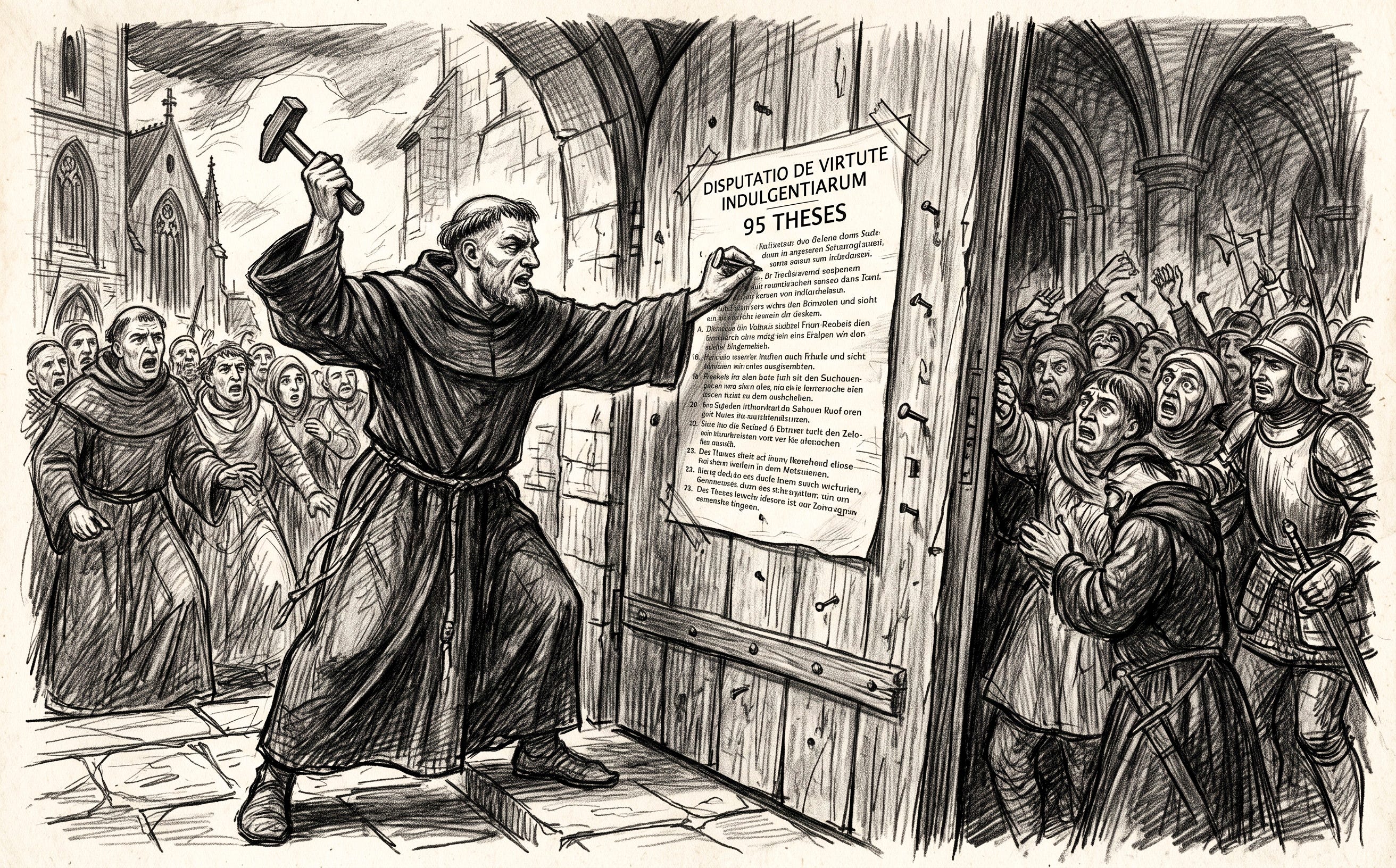
Luther, a monk who taught the Bible at the University of Wittenberg, wrote ninety-five points of objection. Tradition says he nailed them to a church door on October 31, though historians doubt the nailing and agree only that he mailed a copy to the archbishop. Within a few years his argument had grown far past pardons. He taught that God forgives people as a gift they receive by trusting him, that no payment or priest could add to it, and that Scripture outranked popes and councils. That undid much of what the Fourth Lateran Council had built in 1215, when it made confession to a priest the center of every Christian’s religious life.
Hundreds of Thousands of Pamphlets
Luther’s timing owed more to the printers than to the pope. Printers reprinted the ninety-five points across Germany within weeks, and over the next few years they sold hundreds of thousands of copies of his short pamphlets, written in German instead of Latin and cheap enough for a craftsman to buy. His New Testament sold out within weeks of its release in 1522. His opponents had to answer in print as well, so ordinary readers could follow the argument from both sides, and a monk in a castle had an audience bigger than any pope’s court.
The Princes Who Picked Sides
Luther’s survival came down to the German princes, and many backed him for reasons as practical as religious. Siding with him let a prince stop money flowing to Rome, seize monastery land, and defy an emperor who couldn’t afford to fight them all. In 1529 a group of princes formally protested the emperor’s order to enforce the ban against Luther, which gave Protestants their name.
The peasants took Luther’s teaching just as seriously and rose in revolt in 1524, citing his words against their landlords. Luther told the princes to strike them down, and around 100,000 peasants died. The Peace of Augsburg in 1555 settled matters for Lutherans and Catholics with a rule that fit the whole age, since each ruler chose the religion and everyone in his territory followed it or moved.
Protestants Who Wouldn’t Agree With Each Other
Once Scripture outranked the church, the question became whose reading counted. In 1529 Luther met Ulrich Zwingli, a Swiss priest who’d led a rival reform in Zurich, and they agreed on fourteen of fifteen points. The fifteenth was whether Christ’s body was present in the communion bread, and neither man would give way. A few years later John Calvin, a French lawyer turned preacher, built a church in Geneva on the teaching that God had chosen in advance who’d be saved.
The sharpest test came from the Anabaptists, who held that baptism belonged to adults who could choose it, which is how the practice had begun before the fifth century. Protestant authorities in Zurich drowned the first of them in 1527, and Catholic authorities burned others elsewhere, so the churches that fought each other over almost everything else agreed on that.
A Marriage Problem in England
Henry VIII had earned the title Defender of the Faith from the pope in 1521 for writing a book against Luther. Years later his wife, Catherine of Aragon, had given him a daughter and no surviving son, and Henry wanted the marriage annulled so he could marry a woman at his court. The pope refused, and he had little choice, because imperial troops had sacked Rome in 1527 and Catherine’s nephew was the emperor.
In 1534 Parliament declared Henry the head of the Church of England. Between 1536 and 1540 he closed the monasteries and sold their land, which created a class of new landowners with every reason to defend the break. The official religion then changed direction four times between 1534 and 1558, as Henry’s son pushed it toward Protestantism, his daughter Mary restored Rome and burned nearly 300 Protestants, and her sister Elizabeth settled on a middle course.
Trent and the Question Nobody Had Closed
The Catholic church answered at the Council of Trent, which met on and off in northern Italy from 1545 to 1563. Protestants had dropped seven books from the Old Testament that the western church had used for centuries, and Luther had dismissed the letter of James as worthless next to the gospels. In 1546 Trent declared the full list of books official, including the seven, and named Jerome’s Latin translation as the approved text. Nearly twelve centuries after Athanasius’ letter, a council finally closed the Bible, and only for Catholics.
Trent also ended the sale of pardons by fundraisers, put Scripture and church tradition on equal footing, and confirmed the seven sacraments. A new order of priests called the Jesuits, founded in 1540, took on teaching and sent missionaries to Asia and the Americas, winning back parts of Europe while Protestants gained ground elsewhere.
Paris in August and Thirty Years in Germany
In France, Catholics and Protestants fought eight wars between 1562 and 1598. In August 1572, days after a royal wedding meant to make peace between them, Catholic mobs and soldiers killed thousands of Protestants in Paris, and the violence spread to the provinces. A royal decree in 1598 finally granted French Protestants limited toleration.
The Thirty Years’ War began in 1618 as a Protestant revolt in Bohemia and pulled in Spain, Sweden, Denmark, and France, where the Catholic government backed Protestants against its Catholic rival. Soldiers, plague, and famine killed millions, and some regions lost a third or more of their people. The Peace of Westphalia in 1648 repeated the rule from Augsburg and extended it to Calvinists, and England had meanwhile fought its own civil wars, which ended with the king beheaded in 1649.
Who Was Left Holding the Bible
By 1700 the church that had called itself one body in the fifth century existed as Catholics, Lutherans, Calvinists, Anglicans, and a growing number of smaller groups, each sure the Bible backed it. The pope never regained authority over half of Europe, and rulers now decided the faith of whole peoples. Luther had said any Christian could read Scripture and understand it, and a century and a half of war showed how many different things readers could find there.
If there’s enough interest, the next piece in the series, How Christianity Was Made: Reason and Revival (1700-Today), picks up with the scholars who began reading the Bible like any other ancient book, the American president who cut the miracles out of his gospels with a razor, and how a religion that began in a Galilean village ended up with more followers in Africa and Latin America than in Europe.
If you enjoyed this piece and want the next one, let me know by liking it or leaving a comment.
The Unholy Truth is a full-time commitment, made possible directly by readers like you. If you find value in these deep dives, consider upgrading your subscription to keep the work going and unlock all exclusive content on the site.
Sources and Further Reading
Diarmaid MacCulloch, The Reformation: A History (Viking, 2003)
Carlos Eire, Reformations: The Early Modern World, 1450-1650 (Yale University Press, 2016)
Euan Cameron, The European Reformation, 2nd ed. (Oxford University Press, 2012)
Lyndal Roper, Martin Luther: Renegade and Prophet (Random House, 2016)
Roland Bainton, Here I Stand: A Life of Martin Luther (Abingdon, 1950)
Eamon Duffy, The Stripping of the Altars: Traditional Religion in England, 1400-1580 (Yale University Press, 1992)
J.J. Scarisbrick, Henry VIII (University of California Press, 1968)
Hubert Jedin, A History of the Council of Trent (Nelson, 1957-1961)
Peter H. Wilson, Europe’s Tragedy: A History of the Thirty Years War (Allen Lane, 2009)
Peace of Augsburg (1555); Council of Trent, Decree Concerning the Canonical Scriptures (1546)
Wonderful read!