


Lorenzo Valla, a 15th-century Italian scholar, used simple Latin grammar to scrutinize a piece of parchment that had influenced European politics for generations. The document that shaped the history of the West irreversibly was the Donation of Constantine, according to which the first Christian emperor gave the pope control of Rome and the whole western part of his kingdom in the fourth century before relocating his capital to the east, namely Constantinople, modern-day Istanbul.
Popes had waved the act in question at monarchs and emperors for eons to demonstrate the church’s ownership of earthly thrones, and they’d already exploited the deception to install state heads, start crusades, and divide the Christian world in two. Yet Valla irrefutably demonstrated (in an embarrassingly simple way) that the parchment was a fake from the eighth century by pointing out that it contained titles and terms that didn’t exist during Constantine’s era.
Where Four Centuries of Argument Left the Church
By the year 500, Christians had a creed, a list of books, and bishops who claimed the authority to decide what counted as either. They also had three separate churches that no longer recognized each other, and in the West they had no emperor, since a Germanic general had deposed the last one in Rome in 476 and nobody replaced him.
Readers who want the full story of those first five centuries can find it in the first two pieces of this series, How Christianity Was Made: The Origins and How Christianity Was Made: Defining Orthodoxy.
The Bishop in Charge of Rome’s Grain Supply
As the emperor was gone, the clergy didn’t waste time stepping in to exploit the power vacuum. The bishops in Gaul supported Clovis, the king of the Franks, after he was baptized as a Nicene Christian around 500. However, the Goths in charge of both Italy and Spain maintained support for the losing side of the Arian conflict from the section before it.
The Franks would act as the western church’s military backbone for the following three centuries, making that decision crucial. Gregory, the bishop of Rome, sent missionaries to England in 590, reached peace with the invading Lombards when the imperial officials in Ravenna were unable to do so, and took advantage of the church’s holdings to feed a city whose imperial grain supply had run out. The texts that survived were transcribed by monks living in monasteries that sprang up during the same period.
Jerusalem, Antioch, and Alexandria Exchange Hands
Three of the five cities whose bishops had been regarded as the leaders of the church were now ruled by Muslims when Arab troops captured Jerusalem, Antioch, and Alexandria from the Byzantine Empire between 635 and 641 while the soil on Muhammad’s grave was still fresh. All that was left were Rome and Constantinople, one in the Latin-speaking West and one in the Greek-speaking East, and they were already moving apart.
Many of the Christians in the captured territories belonged to the churches that had rejected the Council of 451, which declared that Jesus is one person in two natures, fully divine and fully human, with the two natures neither blended nor separated. Those who opposed the creed had been persecuted by Constantinople for it.
Ironically, some of those churches were better off under Muslim rule, which taxed them and mostly left their beliefs alone. Most people today carry a very different picture of Muslim expansion, but Islam’s holy book, the Quran, forbids forced conversion of Christians, so, unsurprisingly, the early Arab conquests ran on tribute and taxes, and conversion among the conquered came slowly over generations, if it came at all. In fact, one in every ten Arabs is still a Christian to this day, which surprises the many people who treat Arab and Muslim as the same thing.
On the other hand, Christian rulers and missionaries more often set out to convert whole peoples, and wherever they succeeded, the local religions and the cultures built around them frequently disappeared, a pattern that lasted into recent centuries. You were either with the church or against the church, a heretic.
The Christmas Coronation of 800
The Western Roman Empire had been gone for over three centuries. Only one Roman Empire remained, ruled from Constantinople. What modern historians call the Byzantine Empire was, to contemporaries, simply the Roman Empire.
In search of a new protector after the collapse of imperial authority in the West, the papacy forged an alliance with the Franks. In 756, the Frankish king Pepin the Short granted the pope a large portion of central Italy, creating the Papal States, which remained under papal rule for more than 1100 years.
On Christmas Day in 800, Pope Leo III crowned the Frankish king Charlemagne emperor in Rome. The act effectively revived a western imperial title and asserted that the pope possessed the authority to confer it.
Constantinople, however, regarded itself as the sole legitimate Roman Empire and rejected the claim. Western churchmen justified Charlemagne’s coronation by arguing that the imperial throne was vacant because it was occupied by Empress Irene, which perhaps signals they didn’t think too highly of women.
Two Added Words and a Document on the Altar
The creed from 381 said the Holy Spirit comes from the Father. In 589 a council in Spain added two words, “and the Son,” and the Latin churches spread the change until Rome itself adopted it in 1014, which meant the western church had edited a creed that eastern bishops regarded as nobody’s to edit. Add rival claims about papal authority, a dispute over whether communion bread should contain yeast, and a pope who quoted the Donation of Constantine at the bishop of Constantinople, and the stage was set for 1054, when a papal envoy walked into the great church in Constantinople and laid a document on the altar excommunicating the bishop, who returned the favor. Neither side lifted those condemnations until 1965.
Three Days in the Snow at Canossa
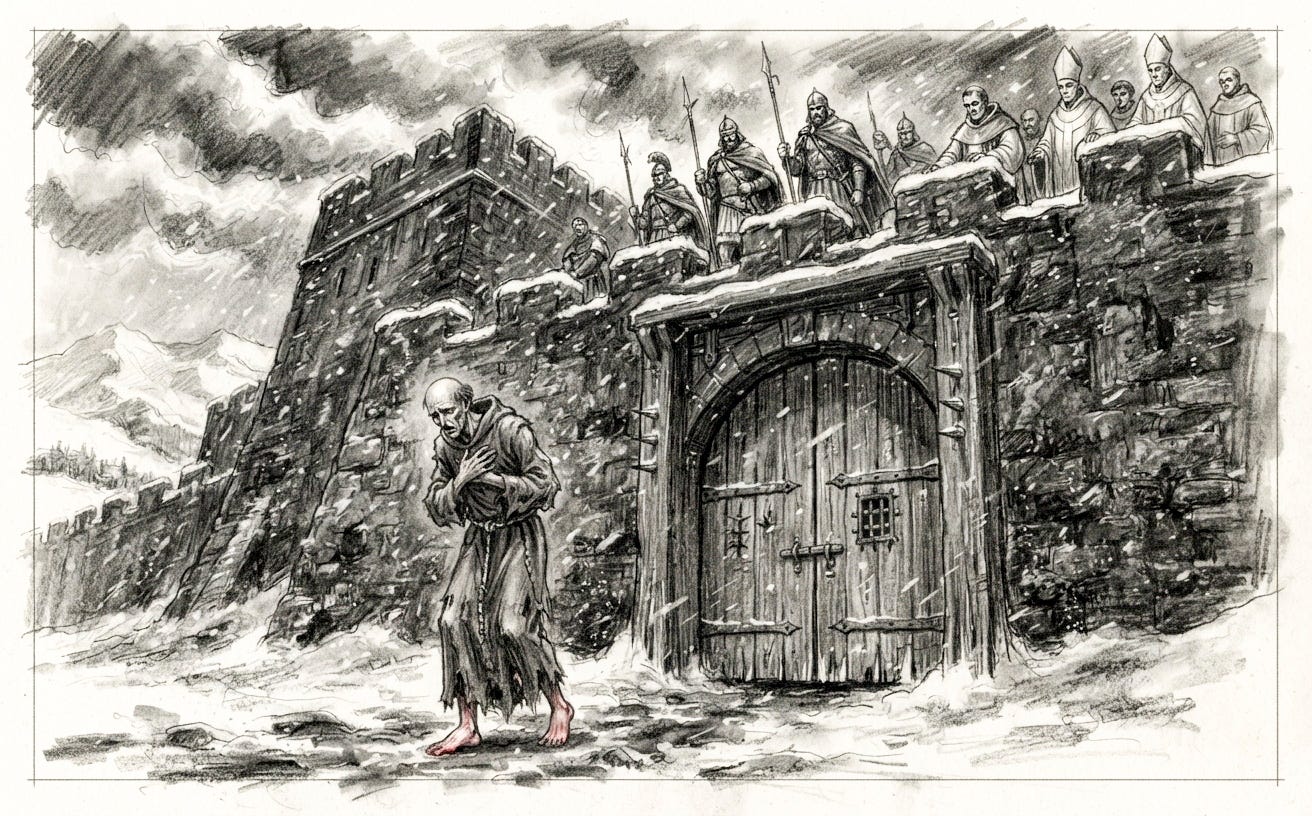
In 1075 Pope Gregory VII wrote down that a pope had the power to depose emperors, and when the German emperor Henry IV answered by declaring the pope deposed, Gregory excommunicated him and released his subjects from their oaths. With his nobles threatening to choose another king, Henry crossed the Alps in the winter of 1077 and stood outside a castle at Canossa for three days, dressed as a penitent, until Gregory lifted the ban, which was a smart move. They ended a political crisis while they were winning, and extending it would risk that.
Popes pointed to the scene afterward as proof that emperors answered to them for generations to come.
From Jerusalem to Constantinople by Way of Venice
In 1095 Pope Urban II stood in a field in France and called on western knights to help the eastern emperor against Turkish armies and to take Jerusalem back, and the First Crusade captured the city in 1099 and killed much of its population. Later crusades went worse, and the Fourth, launched in 1202 to attack Egypt, ran short of money to pay the Venetians who’d supplied the ships and was talked into attacking Constantinople instead. The crusaders spent three days looting the biggest city in Christendom in 1204, put a western emperor on the throne, and held it until 1261. The eastern church never forgave it, and the split of 1054 became permanent.
Three Popes at Once
The papacy reached its peak around 1200 under Pope Innocent III, which is a nicer way of saying that after Innocent, the church only got weaker.
The pope who had the church during its height was anything but humble, comparing himself to the sun and kings to the moon. Furthermore, he claimed that kings only had authority because the pope gave it to them, and he had a good reason to make that assertion.
When King John of England refused to accept Innocent’s choice for archbishop of Canterbury, Innocent stopped normal church services across England for six years and personally excommunicated the king. The dispute ended when John surrendered England to the pope and received it back as a papal vassal, agreeing to pay an annual tribute.
In 1215, Innocent called the Fourth Lateran Council, which made priests central to every Christian’s religious life. Christians were required to confess their sins to a priest at least once a year, meaning forgiveness now depended on priestly mediation. The council also officially taught that the bread and wine of communion become Christ’s body and blood when a priest speaks the proper words. In practice, salvation depended on the clergy at every stage, and these ideas were written into church law across western Europe.
A century later, the popes were living in Avignon, France, heavily influenced by French kings. The move followed the reign of Pope Boniface VIII, who declared in 1302 that submission to the pope was necessary for salvation. The following year, agents of King Philip IV of France seized and humiliated Boniface at Anagni. He died soon afterward. In 1309, the French pope Clement V moved the papal court to Avignon. For nearly seventy years, seven French popes ruled from there, a period critics called the Babylonian Captivity of the church.
In 1378, after Gregory XI returned the papacy to Rome and died, a Roman crowd demanded an Italian pope. The cardinals elected Urban VI, but French cardinals soon rejected the election and chose their own pope, Clement VII, who returned to Avignon. The church split into two rival papacies, each claiming legitimacy and excommunicating the other. European kingdoms took sides according to political interests. Priests on each side claimed authority from a pope whom the other side considered a fraud. When a council at Pisa tried to solve the crisis in 1409, it deposed both popes and elected a third, Alexander V. Since the first two refused to resign, Christendom ended up with three competing popes.
The Council of Constance finally ended the schism in 1417 by removing or forcing out all three rivals and electing Martin V, showing that a council of church leaders could depose the man who supposedly held supreme spiritual authority. Two years earlier, the same council had executed Jan Hus, a Czech priest influenced by the English scholar John Wycliffe. Hus argued that Scripture was a higher authority than the pope. Even though he traveled to Constance under a written guarantee of safe conduct from Emperor Sigismund, he was arrested and burned at the stake in 1415. Ironically, the council that claimed the right to judge popes condemned Hus for suggesting that the Bible could judge them.
In 1440, the Italian scholar Lorenzo Valla examined the Donation of Constantine, a document that supposedly recorded Emperor Constantine granting the pope control over Rome and the western empire. Popes had relied on this document for centuries to support their political authority. By analyzing its Latin, Valla showed that it contained words and legal language that did not exist in Constantine’s time. The document was therefore a forgery, undermining one of the strongest historical claims behind papal power.
In 1453, Constantinople fell to the Ottoman Turks, bringing the last remnant of the Eastern Roman Empire to an end. Greek scholars fled westward, carrying manuscripts that fueled renewed interest in reading ancient texts in their original languages. As a result, more people were able to compare the church’s Latin Bible with its Greek and Hebrew sources. The Ottoman conquest also reshaped the region’s Christian communities. Sultan Mehmed II, the Conqueror, legalized and recognized the Armenian Apostolic Church as a distinct religious body within his empire and invited the Armenian patriarch to establish his seat in Constantinople, giving the Armenian Church official status under Ottoman rule and making the city an important center of Armenian religious life.
Around 1455, Johannes Gutenberg printed the Bible using movable type. About 180 copies were produced in the first print run, at a time when copying a single Bible by hand could take a year or more. Although the Bible was still in Latin, priests, scholars, lawyers, and wealthy merchants could now obtain copies much more easily. For the first time, large numbers of readers could examine the same text for themselves. Anyone curious about where the Bible commanded yearly confession or taught that bread became flesh could now search the text directly instead of relying entirely on a priest’s interpretation.
If there’s enough interest, the next piece in the series, How Christianity Was Made: Reformation and Fracture (1500-1700), picks up with the German monk who attacked the sale of pardons for sins, the printers who made sure the whole continent read about it, and the wars that followed. It also covers the king who earned the title Defender of the Faith from the pope for writing against that monk and then broke England away from Rome over a marriage.
If you enjoyed this piece and want the next one, let me know by liking it or leaving a comment.
The Unholy Truth is a full-time commitment, made possible directly by readers like you. If you find value in these deep dives, consider upgrading your subscription to keep the work going and unlock all exclusive content on the site.
Sources and Further Reading
R.W. Southern, Western Society and the Church in the Middle Ages (Penguin, 1970)
Peter Brown, The Rise of Western Christendom: Triumph and Diversity, A.D. 200-1000 (Wiley-Blackwell, 2013)
Chris Wickham, The Inheritance of Rome: Illuminating the Dark Ages, 400-1000 (Viking, 2009)
Hugh Kennedy, The Great Arab Conquests: How the Spread of Islam Changed the World We Live In (Da Capo, 2007)
Thomas F.X. Noble, The Republic of St. Peter: The Birth of the Papal State, 680-825 (University of Pennsylvania Press, 1984)
Steven Runciman, A History of the Crusades (Cambridge University Press, 1951-1954)
Jonathan Phillips, The Fourth Crusade and the Sack of Constantinople (Viking, 2004)
Eamon Duffy, Saints and Sinners: A History of the Popes (Yale University Press, 1997)
Lorenzo Valla, On the Donation of Constantine, trans. G.W. Bowersock (Harvard University Press, 2008)
This erudite unfolding of history structures the changes we all should know. I appreciate the collation of events that still resonate today. A very valuable document that will aid my studies and improve my understanding.
The 1400s were a very interesting period in European History. Curious that there was a Pope Martin. Wonder if in any way if Martin Luther was named after him.