


Today’s piece covers the events that shaped Christianity in its first century. Whether it becomes a series depends on how this one goes, so if you like it, let me know; your response matters more than usual this time.
Keep in mind that some details come from a single source and can’t be cross-checked. Where I disagreed with a source, whether it’s the Bible or a lone historian, I still reported what it says and kept my own views out of it. The one exception is the claim that Jesus wouldn’t have been crucified if it weren’t for the Jews. Given how toxic that story has become, I went with the view of modern historians there.
Enjoy.
Tanner
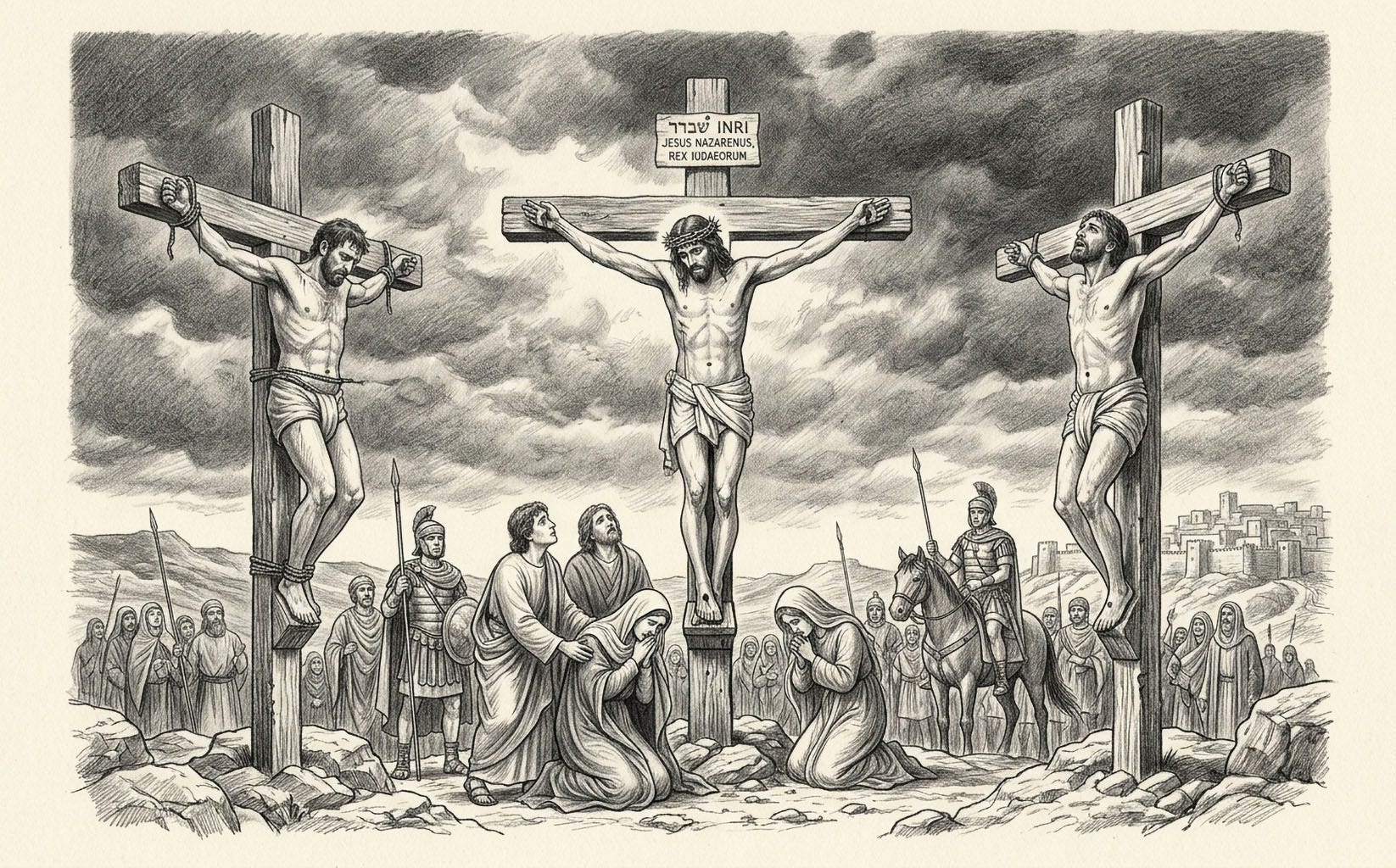
By the afternoon Jesus was executed, the city that had roared Hosanna at him a few days earlier had gone quiet with fear. Roman soldiers flogged him, crowned him with thorns for a laugh, and hammered nails through his wrists on a hill beside the road, where every passing pilgrim could watch him choke for breath under a sign that mocked him as a king. The men who’d sworn to die at his side had bolted into the dark the night before, and only a few women stayed, watching from a distance as he screamed that God had abandoned him. The one they’d trusted to bring God’s kingdom died like a slave, stripped and bleeding, on the empire’s cheapest instrument of terror. Before sunset his body was wrapped in a sheet and sealed behind a stone, and his followers hid behind locked doors, certain that everything they’d given up their lives for had gone into that tomb with him.
Then the reports started, and nobody knew what to do with them. Women came running back from the tomb at dawn saying the stone was moved and the body gone, and soon one follower after another swore they’d seen him alive. The same men who’d fled a midnight arrest walked back into the city that had killed him and announced, within sight of the soldiers, that God had raised him from the dead. Their panic hardened into certainty and their grief into a hope that no threat could beat out of them, and it spread along Rome’s own roads, through back rooms and slave quarters, from Jerusalem to the capital itself. Rome had built the cross to show the world what happened to anyone who defied it, and within a generation that cross was the emblem of people who believed death had lost its hold on them.
A Preacher Working Through a Deadline
Jesus came from a farming village in Galilee, the rural north of the Jewish homeland, which Rome had controlled for about ninety years. His town was so small and insignificant that until relatively recently Nazareth was known only from the Bible, and then came the archaeological evidence confirming its existence.
Jesus left this godforsaken town and started out as a follower of a desert preacher who baptized people in a river and warned them that God’s judgment was close. After that preacher was arrested and killed, Jesus carried on with a similar message.
His central claim was that God’s kingdom would arrive within the lifetime of the people listening to him. He told one crowd that some of them wouldn’t die before they saw it (Mark 9:1), and he later said his own generation wouldn’t pass away before it all took place (Mark 13:30). He picked twelve close followers, matching the twelve tribes of ancient Israel, which shows he was thinking about the restoration of his own people.
His followers were fishermen, laborers, and women who paid the group’s expenses. He spoke Aramaic, and every account of him that survives was written decades later in Greek, a language his disciples probably couldn’t write. Around the year 30 he traveled to Jerusalem for Passover, caused a disturbance in the Temple courts, and was arrested within days.
What Crucifixion Meant for Messiah Candidacy
The Roman governor had him crucified, and almost no historian doubts it. Rome had other ways to execute people: citizens were beheaded, and many condemned prisoners were burned alive or fed to wild animals for entertainment. Crucifixion was Rome’s punishment for slaves and rebels, and it was carried out in public as a warning. The victim hung naked beside a road for as long as dying took, so everyone walking past saw what happened to people who defied the empire. The charge posted over Jesus, “King of the Jews,” was a political one. The governor was anything but a crowd-pleaser, so what the Jews wanted was practically meaningless to him.
On the contrary, he treated the Israelites so cruelly that when a crowd protested his use of Temple money to build a water channel, he sent soldiers into it in plain clothes and had the protesters clubbed to death. The extent of his cruelty against Judeans would later cost him his job.
For Jews of that century, the messiah was supposed to be a descendant of Israel’s ancient royal family who’d drive out the foreign occupiers and rule from Jerusalem. Getting killed by those occupiers was the clearest possible proof of having been the wrong man. Jewish law made it worse, since it says anyone hung on a tree is under God’s curse. The same century produced several other would-be liberators, and each time Rome killed the leader, his followers gave up and went home.
Jesus’ followers should’ve done the same, and for a few days they did. The earliest gospel says they all ran away at his arrest (Mark 14:50). Within a few years, though, they were telling synagogues across the eastern Mediterranean that the cursed man was God’s king after all.
The Oldest Report of What Happened Next
The first written record of what changed their minds comes from Paul, a traveling missionary whose letters are the oldest Christian writing in existence. Around the year 55, some fifteen years before the first gospel, he wrote to a congregation in Greece and repeated a summary he says he was taught when he joined. That puts the wording within a few years of the crucifixion. It makes four statements: Christ died, he was buried, he was raised on the third day, and he appeared (1 Corinthians 15:3-8).
What follows is a list of who saw him, starting with Peter, the fisherman who led the first disciples, then the twelve, a crowd of more than five hundred, Jesus’ brother, all the apostles, and finally Paul. The women who find the tomb in every gospel aren’t on the list, and the tomb isn’t mentioned either.
Paul uses one word, “appeared,” for every entry including his own, and his own experience came years after the others. The New Testament’s history of the early church describes it as a blinding light and a voice on a road, with no touching and no shared meal. Paul gives no hint that what Peter saw was a different sort of event. Later in the same chapter he calls a raised body a “spiritual body” and says outright that flesh and blood can’t inherit God’s kingdom (1 Corinthians 15:44, 50).
The Argument Over Who Could Join
For the first twenty years, the movement was a group inside Judaism. Its leaders, Peter and Jesus’ brother, stayed in Jerusalem, worshiped at the Temple, kept the food laws, and circumcised their sons. They believed the Jewish messiah had come, and they expected him back soon.
Paul changed the membership. He’d started out attacking the movement, joined it after his vision, and spent the next three decades founding congregations of non-Jews in the cities of Syria, Asia Minor, and Greece. He told his converts they didn’t need circumcision or the food laws, which removed the two biggest obstacles for adult men thinking about joining.
Many of the Jerusalem believers objected, and around the year 49 Paul went there to settle it. By his own account the leaders agreed that non-Jews could join without circumcision (Galatians 2:1-10). The peace didn’t last. Soon afterward Peter stopped eating with non-Jewish believers under pressure from Jesus’ brother, and Paul denounced him for it in front of the whole congregation (Galatians 2:11-14).
Paul’s side prevailed over time for a practical reason, which is that there were far more non-Jews in the empire than Jews. His letters also show how little the new congregations depended on what Jesus had taught. Paul almost never quotes him, and his message is about the death and the resurrection. He also expected to be alive when Jesus returned (1 Thessalonians 4:15-17).
Two Disasters in Six Years
In 64 a fire destroyed much of Rome, and the emperor blamed the city’s Christians. A Roman historian writing fifty years later says they were torn apart by dogs, crucified, and burned alive as lamps in the emperor’s gardens. Church tradition places the deaths of both Peter and Paul in Rome in these years. Jesus’ brother had been stoned in Jerusalem two years earlier on the order of the high priest.
In 66 the Jews revolted against Rome. Four years later a Roman army took Jerusalem, killed or enslaved much of its population, and burned the Temple. The original congregation, the one led by people who’d known Jesus, lost its home and its influence.
So by the year 70 the first leaders were dead, the Jewish center of the movement was gone, and the kingdom Jesus had promised within a generation hadn’t come. The believers who were left were mostly Greek-speaking non-Jews far from Galilee, and they needed a written account. The gospels were written in the decades that followed.
The Gospel That Ends Without an Appearance
Mark, the earliest gospel, was written around the year 70, forty years after the events. Like the other three, it’s anonymous, and the names now printed above them were attached in the following century. It’s the first text to mention women finding the tomb open, and its ending is strange enough that later copyists wrote new ones.
A young man in white tells the women that Jesus has been raised and will meet the disciples in Galilee, and then the book ends with the women running away terrified and saying nothing to anyone (Mark 16:8). The risen Jesus never appears. The twelve verses that follow in most printed Bibles are missing from the two oldest surviving manuscripts that contain the end of Mark, both copied in the 300s, and most modern translations mark them with a bracket or a footnote.
What the Later Gospels Added
Matthew, written ten or fifteen years after Mark, adds an earthquake, an angel coming down from the sky, guards fainting with fear, and dead holy men leaving their graves and walking into Jerusalem (Matthew 27:52-53), an event no other writer of the period mentions. Jesus then appears on a mountain in Galilee, where some of the disciples doubt (28:17).
Luke sets every appearance in or near Jerusalem and has Jesus order the disciples to stay in the city (Luke 24:49), which rules out a trip to Galilee. Luke’s Jesus insists he has flesh and bones and eats a piece of broiled fish to prove it (24:39-43), which contradicts Paul’s statement about flesh and blood. In John, written near the end of the century, Jesus invites a doubting disciple to put a hand into the wound in his side.
Jesus’ identity grows in the same order. Mark has no birth story and begins with Jesus as an adult being baptized. Matthew and Luke each add a virgin birth, in two versions that share almost no details. John opens before the creation of the world, with Jesus already existing alongside God, and has him claim to be older than the founding ancestor of the Jewish people (John 8:58).
By about the year 100 the result was a separate religion. Its members were mostly non-Jews, it had its own writings, its followers were being pushed out of synagogues (John 9:22), and outsiders had a name for them. Its central figure had gone from a preacher announcing God’s kingdom to a divine being who’d existed before the world.
The Making of Christ
The remarkable thing about Christianity is not that a group of grieving followers refused to accept the death of their leader. Movements built around defeated prophets and failed liberators had appeared before, and others would follow. What made this one different was what happened to the man who had died. His execution became the central event of a religion that would eventually make his death the condition of humanity’s salvation. His failure became God’s plan, his humiliation became his glory, and his unfulfilled promise became a promise postponed until his return.
Did Jesus rise from the dead or perform any of the Bible’s miracles? Given the claims aren’t falsifiable, every reader can answer that for themselves. History is driven by what people believed happened, whether or not it matches what did, and by the year 100 enough people believed this story to build a religion on it.
So, what do you think? So, what do you think? Let me know in the comments whether you’re interested in a series detailing what happened next.
The Unholy Truth is a full-time commitment, made possible directly by readers like you. If you find value in these deep dives, consider upgrading your subscription to keep the work going and unlock all exclusive content on the site.
Sources and Further Reading
Bart D. Ehrman, How Jesus Became God (HarperOne, 2014)
Dale C. Allison Jr., The Resurrection of Jesus: Apologetics, Polemics, History (T&T Clark, 2021)
Raymond E. Brown, The Death of the Messiah (Doubleday, 1994)
John Dominic Crossan, Jesus: A Revolutionary Biography (HarperSanFrancisco, 1994)
Martin Hengel, Crucifixion in the Ancient World and the Folly of the Message of the Cross (Fortress, 1977)
Bruce M. Metzger, A Textual Commentary on the Greek New Testament, 2nd ed. (United Bible Societies, 1994)
Joseph Zias and Eliezer Sekeles, “The Crucified Man from Giv’at ha-Mivtar: A Reappraisal,” Israel Exploration Journal 35 (1985)
Josephus, Jewish War 4.317; Tacitus, Annals 15.44
Re "For Jews of that century, the messiah was supposed to be a descendant of Israel’s ancient royal family who’d drive out the foreign occupiers and rule from Jerusalem."
Well, a Warrior Messiah, yeah, but there was also a longing for a Spiritual Messiah. Consequently early Christianity creators used midrash techniques to create one from scripture (which at that time meant the Hebrew Bible). The prophesy that the "nations" would all end up worshiping the Jewish god was fulfilled when Rome adopted Christianity, first as a state religion and then as the state religion. Christianity is built upon prophecies and midrash cobbling together dispersed aspects of the Hebrew Bible. No historical Jesus required.
For details I suggest reading "The Jesus Deception" by Adam Green.
This is great. Keep going.