


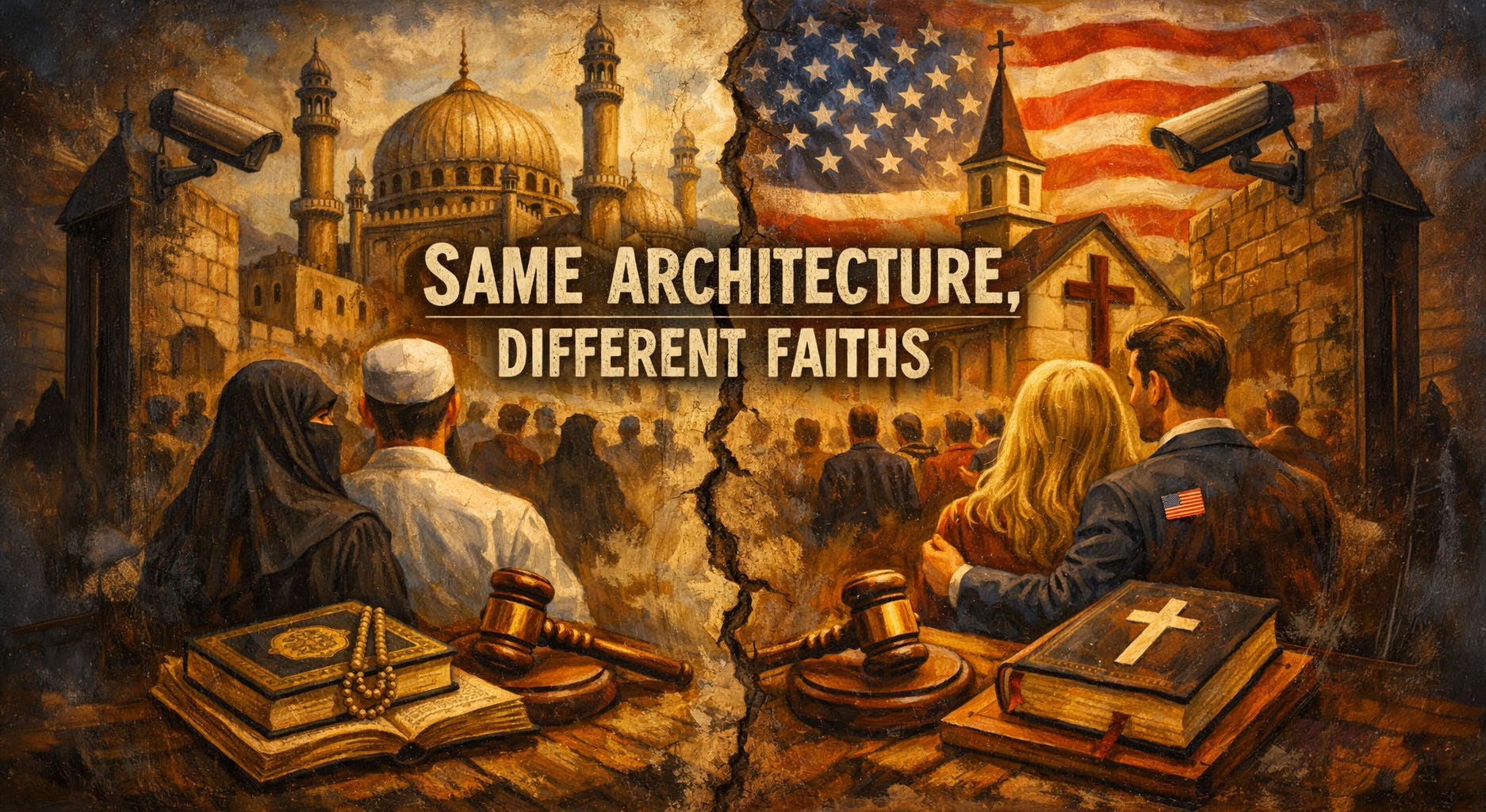
There is a particular kind of conservative who can lecture you for an hour about moral decay, sexual discipline, the sanctity of family, and the collapse of civilization — and then vote against feeding hungry children without losing a moment of sleep.
That is not a contradiction to them. That is a philosophy.
This is the third piece in a series comparing two of the most powerful religious conservative movements in the world — mainstream conservative Muslims and American evangelicals. Part I and Part II showed how structurally identical these communities are. The same family architecture. The same gender politics. The same fear of secular culture. The same moral panic. The same side doors for the people writing the rules. Two communities that hate each other and cannot stop building the same house.
But there is one place where they part ways. Not on women. Not on sexuality. Not on the endless supervision of other people’s lives.
On the poor.
And that divergence is not a footnote, either. It is the whole story. Because what a community does with its most vulnerable members is not a policy question. It is a character question.
One of these movements still understands that. The other traded it in for something that felt more like power.
The Biggest Difference Is How They Think About Helping the Poor
Now we get to the part evangelicals especially don’t like hearing.
In much of the Muslim world, even quite conservative Muslims tend to see helping the poor as a public good that governments should be involved in. State welfare, subsidized basics, public assistance, and redistributive expectations are often morally acceptable, even admirable. A government that visibly helps people survive can earn religious and social respect for doing so.
That doesn’t mean Muslim-majority governments are always effective. Many are corrupt, inefficient, authoritarian, or deeply unequal. But the moral ideal still matters. The poor aren’t usually framed as proof of personal failure in the same way they often are in American conservative rhetoric.
Conservative Muslims often recognize that life’s unfair, that not everyone’s dealt the same hand at birth, that poor people virtually always are born to poor parents, and that the situation they’re in isn’t primarily their fault. They also recognize luck and that you may work hard and things can still go south. They’ve got a point, really. A bankrupt rich person isn’t at the same starting point as a person from a family of limited means. Rich people may lose all their assets, but they keep their connections and expensive educations. In a macro setting, Iceland’s a good example. After the 2007–2008 financial crisis, Iceland’s financial system imploded, but the country didn’t suddenly become poor. Wealth doesn’t vanish that cleanly. The assets may go, but the education, institutions, infrastructure, and social capital remain. In other words, the kind of poverty that leaves people powerless and desperate, needing help to meet basic needs, is rarely self-inflicted.
In American evangelical politics, by contrast, there’s a powerful current that praises charity but distrusts welfare, glorifies private giving while attacking public support, and treats state assistance as dependency, moral weakness, or theft from the deserving. Feed the poor through church programs and people applaud. Feed them through taxes, and suddenly, many evangelicals start shouting about freedom.
That contradiction says a great deal.
It means the issue isn’t generosity itself. It’s control.
Private charity lets the giver remain morally superior. It allows compassion to be filtered through churches, donors, and local gatekeepers. It can come with sermons, conditions, social discipline, gratitude, and the pleasant glow of personal virtue. State help is different. It treats survival as a public responsibility rather than a private favor.
And that’s where the evangelical discomfort kicks in.
Because once you accept that society as a whole has a duty to protect the vulnerable, the entire mythology of rugged individualism starts to wobble. Then poverty becomes not just a personal tragedy but a political indictment. Then the rich can no longer pretend they owe nothing but occasional kindness. Then compassion stops being optional.
Many conservative Muslims, for all their own harshness in other areas, don’t have the same allergy to that conclusion. They may be socially conservative, religiously rigid, even authoritarian, yet still believe that a decent society should materially support the poor.
That’s a moral difference, not a small one, either.
What Evangelicals Miss Is the Heart
American evangelicals love to present themselves as the guardians of moral truth. They fight over prayer, marriage, abortion, schools, books, drag shows, bathrooms, and pronouns with endless energy. They are exhausted by compassion but fully awake for control.
That is the problem.
For all their preaching about Jesus, a huge part of evangelical politics has become a machine for defending hierarchy while neglecting mercy. They are fierce on sexual ethics, fierce on symbolism, fierce on punishing outsiders, fierce on maintaining boundaries. But when the issue is healthcare, wages, housing, debt, hunger, childcare, or basic material dignity, the urgency suddenly drops.
The heart goes missing.
Needless to say, it’s not always. There are evangelicals who care deeply about justice and poverty. There are Muslim conservatives who are cruel and indifferent. But the dominant tendency in American evangelical public life is impossible to miss: moral strictness for the powerless, moral flexibility for the rich, and deep suspicion toward any collective attempt to build a more humane society.
That is why so many evangelicals can recognize discipline in conservative Muslim societies and even secretly admire parts of it, while still hating Islam as a rival civilization. They are looking at a familiar moral architecture built under a different brand name.
The real scandal is not that the two worlds resemble each other.
The real scandal is that one of them still more easily accepts that helping the poor is part of public righteousness, while the other keeps confusing compassion with weakness and greed with freedom.
That should trouble any evangelical who claims to care what Jesus actually taught.
So, What’s Going On?
Three pieces. One argument.
Conservative Muslims and American evangelicals are not opposites. They are not ancient enemies representing incompatible visions of humanity. They are parallel products of the same anxiety — that the modern world is dangerous, that freedom is a threat, that the body must be controlled, that hierarchy is sacred, and that God is most useful as an enforcer.
They built the same house. They police it the same way. They protect the same people at the top and extract the same price from everyone at the bottom. They sell control as love and call the transaction tradition. They are experts at manufacturing siege mentality, because a community that feels under attack does not ask inconvenient questions about who is actually running things.
None of that is unique to Islam. None of it is unique to Christianity. It is what happens when religion decides that order matters more than people.
But one difference remains. And it is not small.
One of these movements still carries, however imperfectly, the idea that a decent society owes something to its most vulnerable members. That helping the poor is not charity. It is obligation. That a government which feeds people is doing something righteous, not something suspicious. That mercy is not weakness dressed in soft clothing. It is the whole point.
The other movement had that idea once. It is still in their texts. It is still in the words of the figure they claim to follow, who was more concerned with the hungry and the sick and the outcast than with almost anything else.
They let it go, but not accidentally. They let it go because compassion is harder to monetize than fear, harder to weaponize than shame, and considerably less useful for winning elections.
That is the real scandal. Not that the two worlds resemble each other. Not that both have built systems of control and called them systems of love.
The scandal is that one of them knew better.
And chose this anyway.
While Islam conaiders charity an obligation, and expects it both from individuals and societies / governments, an in most Muslim countries people do take it very seriously, this unified fundamen has already started to crumble.
The very rich Arabic countries employ lots of Muslim immigrants to do work which citizens so not want to do. But even though they are also Muslim, they are treated as slaves, and cannot expect any kind of charity or support, or treatment like normal employees from the locals and the authorities.
Then there is economy and politics - and Muslim countries are perfectly happy to trade with countries which treat Muslims as subhuman. Like Pakistan's large scale economic relationships wiith China, where the treatment of (Muslim!) Uyghurs in China is of absolutely no importance to Pakistan authorities, and is probably not even an item in the collective consciousness of Pakistani people.
And then there is Afghanistan, where the authorities seem to be completely devoid of any human feelings to its citizens.
So, while certainly much more serious than in the Protestant culture of the US, the treatment of charity by Muslims is getting more and more selective, with looking away whenever convenient.
And I'm not even mentioning genocidal wars between Muslim people in Africa, where (as used to be the case with Christianity in Europe some hundreds of years ago) the biggest enemy is not atheists or non-Muslims but Sunni to Shia or Shia to Sunni.
So with regard to Muslim treatment of charity - your mileage may vary, and by a lot.
Back in 1970s in Riyadh, Saudi Arabia, I was invited to dinner by a Saudi prince, nephew of the then king.
I went along to his palace, if that's the right word, and they laid on a veritable banquet for me as his honoured guest.
There must have been two dozen around the table, all strangers except for the prince and his secretary. I was looking at them, and began to notice that some seemed very badly dressed, little more than rags.
I asked the prince about it & he casually said they were beggars, the poor, & he simply said that it was normal to invite them to dinner, then changed the subject. It was obviously standard practice.