


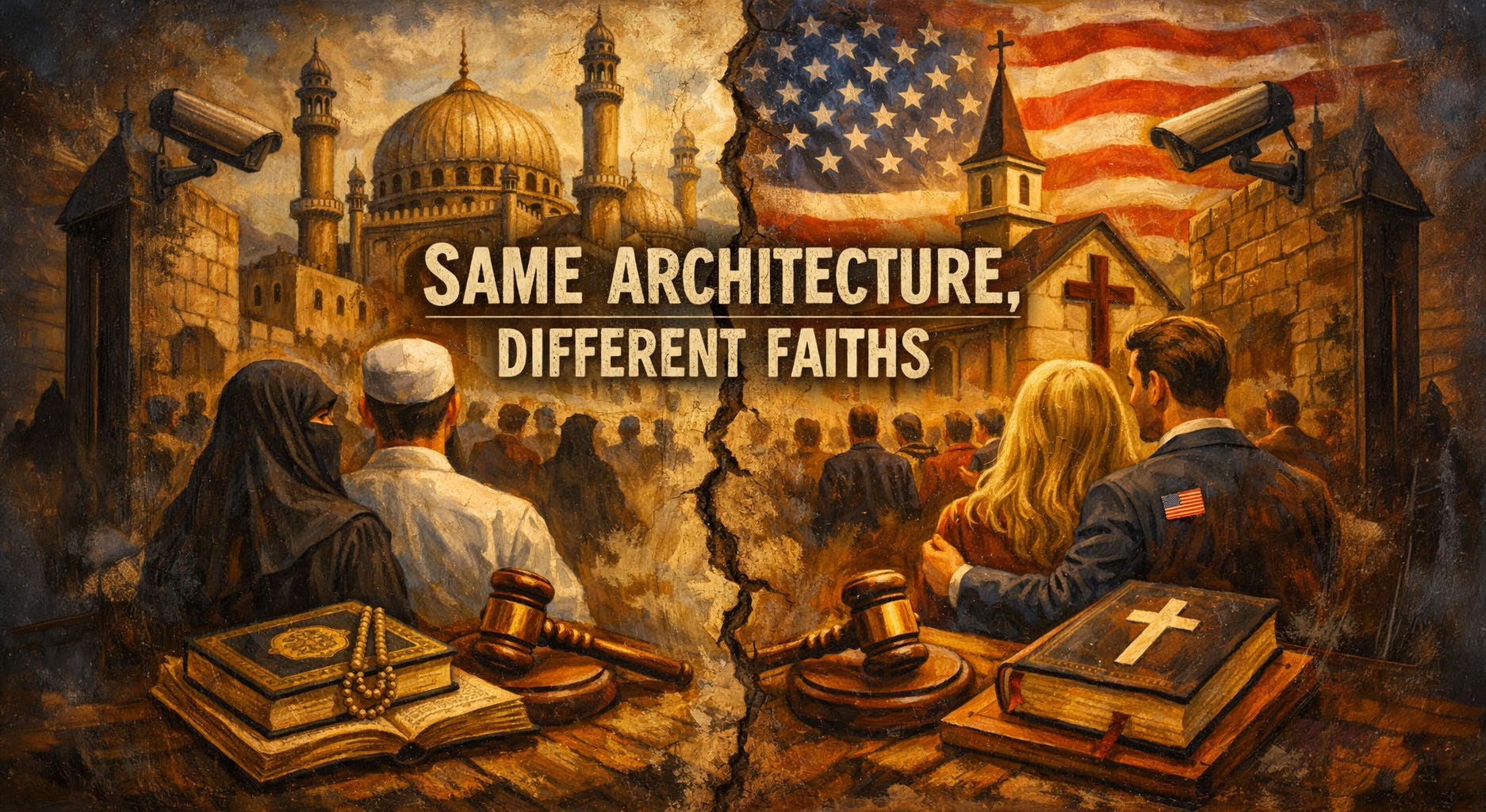
American evangelicals love talking as if Islam is some alien thing from another planet. They describe Muslims as backward, rigid, obsessed with sex, obsessed with rules, obsessed with sin, obsessed with policing women, obsessed with what people do in private, obsessed with what children are taught, obsessed with protecting society from moral decay.
And every time they do that, the obvious point goes sailing over their heads.
They are describing themselves.
Not all Christians, obviously. Not all Muslims either. In fact, the whole point of this article is that the religious label is often irrelevant. Mainstream conservative Muslims across much of the Muslim world and American evangelicals share far more than evangelicals would ever feel comfortable admitting. The resemblance is not superficial. It is structural. It shows up in family life, in politics, in gender expectations, in fear of secular culture, in suspicion of outsiders, in their constant language of moral decline, and in the belief that society falls apart the moment religion loses control.
That is why the two groups often sound like enemies while behaving like cousins.
The irony gets even better when you look at how both communities imagine themselves. Conservative Muslims often believe the West is spiritually empty, sexually chaotic, and morally unmoored. American evangelicals often believe the Muslim world is authoritarian, repressive, and dangerously religious. Both are partly describing real things. Both are also staring into a mirror and pretending they are looking through a window.
They Both Believe Morality Must Be Enforced From Above
One of the clearest similarities is that both conservative Muslims and American evangelicals distrust the idea that ordinary people can be left alone to figure out their own moral lives.
They do not really believe freedom is safe. They may use the word freedom constantly — evangelicals certainly do — but what they usually mean is the freedom to preserve their own moral order, not the freedom of others to reject it.
Conservative Muslims often frame this through religion, community, modesty, family honor, divine law, and the belief that society must visibly submit to moral rules. American evangelicals frame it through “biblical values,” “family values,” the sanctity of marriage, the protection of children, and the claim that America is collapsing because it pushed God out of public life.
Both believe society becomes dangerous when religion stops setting the boundaries. Both fear that once people are allowed too much room to choose for themselves, everything starts sliding: sex, gender, family, authority, education, respect, even truth itself.
That is why both groups are so vulnerable to moral panic. Moral panic is one of their favorite fuels. A schoolbook becomes civilizational collapse. A television show becomes proof of cultural decay. A gay couple becomes an assault on the natural order. A woman choosing her own life becomes evidence that society has forgotten God. Everything is always one step away from disaster. That constant alarm is useful: it keeps followers obedient, keeps them emotionally mobilized, and makes them feel under siege, which is one of the fastest ways to stop people from questioning the system they are defending.
This is also where both communities stop being just religious and become political tribes. For conservative Muslims, Islam fuses with civilization, anti-colonial memory, and resistance to Western domination. For evangelicals, Christianity fuses with nationalism, heritage, and the fantasy of a moral America that once existed and can be restored. Which is why criticism of their religion is never heard as criticism of ideas. It is heard as an attack on the group itself. Disagreement stops being disagreement; it becomes betrayal, and then war.
And once the tribe is under threat, intellectual freedom becomes a casualty. In conservative Muslim settings this means hostility to reinterpretation, pressure against scholars who question inherited doctrine, and reflexive suspicion toward critical history. In evangelical America it appears through culture-war attacks on universities, book banning campaigns, and the rejection of anything that might loosen conservative belief. The logic is identical: truth is already known, so questioning becomes dangerous. That is not confidence. That is fear in ceremonial clothing.
Contrary to popular belief, Islam did not begin as the rigid legal machine many people now imagine. Much of what people now associate with hardline Islamic control — including the criminalization of apostasy, blasphemy, and homosexuality — emerged later through legal and political developments, long after Muhammad’s death. And if American fundamentalists ever got the power they want, it is not difficult to imagine those same prohibitions being turned into law one by one.
It’s all about the mindset, not necessarily religion.
The Protection Myth
This is another area where the family resemblance is almost embarrassing.
Conservative Muslims and American evangelicals both speak endlessly about protecting women while building social systems designed to control them. The details differ. The vocabulary differs. The clothing rules differ. The legal frameworks differ. But the pattern is painfully familiar.
Women are told they are precious, and then treated as dangerous. They are told they are honored, and then monitored. They are told they are central to the family, and then denied equal authority within it. Their sexuality is treated not as their own but as a social risk that men — fathers, husbands, pastors, scholars, community elders — must manage on their behalf.
In conservative Muslim environments this shows up through modesty codes, restrictions on mixing, pressure around marriage, family honor, and the expectation that women carry the burden of public morality on their bodies. In evangelical America it looks different but is no less legible: purity culture, anti-abortion absolutism, suspicion of feminism, the theological praise of submissiveness, and the endless effort to turn motherhood into a woman’s entire moral destiny.
In both worlds, the female body becomes a battlefield where men fight their war against modernity.
And in both worlds, the men doing the lecturing call this protection.
The Architecture Is the Same
Conservative Muslims and American evangelicals did not coordinate. They do not like each other. They do not read each other’s texts or attend each other’s conferences or agree on almost anything theological.
And yet they built the same building.
Same load-bearing walls, same floor plan, same locks on the same doors. The wallpaper is different. The prayers are in different languages. The women dress differently and the men argue about different books. But the structure underneath — who holds authority, who carries shame, who gets monitored, who gets protected by being controlled — is the same structure.
That is not coincidence. It is what happens when any tradition decides that the most important thing religion can do is keep order. Once that decision is made, everything else follows. The family becomes a hierarchy. The community becomes a surveillance system. The woman becomes a symbol. The outsider becomes a threat. And God becomes the enforcer of arrangements that were always, underneath the theology, about power.
Both communities built that building. Both communities live in it. Both communities tell their children it is the only safe place in the world.
That’s all for now today. In Part II, we will explore what people actually do inside it. Stay tuned.
“And God becomes the enforcer of arrangements that were always, underneath the theology, about power.”
If God is removed, all their power would be lost. Western academia is guilty of not informing people that the concept of God is naïve and silly.
https://medium.com/@dtango/western-academia-sustains-eastern-theocracy-131d1735aaa0
Fundamentalists are fundamentalists whatever country they claim.