


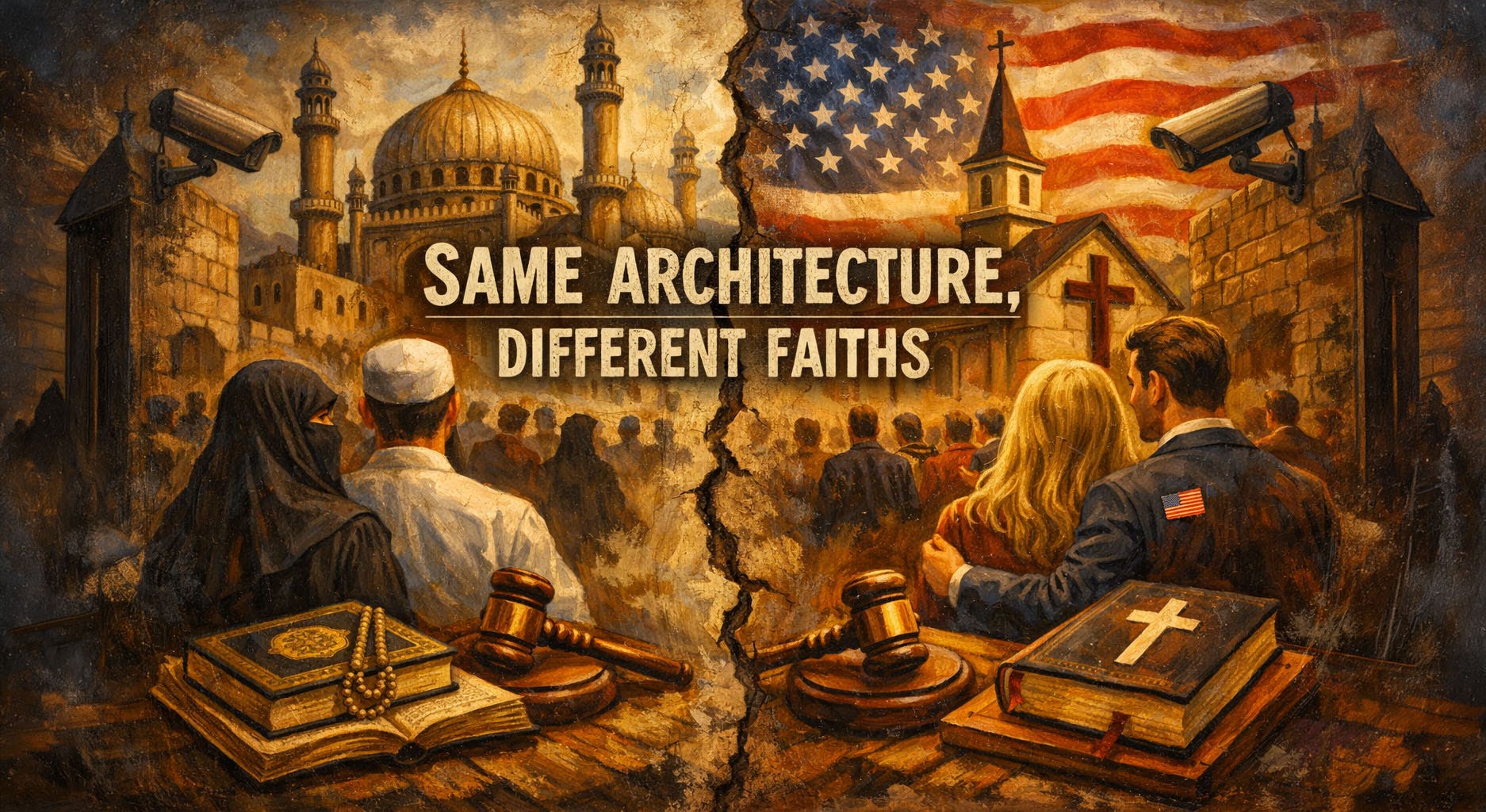
In isolation, American evangelicals and conservative Muslims may think they agree on very little. Some would even be horrified to be placed in the same sentence — Muslims are terrorists who hate Americans for their freedom, remember? — let alone the same argument.
But spend enough time inside both worlds, and the horror starts to look like recognition.
Part I of this piece laid out the structural similarities — the politics, the gender roles, the fear of secular culture, the constant surveillance sold as community and security. If you haven’t read it, the short version is this: these aren’t two opposing civilizations, just two versions of the same one arguing about the brand name.
Part II is where it gets personal.
Because the architecture of control doesn’t stay abstract. It lands in the body. It shows up in who gets to decide what happens to a pregnancy, what desire is allowed to look like, what a family is actually for, and what happens to anyone who uses the side door instead of the front one.
Both communities have spent generations perfecting the answers to those questions, and yes, the answers differ in detail, but in substance, they’re close enough to be embarrassing.
Abortion
What’s interesting — and more complicated — is what actually happened with abortion across the Muslim world. Tunisia, Kazakhstan, Uzbekistan, Kyrgyzstan, Turkey, and Tajikistan all moved beyond the debate long ago. Access was settled, quietly, and life moved on. These are Muslim-majority societies, many of them deeply conservative in their social fabric, and yet they arrived at a more pragmatic position than the American religious right ever has when it comes to the termination of unwanted pregnancies.
But step outside that list, and the picture changes fast. Across much of the Middle East, North Africa, and South Asia, abortion is either heavily restricted or banned outright, not because religious authority and state power have merged into the same voice. In Egypt, Iraq, and Pakistan, abortion is largely illegal except to save the mother’s life. In Yemen and Afghanistan under the Taliban, the question barely exists as a public conversation at all. And the language is almost identical to what you’d hear from a Republican lawmaker in Alabama or Texas: life begins at conception, the family must be protected, women’s bodies are treated as communal property, justified as divine will.
Then the United States had its convulsion — the overturning of Roe, the culture war turned into law — and something interesting happened in Turkey. The idea of restricting abortion surfaced briefly in political conversation, which isn’t entirely surprising if you understand Turkey’s complicated relationship with America: a mixture of love, suspicion, and a nagging conviction that whatever Americans do, they probably do it best. The idea was floated, studied, discussed — and then just as quietly walked back. It never became serious policy.
The reason almost certainly had little to do with women’s rights. Turkey’s retreat was more likely about keeping the image of the traditional Turkish family intact — about not producing children outside of marriage, not creating the social disruption that comes with unwanted pregnancies in a society where family reputation still does enormous work. The protection, in other words, wasn’t really about women. It was about the family unit, the community’s image, the same honor architecture operating through a different lever.
And that logic — protecting the family unit, not the woman — is exactly where conservative Muslims and American evangelicals converge most completely. Both sell abortion restrictions as being about life, about God, about the sanctity of the family. But follow the argument far enough and you always arrive at the same place: a woman’s reproductive choices are too important to be left to the woman. Someone else — a husband, a cleric, a legislature, a pastor — needs to be in the room. The beliefs in the shop window may differ, but the purpose behind them does not.
When these societies land on an outcome that looks modern or human-rights-friendly, that does not necessarily mean they got there for the right reason.
That’s the thread that runs through all of it — the exceptions and the restrictions alike. Whether the outcome is access or prohibition, the woman is rarely the one who decides. The men just disagree about which answer God prefers.
Shared Fear of Sexual Freedom
Both groups are deeply convinced that sexual freedom destroys civilization — not merely disrupts or complicates it, but destroys it.
That’s why so much of their rhetoric sounds hysterical to outsiders. They’re not merely objecting to behavior they dislike. They genuinely believe that loosening sexual rules leads to social death. Marriage collapses. Birth rates collapse. Gender collapses. Authority collapses. And then, in their imagination, society dissolves into a selfish carnival of lust, loneliness, and broken children.
This is why they spend so much time fixating on homosexuality, pornography, sex education, premarital sex, divorce, and gender nonconformity. These issues are never treated as private matters. They’re treated as symbols. The point isn’t only what people do, but what those acts represent in a world where religion no longer controls the script.
And that’s what terrifies them.
American evangelicals often speak as if Muslim conservatism is uniquely obsessed with sex, while overlooking that they are too, even if it takes a different form. They just package it in a different accent. They preach about purity balls instead of hijab. They talk about biblical marriage instead of modesty codes. They lobby school boards instead of religious ministries. But the nervous energy is the same, because they can’t stop talking about what other people do with their bodies when control over the body is one of the clearest signs of social power.
They Both Worship the Family as a Cage
Listen to either group long enough and you’ll hear the same sermon: family is the foundation of civilization.
That much, most people can agree on. But what they forget to tell you is that by “family,” they mean family as they personally define it: one that is father-led, morally policed, sexually disciplined, hierarchical, and insulated from outside influence.
The family becomes less a place of love and more a system for training obedience.
On one hand, they scream about smaller government when it suits them; on the other, they want an intrusive one enforcing the life they prefer. Children must be shielded from dangerous ideas. Wives must support male leadership. Men must defend moral order. Elders must be respected. Shame must keep everybody in line. Religion must be passed down. Social roles must stay clear. Community judgment must remain strong.
That arrangement is sold as stability. Sometimes it does create stability. It also creates silence, hypocrisy, repression, and fear — especially for anyone who doesn’t fit the approved script.
Both conservative Muslims and evangelicals are full of people who learned very early that belonging was conditional. Behave correctly, believe correctly, marry correctly, desire correctly, vote correctly, dress correctly, and you’re safe. Step out of line, and suddenly the family that preached love turns into a disciplinary committee.
Swear words are a great threat to society. Corrupt politicians, even well-documented fraudsters with blatant lies, who sell ideas shaped by the religion they believe in? Perfectly alright.
Both Are Experts at Selective Modernity
This part is almost funny.
Both communities claim to resist modernity, but of course, right up to the point where it becomes useful.
Conservative Muslims use smartphones, social media, luxury brands, global finance, modern medicine, and digital platforms while complaining that the modern world is morally rotten. American evangelicals do the same — running megachurches like corporations, using mass media with machine-like efficiency, and embracing every tool that helps them sell old doctrines in fresh packaging.
Neither group rejects modernity. They reject the parts that weaken hierarchy.
They’re fine with technology and comfort. They like power. They like scale. They’ll take modern medicine when they need it, modern infrastructure when it serves them, and modern communications when it helps them organize and preach.
What they hate is modernity’s attack on inherited authority: individual autonomy, secular law, gender equality, sexual freedom, public skepticism, and the idea that power has to justify itself instead of hiding behind tradition.
And then comes the hypocrisy. The same people who preach the sanctity of marriage get divorced, cheat, and chase sex outside marriage while still demanding moral discipline from everyone else.
In the Muslim world, the hypocrisy just takes different forms. In some places, girls are pushed toward sexual acts that don’t “damage” the hymen. Some hospitals offer hymen repair surgeries to prepare a girl for marriage. Some people arrange quick Islamic marriages with a cleric and two witnesses, with no legal trail, just to create a temporary religious cover — and then “enjoy life” while flattering themselves they’re still good Muslims and that the modern world is corrupt.
It’s impossible not to miss the shared logic behind it: the rule stays in place, the mirage stays intact, but the real behavior is kept out of sight.
The Rule Stays Sacred, Not the Behavior
Conservative Muslims don’t live in the morally disciplined society they preach. American evangelicals don’t live the Christ-centered lives they demand from everyone else. Both communities have developed sophisticated systems for maintaining the appearance of the rules while quietly negotiating around them: the hymen surgeries, the temporary marriages, the divorced pastors preaching family values, the megachurch leaders caught in the scandals they’d spent careers condemning.
The rules aren’t really about behavior. They’re about power, about who gets to define normal, about keeping the hierarchy intact while the people at the top of it do whatever they like.
And the people who pay the real price are never the ones writing the rules: the daughter whose body is inspected before marriage, the woman whose autonomy is legislated away by men who will never face an unwanted pregnancy, the kid who figured out early that belonging was conditional and spent years performing a version of themselves that wouldn’t get them thrown out.
Both communities call this tradition. Both communities call this love.
This is about control, built into the system from the start.
The only honest question left is whether the people inside these systems already know that — and have simply decided that the safety of belonging is worth the cost.
Most of them do know. That’s the part nobody says out loud. And in Part III, that silence matters even more, because once the obsession with control is stripped bare, the real difference between these two worlds is not where they police sex most aggressively, but what they do when the subject is poverty, mercy, and the people at the bottom.
While I agree with the observations, there is one question I have to check to what extent the analogy is valid. What are the proportions of hypocrites to real believers in both societies?
Is it almost all pastors and almost all imams that behave the way described? All males of enough position in both groups?
Or is there a statistically significant difference in proportions, maybe?
The purpose of my question is not to undermine the analogy, but to verify how close actually the two groups really are.
I love this series. But do most of them know?.That isn't the impression I get from those who have escaped.