


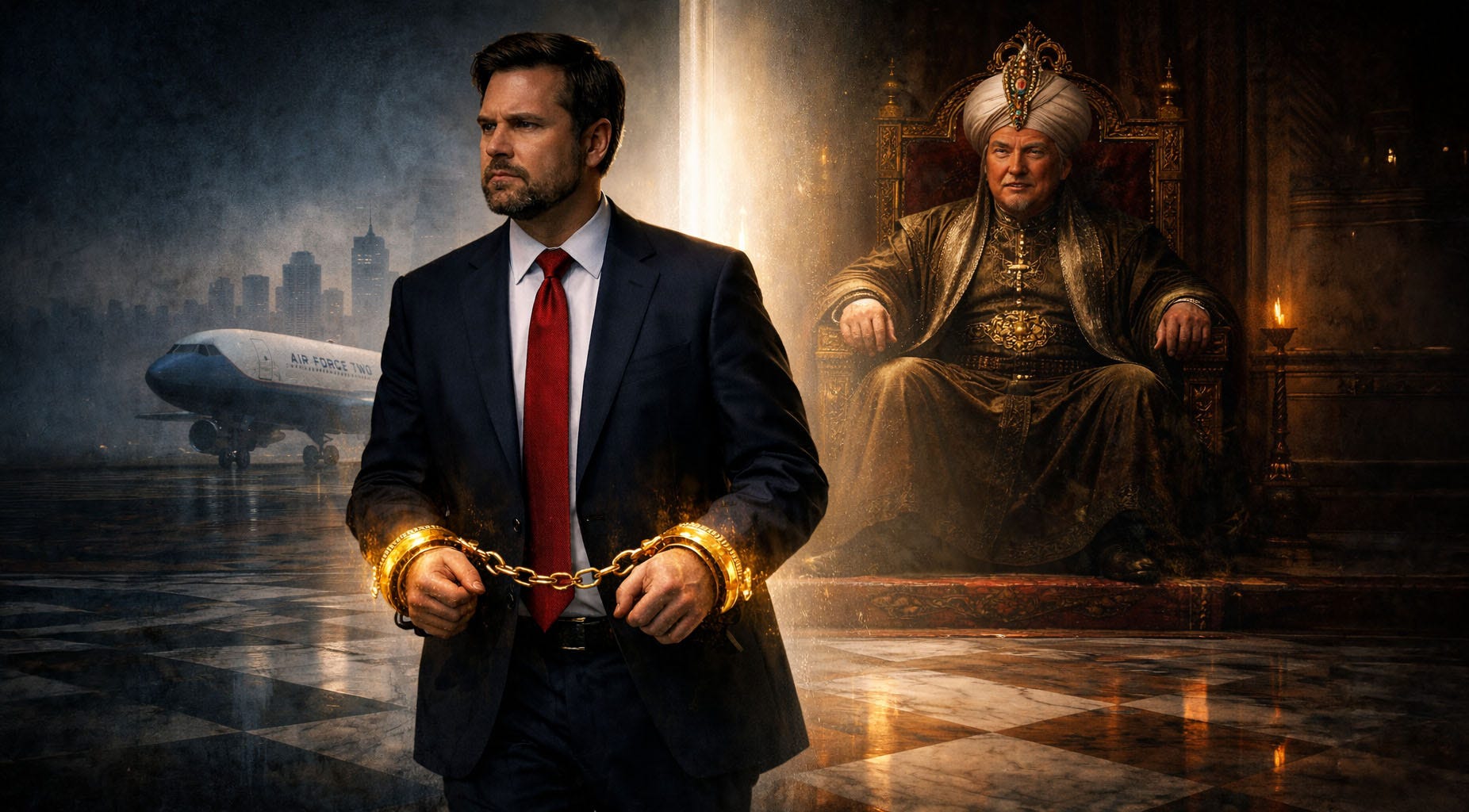
In the Ottoman Empire, which was more pragmatic than Islamic, troublemakers were typically invited to the capital, Constantinople — modern-day Istanbul — by the Sultan, with the appearance of defeat and the offer of becoming a vezir, the modern equivalent of a prime minister. It was a move from a well-worn playbook, an obvious trap, but the offer was so tempting that the troublemakers often took the bait — “what if” echoing in their minds — only to be handcuffed, quickly tried, and executed.
The trap worked for centuries so well, not because it was so subtle, and people didn’t see what was coming, but because ambition is a more reliable weakness than stupidity. The troublemaker wasn’t fooled by the offer — he saw it clearly for what it was. He just couldn’t resist the possibility that this time, this particular time, he might be the one to thread the needle. That he might walk into the Sultan’s palace and walk back out wearing the robes instead of the chains. The Ottomans understood something fundamental about power-hungry men: the dream of the throne is stronger than the fear of the axe.
JD Vance just boarded Air Force Two to Islamabad, and the axe is already sharpened.
An Exceptional Call
A month before the 2024 elections I figured from the headlines and the tone of Kamala Harris that Trump was on his way to the presidency — this time by actually winning it, unlike in 2016. That’s when I stopped writing much about Trump’s contemporary politics, playing three monkeys for the sake of my mental health.
However, this Vance move — the hero miraculously born to save America (and to heal America’s self-inflicted wounds), taking center stage with the support of the selfless president — pushed me to make an exception, so here we go.
A War Nobody Wanted to Own
To understand the trap, you have to understand what the Iran war actually is at this point — not militarily, but politically.
Trump launched the offensive in early March 2026, over the objections of intelligence officials who warned that Iran’s regime was more resilient than Israeli assessments suggested, that the IRGC — Iran’s ideological parallel military, born from the 1979 revolution — would not collapse under pressure, and that closing the Strait of Hormuz was not a bluff. He went ahead anyway, reportedly convinced by Netanyahu’s pre-war briefings that the Iranian population was primed to turn on the regime, that the military campaign would be swift enough to avoid an oil shock, and that a decapitation strike — which killed Khamenei within the first week — would trigger a leadership vacuum Iran couldn’t fill.
I don't have to tell you that none of it played out that way. None of it played out that way. The population didn’t rise. The IRGC filled the vacuum before the smoke cleared. And the Strait, which Trump had privately dismissed as a leverage point Iran would never actually use, closed within 48 hours of the first strike and has stayed closed ever since — taking global oil markets, and Trump’s approval ratings, down with it.
Six weeks into a conflict that was sold to the American public as swift and decisive, the Strait of Hormuz is still choked, gas is over $4 a gallon nationally for the first time since 2022, 20,000 seafarers are stranded in the Persian Gulf, and the ceasefire that was supposed to end it all collapsed within hours of being announced because the two sides couldn’t even agree on whether it covered Lebanon. The war has weakened Trump politically, alienated the anti-interventionist MAGA base that made his coalition possible, and produced none of the clean victories the administration promised. Regime change didn’t happen. The Iranian street didn’t rise up. His son replaced Khamenei and the IRGC is stronger than it was before the first strike.
This is a war that needs a face — but of course not Trump’s, whose brand requires winning, or more often, the appearance of winning. He can’t be photographed presiding over a stalemate. He can’t own $4 gas. He can’t be the president who started a war, promised it would be easy, and is now begging Pakistan to host peace talks that keep collapsing. He needs someone else in the frame. Enter his loyal, ambitious, visibly uncomfortable vice president.
The Mechanics of the Setup
Watch how the handoff was engineered, because the craftsmanship is genuinely impressive.
First, Witkoff and Kushner — Trump’s two original envoys — were run into the ground in Geneva and came back with nothing. Iran publicly refused to engage with them any further. That created a vacuum, and vacuums in this White House get filled with whoever Trump decides to sacrifice next. The Iranians, who’d been following Vance’s carefully leaked private reservations about the war, signaled they’d be more willing to talk to him. At this point, Iran did Trump’s dirty work, handing him the perfect justification to elevate Vance without Trump having to be seen as pushing him into the fire.
Then came the public confirmation. Trump, asked at a press briefing who was leading the diplomatic push, casually listed “Marco, JD” — folding Vance into the effort in the most offhand way possible, as if it were obvious, as if Vance had always been central. No formal announcement. No Rose Garden ceremony. Just a president mentioning his VP’s name in a subordinate clause, making it impossible for Vance to step back without appearing to abandon the mission.
And then the Pakistan trip, with the full press corps watching, with Vance standing at podiums in Islamabad giving updates, with his name attached to every headline about the negotiations. By the time the talks collapsed after 21 hours, “Vance’s Iran talks” was already a fixed phrase in the political vocabulary. Not Trump’s war. Vance’s talks.
That’s how the Sultan invited people to Constantinople. With ceremony. With honor. With the appearance of trust.
The Hungary Footnote Nobody Should Have Missed
Before Islamabad, there was Budapest — and Budapest deserves more attention than it got, because it was either a breathtaking act of political cruelty or an accident that should have made Vance reconsider the whole Pakistan trip before he packed his bags.
Vance was dispatched to Hungary to campaign for Viktor Orbán, a leader Trump had invested significant political capital in as a symbol of the nationalist right’s global momentum. Orbán was trailing badly in the polls. The administration knew it. By Vance’s own admission on Fox News, they knew there was “a very good chance” Orbán would lose before Vance even got on the plane. They sent him anyway.
Orbán’s party was obliterated, and his opponent’s party won a supermajority, meaning more than two-thirds of the parliamentary seats. And the image that will follow Vance into every future profile piece, every opposition ad, every late-night segment, is the one of him on stage in Budapest calling Trump and getting sent to voicemail, then trying again, getting through, and performing a phone call with the leader of the free world in front of a crowd watching a man lose an election. It was humiliating in a way that’s hard to fully articulate — not because anything dramatic happened, but because of the smallness of it. The vice president of the United States, standing on a stage in a foreign country, waiting for his boss to pick up.
If Trump wanted to signal the pecking order before Islamabad, he couldn’t have done it more clearly. The message was: I’ll send you anywhere. I’ll let you fail anywhere. And when you call, I might not answer.
Why Vance Took the Bait Anyway
This is where the Ottoman parallel earns its keep, because the trap only works if the target chooses to walk in. Nobody forced Vance onto Air Force Two. He went anyway.
Vance’s reasoning probably wasn’t wrong on its own terms. He genuinely opposed the war — that much has been confirmed by enough independent sources to be treated as fact. He’d spent weeks watching a conflict unfold that he’d warned against, hemorrhaging credibility with the anti-interventionist voters who were his most natural base, defending in public a policy he’d disputed in private. The peace talks represented the first real opportunity to do what he’d actually wanted to do from the beginning: end it.
There’s also the 2028 calculation, which everyone in his orbit claims nobody is thinking about, which means everyone is thinking about nothing else. If Vance somehow threads the needle — if he sits across from Iranian officials, leverages his anti-war reputation to build the credibility Witkoff and Kushner couldn’t, and comes home with a deal that holds (even somewhat)— he becomes something genuinely rare in American politics: a vice president who ended a war.
The “what if” that the troublemakers in Constantinople kept asking themselves as they rode toward the city gates was the same one Vance asked himself on the flight to Islamabad. What if I’m actually the one who pulls this off?
The Terms Were Never Real
Here’s what should have killed the optimism before it started. Iran’s public negotiating position, the 10-point plan released ahead of the Islamabad talks, included the complete lifting of all sanctions, Iranian sovereignty over the Strait of Hormuz, and a full US military withdrawal from the Middle East. I’m surprised they didn’t demand Trump say sorry for what he did and promise never to do it again.
If anything, these starting positions prove Iran never took these negotiations seriously as diplomacy. Why would they? The talks were more useful as a domestic trophy — proof to their own population that they’d stared down the United States and extracted demands no one else would dare put on paper.
Trump had already described an earlier version of the plan as a “workable basis” for negotiation, then the White House said within 24 hours that the same document was “unacceptable and completely discarded.” The two sides couldn’t agree on whether the ceasefire covered Lebanon. They couldn’t agree on what they’d already agreed to. Sending Vance into that environment and expecting a signed agreement by Sunday was theater, not diplomacy.
And when theater fails on a world stage with your name on the marquee, the audience remembers. “Vance’s failed Iran talks” is a sentence that writes itself into future attack ads with no additional effort required.
The Bodies Trump Left Behind
Vance isn’t the first and won’t be the last. The pattern is consistent enough at this point that calling it as such is almost too generous. “Signature” does a better job.
Michael Flynn was Trump’s first national security advisor, a retired three-star general who’d led “lock her up” chants at the Republican National Convention, who’d staked his reputation and his career on Trump’s first campaign when doing so wasn’t fashionable or safe. Within 24 days of taking office, he was gone — pushed out, hung out to dry over a phone call with the Russian ambassador that senior White House officials, including Vice President Pence, were briefed on and said nothing about until the story broke publicly. Trump didn’t defend him. Trump didn’t call. Trump let him twist, then cut him loose and moved on before the news cycle had time to cool. Flynn spent the next several years fighting federal charges, losing his house, and burning through his savings — before Trump pardoned him on his way out the door in 2020, a gesture calibrated to cost Trump nothing and arrive too late to matter.
Jeff Sessions was the first sitting senator to endorse Trump’s 2016 campaign, at a moment when the Republican establishment was treating Trump like a communicable disease. It was an act of genuine political courage that legitimized Trump’s candidacy in ways that money couldn’t buy. Trump rewarded him with the Attorney General post, then spent two years publicly humiliating him — calling him weak, mocking his Southern accent in private, rage-tweeting about him by name, referring to his own cabinet member as “Mr. Magoo” to anyone who’d listen — all because Sessions had the audacity to follow Justice Department ethics rules and recuse himself from the Russia investigation. Sessions was eventually forced out, ran for his old Senate seat in Alabama in 2020, and was endorsed by Trump’s opponent. He lost.
Chris Christie ran against Trump in 2016, dropped out, and became one of his earliest and most prominent establishment endorsers — arguably doing more than anyone else to normalize Trump for the donor class and the party infrastructure that had been holding its nose. He led Trump’s transition team, put in months of work, and was fired from the transition before Inauguration Day, replaced by Mike Pence, with Trump’s son-in-law Jared Kushner widely reported as the driving force. Christie’s reward for crossing the bridge — and he has his own bridge problems, so perhaps the metaphor is apt — was a phone call telling him he was out.
Mike Pence spent four years as the most publicly loyal vice president in modern memory. He never upstaged Trump, never contradicted him publicly, stood behind him through Access Hollywood and impeachment and the daily chaos, and delivered the evangelical vote that Trump needed but couldn’t reliably generate on his own. On January 6th, 2021, a mob whipped into fury by Trump’s own words marched to the Capitol chanting “hang Mike Pence.” Trump, watching from the White House, was reported to have said Pence deserved it. He didn’t call to check if his vice president was safe. He sent a tweet attacking him while the riot was still ongoing.
Rudy Giuliani was “America’s Mayor” — a man who’d spent decades building a reputation as a tough, credible prosecutor and public servant. He torched all of it for Trump, running a post-election legal campaign so chaotic and unsupported by evidence that judges across the country dismissed case after case with barely concealed contempt. He held press conferences at Four Seasons Total Landscaping. He sweated through his hair dye on live television. He lost his law license. He filed for bankruptcy. Trump, who’d called him one of the greatest lawyers in the country, didn’t cover his legal fees and stopped returning his calls.
The list goes on. Rex Tillerson. Mark Esper. John Kelly. Mark Milley. Bill Barr, who delivered Trump the Mueller summary spin he wanted and was later called “a lazy, slow-moving, lethargic load of crap” in Trump’s own memoir. Each of them, at some point, was essential. Each of them was celebrated, used, and eventually reduced to a cautionary tale.
The mechanism is always the same. Trump needs something — credibility, cover, a specific skill set, a particular relationship, a scapegoat for a specific moment. He offers proximity to power, which is the most intoxicating drug in American political life. The person delivers. Then the thing Trump needed them for either succeeds, in which case Trump absorbs the credit, or fails, in which case Trump was never really involved. The transaction ends. The person finds out what they were actually worth.
Nobody is naive enough to accuse Vance of political naivety. The man who once called his boss “America’s Hitler” and nonetheless played his cards intelligently enough to become his VP when the wind changed direction knows Trump’s history. He’s seen the bodies.
He went to Islamabad anyway.
So What Is This, Really?
The blockade is now in effect — US warships enforcing a hard stop on all traffic entering and leaving Iranian ports, a move that Iran has called piracy and thousands of Iranians rallied against in Tehran yesterday. Iran's IRGC is threatening retaliation. Trump is posting on Truth Social about blowing up Iran's remaining ships. The ceasefire is technically alive but nobody is behaving as though it is. And Vance is back in Washington, giving Fox News interviews about how "the ball is in Iran's court" — the diplomatic equivalent of saying nothing while sounding composed.
The Sultan’s trap didn’t always end in immediate execution. Sometimes the troublemaker was kept comfortable for months, given a title, given access, given just enough rope. The execution came when it was useful — when a scapegoat was needed, when the political calendar demanded a sacrifice, when the Sultan needed to demonstrate that even his most prominent subordinates served at his pleasure.
Trump doesn’t need to fire Vance today. He doesn’t need to publicly blame him this week. The beauty of this particular setup is that the blame accrues slowly, organically, through a thousand news cycles and a thousand “Vance’s failed talks” headlines, building a narrative that will be fully formed and immovable by the time 2028 actually arrives. By then, Vance won’t need to be accused of anything. The record will speak for itself — a vice president who helmed two consecutive high-profile failures in the same weekend, who privately opposed his president’s most consequential decision, and who couldn’t close a deal when it mattered most.
The troublemakers who rode toward Constantinople probably told themselves they were different. That they understood the game better than the ones who’d come before. That they’d spotted the trap and could navigate it anyway. Most of them were right that they’d spotted it. None of that helped them.
Vance is sharp enough to know what this is. The question is whether being sharp enough to see the axe is the same thing as being smart enough to avoid it. So far, the Ottoman historical record isn’t encouraging.
Couldn't happen to a more deserving fellow.
I love this article. Why people never learn that everything is transactional with Trump, that loyalty only goes one way, never ceases to amaze me.