


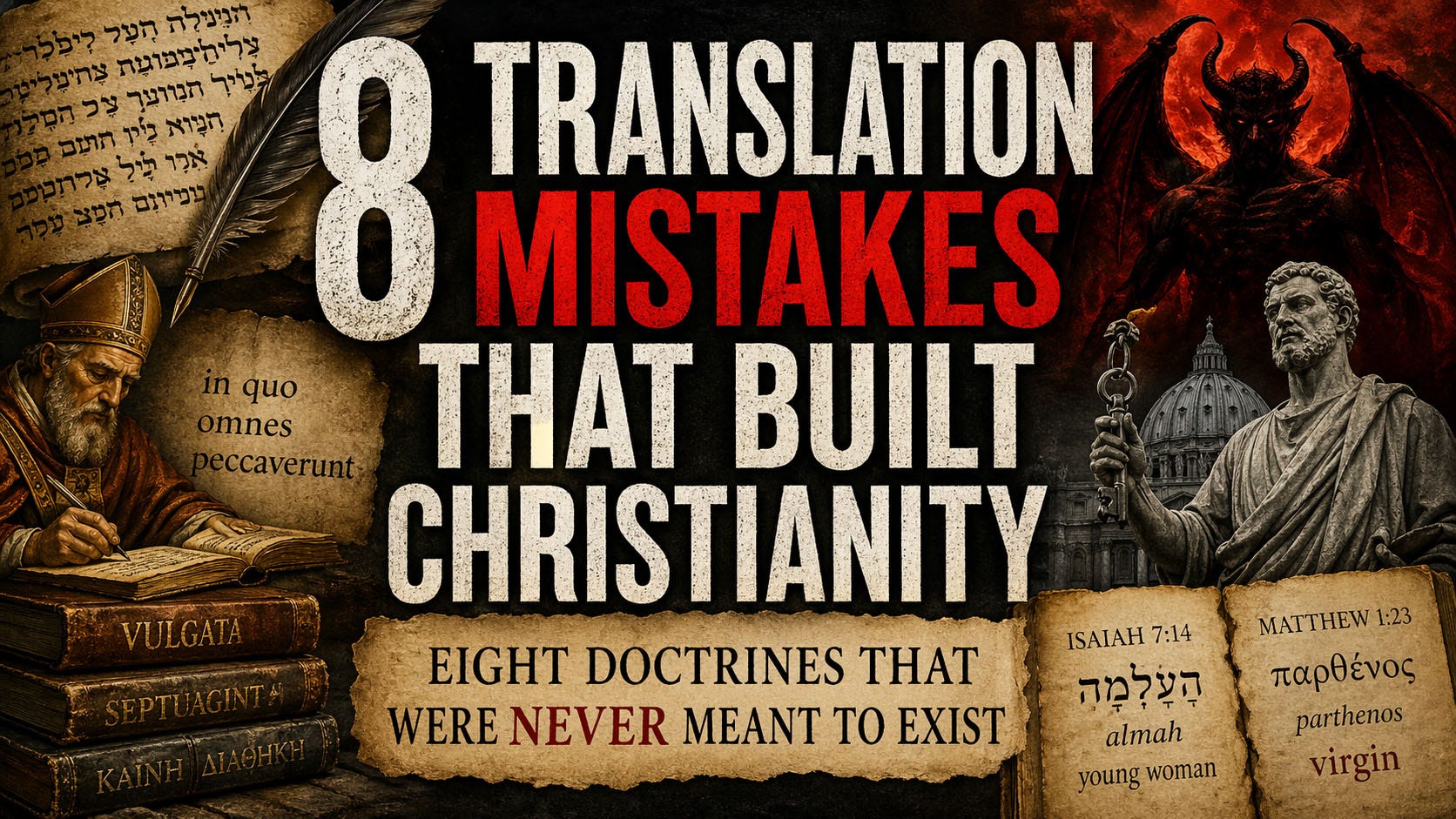
Religion is full of drama: scandals, biblical contradictions, and archaeological findings that quietly falsify the stories of scripture. But some of the most consequential doctrines didn’t come from grand conspiracies or lost gospels. They came from translation choices.
The process that gave us the Bible was so cumbersome that it would be a miracle if nothing went wrong. At every step, there were fragments — scratched onto animal skins, copied by hand in monasteries, passed between languages that do not map neatly onto each other, and shaped by the theological priorities of whoever was holding the quill. Hebrew into Greek. Greek into Latin. Latin into German, English, Coptic, Syriac.
1. The Prosecutor Who Became the Devil
In the Hebrew Bible, ha-satan isn’t anyone’s name. It’s a title with a definite article, and there’s no reason to think only one being holds it. The word gets applied to several different figures — an angel blocking Balaam’s path, human adversaries raised up against Solomon, the courtroom accuser in Job and Zechariah. Deuteronomy 32 says God assigned a divine being to every nation. Daniel names two of them — the princes of Persia and Greece — and describes them as adversaries to God’s messengers. The Hebrew text describes a crowded supernatural world with multiple adversarial beings, one per nation, not a single cosmic villain.
The word ha-satan literally means “the accuser” in Hebrew — a figure who functions in God’s court something like a prosecuting attorney, raising objections, testing the faithful, presenting the case against. In Job, ha-satan operates entirely within divine sanction, with God’s explicit permission. He’s an institutional role, adversarial by design, not a rebel.
Greek rendered this as Satanas, Latin as Satan, and the definite article got lost along with the functional description — a role became a name, a court official became a cosmic villain. Later writers drew from everywhere. Zoroastrian texts gave them Ahriman, the evil counterpart to Ahura Mazda in Zoroastrian theology. 1 Enoch gave them the fallen angels led by Azazel and Semyaza, imprisoned under the earth for corrupting humanity. The Genesis serpent, which the original text presents as just a clever animal, got retroactively identified as Satan in Second Temple writings. Revelation threw in the dragon, the beast, and the whore of Babylon. By the medieval period, all of it had fused into a single figure — a horned adversary ruling an underworld of fire, commanding armies of demons, and hunting human souls. None of that figure is in the Hebrew Bible.
If this interests you, Elaine Pagels covers the full transformation in The Origin of Satan — she traces how the devil’s image was constructed to fit whoever the early church needed to cast as its cosmic enemy: first Rome, then Jews, then heretics.
2. The Word That Locked Women Out
1 Timothy 2:12 is the verse that closed pulpits to women in most of Western church history. It reads, in most translations**:** “I do not permit a woman to teach or to have authority over a man.”
Most mainstream scholars think 1 Timothy is one of the forged Pauline letters — written after Paul’s death by someone using his name. That’s the first problem, and the translation is the second.
The word translated as “have authority” is authentein. It appears exactly once in the entire New Testament — which makes it a hapax legomenon, a word with no other uses in the same author or document to calibrate against. In Greek literature from the same period, authentein appears to carry connotations of domination, coercion, or aggressive self-assertion — something closer to “to dominate” or “to usurp control” than simply “to have authority.”
Translators went with “authority.” That choice transformed a verse that may have been addressing a local situation involving domineering behavior into a universal prohibition on women in leadership.
Of course, it wasn’t the verse that prevented the poor church from subordinating women. If anything, it was another example of making a decision first and then interpreting the Bible to support it.
3. Augustine’s Latin, and the Baby You Were Born Guilty
Paul writes in Romans 5:12 that death spread to all people because all sinned. The Greek phrasing is eph’ hō pantes hēmarton — “because all sinned.” Everyone dies because everyone sins — a moral statement about behavior and its consequences, not about inherited guilt.
Augustine of Hippo, writing in the late fourth and early fifth centuries, was working from a Latin translation that rendered the phrase as in quo omnes peccaverunt — “in whom all sinned.” The antecedent of “whom” in his reading was Adam. So instead of “all people die because all people sin,” the text was read as “all people sinned in Adam.” The guilt was inherited, collective punishment for a crime committed by someone who, on the biblical timeline, died thousands of years before you arrived.
Original sin comes from this reading — the idea that every human being enters the world already culpable, already deserving damnation, already in need of rescue before they’ve done anything at all. Infant baptism is a direct consequence, as are centuries of Christian anxiety about the eternal fate of unbaptized children. And it rests entirely on Augustine misreading a Latin mistranslation of a Greek text.
It asks us to believe Paul knew about original sin but couldn’t be bothered to elaborate on it, left no instructions for what to do about it, and was apparently comfortable with millions of Christians dying in a state of inherited damnation until Augustine arrived centuries later and worked it all out.
4. What You Do vs. What You Believe
Paul writes about justification by faith. The Letter of James writes that “a person is justified by works and not by faith alone.” Both are in the same canon. They contradict each other, and they’ve been generating denominational fractures since the second century.
The Greek word ergon (works, deeds, actions) is straightforward. The theological disagreement is a problem of two distinct early Christian voices being bound into the same book and told to harmonize. But translation choices shaped which side of the argument any tradition landed on. Luther’s decision to include the Letter of James in the Protestant canon while calling it “an epistle of straw” — a document he thought contradicted the Pauline gospel — shows how much interpretive weight was being placed on vocabulary choices throughout the New Testament.
Pistis means faith, trust, allegiance — it has a range. Ergon means deeds. Neither word is ambiguous on its own. The dispute is about which of these God actually responds to, and two New Testament writers give different answers. That conflict has never been resolved — only managed.
5. Repentance for Sale
Jesus preached metanoia — a Greek word meaning a change of mind, a reorientation, a fundamental shift in how you see things. When someone genuinely reconsiders the direction of their life, metanoia is what precedes whatever visible change might follow.
The Latin Vulgate translated metanoia as poenitentiam agere: perform penance. The inner reorientation became an external act, and the external act became something the Church could systematize, regulate, and eventually monetize. Confession, absolution, assigned prayers, the purchase of indulgences to reduce time in purgatory — the entire penitential economy of the medieval Church grew from a translation that swapped a psychological event for a ritual performance.
Martin Luther noticed this in 1516, before he nailed anything to any doors. His encounter with Erasmus’s new Greek New Testament showed him the gap between what the text said and what the Church was selling — a single word, mistranslated from Greek into Latin, with an entire economy built on top of it.
6. Three Words for Death, One Very Hot Place
The afterlife in the Hebrew Bible is deliberately vague. Sheol is where the dead go — both the righteous and the wicked. It’s dark, silent, cut off from the living and from God, but not a place of punishment — just where everyone ends up, the way shadows go when the sun sets.
Greek has Hades, the realm of the dead in Homeric and later Greek religion — morally ambiguous, not a punishment chamber by default, though Greek mythology does include specific zones of torment for specific offenders. When the Septuagint translators needed a Greek equivalent for Sheol, Hades was the obvious choice.
Then there’s Gehenna — a real place, the Valley of Hinnom outside Jerusalem’s southern wall, where garbage burned continuously and where, in an earlier period, the Hebrew Bible suggests child sacrifice was practiced. Jesus used it as a metaphor for judgment, the way any first-century rabbi might reach for a recognizable image of destruction and ruin — not a location in any cosmological map, just a rhetorical shorthand a first-century Jerusalemite wouldn’t need explained.
By the time Jerome produced the Latin Vulgate in the late fourth century, all of this had collapsed together. Sheol, Hades, and Gehenna were variously rendered as infernum or infernus — and the imaginative distance between those distinct concepts had been erased. A somber waiting room, a mythological underworld, and a smoking garbage dump had fused into a single eternal fire-pit. Bart Ehrman traces how that happened in Heaven and Hell: A History of the Afterlife — how much of what Christians treat as scriptural bedrock is sediment left by translators working across three languages.
7. Peter, the Pebble, and the Keys to the Kingdom
Matthew 16:18 reads: “You are Peter, and on this rock I will build my church.” The Catholic Church reads this as the moment Jesus appointed Peter as the first bishop of Rome, establishing apostolic succession and handing the institution its authority directly from God.
The Greek text is playing on two words: Petros (Peter’s name, a masculine noun meaning “rock” or “stone”) and petra (feminine noun, meaning a large foundational mass of rock — bedrock). Jesus says “you are Petros,” and then says “on this petra“ I’ll build my church. There’s a deliberate distinction between Peter the person and the thing being called the foundation. What that foundation is — Peter himself, Peter’s confession of faith, or something else — is contested.
The Aramaic original, if there was one, may have used kepha for both — no gender distinction, no ambiguity to exploit. Jerome’s Vulgate flattened the Greek distinction into Petrus and petram, which preserved some of the wordplay but left the question open.
The Roman church spent two centuries accumulating authority before anyone made much of this verse. Once the institution needed a scriptural address, the Greek pun was there — as long as nobody looked too closely at the original.
8. The Virgin Who Wasn’t Called That
Isaiah 7:14 is where the Virgin Birth is anchored, and the anchor is a mistranslation that generated a doctrine, locked in a reading, and built two thousand years of Marian devotion around a word the original author never used.
The Hebrew text uses the word almah — a young woman of marriageable age, with no implication about sexual experience. If the author of Isaiah had wanted to say “virgin,” the word was available: bethulah, the proper Hebrew term. The author chose almah deliberately, describing a sign for the immediate political circumstances of King Ahaz — not a prophecy about a messiah centuries away.
When Jewish scholars in Alexandria translated the Hebrew scriptures into Greek in the third and second centuries BCE — producing the Septuagint — they rendered almah as parthenos, which in classical Greek most commonly means “virgin,” though it can in limited contexts simply mean “young woman.” The distinction was irrelevant to them. But when the author of Matthew’s gospel chose the Septuagint over the Hebrew original to validate Jesus’ miraculous birth, parthenos became the cornerstone.
Raymond E. Brown acknowledged this in The Birth of the Messiah: the Hebrew almah doesn’t support the virgin birth claim, and Matthew’s entire nativity architecture depends on the Greek wording, not the original.
No Rush for Correcting Mistakes
All these translation mistakes have one thing in common: so many teachings and dogmas were built on them, some foundational, that the errors are now irreversible. Correcting them would mean dismantling the architecture, and nobody with institutional skin in the game is going to do that.
What’s rarely acknowledged is that Christianity isn’t the only casualty. Islam inherited some of these errors directly — the Quranic figure of Shaytan (Iblis), the rebellious angel cast out of heaven, owes more to the personified Satan of late Second Temple Judaism and early Christianity than to anything in the Hebrew Bible. The mistranslation traveled.
Some translation errors have been corrected in modern Bibles. Others are deliberately left as they are — not because scholars don’t know better, but because fixing them would pull the rug out from under doctrines that two billion people currently believe are the word of God.
This publication exists because readers like you choose to support it.
If you’re not already a paid subscriber and you’re finding value here, I’d love for you to consider becoming one to keep The Unholy Truth alive.
Sources and Further Reading
Raymond E. Brown, The Birth of the Messiah, 1977
Bart D. Ehrman, Heaven and Hell: A History of the Afterlife, 2020
Elaine Pagels, Adam, Eve, and the Serpent, 1988
Elaine Pagels, The Origin of Satan, 1995
James Barr, The Garden of Eden and the Hope of Immortality, 1993
Alister McGrath, Reformation Thought: An Introduction, 2012
Bruce Metzger, The Bible in Translation, 2001
Oscar Cullmann, Peter: Disciple, Apostle, Martyr, 1953
N.T. Wright, Justification, 2009
Cynthia Long Westfall, Paul and Gender, 2016
Philip Payne, Man and Woman, One in Christ, 2009
Jeffrey Burton Russell, The Devil: Perceptions of Evil from Antiquity to Primitive Christianity, 1977
Apologies for using an AI summary, wanted to get this out while I was thinking of it. I have another to add to the list:
The "mistranslation" of eternity refers to the argument that Greek words aion and aionios in the Bible, often translated as "eternity" or "eternal," originally meant an "age" or long, limited period of time. Critics argue that translating these as "everlasting" instead of "age-long" has fundamentally altered the understanding of hell and biblical time, confusing finite, distinct periods with endless duration.
Regarding On this rock,
It never made sense that Jesus would want an institution.
His own religious clerics made sure he slept with the fishes.
Institutions are untrustworthy, will sell out their founding principles
to meet any threat or chance for loot.
Jesus said Peter would be the foundation rock,
But St. Peters in Rome is an abomination.
While Jesus praised, “naked and ye clothed me…
an hungered and … done it unto the least of me my brethren,”
St. Peters, the church, sits on a vast treasure of lucre and art market bonanzas
overseen by dyspeptic old males who tamp down females
and are arrayed in stupefying self-grandeur and arrogance.
Jesus would have gagged, though not surprised.
So, I engaged a Greek scholar to challenge God’s Secretaries. Find me the word
that Jesus used and scholar returned with Ekklesia which he said means
a group of like-minded individuals who come together periodically
to discourse on a common interest, often spiritual,
but no institution, dogma, rituals, incense, clerics, foundation fairy tales
and it became instantly clear that God’s Secretaries
chose to alter the meaning to support their patron, a king
who needed enhanced church authority to suppress other Christians.
Not enough. I needed a translation not a mistranslation.
Eighty-five years before God’s Secretaries William Tyndale
did the first English translation ever, was executed by strangulation
and his body burned at the stake, but his translation of Ekklesia
was “congregation.”