


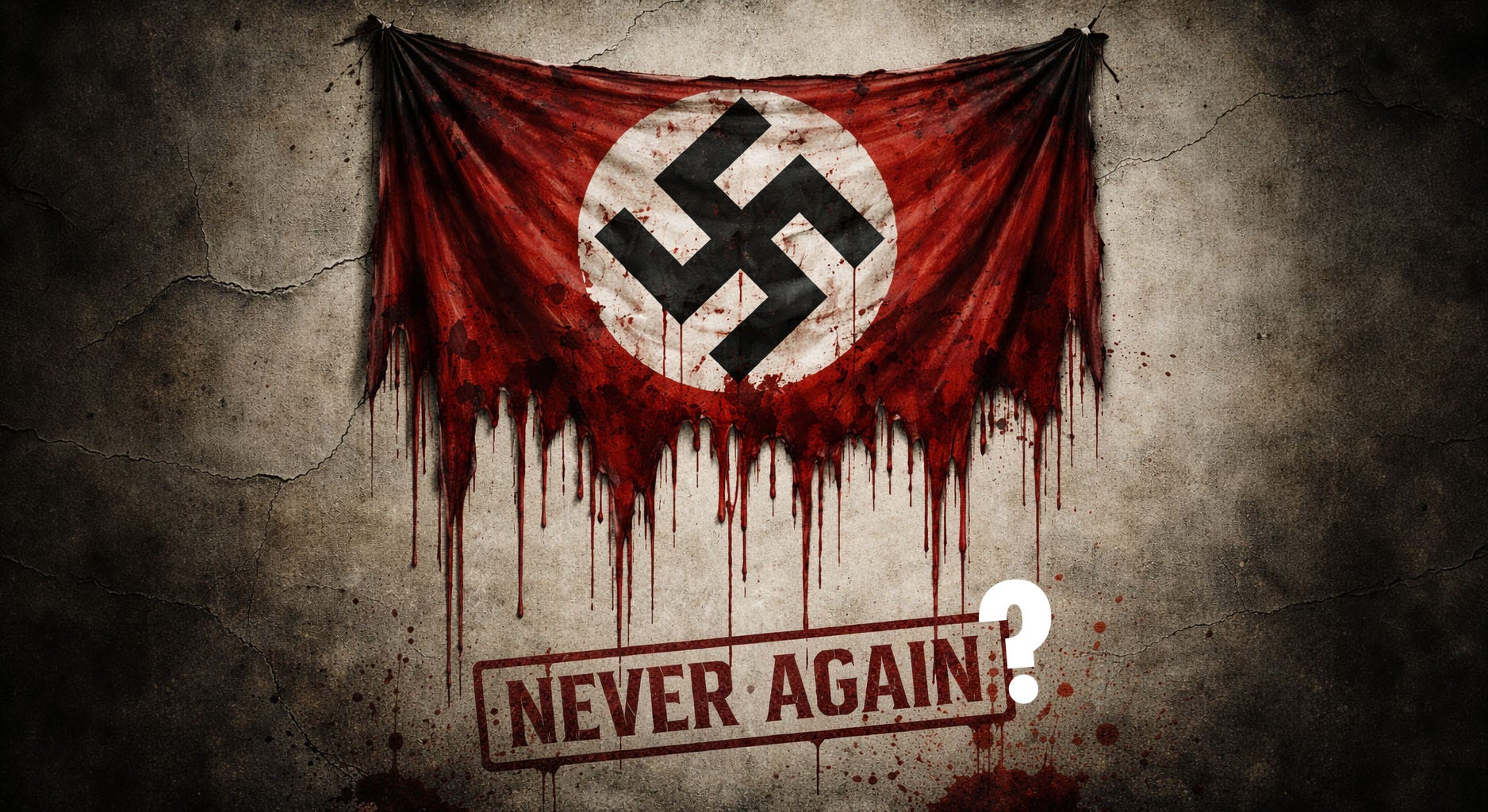
Most people talk about Hitler the way kids talk about a horror-movie villain. One monster. One madman. One unique freak accident of history. We’ve heard that story so often, we don’t question it anymore. It feels comfortable.
In sci-fi movies, it’s not unusual to see a plot built around going back in time to eliminate Hitler and prevent the Second World War. The message is simple: Germany under Hitler was the problem, and without Hitler, history would’ve gone in a different direction.
That story is reassuring. And it’s misleading.
Making Hitler the primary scapegoat protects everyone else. It protects the judges who went along. It protects the newspapers that normalized him. It protects the politicians who thought they could “use” him. It protects the business elites who funded him because they hated the left more than they feared fascism. It protects the voters who treated democracy like a toy they could smash when life got hard.
It also protects modern people from a deeply uncomfortable truth: you can get a Hitler without “Hitler-level” citizens. You just need enough fear, enough economic pain, enough humiliation, enough scapegoating, and enough cowardice in the institutions that are supposed to stop it.
Before going any further, this needs to be clear. This argument isn’t about shifting blame away from the perpetrators. It’s about refusing to pretend that Nazi Germany was some supernatural anomaly with no warning signs and no accomplices.
And when I say France, the UK, or Germany, I’m not talking about entire nations. I’m talking about the politicians, power brokers, and institutions making decisions at the time.
That distinction matters. Because the moment we reduce this to one uniquely evil man and a nation of misguided voters, we stop asking the questions that actually prevent history from repeating itself.
At the end of the day, this isn’t about blaming Britain and France from the outside. British and French politicians’ primary responsibility was to protect their people from Hitler, and it’s beyond question that they catastrophically failed. They sell the Third Reich as inevitable—in reality, it was anything but.
History as We Know It Was Written By Western Europeans
At the end of World War II, the narrative was flipped: the Allied powers marketed themselves as the heroes who saved the world, placing the full blame squarely on Germany. Western Germany—treated as the only legitimate German voice in the postwar West—had no choice but to go along with that narrative. After all, it’d become part of the Axis powers and now needed Western support in the new Cold War against the communist threat.
Whenever World War II is discussed, especially the crimes against humanity, the focus almost exclusively centers on the Jewish genocide—giving the impression that Jews were the only major victims, with six million lives lost. Meanwhile, over ten million Soviet civilians were killed by Nazi Germany, yet those lives are often brushed aside. In the postwar moral script, “Jews” were seen as “our kind of people”—Western, European, cultural cousins—who deserved mourning and remembrance. Russian victims? That was the enemy’s problem.
The revolutionaries who took over the German Republic after the collapse of the monarchy at the end of the Great War are still portrayed as heroes—liberal saviors who simply wanted to bring democracy to Germany, only to have it stolen away by the big bad Hitler. But dig a little deeper, and in the footnotes you’ll often find that many of the public faces of this movement were Jewish intellectuals, artists, and liberal elites. I’m not saying this as a criticism—you can’t blame them for wanting democracy or an end to militarism—but becoming the visible face of these revolutionary changes came with a price.
In history rewritten by the West during the Cold War, the postwar narrative airbrushes all complexity out of the picture: everyone who built the Weimar Republic becomes a hero, everyone who questioned it becomes a villain, and all responsibility for war, death, and collapse is dumped on Hitler, who inevitably appeared out of thin air.
Revolutionaries Were Criminally Incompetent If Not Treators
At the end of World War I, the Allied powers were greedy, and Germany’s revolutionary leaders—who overthrew the monarchy and built the Weimar Republic—were criminally incompetent. They signed a devastating and humiliating treaty—the Treaty of Versailles—without grasping how desperate Britain and France were to avoid another war so soon after the last one. Had Germany pushed harder and used its leverage more intelligently, there’s strong evidence the Allies would’ve accepted major concessions just to keep Europe from exploding again.
Now look at what happened to the Ottoman Empire, Germany’s major ally during World War I. The Ottomans were handed an equally brutal settlement, designed to strip them of nearly all their territory and reduce them to a powerless rump state under the sultan. But unlike the Germans, the Turks refused to accept it.
A respected general, Mustafa Kemal (later known as Atatürk), rejected the surrender terms, revived the last Ottoman parliament, and built a new army from the wreckage of the old one—institutions the occupying Allied forces had already dissolved. The Ottoman parliament, now based in unoccupied Ankara, declared the Sultan a traitor for signing a treaty imposed on him without parliamentary consent. He hadn’t sought approval; he had dissolved the parliament instead. The treaty was rejected outright, along with the assumption that defeat meant submission.
Between 1918 and 1922, France, Britain, Italy, and Greece were the occupiers of the empire on paper, but only Greece was seriously committed to occupying Turkish lands and fighting for them during this postwar conflict. Italy, one of the supposed victors who invaded parts of modern-day southern Turkey, quietly supplied the Turks with weapons against the Greeks. Profiting from the conflict proved more appealing to Italy than joining the Greeks in their fight. Soviet Russia provided funding, preferring the Bosphorus in Turkish hands rather than under French and British control. Aside from the Greeks, the rest of the Allied powers mostly watched, calculated, and stayed out of another draining war.
In the end, Greece was defeated. British and French forces quietly withdrew, handing over the Bosphorus to a ragtag army that barely had a navy. And that’s the point: the Bosphorus wasn’t some symbolic strip of water. Controlling it meant controlling Russia’s commercial lifeline and its naval access between the Black Sea and the Mediterranean—access for which countless wars had been fought. But even that wasn’t enough to stir the Allies into continuing the fight.
The Sultan was asked to leave with the occupying British forces, and Turkey was given a new treaty without further military conflict with France or Britain. Turkey assumed responsibility for the Ottoman Empire’s external debt in proportion to the territory it retained. The monarchy was over. Turkey became the legal continuation of the Ottoman Empire, even keeping its national flag. On Turkey’s new map, there were no oil resources: Syria and Iraq had already been colonized, and leaving oil reserves to Turkey was considered a step too far.
Democracy Warriors of Germany
Meanwhile, in Germany, just the opposite happened. It wasn’t the monarchy agreeing to a devastating treaty to end World War I. Instead, Germany’s revolutionaries replaced the monarch and handed the country to France and Britain on a silver platter.
France and Britain took advantage of Germany’s chaos with a clear attitude: we don’t care that you’re now a democracy, and we don’t care that the monarchy that started the war is gone. We want to keep you weak, treat you as an enemy, and take what we can. Remember, this was still colonial greed driving policy, not a long-term strategy for a peaceful Europe—a fatal mistake France and Britain wouldn’t repeat after World War II.
As a result, German democracy from the start was a handicapped state filled with people who felt too ashamed to be German. Beaten, humiliated, and silenced, they weren’t building a reformed nation. They were just surviving another day every day. What Germany desperately wanted was someone who could make them feel proud to be German again—and who could see through Britain and France’s bluff and push for a better treaty.
And the Allied powers? They weren’t interested in peace or healing. They were after money, money, and then more money—sitting at the poker table with a weak hand, bluffing hard, and hoping Germany wouldn’t realize it had better cards all along and didn’t need to be kept on the brink of famine.
When Hitler called the revolutionaries traitors for signing the treaty exactly as it was handed to them, he wasn’t far off. When the Sultan did the same—signing a treaty exactly as it was given to him—the Turks reacted similarly as far as the signers were concerned, but they did so from the beginning. They called the signers traitors, rejected the treaty’s legitimacy, forced a new, infinitely more favorable treaty without further military conflict with Britain or France—only with Greece—and eventually sent away the Sultan who had signed the initial treaty alongside the retreating “enemy.” Germany, by contrast, didn’t even have a country like Greece willing to continue the fight after four years of devastation that ended in 1918.
Hitler Didn’t Seize Power From Outside.
Hitler didn’t conquer Germany first and then rule it. He was invited into the building.
He never won a majority in a free national election, but he did become the largest single political force, and the system was already cracking.
The Republic of Weimar Germany had elections, parties, newspapers, courts, and a constitution. It also had a built-in self-destruct button: emergency powers that allowed the president to rule by decree in a “national emergency.” That was Article 48.
Again, those emergency powers weren’t invented by Hitler. They were created by revolutionaries who failed to protect the system from misuse. When Hitler arrived, the laws were already there, waiting to be exploited. Once leaders start relying on emergency decrees because parliament is “too slow” or “too chaotic,” democracy becomes a mere hurdle. Elections still exist, but real power starts moving elsewhere.
Yet in schools, we teach children to hate Hitler while rarely explaining how dictators actually take power—by exploiting emergency powers that suspend democratic constraints by design in genuinely urgent situations.
We also don’t teach them that politicians who truly love their country refuse to misuse these powers, even when doing so appears beneficial. A real patriot understands that abusing emergency authority weakens democracy itself and makes the system vulnerable to dictatorship, even if the original intention isn’t malicious.
Emergency powers are a suspension of democratic procedures meant to prevent catastrophe and allow immediate decisions. In a democracy, the justification for suspending democracy is supposed to meet an extremely high bar.
The Real Fuel Was Crisis, Humiliation, and Fear
Germany after World War I was a perfect storm.
Economic pain. Political violence in the streets. Radical parties fighting like gangs. National humiliation from the Treaty of Versailles. A society drowning in resentment and looking for a target.
Then the Great Depression hit, and desperation spreads fast. When people are scared and broke, they stop caring about principles. They start caring about certainty. They start craving someone who sounds like he knows what he’s doing.
Democracy depends on people believing the system is worth protecting even when they lose. When enough people decide “this system is useless,” they’ll trade it for anyone who promises order.
Hitler sold order like a drug.
Scapegoats Make Weak People Feel Strong
The basic trick of authoritarian politics is to invent an “enemy within,” frame them as an existential threat, and then present yourself as the only one who can protect the people from it.
It is always the same structure.
Your problems aren’t complicated. You are being sabotaged. The nation is being betrayed. The old morals are collapsing. The “real people” are being replaced. The enemy is everywhere. The enemy is why you feel small.
Now you can feel powerful again, not by building anything, but by hating the right targets.
That’s why antisemitism wasn’t just a “prejudice.” It was a political tool. It took anxiety and turned it into a direction. It made personal failure feel like national victimhood.
And once a society accepts scapegoating as normal, violence becomes easier to sell. First socially. Then legally. Then physically.
The Elites Thought They Could Control Him
One of the most embarrassing parts of this history is how many respectable people convinced themselves they could manage Hitler.
They saw him as useful.
They thought: we’ll put him in office, we’ll calm down his supporters, we’ll get the benefits of his popularity, and the grown-ups will still run the government.
When President Hindenburg appointed Hitler chancellor in January 1933, it was not because Hitler “stormed the palace.” It was because elites wanted a solution to gridlock and unrest, and they believed they could box him in.
They were wrong in the most catastrophic way possible.
Allied Forces Made Hitler a German Hero Overnight
Hitler, not caring about the consequences or how many lives were at risk, unilaterally canceled the Versailles Treaty—exposing that Britain and France had been bluffing with a trash hand all along. They could have been pushed into scrapping the impossible debt payments or allowing Germany to rebuild its army. Hitler wasted no time: he launched infrastructure projects, got the economy moving again, and began rearming. And what happened in return? Nothing.
To many Germans, that silence was the proof. The so-called revolutionaries who had taken power after the Kaiser fell hadn’t brought democracy—they had brought national humiliation and economic collapse. And who were those revolutionaries led by? Jewish intellectuals, lawyers, and elites. Did they suffer when the economy crashed? No. They were wealthy, insulated, and untouched—unlike the “real” Germans who had lost everything. Jews were inherently consume the societies they lived in, eating them from the inside out.
People who watch their children die of hunger don’t enjoy the luxury of political debate. They don’t get to argue about direction or freely express opinions. Oppression plus food on the table always beats freedom plus hunger.
And the alternative was so bad—a pitiful Germany on the verge of starvation but technically democratic—that Hitler’s flaws became easier to overlook. A strong Germany, with food on the table, sovereignty restored, and claims of great-power status that brought France and Britain to their knees by unilaterally cancelling Versailles, felt preferable to democratic collapse and national humiliation.
Supporting Dictatorship Was the Safer Option
Of course, the Nazis didn’t just beat Germany into submission overnight. They used law, fear, and procedure.
After the Reichstag fire, civil liberties were suspended through emergency measures using Article 48 logic, and opponents were hunted under the banner of “public safety.”
Then came the Enabling Act. That was the moment the system basically signed itself away.
On March 23, 1933, the Reichstag passed the Enabling Act, which allowed Hitler’s government to make laws without parliament. That is dictatorship in legal language.
Again: this was voted through. People love to imagine dictatorships as pure force. Often, the force comes after the paperwork.
And once dictatorship is “legal,” institutions start cooperating because they prefer obedience over conflict. Courts adapt. Bureaucracies comply. Media self-censors. Business aligns. The machine keeps running, just under new ownership.
Ordinary People Helped, Too, Because They Wanted Relief
It is tempting to believe that only monsters create monsters.
But authoritarianism is also built by exhausted people who want relief.
Some supported Hitler because they believed him. Some supported him because they hated communists more. Some supported him because they wanted jobs. Some supported him because everyone around them was cheering and they didn’t want to be the odd one out. Some supported him because propaganda worked. Some stayed quiet because they were afraid.
A society doesn’t have to be “evil” to do evil things. It just has to be trained to obey, pressured to conform, and scared into thinking brutality is self-defense.
That training can happen anywhere.
War Isn't “Nations Fighting.” It’s Leaders Choosing Enemies.
Now connect this to the bigger point you’re making.
War gets sold like a natural disaster: “It happened.” “They started it.” “They hate us.” “We had no choice.”
That story exists to hide the real mechanics.
War isn’t primarily about citizens. It is about leadership decisions, state interests, money, prestige, and control. Politicians decide who counts as a patriot, who counts as a traitor, who counts as a “threat,” and which deaths will be treated as noble instead of pointless.
They outsource the bloodshed to ordinary people, then wrap it in flags and speeches.
And the public gets trained to ask the wrong questions.
Instead of asking, “Who benefits from this enemy?” people ask, “How can those people be so evil?”
For example, after World War I, Turkey reassessed who its enemies should be and concluded that neutrality was the safest option. It rebuilt relations with former enemies—including Greece, which it had fought for four years during the War of Independence, and Britain and France, which had dismantled the Ottoman Empire and then burned bridges with the Arab world over alleged betrayal and wartime alliances with Christian powers instead of the Islamic Ottoman state—effectively showing that religion wasn’t a reliable basis for alliances.
That strategic choice later positioned Turkey alongside Britain and France within NATO during the Cold War.
The so-called enemies of Turks didn’t disappear because they “changed who they were.” They disappeared because political leadership decided hostility was no longer useful. During the Second World War, Turkey instead helped Greece with a nationwide food aid campaign, after Greeks were driven to starvation by the Axis powers. Ironically, the Turkish president at the time was the same man who had commanded two major battles against Greece during the War of Independence less than two decades earlier.
Had Turkish leaders chosen otherwise, Greece, Britain, and France could’ve been framed as eternal enemies—and the public would have accepted it just as easily, joining longtime ally Germany in the Second World War without a second thought.
That’s the point: politicians decide who the enemy is. Armies fight accordingly. People die thinking they died for their country. And ordinary people grow up believing the enemy was inevitable—hated not because of decisions made at the top, but because of who they supposedly were.
Again, remember this: not voluntarily, but through resistance, Turkey ended up with a far more favorable treaty four years after the Great War. Although unplanned, that outcome happened to allow France and Britain to build a positive relationship with Turkey and bring hostilities to an end. Keeping Germany as the enemy, by contrast, remained highly profitable on paper for Britain and France, as long as Germany was kept crippled, all while they had no backup plan in case they couldn’t keep the genie in the bottle.
So, What’s Going on?
The Great War was handled disastrously. By the time it ended, everyone knew another world war was coming—with or without Hitler. Some countries rebuilt their entire economies after World War I on the assumption that another major war was inevitable. The phrase “World War II” existed before the war itself, before Hitler rose to power, before the final collapse. That alone tells you how predictable the trajectory already was.
It’s impossible that French and British leaders didn’t see where this was heading. They watched it unfold in real time. They saw German children starve while denying any moral responsibility—because the money was too good. They saw Germany rearm. They saw treaties violated by the regime they had helped bring into being. They saw warnings ignored and opportunities to act slip away. Their inaction wasn’t ignorance. It was calculation, hesitation, and wishful thinking.
They tried to squeeze the last drop out of Germany while knowing their own hand was weak. And when Germany finally stopped paying, they didn’t have the nerve to do anything about it.
It’s like refusing to pull your money out of a visibly collapsing bank because you’re greedy and the interest rates look irresistible—then acting shocked when the bank crashes and your capital is gone. Afterward, you demand sympathy. You insist there was nothing you could have done. That you were merely a victim of fate and circumstances beyond your control.
That’s all for now.
Next time, we’ll talk about something even harder to swallow: how German admirals after the war accepted that France alone—without British help—could’ve ended Hitler’s openly hostile rule before it even began, and chose not to act.
Stayed tuned.
I’m a full-time content creator, and this space runs on reader support. If you want to help keep it going, consider becoming a paid subscriber today.
Paid subscribers get full access to exclusive posts and the complete archive of The Unholy Truth — from day one onward.
Going through a hard patch? Just email tanner@theunholytruth.com for a complimentary subscription. Ideas should remain accessible to everyone, not just those who can afford them.
Sources and Further Reading
Richard J. Evans, The Coming of the Third Reich (2003)
Ian Kershaw, Hitler 1889–1936 Hubris (1998)
Ian Kershaw, Hitler 1936–1945 Nemesis (2000)
William L. Shirer, The Rise and Fall of the Third Reich (1960)
Timothy Snyder, On Tyranny (2017)
Hannah Arendt, The Origins of Totalitarianism (1951)
Ervand Abrahamian, The Coup 1953 The CIA and the Roots of Modern U.S.–Iran Relations (2013)
Stephen Kinzer, All the Shah’s Men (2003)
Gregory Gause, The International Relations of the Persian Gulf (2010)
Given the current rise in anti-Semitism, I'd like to push back on your explanation of why the genocide of Jews has more salience than that of Russians or others. You suggest it was that Jews were "Western," while "Western" civilization had long considered Jews other. The relevant point is that Jews were killed simply because they were Jews, while most war deaths, even of civilians, serve to further war ends.
This aligns with my thoughts. Great to know I am not alone.