


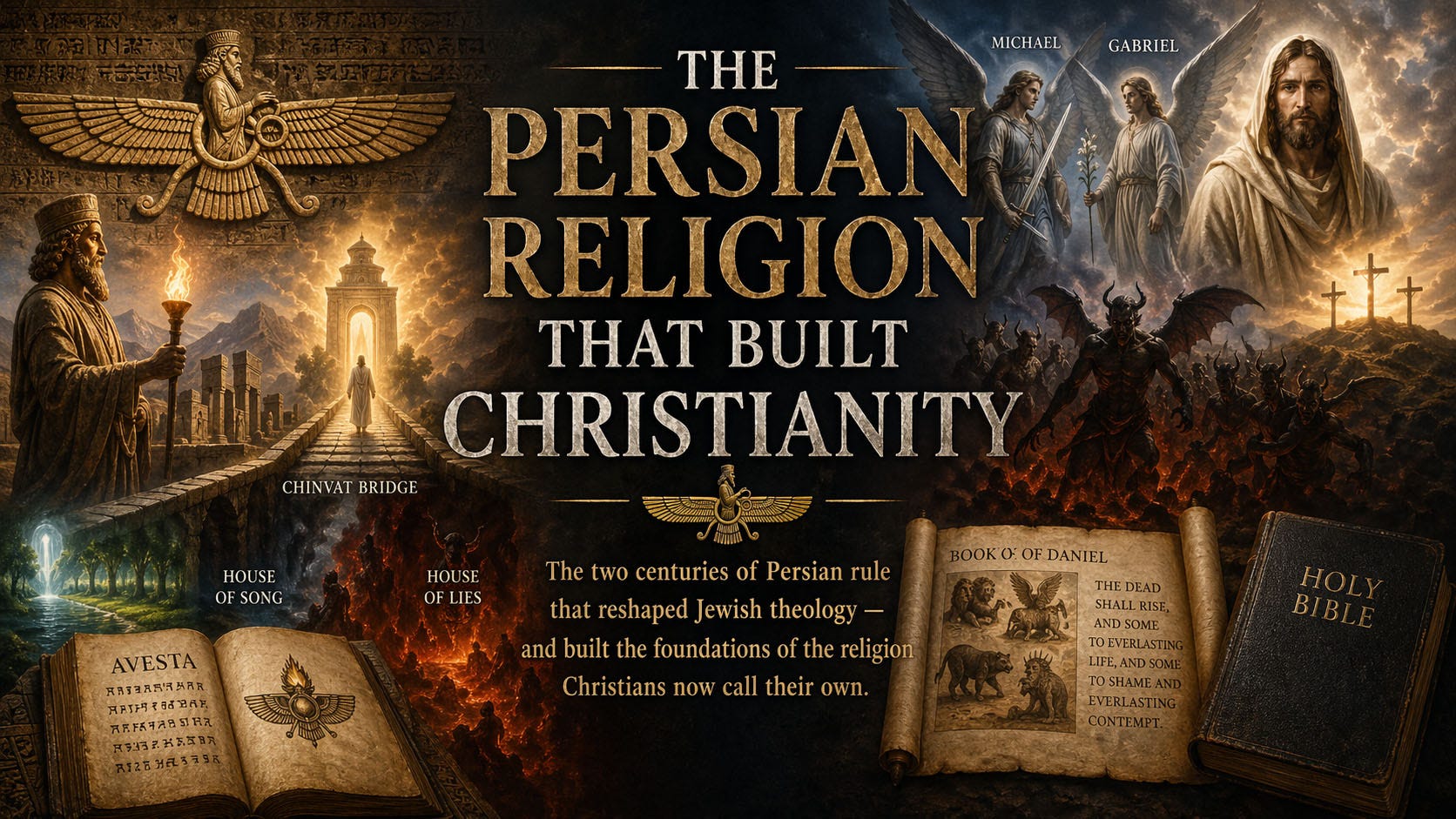
Most Christians have never heard of Zarathustra. They’ve never read the Gathas, never touched the Avesta, never thought about where their ideas of heaven, hell, or the end of the world came from. The assumption is that these concepts were handed down from God, preserved in scripture, and unique to the Judeo-Christian tradition — an assumption that doesn’t survive ten minutes with the historical record.
The Persian religion of Zoroastrianism had a fully developed heaven and hell, an army of angels and demons, a cosmic battle between good and evil, a virgin-born savior, a resurrection of the dead, and a final judgment — centuries before Christianity existed. These are specific structural and textual matches that appear in the Bible hundreds of years after they appear in Persian scripture.
Share theunholytruth.com with your family, friends, and followers. It’s free, and it’s the single biggest thing you can do to help this publication grow.
The Empire That Ruled Judah for Two Centuries
The Babylonians sacked Jerusalem in 586 BCE and dragged the Jewish elite—namely the priests, scribes, and aristocrats—back to Babylon in chains. For roughly fifty years, these exiles sat in a foreign capital, watching their religion strain against a world that didn’t care about it. Then Cyrus the Great showed up, a Persian Zoroastrian who, in 539 BCE, conquered Babylon and did something that shocked the ancient world: he let the Jews go home.
Not only that, but he also funded the rebuilding of their temple. The Hebrew Bible even calls Cyrus the Great a messiah (meaning “anointed one” by Yahweh), indicating how grateful the Jews were at the time for his unexpected benevolence. Yes, the Book of Isaiah in the Old Testament refers to this pagan emperor as a divinely appointed figure—an unlikely choice by Hebrew standards.
What the history of modern-day Christianity skips is what the Jews carried with them when they left Babylon: the lasting influence of nearly two centuries of Babylonian culture and ideas.
How the Hebrew Religion Was Before Persia
In the oldest parts of the Hebrew Bible — the early Pentateuch, Joshua, Judges, the early prophets — heaven and hell are suspiciously missing. The dead go to Sheol, which isn’t hell and isn’t heaven. It’s a dim underworld where everyone ends up, good and bad, king and beggar, with no flames, no reward, no punishment — just darkness and silence. The Psalms complain that the dead can’t even praise God anymore, because Sheol is that kind of place.
Look for Satan in these older texts and you get something stranger. In the book of Job, “the satan” isn’t even a proper name — it’s a title, literally “the adversary” or “the accuser.” He works for God as part of the heavenly court, a kind of cosmic prosecutor who tests human loyalty with God’s permission, not an independent evil power in rebellion against the divine order. He’s a functionary doing his job.
Look for the resurrection of the dead, the end of the world, or the defeat of evil by a messiah figure, and you’ll find almost nothing. The earliest Hebrew religion is concerned with this life, this land, and this people, and the cosmic questions — what happens after death, who runs the spiritual world, how history ends — aren’t there yet. Then the exile happens, and when Jewish texts start showing up again in the Persian period and after, everything’s different.
Chinvat Bridge vs Christian Afterlife
Zoroastrian theology says that after death, your soul travels to the Chinvat Bridge, which responds to your moral record. If you’ve lived righteously, the bridge widens and you walk across it into the “House of Song,” a paradise of light and music. If you’ve lived wickedly, the bridge narrows to the width of a blade and you fall into the “House of Lies,” a place of torment.
Christians who’ve never heard of Zoroastrianism will recognize the pattern immediately: a binary sorting after death, heaven for the good and hell for the wicked, judged by how you lived, with no second chances.
Persian religion laid this out centuries before Hebrew religion developed anything like it, and by the time the New Testament is written, the Christian afterlife reads like a direct descendant of the Zoroastrian one.
Amesha Spentas vs Christian Angelic Host
Zoroastrianism populated the spiritual world with beings called Amesha Spentas — “Holy Immortals” who served Ahura Mazda, the supreme god of light. They had names, functions, and domains, and while they weren’t God, they weren’t human either. They were messengers, protectors, and embodiments of divine attributes. On the other side, Angra Mainyu, the spirit of chaos, commanded a host of daevas — evil spirits who corrupted humans, spread lies, and waged war against the forces of good.
Christian angelology contains the same cast: named archangels with specific functions, guardian angels assigned to individuals, ranks and orders of heavenly beings, and demons under Satan’s command tempting humans, possessing bodies, and opposing God at every turn.
The early Hebrew Bible barely mentioned angels at all, and when it did, they were anonymous messengers with no personal identities. In post-exilic Jewish literature and Christian scripture, suddenly there are named archangels like Michael and Gabriel, organized demonic hierarchies, and a cosmic spiritual war running behind the scenes. All of that development happened under Persian rule, in direct contact with Persian religion.
Saoshyant vs Virgin-Born Messiah
Zoroastrian scripture describes a future savior called the Saoshyant, and the parallels with Christian messianic expectation are the most precise in the whole comparison. He’ll be born of a virgin — specifically, a young woman who bathes in a lake where the preserved seed of Zarathustra has been kept by divine guardians. When the time comes, the seed enters her miraculously, she conceives, and she gives birth to the savior who will defeat evil, raise the dead, and preside over the final judgment.
The Zoroastrian savior tradition contains a supernatural conception, a virgin mother, a cosmic redeemer, a final victory over evil, the resurrection of the dead, the renewal of the world, and eternal life for the righteous. Every one of these themes gets reworked into the Christian Jesus story. The mechanism changes — a lake becomes the Holy Spirit — but the structure matches point by point.
Christian apologists typically respond by arguing that both traditions got these ideas from God, so of course they match. The problem is that Zoroastrianism had them first, and the Jewish and Christian versions appeared after sustained contact with Persian religion. If both got the same revelation from God, then God apparently revealed it to the Persians centuries earlier and didn’t tell the Hebrews until they moved in next door. That’s strange theology, but it’s the logical consequence of the apologetic position.
Satan’s Promotion to Cosmic Villain
The Satan of the Hebrew Bible is a forgettable figure who shows up only a handful of times. In Job, he’s the prosecutor in God’s court; in Zechariah, he’s an accuser; in 1 Chronicles, he incites David to take a census — a bad act, but not cosmic rebellion.
By the time the New Testament is written, Satan is running an empire. He rules this world, commands demons, tempts Jesus in the wilderness, falls from heaven like lightning, deceives the nations, and gets thrown into the lake of fire at the end of time. He’s a proper villain with motive, will, and a global strategy.
The distance between the Satan of Job and the Satan of Revelation is enormous, and Persian religion covers most of it. Angra Mainyu — the cosmic enemy of Ahura Mazda — was already this kind of figure: independent, evil by nature, commander of demonic forces, and doomed to final defeat. Christians reshaped Angra Mainyu to fit their own theology, but the structural inheritance becomes obvious the moment you compare the two side by side. The Satan who appears in the Gospels, in Paul’s letters, and in Revelation is a direct descendant of Persian cosmic dualism.
Persian Apocalypse vs Book of Daniel
The most dramatic example of Persian influence sits right there in the Hebrew Bible, in the book of Daniel. Daniel claims to be set during the Babylonian exile, but most scholars agree it was actually written much later, in the 2nd century BCE, during the Maccabean revolt. It shows up centuries after Persian religious ideas had time to percolate into Jewish thought, and it reads like a Zoroastrian text with Jewish names pasted over it.
There’s a cosmic battle between heavenly beings. There are named archangels — Michael, Gabriel — who command armies and fight spiritual wars. There’s a vision of the end of history, where the dead rise and are judged, some to everlasting life and some to everlasting shame. There’s an apocalyptic timeline with symbolic beasts representing empires and a messianic figure who comes “with the clouds of heaven.”
Every one of these elements is absent from older Hebrew literature and present in Zoroastrian scripture, which makes Daniel the point where influence becomes impossible to ignore. From Daniel, these ideas flow directly into the apocalyptic literature of Second Temple Judaism — the books of Enoch, the Dead Sea Scrolls, the writings of the Essenes — and from there straight into the New Testament. Revelation expands on Daniel’s apocalyptic vision, and Daniel itself reads as a Jewish reworking of Zoroastrian source material.
What Mainstream Scholarship Says
The Persian influence on Judaism and Christianity is standard textbook material in religious studies departments. Mary Boyce spent her career documenting Zoroastrian history and argued that Jewish religion was reshaped during and after the Persian period, and her argument appears in the standard academic works on Zoroastrianism that have trained generations of scholars.
Lester Grabbe, a Second Temple Judaism specialist, catalogs the Persian fingerprints on Jewish apocalyptic literature in detail. John Hinnells mapped the spread of Zoroastrian dualism into Jewish and Christian thought across multiple books and academic papers. Paula Fredriksen, Bart Ehrman, and other biblical scholars have written extensively on how Jewish ideas about the afterlife, the messiah, and cosmic evil shifted after the Babylonian exile — and how the timeline makes Persian influence the most likely explanation.
What Conservative Christian Scholarship Says
Conservative Christian scholars who resist the borrowing thesis tend to fall back on one of two moves. The first is denying that the parallels are as close as critics claim, which requires ignoring the actual texts. The second is conceding the parallels but arguing that God “progressively revealed” these truths, which requires accepting that God chose to reveal them to the Persians first and to the Jews only after they lived under Persian rule for two hundred years. The first move collapses the moment anyone reads the actual Zoroastrian texts, and the second move concedes the historical claim while dressing the concession up as divine strategy.
In academic religious studies, the question of whether Persian religion shaped Jewish and Christian theology was settled decades ago, and what remains open is how extensively.
Conservative Christian “scholars” often reject even obvious findings if they think they contradict the Bible, and therefore are not taken seriously enough to have real influence on academic discourse — nor do they seek it. Their purpose is to manufacture the appearance of an ongoing scholarly debate where none exists.
This publication exists because readers like you choose to support it.
If you’re not already a paid subscriber and you’re finding value here, I’d love for you to consider becoming one to keep The Unholy Truth alive.
So, What Will Happen Now?
Now that it’s clear that many Christian—and later Islamic—ideas can be traced back to a very different, pre-existing cultural world, the question is how it remains so absent from mainstream religious awareness.
The answer is not a mystery. Christianity has found that indifference is a better tool than hostility, and as long as these ideas remain confined to scholarly circles, it can continue business as usual.
Sources and Further Reading
Zoroastrians: Their Religious Beliefs and Practices — Mary Boyce, 2001
A History of the Jews and Judaism in the Second Temple Period — Lester L. Grabbe, 2004
Zoroastrian and Parsi Studies: Selected Works of John R. Hinnells — John R. Hinnells, 2000
The Hebrew Bible: A Socio-Literary Introduction — Norman Gottwald, 1985
From Jesus to Christ: The Origins of the New Testament Images of Jesus — Paula Fredriksen, 2000
Heaven and Hell: A History of the Afterlife — Bart D. Ehrman, 2020
Zoroastrianism wasn’t around until the 6th century BCE. The stories of Abraham predate that by 1000+ years
This is an interesting bit of history. I knew about Daniel being influenced by the exile.
One open question is what happened after the first couple of centuries CE. Rabbinical Judaism seemed to mostly retreat from the dualism that was popular before the temple was destroyed, though vestiges remained. While Christianity as it settled into a set of dogma, seemed to have more fully embraced it.
For example, the Jewish scholars I have read claim that Satan as adversary and ruler over the earth is contrary to the Faith's traditions.
There is a book on my reading list about the history of Satan.
What are your thoughts on all this?