


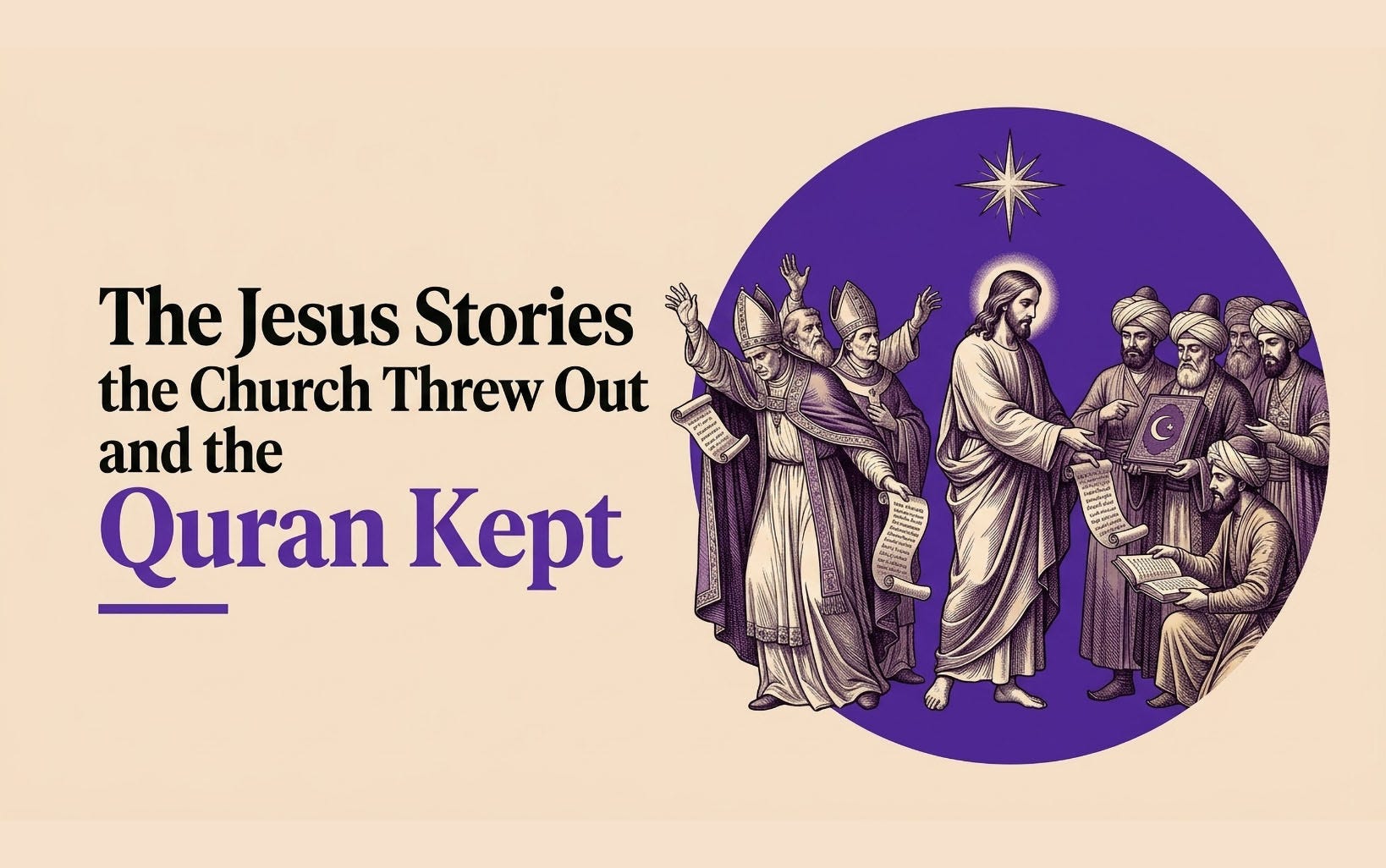
What happens to a story when the Church declares it a forgery? Usually it disappears, but sometimes it hides in plain sight, painted on chapel walls, celebrated on church calendars, and eventually preserved inside the Quran.
Long before the 27-book New Testament was officially finalized, the Christian world was a Wild West of unofficial gospels featuring vigilante toddler-saints, teenage virgins fed by angels in the Temple, and palm trees that bent down to feed pregnant mothers. Orthodox bishops eventually purged these tales from the Bible, but they couldn’t purge them from the cultural memory of the Near East.
Today Christians look at Islam and see a completely different religion with enough similarities to make them think Muhammad must have stolen from theirs. In reality, Islam is built on Christianity, though, just a version Paul never had a hand in.
When the Quran emerged in seventh-century Arabia, it responded to the living, oral folklore of local Christians in the Near East, much closer to home than the finalized 27 books of the West. And in doing so, it left both Christian and Muslim apologists with an awkward historical problem.
Twelve Clay Sparrows of a Dangerous Five-Year-Old
Let’s start with a story from The Infancy Gospel of Thomas, which we covered in an earlier piece.
Around the second century, somebody wrote down this collection of tales about Jesus as a boy. In its opening scene, five-year-old Jesus is playing by a stream on the Sabbath and molds twelve sparrows out of mud. A neighbor runs to Joseph to report the Sabbath violation. Jesus claps his hands, tells the birds to go, and they fly off chirping.
The Quran tells this story twice, in chapters 3 and 5. Jesus says he’ll make “the shape of a bird” out of clay and breathe into it, and it’ll become a bird by God’s permission. The miracle sits in a list next to healing the blind and raising the dead, with no setup and no explanation, which tells you the audience already knew it. Nobody drops a one-line reference to a story their listeners have never heard.
The Quran understandably leaves out the rest of the book, where young Jesus withers a boy who splashes his pools, kills another kid who bumps into his shoulder in the street, blinds the neighbors who complain about it, and strikes down a teacher who smacks him during an alphabet lesson.
Christian leaders were less selective and threw the whole book out. By the 180s a bishop in what’s now France was already quoting one of its stories as an example of heretic forgery, and a sixth-century church list of banned books, known as the Gelasian Decree, put a “book about the infancy of the Savior” on the reject pile.
The Girl Raised in the Temple and Fed by Angels
The New Testament says almost nothing about Mary before the angel shows up. Christians in the second century found that unsatisfying, so somebody filled in the gap with a text now called the Protoevangelium of James. In it, Mary’s mother is childless for years, then vows her baby to God. At age three, Mary goes to live in the Jerusalem Temple, where an angel brings her food. When she turns twelve, the priests panic that a girl hitting puberty will make the sanctuary unclean, so they summon the widowers of Israel, have each bring a rod, and wait for a sign. A dove flies out of Joseph’s rod, and he gets the job of taking her in.
Chapter 3 of the Quran tells the same story. Mary’s mother vows the child in her womb to God’s service. Zechariah, the father of John the Baptist, is put in charge of her, and every time he walks into her sanctuary he finds food already there. When he asks where it came from, Mary tells him it’s from God. A few verses later the Quran reminds its audience that the Prophet wasn’t present “when they cast their pens” to decide who’d take charge of Mary. That’s the rods scene, remembered as drawing lots, and Zechariah is the priest who runs the selection in the Protoevangelium too.
The Western church never let this book anywhere near the Bible, and the same Gelasian Decree that banned the infancy stories also condemned a gospel circulating under James’ name. Yet the Catholic calendar still celebrates Mary’s Presentation in the Temple every November 21 and honors her parents, Joachim and Anne, every July 26. Those feasts, and the names of those parents, come straight from the book Rome rejected. The Quran and the Catholic Church both kept the story while only one of them admits where it came from.
A Palm Tree, a Stream, and a Detour
Chapter 19 of the Quran has the most vivid birth scene in either scripture. Mary goes off alone, and labor pains drive her to the trunk of a palm tree, where she wishes she’d died and been forgotten. A voice from below tells her not to grieve, since God has put a stream at her feet, and if she shakes the trunk, fresh ripe dates will fall on her.
Christian readers who know only Luke’s manger have no idea what to do with this. Christian readers of the seventh century would have recognized it right away. A Latin text known as the Gospel of Pseudo-Matthew, put together around the early 600s from older material, tells how the Holy Family rested under a palm during the flight to Egypt. Mary wants fruit, Joseph worries about water, and the infant Jesus orders the palm to bend down so his mother can pick dates, then tells it to open a spring from its roots. Same tree, same fruit, same water, just moved to a different week of Jesus’ life. An infant who gives orders to trees isn’t far from one who speaks from his cradle, which is what Jesus does a few verses later in the same Quran chapter to defend his mother.
On the road between Jerusalem and Bethlehem stood a Byzantine church called the Kathisma, Greek for “the seat,” built around a rock where a pregnant Mary was said to have stopped to rest. Local Christian tradition there had already tied the palm-tree rest stop to a pregnant Mary on her way to give birth, and the Quran’s scene matches that local version far better than it matches anything in Luke or Matthew.
The Crucifixion That Only Looked Like One
Chapter 4 of the Quran says the Jews claimed to have killed Jesus, “but they didn’t kill him and didn’t crucify him, it was only made to appear so to them.” Christians treat this as the most un-Christian line in the book, even though Christians in the second century said it first.
A teacher in Alexandria named Basilides, teaching in the 120s and 130s, taught that Simon of Cyrene, the man the Gospels say was forced to carry Jesus’ cross, was changed to look like Jesus and crucified in his place while Jesus stood nearby laughing at the executioners. We know this because a bishop wrote it up as heresy around 180. A text called the Second Treatise of the Great Seth, found among the Egyptian manuscripts unearthed at Nag Hammadi, puts it in Jesus’ own mouth: it was another who drank the gall and vinegar, and it was Simon who carried the cross on his shoulder. Other early Christians went further and taught that Jesus never had a physical body at all, so nothing on that cross could suffer.
The motive differs from the Quran’s. Those Christians thought flesh was beneath a divine being, while the Quran wants to spare a prophet the humiliation of execution. The move is identical, though, and it was circulating among Christians for five hundred years before the Quran repeated it.
The Canon Was Drawn Up by Bishops, and the Losers Kept Talking
The 27-book New Testament didn’t exist as a fixed list until a bishop of Alexandria named Athanasius spelled it out in a letter in 367, and even then churches kept arguing for centuries. The Syriac-speaking churches closest to Arabia used a Bible that left out 2 Peter, 2 and 3 John, Jude, and Revelation. The Ethiopian church across the Red Sea used a bigger one.
None of those lists stopped ordinary believers from loving the rejected stories. They heard them in sermons and hymns, saw them painted on church walls, and celebrated them on feast days. A Christian in seventh-century Arabia knew Jesus through that world of story, since almost nobody owned a book. The Quran preserves the faith those people practiced, rejected books and all.
That leaves both camps with a problem. Christian apologists who sneer that the Quran “borrowed from apocrypha” are sneering at what their own ancestors believed and still celebrate on the calendar. Muslim apologists who insist the Quran couldn’t have human sources have to explain why its Jesus stories were written down by Christians centuries earlier, in books those same Christians eventually binned.
The rejected gospels aren’t the only Christian material hiding in the Quran. Chapter 18 contains two more Christian legends: a group of young men who sleep in a cave for centuries, and a world-conquering king who walls out the monstrous armies of Gog and Magog. One of them was written down in Syriac within a few years of the Quran’s own appearance, and the details line up so closely they’re hard to explain any other way. Paid subscribers get the full breakdown below, including the fish that comes back to life in both a Moses story and an Alexander the Great adventure. If you’re on the free list, this is a good one to upgrade for.
Exclusive Content for Paid Subscribers
The Christian Bedtime Stories in Chapter 18
Chapter 18 of the Quran, known as “The Cave,” reads like an anthology, and two of its most famous stories were already well known to Christians.
The first is the..