


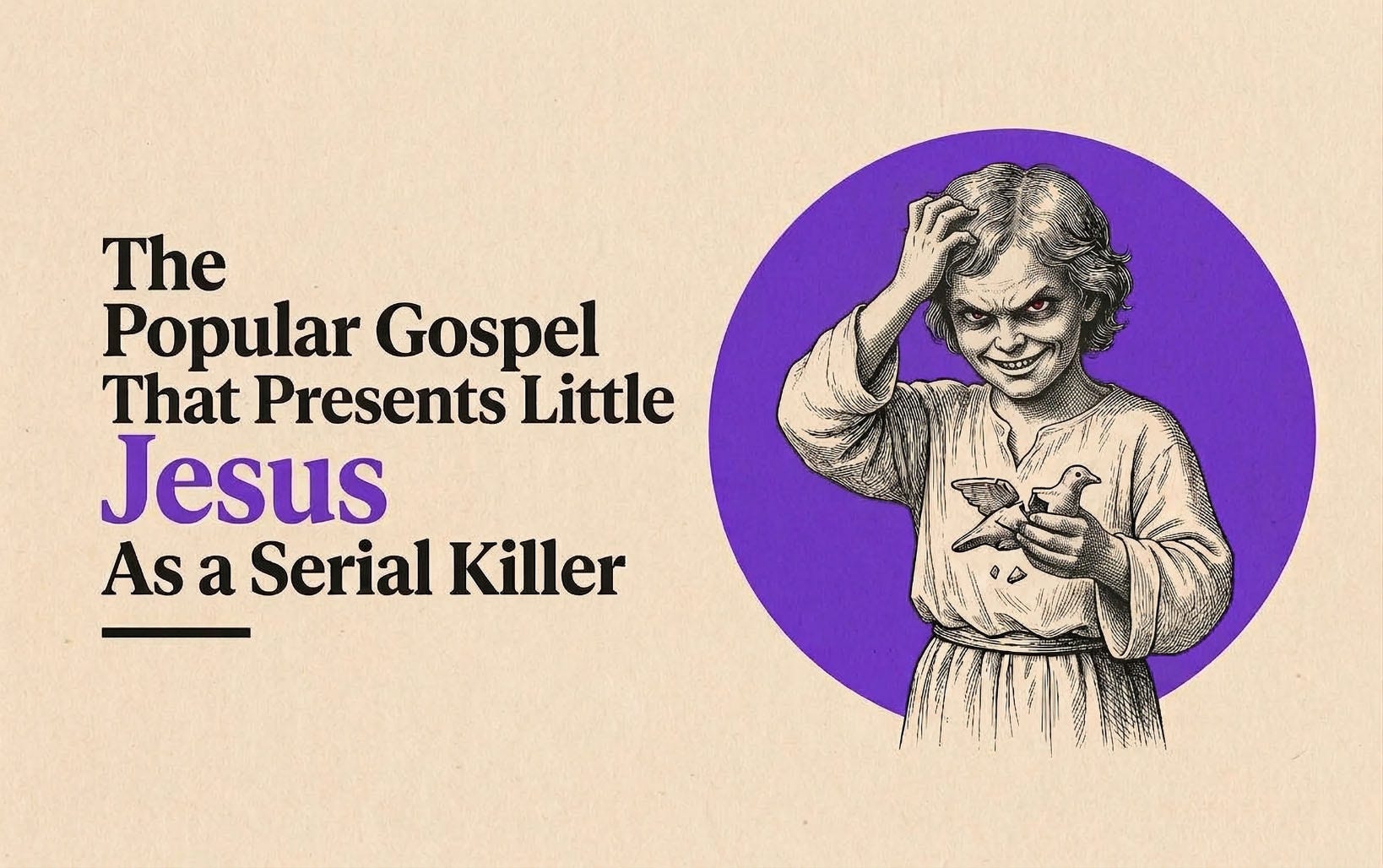
Before Jesus ever turned water into wine or healed the sick in Galilee, early Christians swapped stories about a very different miracle worker: a volatile five-year-old with a god's power and a toddler's temper. In the non-canonical Infancy Gospel of Thomas, Jesus makes clay sparrows fly, and in his spare time, he strikes annoying people dead and blinds neighbors who dare to complain. It's an eerie, forgotten portrait of a divine child learning restraint, and for centuries it was one of the most popular stories in the ancient world.
Five Years Old with a Body Count
The book opens with Jesus at five, playing by a stream after a rainstorm on the Sabbath. He gathers the runoff into little pools, makes the water clean with a word, and molds twelve sparrows out of soft clay. A neighbor sees it and runs to tell Joseph his son is working on the Sabbath. His stepfather Joseph comes down to scold him, Jesus claps his hands, and the sparrows fly off chirping. So far you’ve got a sweet story with a Sabbath lesson the adult Jesus of the Gospels would recognize.
Then the son of Annas the scribe takes a willow branch and drains the pools Jesus made. Jesus calls him a godless fool, tells him he’ll wither like a tree, and the boy dries up on the spot. Shortly after, as Jesus walks through the village, another boy running past knocks into his shoulder. Jesus tells him he won’t go any further on his way, and the child drops dead.
The dead boy’s parents go to Joseph with a reasonable request: teach your son to bless instead of curse, or take your family and leave, because he’s killing our children. Joseph confronts Jesus, who says he’ll keep quiet for Joseph’s sake but the accusers will still pay. They go blind immediately. Joseph’s response is to grab the boy by the ear and yank it hard, which earns him a lecture from a five-year-old about not knowing who he’s dealing with.
Most notably, nobody in the text treats the dead children as a moral problem for Jesus**, and judging by how popular the book was among early Christians, neither did the people reading it.
Three Teachers and One Very Bad School Year
A teacher named Zacchaeus overhears Jesus mouthing off to Joseph and offers to teach him his letters, assuming discipline is what’s missing. He writes out the alphabet and starts drilling him.
Jesus refuses to move past alpha until the teacher explains what alpha is, then lectures him on the letter’s shape, its strokes and its middle line, in language that sounds profound and says very little. Zacchaeus ends up humiliated in front of a crowd, saying the child must be a god or an angel and begging Joseph to take him away.
Joseph tries a second teacher, who loses his patience and smacks Jesus on the head. Jesus curses him and the man collapses, or drops dead, depending on which version you read.
Joseph tells Mary to keep the boy indoors, since anyone who makes him angry dies. A third teacher, a friend of Joseph’s, has the good sense to let Jesus teach himself. Jesus reads the law aloud with authority, the teacher praises him, and Jesus, pleased, heals the second teacher (or raises him from the dead).
Ancient readers saw childhood as an unfinished stage of life, and the book traces an arc. In the later chapters Jesus raises a boy named Zeno who fell off a roof (partly to clear himself of a murder charge), heals his brother James of a snakebite, carries water home in his cloak when a jar breaks, and stretches a short board so Joseph can finish a bed for a rich customer. The miracles keep coming, but the body count stops. By the last chapter he’s twelve, and the text runs straight into Luke’s temple story almost word for word, as if the author wanted his book to dock well with the one everybody already knew.
Greek Audiences Already Knew Divine Children Were Dangerous
Whoever wrote this was likely writing for people raised on Greek stories, where gods behave no differently as children. The Homeric Hymn to Hermes has the god born at dawn, inventing the lyre by noon and stealing Apollo’s cattle by nightfall, then lying to Zeus’ face about it. Heracles strangled two snakes in his cradle. Greek and Roman biographers loved childhood episodes that predicted the adult, and Plutarch, the first-century biographer, has a young Alexander taming a horse nobody else could ride.
Luke’s temple story belongs to that same genre, a boy outclassing the experts. The Infancy Gospel of Thomas takes the premise to its logical end. If Jesus was divine at five, then a five-year-old with divine power and a five-year-old’s temper is what you’d get. The author never hints that this is a problem, because for his audience power was the whole appeal. A god who could wither a bully was a god worth praying to.
The text also answers a theological question the canon leaves open. If Jesus was fully God from birth, did he know everything as a toddler? The alphabet scene says yes, and the teachers who can’t see it get hurt. Later church thinkers wanted a Jesus who grew in wisdom the way Luke says, so the answer this gospel gave became an embarrassment.
The Church Tried to Ignore It and Lost
Readers expecting another suppression story are in for a surprise. No council condemned this book by name, and nobody needed one, since it never had a claim to apostolic authorship and nobody seriously proposed reading it in church. Bishops dealt with it by arguing against its premise. John Chrysostom, the fourth-century archbishop of Constantinople, pointed to John 2:11, which calls the wedding at Cana the first of Jesus’ signs, and argued that this ruled out childhood miracles entirely. If Cana came first, the sparrows never flew.
While that argument won among theologians, it failed everywhere else. The stories were already old by Chrysostom’s time. Irenaeus, the second-century bishop of Lyon, quotes the alpha episode around 180, which puts the material in circulation within a few generations of the Gospels themselves. The text spread into Syriac, Latin, Georgian, Ethiopic and Slavonic, and the clay birds turn up in the Qur’an. Medieval writers folded its episodes into longer infancy collections, and artists put them on church walls. The British Museum holds the Tring tiles, a set of fourteenth-century English tiles that show the child Jesus striking down a playmate and, later in the series, bringing children back to life.
Medieval laypeople grew up with this Jesus while their theologians insisted the stories were false, and the laypeople kept copying them. Look at what the book offered a peasant family in a village where children died constantly and nobody could protect them: a God who’d been a child himself, who had enemies on the street and a father who pulled his ear, and who could raise a dead boy when he chose to. The Gospels gave them a savior for the end of the world, while this gospel gave them one for the neighborhood.
The cursing Jesus is the part everybody remembers, but the history behind the text is where things get truly wild. Below the line, paid supporters get access to the hidden layers of this text that scribes tried to erase: how 5th-century manuscripts reveal an even colder version of the story, the bizarre missing miracles left out of modern translations (including riding sunbeams and leaping salted fish), and a direct side-by-side look at how medieval copyists edited “Psycho Jesus” to protect his reputation.
If you’ve been reading for free, today is a great day to unlock full access and keep deep-dive historical pieces like this coming four days a week.
Exclusive Content to Paid Subscribers
The Lost Scenes and Censored Variations
Modern translations of the Infancy Gospel of Thomas offer a surprisingly sanitized view of the text—the result of copyists quietly wrestling with its contents for over a thousand years. The moment medieval scribes encountered stories of a five-year-old striking his playmates dead, a silent war broke out in the scriptoriums. Yet, try as they might, they never fully erased the darker, older layers of the gospel…