


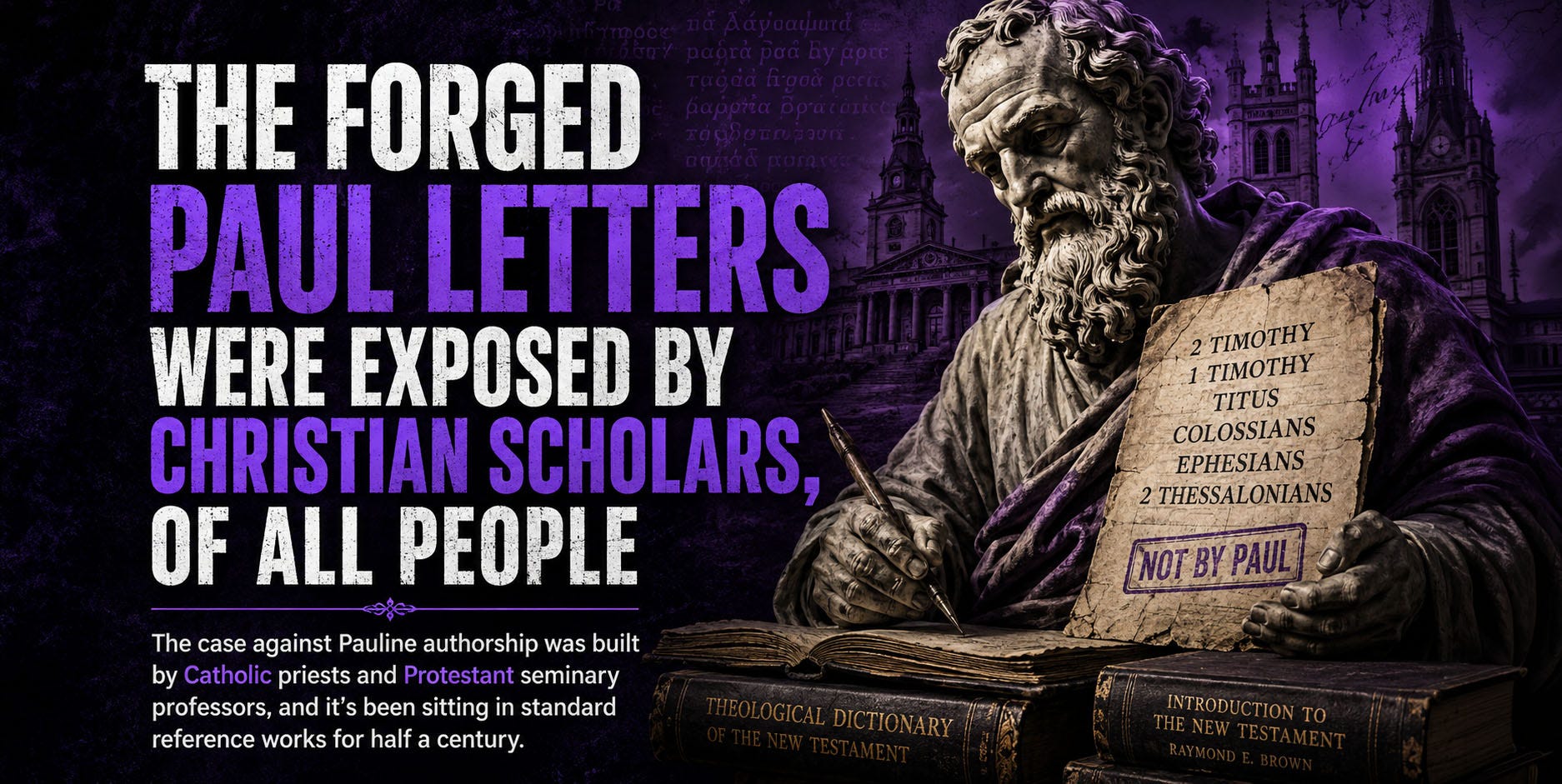
There are thirteen letters in the Bible attributed to Paul, and all thirteen of them shaped Christianity as we know it. Scholars worked out long ago that six weren’t written by the same man who wrote the other seven.
Bring up the forged letters and you’ll watch people file it under atheist debate-club material, the sort of thing that comes packaged with a podcast microphone and an axe to grind, as though who wrote Colossians has any bearing on whether God exists. To be fair, that’s mostly a Medium phenomenon and hasn’t happened yet here.
Then you look at who built the argument. These are professors at Notre Dame, Yale, Princeton Theological Seminary, and the Catholic University of America. Several of them are ordained. The most influential voice on the question was a Catholic priest who served on the Pontifical Biblical Commission under two popes and taught for decades at Union Theological Seminary.
The Seven Letters Nobody Argues About
Thirteen letters in the New Testament open by claiming Paul as their author. Critical scholarship sorts them into three piles, and the sorting has held since the 1970s.
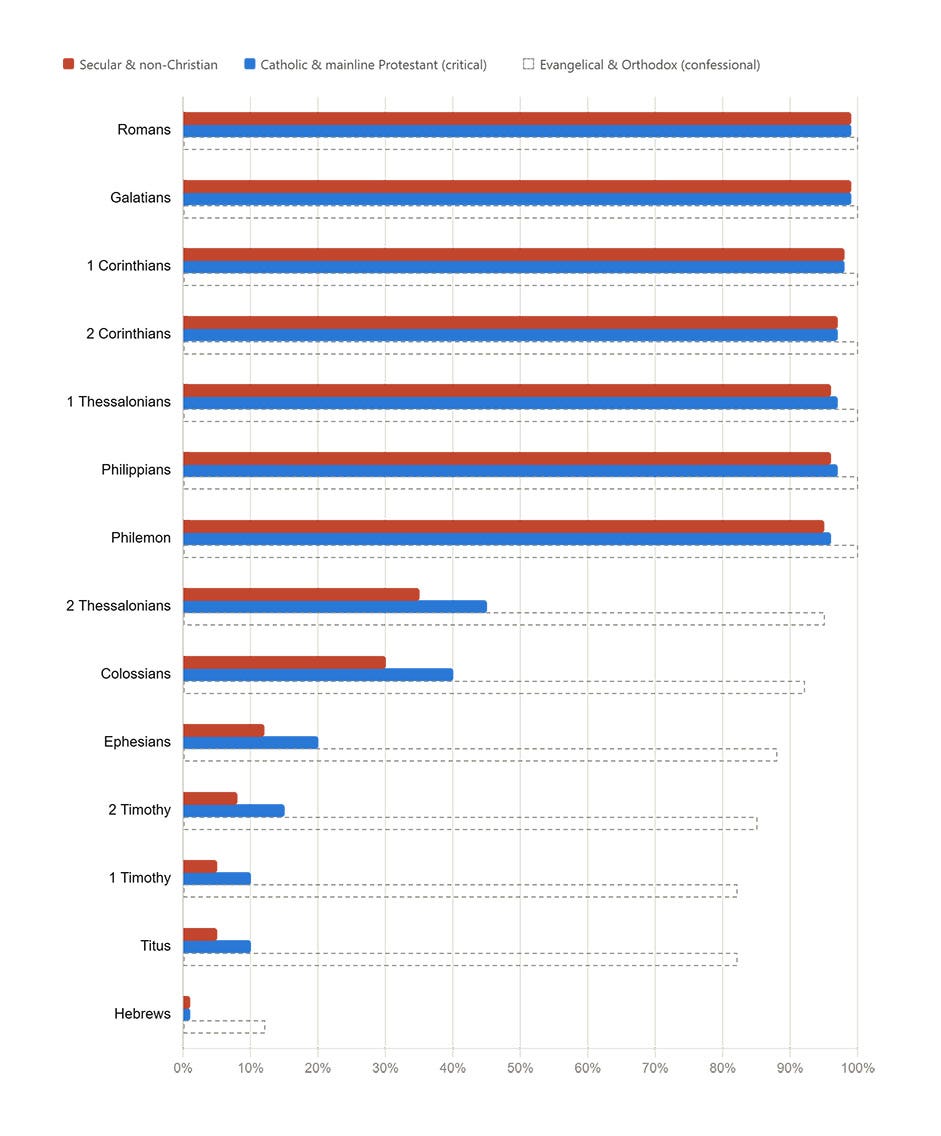
Seven are undisputed: Romans, 1 Corinthians, 2 Corinthians, Galatians, Philippians, 1 Thessalonians, and Philemon. You can argue about how to read them, but nobody serious argues about who wrote them.
Three sit in contested territory: Ephesians, Colossians, and 2 Thessalonians. Raymond Brown, the priest mentioned above, worked through the state of the field in his Introduction to the New Testament and put rough numbers on it. Around 80 percent of critical scholars judged Ephesians to have been written by someone other than Paul, roughly 60 percent said the same about Colossians, and the split on 2 Thessalonians ran close to even.
Then there are the three Pastoral Epistles: 1 Timothy, 2 Timothy, and Titus. Brown estimated that 80 to 90 percent of critical scholarship treats these as written after Paul’s death by an admirer using his name. That’s about as close to unanimous as this field gets.
Worth being clear about what undisputed means, because it’s a weaker claim than it sounds. It means the vocabulary, the theology, and the situations these letters address all hold together, and that the external evidence puts them in circulation early, so there’s no reason to doubt they started with Paul. It doesn’t certify every sentence in them. 2 Corinthians and Philippians both look like several letters composed together by a later editor, the passage in 1 Corinthians ordering women to keep silent in church is widely treated as something a scribe inserted, and every one of these letters was copied by hand for centuries before our earliest complete manuscripts. Nobody has the originals, so undisputed here rests on the absence of evidence against rather than the presence of evidence for.
Three Hundred Words Paul Never Used
The oldest thread of the argument runs through vocabulary. P.N. Harrison’s 1921 study counted 306 words in the Pastorals that appear nowhere in the other ten letters bearing Paul’s name, with 175 of them absent from the entire rest of the New Testament. A large share of that vocabulary turns up in Christian writing of the second century, which is a strange place for a man executed under Nero to be borrowing his diction from.
Word counts on their own prove less than people want them to. Luke Timothy Johnson, a Catholic scholar at Emory, has argued at length in his Anchor Bible commentary that the vocabulary evidence gets oversold, that samples this small can’t carry the statistical weight placed on them, and that a secretary given latitude over the wording, writing on subjects Paul hadn’t addressed before, accounts for much of the gap. He’s right that the numbers alone won’t settle it. The reason the consensus holds anyway is that the vocabulary lines up with everything else that’s odd about these letters.
The Pastorals Describe a Church That Hadn’t Been Built Yet
In 1 Timothy 3 what you get is a job description with qualifications for overseers, qualifications for deacons, and standards for their households and their drinking. Titus 1:5 has Paul instructing his delegate to appoint elders town by town. First Timothy 5 sets up an enrolled order of widows with an age minimum of sixty and rules about which younger women to keep off the list.
However, in 1 Corinthians 12 through 14, Paul deals with an assembly that has prophets and tongue-speakers talking over each other, and his solution is a set of ad hoc instructions about taking turns. There’s no office to appeal to, because there isn’t one yet. Philippians 1:1 greets overseers and deacons without a word about how anybody qualifies for the job. The institutional machinery in the Pastorals belongs to the generation that had to organize itself after the apostles died and the second coming didn’t arrive on schedule.
Second Thessalonians Warns Its Readers About Forged Paul Letters
2 Thessalonians 2:2 tells the congregation not to get rattled by a spirit, a spoken word, or a letter appearing to come from Paul. The closing at 3:17 makes a point of the signature in Paul’s own hand, presented as the mark of authenticity in every letter he writes. A letter that half the field judges to be pseudonymous spends its energy insisting on its own credentials, which is the overcorrection of a forger covering his tracks.
The theology underneath supports the case. 1 Thessalonians 5 has the day of the Lord arriving like a thief in the night, with no warning and no schedule. 2 Thessalonians 2 tells readers to calm down, because the rebellion has to come first and the man of lawlessness has to be revealed, seated in the temple and declaring himself God. Those are two different answers to the same pastoral emergency, and the second one reads like an attempt to manage disappointment among people who took the first one literally.
In Colossians and Ephesians the Resurrection Already Happened
Paul’s position in Romans 6 keeps the believer’s resurrection in the future tense. You’re buried with Christ now and you’ll be raised with him later, and the gap between those two things is where the whole ethical argument lives.
Colossians 2:12 and 3:1 close that gap. The believer has been raised already. Ephesians 2:6 goes further and seats him with Christ in the heavenly places, present tense, transaction complete. A church that had stopped expecting the end within the lifetime of its members needed the payoff moved from the future into the present, and that shift is a main reason these two letters get dated after Paul’s lifetime.
Ancient Christians Punished Forgers Who Meant Well
The standard defense holds that pseudonymity was an accepted convention, a respectful gesture from a disciple toward a dead teacher. That description of the writer is an assumption the defense needs rather than something anyone can show. Nobody knows who produced these letters. They could have come from a devoted student, or from someone a generation removed who never met Paul, or from a party inside a church that wanted its position on women and slaves to carry apostolic weight. The defense picks the most flattering of those and argues the ethics from there, which concedes that Paul didn’t write the letter and moves the discussion to the writer’s manners.
The people running the early church weren’t lenient on the manners either.
The people running the early church weren’t lenient on the manners either. Tertullian reports that a presbyter in Asia who composed the Acts of Paul out of admiration for the apostle was convicted and removed from office, and the man’s motives were never in question. The Muratorian Fragment, an early list of accepted books, names letters to the Laodiceans and the Alexandrians as forgeries circulating under Paul’s name and rules them out of the church’s reading.
Bruce Metzger, a Presbyterian minister who taught at Princeton Theological Seminary and shaped the Greek text nearly every modern translation rests on, worked through the ancient evidence in a 1972 article and reached the same conclusion. Antiquity knew what a literary forgery was, had a word for it, and disapproved.
If you’re finding value here, I’d love for you to consider becoming a supporter to keep The Unholy Truth alive.
The Forgeries Did the Most Damage
1 Timothy 2:11-15 orders women to learn in silence and forbids them to teach or hold authority over a man, grounding it in Eve. Ephesians 6:5 and Colossians 3:22 instruct slaves to obey their masters with fear and trembling, and Titus 2:9 tells them not to talk back. The consequences are still running. Rome ordains no women, the papacy is closed to them, and the Vatican’s 1976 declaration on the question cites 1 Timothy directly.
The undisputed Paul gives you Romans 16, where Phoebe is a deacon of the church at Cenchreae, Junia is prominent among the apostles, and Prisca gets named ahead of her husband. That’s the man whose name got attached to the household codes, by writers he never met, in service of an arrangement he never endorsed. Two thousand years of Christian teaching on women and on slavery leans hardest on the letters with the weakest claim to his authorship, and the seminaries have known it the whole time.
Sources and Further Reading
Raymond E. Brown, An Introduction to the New Testament (Doubleday, 1997)
Bart D. Ehrman, Forged: Writing in the Name of God (HarperOne, 2011)
Bart D. Ehrman, Forgery and Counterforgery (Oxford University Press, 2013)
Bruce M. Metzger, “Literary Forgeries and Canonical Pseudepigrapha,” Journal of Biblical Literature 91 (1972)
P.N. Harrison, The Problem of the Pastoral Epistles (Oxford University Press, 1921)
Luke Timothy Johnson, The First and Second Letters to Timothy, Anchor Bible (Doubleday, 2001)
Joseph A. Fitzmyer, Raymond E. Brown, and Roland E. Murphy, eds., The New Jerome Biblical Commentary (Prentice Hall, 1990)
Tertullian, On Baptism 17
Clement, who would become Pope, wrote that Paul was martyred under the prefects, which would mean after Nero committed suicide and before Galba became Emperor. That would be in June, 68 CE.
Philippians may have been reduced rather than composed of fragments. The names hang together. The Household of Caesar was the agency responsible for the finances of the Roman Army. Epaphroditus would have been a member of that agency, if not its head. Philippi was a major Roman military base. Clement would go on to become the Pope. Perhaps the missing pieces of Philippians mentioned Nero, and not in a bad way? Epaphroditus pays Paul his service. Was Paul on Nero's payroll?
Paul is called a tent maker, but perhaps tent seller is more accurate, and his biggest customer would have been the Roman Army. He was friends with Priscilla and Aquila, Jewish tent makers who were expelled by the Emperor Claudius from Rome. Aquila is an odd name for a Jewish man, because it happens to be the Latin word for the totem of a Roman Legion. But it is a good name if you are selling tents to the legions.
The trouble is modern Christianity is herded towards Pauline doctrine which often differs substantially from what Yeshua and James intended