


In the previous parts of this series on modern woke culture—what I call shallow progressivism—I argued that something important has shifted. The language sounds noble. The goals sound noble. The cause often is noble. But the strategy is increasingly reckless.
Now we get to the promise I made.
This installment is about enforcement.
Not discussion. Not awareness. Enforcement.
The enforcement of the idea that being white is a privilege and that this privilege comes with moral responsibilities. Not just empathy. Not just fairness. But obligations. Behavioral rules. Speech rules. Social rules.
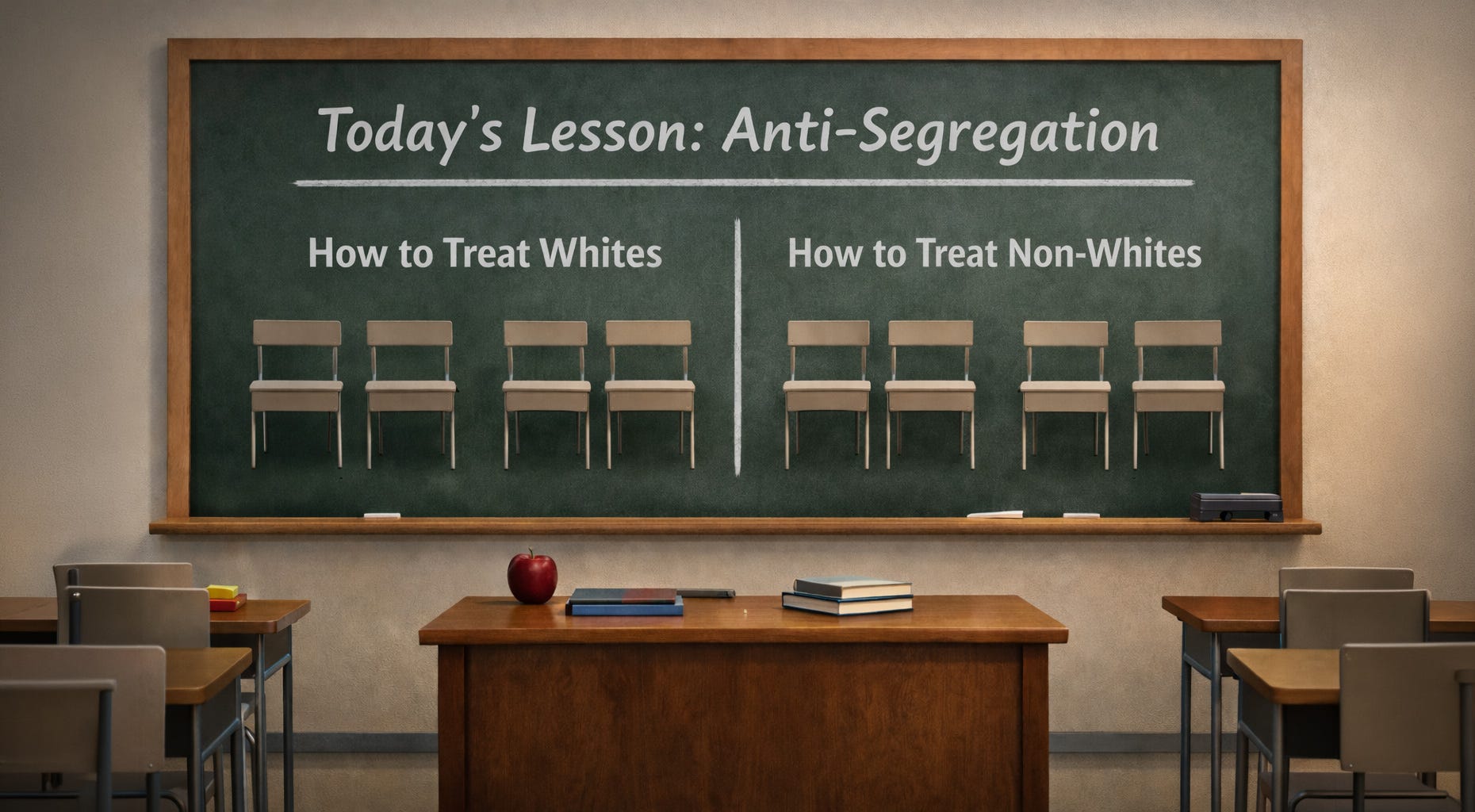
The message is simple and repeated everywhere: If you’re white, you can’t treat non-whites the same way you treat other white people.
That is now presented as moral progress.
The Original Idea Was About Systems
The concept of “white privilege” didn’t start as a moral accusation but as a structural observation. Scholars like Peggy McIntosh wrote about invisible advantages—things that often go unnoticed by those who benefit from them.
The idea wasn’t that white people were evil. The idea was that certain systems historically favored them.
That conversation was legitimate.
It helped people understand how housing policies, education systems, policing patterns, and hiring networks can create uneven outcomes without explicit hatred.
But that analytical tool has now been turned into something else.
It’s become personal. Moral. Behavioral.
It’s no longer about examining systems. It’s about managing individuals.
And once you start managing individuals based on skin color, you’re doing something very different from fighting racism.
You Are White, Therefore You Owe
The modern version goes like this:
You’re white.
Therefore, you benefit from structures you didn’t build.
Therefore, you carry responsibility.
Therefore, you must behave differently.
Speak differently.
Position yourself differently.
You must “amplify.”
You must “step back.”
You must “listen more than you speak.”
You must “check your privilege.”
Notice the shift.
The fight against discrimination now begins with segregation and assigning a moral category at birth.
White is no longer just a descriptor. It becomes a status. A permanent asterisk next to your name.
And from there comes instruction.
It starts to resemble an old aristocratic code. If you were born into royalty, you were told you carried inherited status—and with it, inherited duties. You didn’t earn the crown, but you were expected to act accordingly. Speak carefully. Represent properly. Carry the weight of the title whether you asked for it or not.
Now replace “royalty” with “whiteness.”
You didn’t choose it. You didn’t design the system. But you’re told you carry its moral burden. You must self-monitor. Self-limit. Self-correct.
The irony is striking. A movement that claims to dismantle hierarchies begins by reassigning rank—only this time, the rank comes with moral liability instead of privilege.
And once identity becomes a title with behavioral rules attached, you’re no longer talking about equality.
You’re talking about caste management.
What could possibly go wrong with telling white teenagers, “You’re white. You’re special. You can’t behave like other races”?
How could it possibly be a bad idea to let white teenagers fight for racial equality in a way that allows them to feel morally superior — satisfying them the same way they might feel after giving up their seat to a disabled passenger on public transport? How generous.
This publication exists because readers like you choose to support it.
If you’re already a paid subscriber, thank you. If not, and you’re finding value here, I’d love for you to consider becoming one.
The Quiet Re-Segregation
The irony is hard to miss.
For decades, the ideal many progressives defended was color-blindness. Judge people as individuals. Don’t sort them by race. Don’t assume traits, guilt, or innocence based on skin tone.
Now, increasingly, the starting point is exactly that sorting.
Workshops divide rooms by racial identity.
Conversations begin with “as a white person…”
Corporate training sessions tell white employees to understand their position in the hierarchy.
The logic may claim to be anti-racist. But the method is racial classification.
We’re back to labeling.
We’re back to assigning expectations based on skin.
That should make anyone uncomfortable.
Treating People Differently to Prove You’re Equal
Here is the practical consequence.
You’re told you can’t treat non-white people the same way you treat white people.
If you challenge a white colleague directly, that’s professional debate.
If you challenge a non-white colleague directly, you must consider “power dynamics.”
If you joke with white friends freely, that’s normal.
If you joke the same way with non-white friends, you risk harm.
The result is a strange behavioral double standard.
You walk on eggshells around some people and act naturally around others.
And that’s supposed to be progress.
But treating people differently because of race—even with good intentions—is still racial differentiation.
You’re not transcending race. You’re centering it.
Responsibility Without Agency
There’s another uncomfortable part.
The framework assigns responsibility to white individuals for systems they didn’t design and often don’t control.
It tells a working-class white person struggling to pay rent that they still benefit from privilege.
Maybe they do in some statistical sense.
But telling someone drowning that they’re floating higher than someone else doesn’t make them feel morally obligated. It makes them defensive.
This is where shallow progressivism miscalculates.
It assumes moral clarity will override human psychology.
It assumes people will accept inherited responsibility calmly.
History suggests otherwise.
When you attach guilt to identity, you trigger backlash.
The Language of “Do Better”
The tone has also shifted.
It’s no longer about persuasion. It’s about correction.
“Do better.”
“Educate yourself.”
“Check your privilege.”
“Silence is violence.”
These phrases function less like invitations and more like commands.
They turn social discourse into compliance training.
And compliance rarely builds solidarity.
It builds resentment.
From Structural Reform to Social Policing
There’s a difference between changing systems and policing behavior.
Changing systems means reforming housing policies, improving schools, ensuring fair hiring practices, reducing bias in law enforcement.
Policing behavior means scrutinizing conversations, monitoring tone, evaluating micro-expressions.
One addresses material inequality.
The other manages social performance.
Guess which one is easier.
Corporations love behavioral workshops. They can sponsor them without changing executive pay or supply chains.
Governments can tweet solidarity without fixing zoning laws.
Shallow progressivism is efficient because it operates at the symbolic level.
It feels active without being disruptive.
The Moral Trap
Here’s the trap.
If you criticize this enforcement culture, you’re accused of defending racism.
The argument becomes binary.
Either you accept the privilege framework as moral law, or you’re protecting injustice.
This binary thinking is dangerous.
It collapses nuance.
It refuses to distinguish between opposing racism and opposing a specific strategy.
You can believe racism exists.
You can believe history created uneven systems.
You can believe discrimination must be fought.
And still question whether sorting people by race and assigning moral duties at birth is the right way.
That’s not betrayal.
That’s debate.
The Psychological Cost
There’s also a psychological cost to constantly telling one group they’re privileged and must manage themselves.
Identity hardens.
White people begin to see themselves as a political category first.
Non-white people are encouraged to view interactions through constant power analysis.
Suspicion increases.
Authenticity decreases.
Instead of building a shared civic identity, we deepen parallel identities.
That may feel righteous. It’s rarely stabilizing.
The End of Color-Blindness
Color-blindness is often mocked today as naïve.
Critics argue that ignoring race ignores injustice.
That’s fair.
But there’s a difference between recognizing historical inequality and permanently centering race in every interaction.
Color-blindness as an aspiration meant this: the goal is to reach a society where race doesn’t determine treatment.
Shallow progressivism redefines the goal.
The new goal is constant racial awareness.
Permanent categorization.
Ongoing behavioral calibration.
That may fix some blind spots.
It may also freeze us in racial consciousness forever.
What Genuine Equality Would Look Like
Genuine equality would mean:
Equal standards.
Equal expectations.
Equal criticism.
Equal praise.
It would mean that a rude person is rude, not racially oppressive by default.
It would mean that disagreement is disagreement, not necessarily power abuse.
It would mean that policies target outcomes without moralizing identities.
That approach is harder.
It requires long-term structural reform, not short-term virtue signaling.
It requires patience, not moral theater.
The Risk of Backlash
History shows something consistent.
When movements attach collective moral guilt to identity, backlash follows.
People don’t like being told that their skin makes them morally suspect.
Even if the intention is educational, the emotional reaction is defensive.
We’re already seeing polarization grow.
Not because racism disappeared.
But because the strategy shifted from reform to moral enforcement.
And enforcement invites resistance.
Shallow vs Serious Progress
Serious progress is boring.
It involves policy drafts, budget fights, zoning changes, education funding, criminal justice reform.
Shallow progress is loud.
It lives on social media.
It thrives on public shaming.
It feels powerful because it changes language quickly.
But language control isn’t the same as social transformation.
You can correct every micro-expression in a meeting and still have unequal schools across town.
A Question That Matters
If the fight against racism begins by dividing society into moral categories based on race, what kind of society are we building?
If white people must constantly adjust behavior because of identity, and non-white people must constantly interpret interactions through power, are we healing divisions or institutionalizing them?
Intentions matter.
But outcomes matter more.
And the outcome of constant racial framing is constant racial tension.
The Difference Between Awareness and Enforcement
Awareness is understanding that history shaped present inequalities.
Enforcement is telling people how they must behave because of their race.
Awareness invites empathy.
Enforcement demands compliance.
One builds conversation.
The other builds rules.
When movements slide from awareness into enforcement, they often lose moral credibility.
The Long Game
There’s something deeply inconsistent about watching white progressives react with outrage to cartoons depicting Obama as an ape while having shrugged for years at similar depictions of George W. Bush.
If turning Bush into an ape was acceptable political satire because he was “just a politician,” then you can’t suddenly claim that drawing Obama as an ape is automatically beyond the pale. Either dehumanizing imagery is acceptable political mockery, or it isn’t.
If you normalize the language of dehumanization, you don’t get to control where it lands next.
You can’t build a culture where politicians are routinely portrayed as animals and then act shocked when that same imagery is used against a Black politician. Once the tool is legitimized, it will be used across the board. And pretending the moral rules change depending on who is being targeted only deepens division.
This may sound hard to grasp, but humans are a species of great apes. If you can turn a white politician into something resembling non-human apes with a few strokes, so can you do it with Japanese, Chinese, Indian, African, or Native American politicians. Shocking, I know.
If you were fine with depicting Bush as an ape, then you were morally obliged to apply the same standard when it happened to Obama. You don’t get to defend dehumanizing satire when it targets one politician and suddenly treat it as uniquely monstrous when it targets another.
The people who drew Obama as an ape didn’t publicly say, “We’re doing this because he’s Black first and a politician second.” That claim was supplied by those who were publicly outraged as an interpretation.
Do you know what this all feels like? Harshly judging the morality of someone’s mother because your own mother once came across her at a brothel.
And that is precisely the point.
If the goal is a society where race doesn’t determine opportunity or treatment, then we must be careful not to entrench race as the central organizing principle of every reaction, every judgment, every moral panic.
You can’t reach unity by hardening categories.
You can’t reduce racial tension by constantly rehearsing racial difference.
You can’t build shared citizenship by assigning moral weight to skin.
The enforcement culture may feel righteous.
But righteousness isn’t the same as wisdom.
Real progressivism begins with feedback and self-criticism. The moment you decide who is inherently right and who is inherently wrong, you stop reforming society and start hardening camps. And once that happens, you become as corrosive as the very forces you claim to be fighting.
And that’s it for today.
In the next part of this series, we’ll look at antisemitism, Israel, and how we should confront racism, bigotry, and misogyny without reproducing the same patterns we claim to oppose. Real change doesn’t begin with demanding that others transform. It begins with the discipline to examine, criticise, and correct ourselves first.