


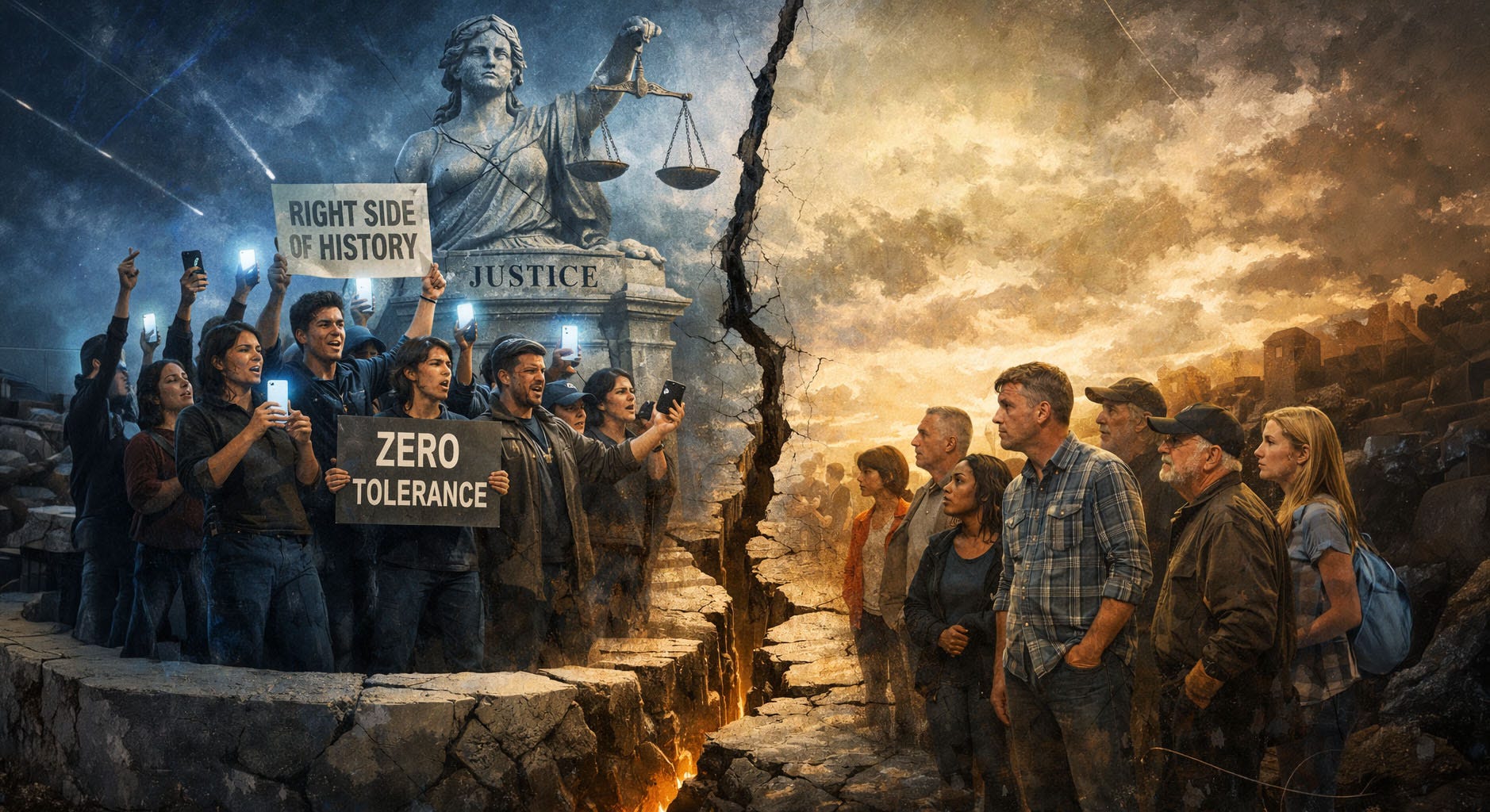
In a previous post, “Is Woke Culture Quietly Killing Democracy?”, we discussed at length how progressivism used to mean something solid. It meant expanding rights. It meant correcting injustice. It meant building a fairer society—without burning it down in the process.
Somewhere along the way, that meaning got hijacked.
Now, for too many people, being progressive means declaring moral superiority, silencing dissent, and calling it justice. It means confusing purity with progress and noise with impact. Worst of all, it means refusing responsibility for the damage done along the way.
Being on the “right side of history” has become a substitute for thinking—a slogan you can hide behind when your methods fail. A moral shield against criticism. After all, if your cause is noble, how could your strategy be wrong?
That assumption is exactly how movements rot from the inside.
A good cause does not excuse reckless tactics. It never has. And it never will.
If your version of progress requires tearing apart the social fabric, humiliating anyone who disagrees, or treating half the population as irredeemable villains, you are not building a better future. You are planting landmines under it.
Societies don’t move forward by fracture. They implode.
Progressivism Without Depth
Today, let’s talk about what happens when progressivism loses depth. When it becomes shallow, reactive, and obsessed with appearances instead of outcomes and how it turns into something that looks a lot like religious zealotry—just without the religion.
Shallow progrevism means obsessing over how things are said instead of what they actually mean. It means turning language into landmines and turning people into villains over the smallest deviation from the script. It means fighting symbolic battles while real-world injustice continues unchecked.
It also means forgetting the bigger picture.
You stop asking what your ultimate goal is. You stop thinking about how your tactics affect the very groups you claim to fight for. Instead, it becomes all about your moral stance, your frustration, your righteousness.
And that’s where it gets dangerous.
When you’re so invested in being “on the right side,” you can’t see the harm your strategy is causing. You might think you’re fighting misogyny, racism, and homophobia—but the way you choose to do it may be fueling them. You might think you’re silencing bigots—but you’re also pushing moderate people into their arms by refusing to listen, engage, or allow honest disagreement.
Then comes the helplessness. You wonder why bigotry keeps rising, why things feel worse despite all your efforts. But instead of asking tough questions, you double down. You reject any self-criticism. You blame others for not “getting it.” You treat disagreement as betrayal. And in doing so, you mirror the same blind certainty and moral arrogance you once fought against.
Shallow progressivism makes you an enemy of those who disagree while you’re supposed to be influencing them and eventually you become a joke. Even people on your side see the shallowness. They see how you obsess over petty word choices while ignoring bigger problems. You start to look less like a reformer and more like a religious zealot—treating minor missteps like heresy, fixating on performative outrage, and calling it moral progress.
Just like some Christians think they’re holy because they avoid swearing or wear crosses while ignoring poverty, abuse, or injustice, being “progressive” without depth means getting caught up in appearances instead of real impact. You obsess over language, symbols, and purity tests—but forget the big picture. You become more focused on looking good than doing good. And worse—you end up useless to society. If not harmful.
When progressivism loses its depth, it also loses the people who once stood with it. You alienate those who think like you because they see you’ve lost your way. You’ve become as unpleasant and intolerant as the very people you claim to oppose. You’re not fighting their ugliness—you’re mimicking it.
Worse still, they stop seeing tangible value in your cause. You become a liability. From ally to embarrassment. From changemaker to gatekeeper. And the more you cling to moral superiority without self-awareness, the faster your support crumbles.
Moral Certainty Isn’t Moral Wisdom
One of the most dangerous ideas in shallow progressivism is the belief that moral correctness grants unlimited authority.
Once you convince yourself that you are unquestionably right, everyone who resists you becomes suspicious. Then immoral. Then dangerous. Then disposable.
That’s how people stop being neighbors and start being enemies.
You see it every day online. Disagreement isn’t treated as something to engage with or refute. It’s treated as contamination. A sign that the person across from you is broken, ignorant, or evil.
And once you’ve labeled someone as evil, anything done to them feels justified. Mockery becomes acceptable. Silencing becomes necessary. Deplatforming becomes righteous.
At that point, shallow progressivism stops being about justice and starts behaving like dogma.
Ironically, this is the exact pattern shallow progressives claim to oppose when criticizing religion or nationalism. Absolute truth. Moral hierarchy. Punishment for heresy. Social exile for unbelievers.
Same structure. Different vocabulary.
The N-Word: From Moral Panic to a Perfect Weapon
Few examples show this failure more clearly than how white progressives handle the N-word.
The original goal was reasonable: reduce harm, acknowledge history, stop casual cruelty.
What happened instead was linguistic absolutism.
The word became unspeakable under any circumstances—even in academic discussion, analysis, or when quoting historical documents. Context stopped mattering. Intent stopped mattering. Explanation stopped mattering.
A single syllable, spoken by someone with poor judgment but no ill intent, can instantly end careers, friendships, and reputations.
And that didn’t weaken racism.
It made the word more powerful than ever.
Racists didn’t lose a weapon—they got it upgraded. A perfect provocation. A verbal grenade. Say it once, watch the room explode, then sit back and enjoy the chaos.
White progressives, while trying to defuse the bomb, neatly polished it, loaded it, and placed it on a pedestal.
The result is absurd: the word now carries more power than it did when it was widely used.
Homo and the Dutch
Now look at how the Dutch handled the word “homo,” which is still a harsh homophobic slur in English. They de-weaponized it. They embraced it.
Ik ben homo – I am gay
Homohuwelijk – Same-sex marriage
Homobar – Gay bar
Bigots lost one of their most powerful words. The sting is gone.
After all, “homo” is a completely innocent word in its origin—it simply means “same” in Greek. In Dutch, it became shorthand for “same-sex” or “same-sexual.” Simple. Clear. No panic. No pedestal.
I’m not saying this work with every words. What I’m saying there is more than one way to deal with slurs but we stopped asking if our strategy is the best way.
Instead we nearly killed the career of Paula Deen, who was brought up in the South at a time when the word was perfectly acceptable socially, and wasn’t necessarily used it as a malice, at a time black people themselves weren’t suddenly offended when they heard the word in context.
When Agatha Christie published “Ten little Nigg*rs” in 1935 she wasn’t being white supremesist. While the already the word was started to be frowned up on America, in the English speaking word, including pockets of America, the word was being used ot necessarily with malice.
You cannot promote tollerence with intollrence.
Blackface: From Shame to Moral Bomb
Now let’s move on to another mistake made in the name of inclusivity: blackface.
Decades ago, blackface was already dying out. Those old theater acts had become an embarrassment to white people—not something Black people needed to take seriously or feel wounded by. It was silly, outdated, and worthless. A leftover from a past most people were ready to leave behind. When it resurfaced, it got laughed at—not treated like a hate crime.
There’s a reason The Golden Girls could air an episode in the late 1980s with dark facial beauty masks without triggering a national meltdown. In “Mixed Blessings,” Dorothy, Blanche, and Rose accidentally greet Dorothy’s son’s Black fiancée and her parents—while still wearing dark mud masks. It’s awkward. Deeply uncomfortable. And exactly the kind of tension good comedy feeds on.
The joke isn’t racism. The joke is the horror of being mistaken for something you absolutely don’t want to be. It’s the same mechanism as those classic farce moments where you do something completely innocent and somehow end up looking like a creep whom parents should be wary of. The comedy lives in the gap between intention and appearance. You know you’re innocent. Everyone else sees something else—something mortifying to you. That split-second panic is the punchline.
Most important of all, Black audiences at the time could tell the difference between mockery, ignorance, and malice. They understood that the episode wasn’t celebrating racism but exposing how absurd and shameful it is. The three women looked like they would rather vanish from the face of the earth than be caught in that situation. That mattered.
Back then, not everyone was trying to claim victimhood or being pushed into it. Not every misunderstanding was treated as an unforgivable offense.
Then a new kind of moral politics stepped in and changed the temperature.
Blackface, which had long been buried as an ugly chapter of history, was revived, turning it into a kind of secular blasphemy. Instead of allowing it to remain a historical nonesence - something white people to be ashamed of, not black people to be offended by, it became a moral tripwire. A career-ending offense. A stain that could be dug up decades later and judged by today’s standards, stripped of context, nuance, or intent.
People began losing jobs over Halloween costumes worn in eras when the cultural conversation was different. Clumsy decisions were treated as evidence of cruelty. Context stopped mattering. Intent stopped mattering. The only thing that mattered was outrage.
And once again, the worst actors benefited.
White supremacists didn’t suddenly realize they were wrong and went home. They gained an easy button to push—a guaranteed way to provoke outrage, polarize debate, and frame themselves as martyrs of “cancel culture.” The cycle fed itself.
What’s worse, overreaction always backfires. When the punishment doesn’t match the offense, the public forgets about the victims you supposedly protect, and the villain in your story starts to look like the real victims.
And the Golden Girls? Today, The Walt Disney Company owns the rights to it, and the “Mixed Blessings” episode has been effectively censored on many platforms. A scene originally designed to mock racism now sits in cultural quarantine. The irony is hard to miss.
Blackface and the Netherlands
You might think I’m obsessed with the Netherlands, but there’s a reason I keep bringing them up. The Dutch are practical. When something’s out of their control, they don’t spiral into moral panic—they de-escalate, pivot, and find a workaround that works. That’s why they decriminalized marijuana. Not because they loved weed, but because they realized prohibition wasn’t working. Instead of wasting money chasing stoners, they taxed it, regulated it, and killed the black market. And just like that, weed lost its rebel cool. Legal, taxed, boring. Problem solved.
Now take blackface.
Unlike in the U.S., the Dutch blackface “scandal” wasn’t really a domestic issue. It became an international outrage when Americans discovered that Dutch children celebrate Sinterklaas (the origin of Santa Claus) on December 5—not Christmas—and that his helper, Zwarte Piet (Black Pete), was traditionally played by white people in blackface. Sometimes by several of them surrounding Santa.
So when Americans saw blackface in what looked like a weird pre-Christmas Christmas celebration, they were horrified. Racism in plain sight. But to the Dutch? It didn’t feel racist at all. It was a children’s tradition, not a political statement.
Zwarte Piet wasn’t presented to kids as an African man. He was just Sinterklaas’s helper, with a face painted jet-black. A magical, kind figure who brought gifts. The blackface wasn’t rooted in minstrelsy or slavery the way it was in the U.S.—even if, historically, it carried some colonial baggage, it lost over time. As practiced, it felt harmless. So the Dutch, who aren’t known for bowing to performative outrage, saw no reason to change a tradition just to satisfy international optics.
But eventually, they did change it. And they did it the smart way—without upsetting Dutch conservatives who get annoyed when change is done just for appearance’s sake, with no real purpose but most importantly without turning it into some forbidden, radioactive topic. They didn’t rewrite their entire tradition as racist.
Instead, they rainbowed it.
Today, Sinterklaas walks with a whole squad of Petes—red Pete, green Pete, blue Pete, yellow Pete, purple Pete, and yes, even black Pete. No more racial panic. No more ideological purity tests. Just colorful helpers in a children’s holiday.
The result? No more global headlines. No more blackface debates. The tradition survived without turning blackface into the holy cross of white supremacy that everyone must learn.
Symbolic Warfare Doesn’t Feed Families
This is the part that shallow progressivism hates confronting.
All this obsession with appearances, language traps, and moral spectacle has not improved the lives of the people it claims to defend.
It hasn’t closed the racial wealth gap.
It hasn’t fixed unequal schools.
It hasn’t reduced incarceration rates.
It hasn’t created safer neighborhoods or better healthcare access.
It hasn’t put more food on tables or more opportunities in front of children.
What it has done is create endless symbolic battles. Language skirmishes. Online purity tests. Public shaming rituals.
It looks like action. It feels like righteousness. But it produces no measurable results.
Real injustice thrives comfortably while everyone argues over phrasing.
The Collapse of Common Sense
Once moral panic takes over, logic is the first casualty.
At one point, shallow progressives seriously tried to ban the word “brainstorming” in offices, claiming it could offend people with epilepsy.
People with epilepsy were not offended.
They understood context. They understood metaphor. They didn’t ask to be treated like fragile objects who needed reality padded for them.
Now the war against imaginary ghosts continues—this time with phrases that include the word “black” in a negative context:
Black sheep.
Black mark.
Blacklist.
As if these metaphors have anything to do with Black people. As if any sensible African would hear the term blackmail and feel offended, but hear Black Friday and feel flattered because it sounds “positive” in that sense.
This kind of thinking doesn’t elevate anyone. It insults everyone.
It treats minorities as intellectually helpless while pretending to defend them.
How about we begin the fight against racism by ditching the condescending idea that ethnic Africans are too simple to grasp context? Food for thought.
Guilt-Driven Progress Breeds Backlash
There is a reason backlash follows these movements like a shadow.
When progress is driven by guilt instead of reason, fear instead of persuasion, it creates pressure without legitimacy. And pressure without legitimacy eventually snaps.
People don’t radicalize because they are allowed to speak. They radicalize because they are told their concerns don’t matter. Because they are mocked instead of answered. Because they are excluded instead of engaged.
You don’t reduce extremism by crushing dissent. You feed it.
Every time someone is silenced instead of debated, someone else notices. Every time a person is publicly humiliated for asking the wrong question, others stop asking questions and start looking elsewhere for answers.
That’s how extremists recruit. They offer belonging where progressives offer scolding.
Focus on Where Language Matters
While we wage pointless symbolic wars, real language problems go untouched.
How about we stop training cops to see skin color first?
Start with police language. Law enforcement still describes people as “Black” and “White” as if those are biological categories carved in stone. That vocabulary comes from a time when the law explicitly treated Black and White people unequally. It was crucial to know the victim's skin color, not just the perpetrator's.
Officers are trained to treat race as a primary identifier—almost on the same level as gender. That isn’t objectivity. It’s inherited framing.
If race-based labeling were purely about identifying suspects, why are victims routinely described the same way? Why does a report say “Black female” or “White male” when the person was robbed, assaulted, or killed? A victim’s skin tone rarely helps solve a crime. Yet race is still presented as essential information, something that must be mentioned.
If we genuinely want color-blind policing, we should stop teaching officers that race is a fundamental human category. It isn’t. It’s socially constructed, fluid across cultures, and far less precise than we pretend. Using it as a sorting tool reinforces the very divisions we claim to oppose.
And it doesn’t stay inside police reports. True crime shows repeat it. News headlines repeat it. The framing seeps into public consciousness. You’re not simply told a man was shot. You’re told a Black male was shot. Not that a child was kidnapped—but that a Black child was kidnapped. The entire language framework comes from segregated America.
Need evidence? Watch a British true crime show. You won’t be bombarded with the skin color of everyone involved unless it’s directly relevant to identifying a suspect.
So, What’s Going On?
If progress is worth fighting for, it’s worth doing carefully.
Not loudly.
Not aggressively.
Not through fear and humiliation.
But thoughtfully. Patiently. With humility.
That means accepting disagreement. Explaining instead of shaming. Persuading instead of threatening. Building coalitions instead of burning bridges.
It means remembering that the goal is not moral purity. The goal is a better society.
And a better society does not emerge from moral panic, linguistic traps, or symbolic theater. It emerges from trust, fairness, and results.
If you forget that the people you’re trying to “fix” are human beings, you don’t get progress.
You collapse.
And history doesn’t reward people for being loud about being right. It remembers whether they actually made things better.
That’s all for now.
In the third installment on modern woke culture—or what I call shallow progressivism—we’ll tackle enforcement of the idea that being white is a privilege and comes with responsibilities. You cannot treat non-whites the same way you treat other white people.
We’ll examine how the fight against racism increasingly begins by segregating white people as a special category in society and instructing them how to behave toward others—rather than striving for genuine color-blindness.
Stay tuned.
Most Definitely your best article , SPOT on, both sides do not realize they are same , NO COMMON SENSE