

I’m a lifelong progressive. It upsets me to see people unfairly criticizing younger generations—blind to the fact that for every generation, yesterday feels known, safe, and beautiful, while tomorrow feels unknown, scary, and wrong. They forget how they themselves were judged in their youth by older generations, only to turn around and repeat the cycle once they get older.
I’m categorically against misogyny, homophobia, antisemitism, and racism—without exceptions, without caveats, without “but what about,” and without giving any validity to so-called “pattern” arguments. That position is not up for negotiation.
If I sense any trace of it in you, I’ll stay in the conversation—eager to understand how you got there, wondering if I can help you help yourself. And I’ll feel a strange kind of melancholy, asking what life gave me that it didn’t give you. Were you starved of experience? Emotionally stunted? Intellectually boxed in? I’ll be trying to figure out what went wrong—and whether it could’ve been different. But I won’t give up on our connection because of that, even if you unknowingly speak ill of a group I belong to. Connected, we grow. Divided, we collapse. This goes beyond who’s right or wrong.
And precisely because of that, I’m deeply frustrated by what passes for “woke” behavior today—not because I disagree with what it claims to want to achieve on paper, which often overlaps with my own values, but because of how it believes those goals should be implemented.
Let me explain.
The IT World: When Tools Become Moral Enforcers
Let’s start with tech, where today’s woke culture was born. If you want to stay mainstream as an IT company now, you have to follow a particular set of values—call them “woke,” “socially conscious,” or “progressive”—or risk controversy, backlash, and reputational damage.
And lately, these companies aren’t just enforcing those values on themselves. They’re outsourcing them to the tools they build.
I’m talking about software tools that were originally designed for one purpose:
To fix grammar.
To catch spelling errors.
To clean up structure.
To help people communicate more clearly.
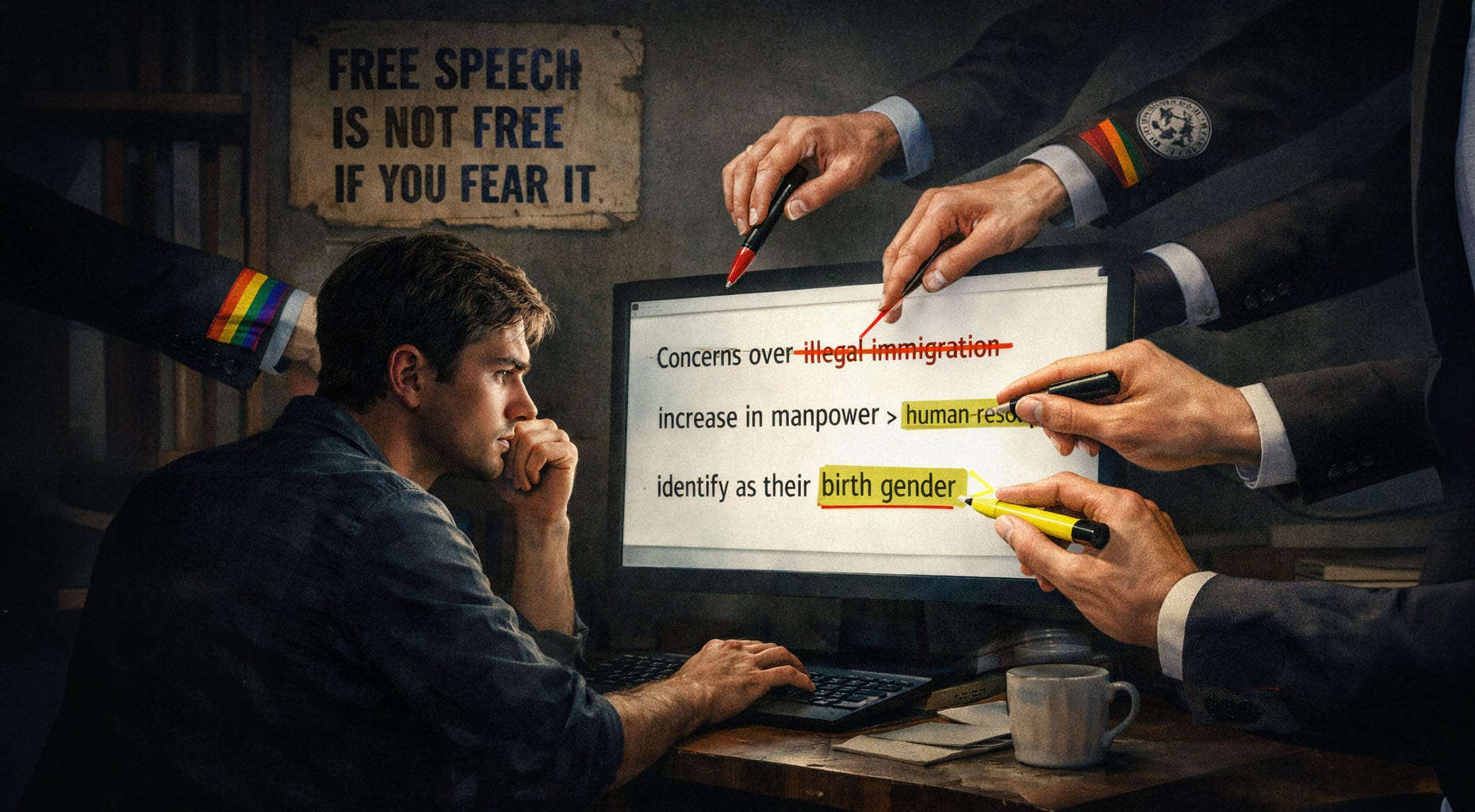
But now, they do something else. They nudge. They reframe. They “correct” your word choices—not just for clarity, but for moral compliance. They quietly enforce an invisible rulebook: one you didn’t vote on, never agreed to, and aren’t allowed to question.
Tech companies no longer worry just about how they present things. They’ve taken it upon themselves to worry about how you speak. They’ve decided they have a moral obligation that overrides your autonomy. So they move beyond grammar and clarity—and start reshaping your ideas.
If they find your text beyond their help, they simply refuse to work on it altogether, saying you’re violating their terms—feeling “socially responsible.”
That’s not inclusivity. That’s soft authoritarianism. That’s how regimes are built: by claiming a monopoly on virtue and policing thought through language. And the people doing this believe, just as firmly as any fanatic, that they are morally right—and that your words must reflect their version of morality.
And I’m not saying this as a conservative, a reactionary, or a culture war troll. I’m not a Trump supporter. I’m not a Republican. I don’t defend racism or bigotry. I don’t excuse homophobia in the name of religion. And I certainly don’t believe in conspiracy theories about Jewish elites running the world.
But here’s what I am saying: I don’t see any meaningful difference between this and, say, companies in Iran refusing to let you use their tools because you criticize the government—or expose its lies about Islam.
In that system, “Islam” becomes whatever the regime says it is. The government is Islam. Anything else is automatically immoral. The tools are said to be “for the well-being of society”—but only as they define it. And anyone who disagrees? Labeled evil. Not mistaken. Not misinformed. Just inherently bad for Iranian society. Unworthy of dialogue. A threat that must be silenced or reprogrammed “in the right direction.” Systems are built not to consider these people—but to erase them.
Sound familiar?
Because when you decide that what you have is the absolute morality—and anyone who questions it is immoral—you’re not building a democracy. You’re building a theocracy without a god. One that only works as long as it thinks like you. A system where only those who already agree with you are allowed to speak, build, or decide. And when the interests of the gatekeepers change, that system will turn on you—meaning everything you did to build it will be used to suppress you.
Take Iran’s neighbor Turkey as a real-life example. The entire system was originally built by secularists to suppress Islamists. Why? Because they believed they were protecting the country from the threat of theocracy—and that conviction gave them moral license to do anything. After all, what could be wrong with defending the republic from religious extremism?
So they banned parties, jailed politicians, rewrote laws, and weaponized the courts. They built a system that worked exactly as intended.
Then one day, the Islamists won an election.
And when they took power, they didn’t have to build a new system. They just flipped the switch. The same institutions, laws, and tools that had once silenced them now worked perfectly to silence the secularists.
That’s what happens when you build a machine that only serves your version of the truth. Eventually, someone else will use it against you.
The Illusion of Moral Finality
One of the most dangerous beliefs a movement can adopt is the idea that it has reached the final moral destination.
That its values are settled.
That its conclusions are obvious.
That disagreement is no longer disagreement, but pathology.
A lot of people who identify as “woke” today genuinely believe they are holding the last and perfect moral map. They see themselves not as participants in an ongoing democratic conversation, but as guardians of truth correcting the rest of society.
That belief feels good.
It feels righteous.
It feels safe.
And it blinds people to a basic historical fact: every group that thought it had absolute moral clarity eventually became oppressive.
Not because their values were evil.
But because they stopped needing consent.
This Is How Censorship Actually Starts
People imagine censorship as boots and batons.
It doesn’t have to.
Censorship can well start as help, guidance, best practices, just being careful.
No one phrases it as outright : “You are not allowed to say this.”
They say:
“Wouldn’t it be better if you said it this way?”
And if you object, you’re told:
“This is for everyone’s good.”
That’s how speech narrows without anyone signing a law.
Progress Isn’t Enforcement—It’s Persuasion
Real progress has always worked the same way.
You convince people.
You argue.
You expose harm.
You make injustice visible.
You change minds slowly and painfully.
You do not win by forcing language compliance.
Civil rights didn’t succeed because people were silenced.
Women’s rights didn’t succeed because speech was policed.
LGBTQ rights didn’t succeed because dissent vanished.
They succeeded because people were shown why change was necessary.
Once you stop believing persuasion matters, democracy is already on life support.
Selective Moral Enforcement
To understand someone’s moral standards, don’t watch how one treats people they agree with—watch how they talk about those they disagree with or even despise. That’s when selective morality kicks in for most.
The self-proclaimed “woke” crowd would never dare post something openly racist or antisemitic. But when it comes to misogyny—still one of the most socially accepted forms of bigotry—they seem completely blind. I’m floored by the misogynistic trash I see about women politicians they don’t like. It’s like their hatred overrides every value they claim to stand for. They hate these women more than they care about sexism. And they don’t seem to realize: if you think being on the “right side” justifies this stuff, then you’ve lost the moral high ground. You lost, the other side won.
The second you let emotions replace principles, your values get blurry. That’s how groups at war start to sound exactly the same. They’re so caught up in fighting the “other side” that they can’t hear how they’ve become indistinguishable. And the whole time, they still believe they’re the opposite of the people they hate.
Take Marjorie Taylor Greene. I don’t respect her enough to even hate her. The woman has a PhD in idiocy and hate speech. In many European countries, she’d be charged with hate crimes by now. But even for her—I won’t tolerate sexist attacks. If you’re mocking her because she’s a woman, not because she’s wrong, you’ve lost the plot.
You don’t get to act morally superior if you stoop to the same low blows. Misogyny isn’t suddenly okay because it’s aimed at someone you hate. It’s either wrong, or it’s just another tool in your belt—and if it’s a tool, don’t act shocked when someone uses it against your side next time.
The Table Always Turns
Power moves.
The rules you enforce today will be enforced by someone else tomorrow.
The same language controls you cheer for now *can—and will—*be used against you when the cultural wind shifts.
History guarantees this.
If you’re okay with systems that quietly reshape speech to match sacred moral standards, you’d better be ready for the day those standards aren’t yours anymore.
Because they won’t be.
Close your eyes and imagine this: the very tools you’re building or relying on suddenly start twisting your words to sound more homophobic, more antisemitic, more racist. Your inclusive message gets flagged and hidden—not because no one wants to read it, but because the algorithm’s definition of “value” changed overnight.
And this isn’t a far-fetched what-if.
Netflix is already quietly cancelling shows with LGBTQ+ relationships, spooked by the threat of another “Cancel Netflix” campaign. The shift doesn’t need to be loud. Fear is enough. Just a silent tilt in the system, and the values flip.
People are making the same mistake Trump supporters made over and over again—so focused on what is being done that they forget to ask how it’s being done. And that might be the more dangerous part.
Even if they thought Trump was doing what America “desperately needed,” they should have paid closer attention when he used emergency powers to bypass democratic norms. Because that opened the “threat” for the next “evil” liberal president—to do the exact same thing for their own cause, as easily suspending democratic traditions.
That’s how authoritarianism grows: through short-sighted people who never bother to ask how power is being structured.
Adolf Hitler didn’t build the Third Reich through a majority vote. He invoked emergency powers, bypassed democracy, and slowly dismantled it altogether. If Trump’s base ever bothered to ask “how” instead of just “what,” they’d be losing sleep over this. Especially now that MAGA supporters call Nazis “socialists” and think that label explains everything.
Democracy Isn’t the Dictatorship of the Majority
Democracy is not clean. It is not safe. It is anything but emotionally soothing.
It requires hearing things you hate. It requires arguments that make you angry.
It requires speech you find offensive. The moment you decide discomfort is unacceptable, democracy becomes optional.
And optional democracy doesn’t last long.
That’s why communication matters.
If 60% of people support a big change but 40% strongly oppose it, pushing that change through without care or strategy can help create the next Trump—even if your cause is morally right.
Look at history.
Today, we praise the North for abolishing slavery—it was the moral choice. I mean, what could be more fundamental? The fact that one human shouldn’t have the right to own another is something we could all agree on unless we’re some sort of a fanatic who’s given up on
But what’s often overlooked is how catastrophically that change was implemented. The politicians leading the effort completely failed to anticipate or manage the backlash. Their incompetence contributed directly to a civil war that killed over 600,000 people. They had the right cause—but the wrong strategy. And they got away with it, in part, because they could pin all the blame on the South’s moral failure, creating the impression that the outcome was beyond their control.
And the damage didn’t end there. Racism didn’t disappear. In many parts of the South, it went underground, then reemerged louder than ever. Resentment toward the federal government is still alive and well—you see it in voter suppression, coded language, and cultural divides that remain unhealed.
Democracy isn’t just doing what the majority wants. It’s not just doing the “honorable” thing either.
It’s also about strategy.
It’s about education, conversation, and patience. It’s about helping people understand why a change matters—not just ramming it through because you have the votes.
In fact, in a democracy, sometimes passing a progressive policy that 40% of people strongly want while 60% somewhat don’t is safer and more successful than pushing through something that 60% strongly want while 40% violently reject.
Because resentment grows in the dark. And when people feel ignored or steamrolled, they don’t just disagree—they radicalize.
That’s how you get a Putin in Russia. An Erdoğan in Turkey. A Orbán in Hungary. A Wilders in the Netherlands. A Le Pen in France.
Authoritarians are born in the vacuum left behind by failed democrats. Not because the people want tyranny—but because they’re tired of being unheard. Because when people feel powerless, they don’t dream of freedom. They dream of control.
And if democracy keeps pretending that having 51% support is enough, it’s going to keep giving birth to these monsters.
That’s all for today. In the next installment, I’ll explore how progressivism, stripped of a big‑picture vision, doesn’t liberate people. On the contrary, it radicalizes them, creating zealotry without a god.
Stay tuned.
I am against censorship. And I am against misogyny, homophobia, racism etc.
But there is a difference between censorship of things people have the right to say (even if a lot would disagree) and hate speech. There is also a difference between polite criticism and statements which are right but formulated in an insulting way.
I do not see anything wrong in tools which would suggest changes to text you want to publish to keep the meaning but make it more polite. Provided that this is just a suggestion, not something forced on you, so that you can publish your text will all insulting parts - and then be accountable for how you formulated it.
Also, some people do not realize that some statements may be offensive, but would avoid them if it was pointed out. Such things happen to me, it's embarrassing and I would not mind a tool which would bring my attention to how my text might be understood.
As for hate speech - this is a bit less easy to solve. Whether it is automated moderation, or a moderation by humans when the published text is reported as hate speech, or something in between - you will always have the problem that a group of people may cause removal of text which is perfectly right but against their vorldview. This happens frequently on Facebook with right wing and fashist group reporting absolutely justified posts without hate speech as hate speech, and the posts are removed.
But this is not a reason to not have mechanisms against hate speech - which may be just disgusting and unpleasant, but may be life damaging and bringing people to commit suicides.
I recently retired from over 40 years in IT, much of that in management. I have seen all this unfold over time. When I saw that this article specifically addresses IT, I felt I should offer my perspective. And I believe that this article's description is out of date by over a year (several years with respect to Xtwitter), at least in the US market which is what I am familiar with. The 180 U-turn has been breathtaking. I talk with former colleagues regularly, and I often hear about long standing practices being abandoned. People in these companies are afraid to raise any concerns about their company's behavior that they would have been open about before. Left leaning speech is more strictly criticized both internally and externally. The level of fear in the industry at present is appalling. All this is in pursuit of approval by an administration. At the end of the day, all that matters to these CEOs is the ability by billionaires to amass even more money. Which leads to the question as to how much the Tech leaders ever really cared about what is described in the article.