


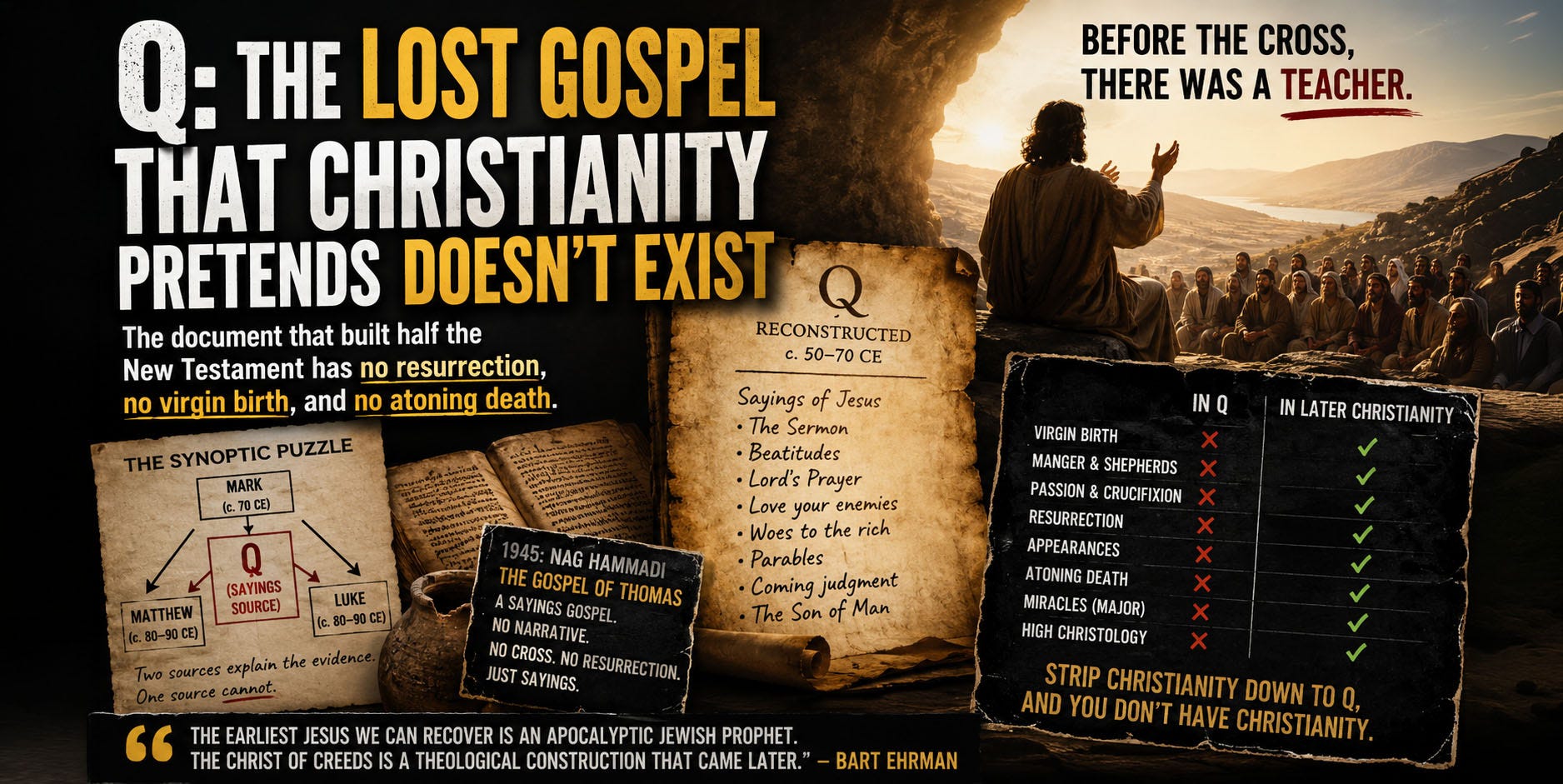
Pick up any standard introduction to the New Testament published in the last hundred years and you’ll find a quiet admission tucked somewhere in the early chapters. Written in rough Greek with countless errors, Matthew and Luke didn’t just iron out Mark - they also copied, almost word for word in many places, from a source nobody has ever found. Scholars call it Q, from the German Quelle, meaning source. It’s the document that built two of the four canonical gospels, and almost no Christian in a pew has ever heard of it.
Q is awkward because reconstructing what it contained means watching Christianity’s central claims drop away one by one, leaving no virgin birth, no empty tomb, no atoning death, no resurrection appearances, no miracles of the kind that became theological cornerstones - just a Galilean teacher saying sharp things about money, hypocrisy, and the coming judgment.
The implications are bad enough that the response from the church has mostly been to act like the conversation isn’t happening.
The Puzzle Matthew and Luke Gave Away by Accident
Those who read the gospels objectively in Greek, or even in a decent parallel English translation, run into the same problem within about an hour. Matthew, Mark, and Luke share enormous amounts of text. The wording often matches down to particles and word order - the kind of agreement that doesn’t happen when two authors independently write up the same events.
The simplest explanation, worked out across the 19th century and locked down by scholars like B.H. Streeter at Oxford in the 1920s, is that Mark was written first. Matthew and Luke each had a copy of Mark on the desk and copied from it freely, editing as they went. That accounts for the text all three share.
Matthew and Luke also share a second large body of text that isn’t in Mark. Hundreds of verses, mostly sayings rather than narrative. The Beatitudes, the Lord’s Prayer, love your enemies, the lilies of the field, the woes against the Pharisees. Stretches of these run parallel in Matthew and Luke with the kind of verbatim agreement that demands a written source. They didn’t get there by coincidence, and they didn’t get there from Mark, because Mark doesn’t have them.
The cleanest explanation - the one that’s held up under more than a century of attack and remains the dominant scholarly position - is that both Matthew and Luke had access to a second written document. A collection of Jesus’s sayings, probably in Greek, circulating among early Christian communities before either gospel was written. Mark didn’t use it or didn’t know it. Matthew and Luke both did. Then it disappeared, replaced by the gospels that swallowed it.
Unless an institution like the Vatican has it but prefers to keep quiet about it, there’s no surviving manuscript, and nobody in antiquity quotes “Q” by that name. Its existence is a deduction rather than a discovery. The deduction is so well-grounded that any alternative theory has to perform serious gymnastics to explain the textual evidence. The main competitor, the Farrer hypothesis, argues Luke just copied Matthew directly without any lost source. The problem is that Luke’s order of the material is often demonstrably more primitive than Matthew’s, and Luke makes editorial choices that don’t make sense if he had Matthew in front of him. The two-source theory - Mark plus Q - fits the data. Most working New Testament scholars accept it, including conservatives who don’t want to.
What’s in It, and What Isn’t
Reconstructing Q is possible because of how mechanical Matthew and Luke’s copying was. When you line up the parallel passages and isolate what they share that isn’t from Mark, you get a coherent document. The International Q Project, a collaborative scholarly effort that ran for years, produced a critical reconstruction running about 4,500 words. James M. Robinson, John Kloppenborg, and Paul Hoffmann published the Critical Edition of Q in 2000, and it’s been the working text for the field ever since.
Read it straight through and the experience is jarring if you’re coming from the canonical gospels. Q opens with John the Baptist preaching judgment. Jesus is baptized, then tempted in the wilderness. He delivers a long inaugural sermon - the source of what Matthew expanded into the Sermon on the Mount and Luke compressed into the Sermon on the Plain. He pronounces blessings on the poor and woes on the rich. He teaches about prayer, anxiety, and hypocrisy. He sends out disciples to spread the message of the coming kingdom, clashes with opponents who accuse him of working by demonic power, and warns Galilean towns that they’ll be judged worse than Sodom for ignoring him. He predicts a final reckoning where the Son of Man returns suddenly, like lightning, like a thief in the night.
That’s most of it. What’s missing is the structure of historic Christianity.
No birth narrative. No Bethlehem, no manger, no shepherds, no wise men, no flight to Egypt, no star, no virgin. Jesus shows up as an adult and starts preaching.
No passion narrative. Q doesn’t describe the crucifixion, and Jesus’s death isn’t mentioned as an event, let alone interpreted as a sacrifice for sin.
No resurrection. No empty tomb, no appearances to the disciples, no commission to spread the gospel after rising from the dead. The document ends, as best anyone can reconstruct, with sayings about judgment and the disciples sitting on thrones judging the twelve tribes of Israel.
No atonement theology. Nothing about Jesus dying for sins, nothing about his blood, no sacrificial language, no substitutionary suffering. Salvation in Q means alignment with the kingdom Jesus is announcing, demonstrated by how you live - with no transaction completed on a cross.
Almost no miracles. Q mentions the healing of the centurion’s servant and the casting out of a demon that leads to the Beelzebul controversy, and that’s about it. The miracle-heavy Jesus of Mark - multiplying loaves, walking on water, calming storms, raising the dead - doesn’t appear in Q.
No high Christology. Jesus in Q is the Son of Man, a phrase loaded with apocalyptic meaning but distant from Pauline incarnational theology. He’s a wisdom teacher and a prophet of the coming judgment. He isn’t pre-existent. He doesn’t claim divinity. The Jesus who says “before Abraham was, I am” in the Gospel of John has no parallel in Q.
Strip Christianity down to Q and you don’t have Christianity. You have a Jewish reform movement led by an apocalyptic teacher with sharp things to say about wealth, religious authority, and the imminence of God’s judgment.
The Teacher Hiding Under the Theology
If Q is anywhere close to what Jesus’s earliest followers preserved of his teaching, the implications for the historical Jesus are direct. He sounds like a Jewish wisdom teacher in the prophetic tradition, working inside Second Temple Judaism rather than against it. His ethic is demanding and confrontational, aimed at the wealthy, the religious establishment, and people who think their social status will spare them from the coming judgment. He expects God to intervene soon. He thinks the people listening to him have a narrow window to get right.
Bart Ehrman has been making this case in book after book for thirty years, and he’s hardly alone. E.P. Sanders, Dale Allison, Paula Fredriksen, and John P. Meier - working from different angles - converge on a roughly similar picture. Jesus the apocalyptic Jewish prophet. The Christianity that emerged later, with its incarnate God-man dying for the sins of the world and rising on the third day, is the theological elaboration that grew up around him, mostly through Paul and the gospel writers who came after.
Q doesn’t prove this on its own, but Q is one of the strongest pieces of evidence for it, because Q predates the gospels that swallowed it. It comes earlier, closer in time to the historical Jesus, and doesn’t yet have the theology that later defined the religion.
John Kloppenborg, probably the most influential Q scholar of the last forty years, has argued that Q itself was composed in stages. An earliest stratum of wisdom sayings, then a middle stage adding apocalyptic warnings and conflict passages, and finally a stage with the temptation narrative and a sharper polemical edge. Even the latest portion of Q doesn’t include a resurrection or an atoning death. The earliest Christians who used this document, whoever they were, didn’t think those were the main point.
Why Mark Might Not Have Wanted It
Here the awkwardness deepens. Mark, the first canonical gospel and the source Matthew and Luke depend on for narrative, either didn’t know Q or chose not to use it. The two main collections of Jesus writings in early Christianity - the sayings tradition preserved in Q and the narrative tradition preserved in Mark - look like they came out of different communities with different priorities.
Mark is obsessed with Jesus’s death. The crucifixion is the climax the whole gospel builds toward. The earliest manuscripts of Mark end at chapter 16 verse 8, with the women fleeing the empty tomb in terror and saying nothing to anyone. There are no resurrection appearances in the original ending. The longer endings of Mark were added later by scribes who couldn’t stand the abruptness.
Q has no crucifixion at all. The community that preserved Q wasn’t telling a story about a dying and rising savior - they were preserving the words of a teacher whose teachings they believed had ongoing authority.
These are two different theological centers of gravity. Mark’s version won. The Q community’s sayings got folded into Matthew and Luke, who married the sayings to the passion narrative and produced the hybrid that became orthodox Christianity. The freestanding Q document then dropped out of circulation, made redundant by the gospels that had cannibalized it.
The textual evidence pushes anyone who reads it without theological pre-commitment toward the same conclusion. The earliest Christians were arguing factions with different sources, different theologies, and different memories of what Jesus had been about. The Q community and the Markan community look like two of them, and they didn’t agree on what mattered most.
The Discovery That Made Q Harder to Dismiss
For more than a century, Q skeptics had one solid line of defense. Sayings gospels, they argued, didn’t exist as an ancient genre. A document that consisted only of a teacher’s sayings - with no biographical framing, no death, no resurrection - was a modern scholarly invention. Ancient Christians wrote narratives.
Then in 1945, near Nag Hammadi in Egypt, a farmer named Muhammad Ali al-Samman dug up a sealed jar containing thirteen leather-bound codices. Among them was the Gospel of Thomas - a sayings gospel. 114 sayings of Jesus, in Coptic translation from a Greek original, with no narrative framing, no passion, no resurrection, no biographical structure. Just sayings.
The Gospel of Thomas isn’t Q. Thomas is a different document with different content, probably composed somewhat later, with some Gnostic features. But its existence demolished the argument that nobody in early Christianity wrote sayings gospels. Somebody clearly did, and more than one community wrote them. The discovery of Thomas made Q’s reconstructed form vastly more plausible.
Helmut Koester at Harvard, working in the decades after Nag Hammadi, argued that Thomas preserved an independent sayings tradition that overlapped with Q in revealing ways. Some sayings appear in both with slightly different wording, suggesting they drew on a common early source rather than copying from each other. The sayings tradition was widely distributed in the early decades of Christianity, and we now have one surviving example of it in Thomas plus the reconstructed remains of another in Q.
The implication is that the earliest Christianity was a teaching movement before it became a salvation cult. People preserved what Jesus had said because they thought what he had said was the point. The transformation of that movement into a religion centered on his death and resurrection happened later, driven by Paul and the gospel writers who followed him.
What the Average Christian Gets Told
None of this is hidden. The two-source theory is in every standard textbook. Bart Ehrman explains Q in books that have sold millions of copies. The Critical Edition of Q is on seminary shelves, and most graduates of accredited divinity programs have spent a semester or more on the synoptic problem.
The path from seminary to pulpit has filters. Pastors who learned about Q in school mostly don’t preach about it. The reasons are institutional. A pastor whose congregation expects the historical Jesus to match the creedal Jesus has limited incentive to introduce them to a document that suggests the earliest Christians didn’t yet believe most of what the creeds affirm. Easier to preach the gospel that’s in the pew Bible. Easier to talk about the Sermon on the Mount without mentioning that the version in Matthew and the version in Luke both come from a lost document with no resurrection in it.
The result is two parallel conversations about Christianity. The academic one, where Q is normal background knowledge and the staged development of early Christian theology is taken for granted. And the popular one, where Jesus said what the red letters say he said, the four gospels are independent eyewitness accounts, and the question of how the texts got there doesn’t come up.
The gap matters because the popular version drives political and cultural commitments. American Christianity argues about biblical authority, scriptural inerrancy, and what the Bible “really teaches” - without most participants knowing that two of the four gospels are partly built from a source the church has never bothered to tell them about. The conversation happens at a level of historical awareness that the academy left behind in 1850.
If you’re not already a paid subscriber and you’re finding value here, I’d love for you to consider becoming one to keep The Unholy Truth alive.
The Jesus Q Gives Back
What does it actually mean to take Q seriously?
It means that the earliest writings about Jesus we can reconstruct show a teacher whose central message was the imminent judgment of God and the inversion of social hierarchies. Blessed are the poor, woe to the rich. Love your enemies. Don’t worry about tomorrow. Don’t store up treasure. Be ready, because the Son of Man is coming at an hour you don’t expect.
It means his death wasn’t yet, in those earliest writings, the saving event around which everything else organized. His teaching carried the weight. Following him meant taking his sayings seriously enough to reorient your life around them.
It means the resurrection - the cornerstone of Pauline theology and Nicene Christianity - was a later development. The resurrection appearances show up in Paul’s letters within twenty-five years of Jesus’s death, so the belief itself isn’t a late invention. The point is that resurrection wasn’t, apparently, the center of gravity for the community that preserved Q.
It means Christianity as practiced for the last two thousand years is the product of a particular theological reworking - mostly Pauline - that took the apocalyptic Jewish teacher visible in Q and rebuilt him into the incarnate divine Son who died for the sins of the world. Q is the evidence that there was a different Jesus before that rebuild, and that earlier Jesus is a lot harder to recruit into the doctrines that came later.
Christianity has never quite known what to do with that. The honest move would be to engage it directly, the way critical scholars have for two centuries. The actual move has been to keep Q in the seminary and out of the sermon - to let the laity inherit the polished theological product without ever showing them the workshop.
Matthew and Luke left the source half-visible inside their own gospels, traceable by anyone willing to compare the synoptic parallels carefully. The pulpit has spent two thousand years declining to make that comparison while the academy has spent two centuries making it.
Sources and Further Reading
Primary Scholarly Text
Robinson, James M., Paul Hoffmann, and John S. Kloppenborg, eds. The Critical Edition of Q. Hermeneia Supplement. Minneapolis: Fortress Press, 2000. The standard scholarly reconstruction of Q used by researchers worldwide.
On the Synoptic Problem and Two-Source Theory
Streeter, B.H. The Four Gospels: A Study of Origins. London: Macmillan, 1924. The foundational work establishing Markan priority and the two-source hypothesis.
Kloppenborg, John S. The Formation of Q: Trajectories in Ancient Wisdom Collections. Philadelphia: Fortress Press, 1987. The leading argument for Q’s compositional layers.
Kloppenborg, John S. Excavating Q: The History and Setting of the Sayings Gospel. Minneapolis: Fortress Press, 2000. Comprehensive defense of Q’s existence and reconstruction.
On the Historical Jesus
Ehrman, Bart D. Jesus: Apocalyptic Prophet of the New Millennium. Oxford: Oxford University Press, 1999.
Sanders, E.P. Jesus and Judaism. Philadelphia: Fortress Press, 1985.
Meier, John P. A Marginal Jew: Rethinking the Historical Jesus. 5 vols. New York: Doubleday/Yale University Press, 1991–2016.
Allison, Dale C. Jesus of Nazareth: Millenarian Prophet. Minneapolis: Fortress Press, 1998.
Fredriksen, Paula. Jesus of Nazareth, King of the Jews. New York: Knopf, 1999.
On the Gospel of Thomas and the Sayings Tradition
Koester, Helmut. Ancient Christian Gospels: Their History and Development. Philadelphia: Trinity Press International, 1990. Argues for Thomas’s independence and its overlap with Q.
Robinson, James M., and Helmut Koester. Trajectories through Early Christianity. Philadelphia: Fortress Press, 1971. The foundational work on early Christian diversity.
The Farrer Hypothesis (The Main Alternative to Q)
Farrer, Austin. “On Dispensing with Q.” In Studies in the Gospels, edited by D.E. Nineham. Oxford: Blackwell, 1955. The original argument that Luke copied Matthew directly.
Goodacre, Mark. The Case Against Q. Harrisburg: Trinity Press International, 2002. The strongest modern case for the Farrer hypothesis.
Accessible Introductions
Ehrman, Bart D. Misquoting Jesus. New York: HarperOne, 2005.
Ehrman, Bart D. How Jesus Became God. New York: HarperOne, 2014.
Tuckett, Christopher M. Q and the History of Early Christianity. Edinburgh: T&T Clark, 1996.
The reason Jesus warned about Sodom is given in Ezekiel 16:49-50. Unfortunately for Evangelicals and other conservative Christians, sexual behavior had nothing to do with it.
What fascinates me is that none of this is really “secret.” It’s sitting in seminaries and scholarly introductions in plain sight. The scandal isn’t that Christianity has complicated textual history. It’s that so many churches seem terrified their people might discover faith can survive knowing how the sausage was made.