


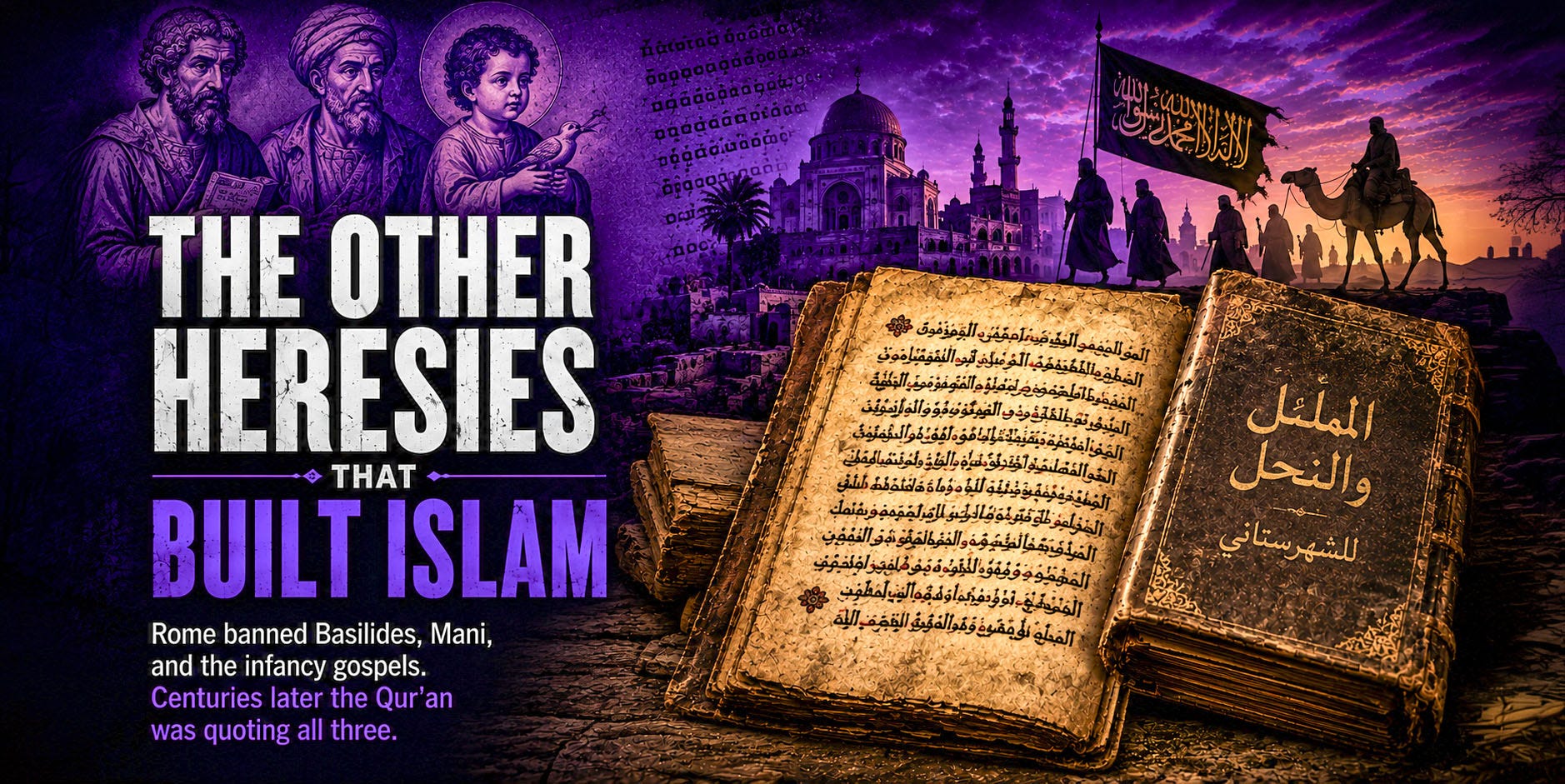
The church spent its formative centuries destroying the idea of a Torah-keeping, non-divine Jesus, and that idea then became the foundation of Islam. The Christianity Islam actually encountered was made up almost entirely of communities Constantinople had condemned: the Church of the East across Mesopotamia and Persia, Miaphysites in Syria, Egypt, Najran, and Ethiopia, who held that Christ has one united nature rather than two, all of them people who’d lost at the councils of Ephesus in 431 and Chalcedon in 451, where the church settled how Christ could be both divine and human, and been prosecuted for it ever since. Within Christianity itself, the Ebionites held exactly the position the Qur’an would later hold, keeping the Jewish law, treating Jesus as a human messiah chosen by God rather than born divine, and rejecting Paul as the man who wrecked the movement. Their theology was continuous with James’s Jerusalem community, which means the believers closest to Jesus’s own family ended up on the heresy lists while gentiles who’d never kept the law built the winning tradition.
The gap in the argument is that nobody can find a seventh-century Ebionite congregation in Arabia. A tenth-century Muslim polemic looked for a while like it preserved genuine Jewish Christian source material and might close that gap, and the reading came apart within two years of being proposed. What survives is a body of Jewish Christian writing that teaches a True Prophet recurring through history in Adam, Moses, and Jesus, and holds that the scriptures contain false passages inserted by people who tampered with the text. That does the same work as the Qur’anic chain of messengers and the charge that earlier communities corrupted the revelation they were given. The ideas were in circulation in the environment the Qur’an addresses, and ideas travel without leaving membership rolls. Direct descent is more than the evidence supports; what it does support is that the positions orthodoxy had to eliminate were still available to be thought in the seventh century, and one of them went on to become the second-largest religion on earth.
The Ebionites were one case out of many Christian heresies that built Islam. Jewish Christianity gave the Qur’an a human Jesus and a chain of prophets, and that’s the tidiest line of descent because the theology matches so cleanly. It’s also the least interesting one, because a group that never accepted the incarnation obviously produces a Jesus who isn’t divine. The harder question is what happens to the material Rome worked hardest to destroy, the books it burned and the teachers it excommunicated by name, and the answer is that a good deal of it kept circulating east of the empire’s reach and turns up in Arabic three or four centuries later.
The Man on the Cross Was Somebody Else
Basilides taught in Alexandria in the 120s and 130s, and he denied that Jesus died on the cross at all. The account that survives, written by a bishop refuting him around 180, has Simon of Cyrene, the man the gospels have carrying the crossbeam, transfigured into Jesus’s likeness and executed in his place, while Jesus stood off to the side in Simon’s form watching the Romans kill the wrong man.
That’s a hostile witness, and a second Alexandrian source gives a different account of what Basilides taught, so the details are contested. What isn’t contested is that the position existed and that the church treated it as a serious threat, because the major heresy-hunters of the second and third centuries wrote at length against the idea that Christ only appeared to have a body and only seemed to suffer. The Nag Hammadi library, dug up in Egypt in 1945, produced two texts that hold the same view, both describing a Jesus who watches his own crucifixion from above, and in one of them he’s laughing.
Verse 4:157 says the Jews neither killed nor crucified Jesus, “but it was made to appear so to them.” The Arabic phrase, shubbiha lahum, is two words, and Muslim commentators have argued about it for twelve hundred years without settling on a reading. The substitutionist interpretation, in which somebody else died in Jesus’s place, became the majority position among the classical commentators, and various commentators nominate Judas, a volunteer disciple, or a Roman soldier. A competing reading has the verse denying Jewish agency rather than denying the crucifixion.
Set that aside and the situation is still remarkable. A position that Christianity spent its first three centuries stamping out, one that had a name, a founder, and a paper trail of refutations, shows up as scripture in seventh-century Arabia.
A Five-Year-Old Jesus Makes Birds Out of Clay
Verse 3:49 has Jesus tell the Israelites that he shapes a bird out of clay, breathes into it, and it becomes a living bird by God’s permission. Verse 5:110 repeats it, with God reminding Jesus that he did this.
The story comes from the Infancy Gospel of Thomas, a second-century text where the child Jesus molds twelve sparrows from clay on the Sabbath, gets scolded for working, and claps his hands so the birds fly off and destroy the evidence. Matthew, Mark, Luke, and John have nothing like it. No council accepted the book, and it circulated anyway, in Greek, Syriac, Latin, Armenian, Georgian, and Ethiopic, which tells you how popular a childhood Jesus who works miracles and occasionally kills the neighbors’ kids turned out to be.
It isn’t the only one, either. Verse 19:29-33 has the infant Jesus speak from the cradle to defend his mother, a scene with no parallel in the four gospels and a long history in Syriac Christian material. Verse 3:37 has Mary raised in the temple and fed by God, and verse 3:44 has the men cast lots to decide who takes charge of her, both of which come out of the Protevangelium of James, a second-century account of Mary’s childhood that the Western church eventually rejected outright while the Eastern churches kept the substance of it in their liturgy.
The transmission route taken was that Christian material moved through Syriac into Arabic-speaking communities in volume, and these particular stories were the popular devotional literature of the day, the material people told each other rather than the material bishops signed off on. Whoever was talking about Jesus in seventh-century Arabia had read the books Rome threw out, or heard from somebody who had.
Mani Claimed the Seal Three Centuries Before Muhammad
Mani was born in Babylonia in 216, under Persian rule, in a Jewish Christian baptizing community. He preached a religion that ran a chain of messengers through Adam, Seth, Noah, Abraham, Zoroaster, Buddha, and Jesus, each sent to a different people with the same message, each message corrupted after the messenger died. He identified himself as the last of them, and Manichaean texts call him the seal of the prophets.
Verse 33:40 calls Muhammad the seal of the prophets, and the title was already a working technical term in Manichaean usage well before Islam. The chain of messengers with a repeated message and a final seal, the charge that earlier communities corrupted what they’d been given, and a Jesus who wasn’t crucified in the flesh: Manichaeism holds all three, and so does the Qur’an.
Nobody has produced a Manichaean congregation in Mecca, and the honest position is that Mani’s religion and Muhammad’s inherited from overlapping sources rather than one copying the other. Both grew out of the same eastern Christian and Jewish Christian environment, one in third-century Mesopotamia and one in seventh-century Arabia, and both reached for the same vocabulary because the vocabulary was lying there.
Diocletian Ordered the Books Burned and a Baghdad Bookseller Kept the Contents
In 302, Diocletian issued an order that Manichaean leaders be burned along with their scriptures. Justinian later made the religion a capital offense. The Roman state hunted Manichaeans for the better part of three centuries, and it worked, in the sense that almost nothing survived in Greek or Latin.
What survived came from a bookseller called Ibn al-Nadim in Baghdad who compiled the Fihrist, which means the catalog, and that’s what it is: a list of every book he could find in Arabic, finished around 987. He devoted a long section to Mani, described the Manichaean scriptures, quoted from them, and recorded the cosmology in detail.
What makes him useful is that he wasn’t a follower of Mani. On the contrary, he was a Muslim bibliographer doing what bibliographers do, and because he did it, the Fihrist remained the single best account of Manichaean doctrine available to scholarship until the twentieth century, when German expeditions to Turfan and the Coptic codices from Medinet Madi finally produced primary texts.
A religion the Christian empire spent two hundred years erasing survives in usable form because a Muslim shopkeeper wrote down what was in the books.
The Qur’an Gave the Mandaeans a Legal Status Rome Never Offered
Verses 2:62, 5:69, and 22:17 name the Sabians alongside Jews and Christians as a protected community. The Qur’an never defines them, and Muslim jurists spent centuries arguing about who qualified, which was a live question because the answer determined whether a given community got taxed or killed.
The best candidate is the Mandaeans, a baptizing sect in southern Mesopotamia who revere John the Baptist, reject Jesus as a false prophet, and hold a dualist cosmology of light and darkness that no church would have tolerated for an afternoon. They’re the only gnostic community from late antiquity still practicing today, with their own scriptures in their own dialect of Aramaic. The identification wasn’t stable, and it stretched over the centuries to cover groups the jurists needed to bring inside the category.
Christianity’s answer to groups like this was suppression. Islamic law’s answer was a tax bracket, which is a lower bar than tolerance and considerably higher than the alternative on offer further west.
Emanation Runs Through Ismaili Cosmology
By the tenth century the Ismailis were producing systematic Neoplatonic theology in Arabic, describing a God beyond being who originates a first Intellect, from which Soul proceeds, and from which the material world descends by stages. An encyclopedia compiled anonymously in Basra put a version of it into general circulation.
The lineage runs from Greek Platonism through late-antique commentators and their Arabic translations into Islamic philosophy, and it’s the same lineage that fed gnostic cosmology in the second century. Both ended up with a hidden ultimate reality, a descending series of intelligences, and a doctrine of the soul’s return, because both were reading Plato through the same intermediaries.
If you find value here, become a supporter of The Unholy Truth. Paid subscriptions are what make this work possible.
Inheritance Explains the Materials, Not the Building
When Rome’s councils met to define orthodoxy, they drew hard lines that converted millions of believers into outcasts overnight. But excommunication is not extinction. Driven past the imperial frontier into the deserts of Arabia, the marshes of Mesopotamia, and the cities of Persia, these condemned christologies, banned infancy tales, and gnostic cosmologies continued to whisper through the Syriac and Arabic-speaking worlds. They circulated not as cold academic theology, but as the living, popular devotional atmosphere of late antiquity.
When the Qur’an emerged in seventh-century Arabia, it spoke directly into that rich, eclectic landscape. It reached for a vocabulary that was already lingering in the air—a human Messiah who molded sparrows from clay, a chain of prophets culminating in a final seal, a Jesus whose end on the cross was not as it seemed, and a tradition of scripture preserved against text-tampering.
In a sense, the great imperial purges failed by succeeding too well. By chasing its dissidents into the East, the church ensured that the alternative visions of Jesus it strove so fiercely to erase were preserved, recontextualized, and given new life. What orthodoxy condemned as heresy did not die in the sands; it became the bedrock of a new global civilization, leaving the ideas Rome burned to become the cornerstone of the second-largest religion on Earth.
Recommended Reading

Lost Christianities
If you want the long version of what this piece only sketches, start with Bart Ehrman’s Lost Christianities. It’s the book on the movements the church spent three centuries beating into silence: the Ebionites who kept the law and refused to call Jesus divine, the teachers who insisted the body on the cross was an illusion, and the gospels that circulated for generations before they were legislated out of existence. Ehrman writes for readers who want the evidence rather than the reassurance, and he’s straight about where the sources run thin. It’s cheap in paperback, it’s on Kindle and Audible, and it’ll change how you read every sentence above.
✔️ Read

Muhammad
If you want the man rather than the theology, read Maxime Rodinson’s Muhammad. Rodinson was a Sorbonne professor and an avowed Marxist who treats Muhammad as a person with a biography, a temperament, and a set of political problems to solve, set against the wreckage of two exhausted empires. It reads like a life, not a seminar, which is why it’s still the standard secular account sixty-five years on, and still banned in parts of the Arab world for approaching a prophet the way you’d approach any other historical figure. New York Review Books has it back in paperback.
✔️ Read
Sources and Further Reading
Irenaeus, Against Heresies, Book I
The Nag Hammadi Scriptures, ed. Marvin Meyer (HarperOne, 2007)
Ibn al-Nadim, The Fihrist, trans. Bayard Dodge (Columbia, 1970)
Gabriel Said Reynolds, The Qur’an and Its Biblical Subtext (Routledge, 2010)
Gabriel Said Reynolds, The Qur’an and the Bible: Text and Commentary (Yale, 2018)
Sidney H. Griffith, The Bible in Arabic: The Scriptures of the “People of the Book” in the Language of Islam (Princeton, 2013)
Guy G. Stroumsa, “Seal of the Prophets: The Nature of a Manichaean Metaphor,” Jerusalem Studies in Arabic and Islam 7 (1986)
Samuel N. C. Lieu, Manichaeism in the Later Roman Empire and Medieval China, 2nd ed. (Mohr Siebeck, 1992)
Iain Gardner and Samuel N. C. Lieu, Manichaean Texts from the Roman Empire (Cambridge, 2004)
Jason David BeDuhn, The Manichaean Body (Johns Hopkins, 2000)
Kevin van Bladel, From Sasanian Mandaeans to Sabians of the Marshes (Brill, 2017)
Bart D. Ehrman, Lost Christianities (Oxford, 2003)
Karen L. King, What Is Gnosticism? (Harvard, 2003)
Patricia Crone, “Jewish Christianity and the Qur’an,” Journal of Near Eastern Studies 74-75 (2015-2016)
Fascinating stuff, I don't know all that much about Islam. I doubt there are any polls, but I would wager that only a tiny percentage of Christians know just how diverse the early faith was, and how much of what was codified was by the exercise of coercive force.
Just so intriguing! So ironic too that what the Church fought to destroy ended up being spread all over the outer reaches of Rome to set the stage for much of Islam to come.
I was particularly impressed too by the fact of a living Gnostic sect from antiquity, the Mandaeans, still out there practicing their beliefs with scriptures written in Aramaic, although their version of it.
All in all, despite the oppression and the outright kills, religion seems to find a way.
What an enduring and die-hard force it is.