


The messianic checklist already circulating in a Dead Sea Scrolls fragment a century before Jesus answered John the Baptist's messengers with it. The "Son of God" title sitting in another scroll from the same caves before Gabriel ever said it to Mary. The baptism, the new covenant, the beatitudes, the light-and-darkness dualism, the persecuted teacher facing down a corrupt priesthood. All this we already talked about in How the Dead Sea Scrolls Undermine the New Testament Story and which you can read after this piece if interested.
Today’s article is about method because the parallels are only half the damage. The other half is what the scrolls do to the way the New Testament talks about itself.
Prophecy Fulfillment Was a Technique
Blow the dust off your Bible sitting on your bookcase and open Matthew to count the times the author stops the narrative to tell you that something happened “to fulfill what was spoken by the prophet.” The virgin birth, the flight to Egypt, the move to Nazareth, the donkey at the triumphal entry, the thirty pieces of silver. The pattern is relentless, and Christian readers have always taken it as proof. Event lines up with ancient prophecy, therefore God arranged the event, therefore the gospel is true.
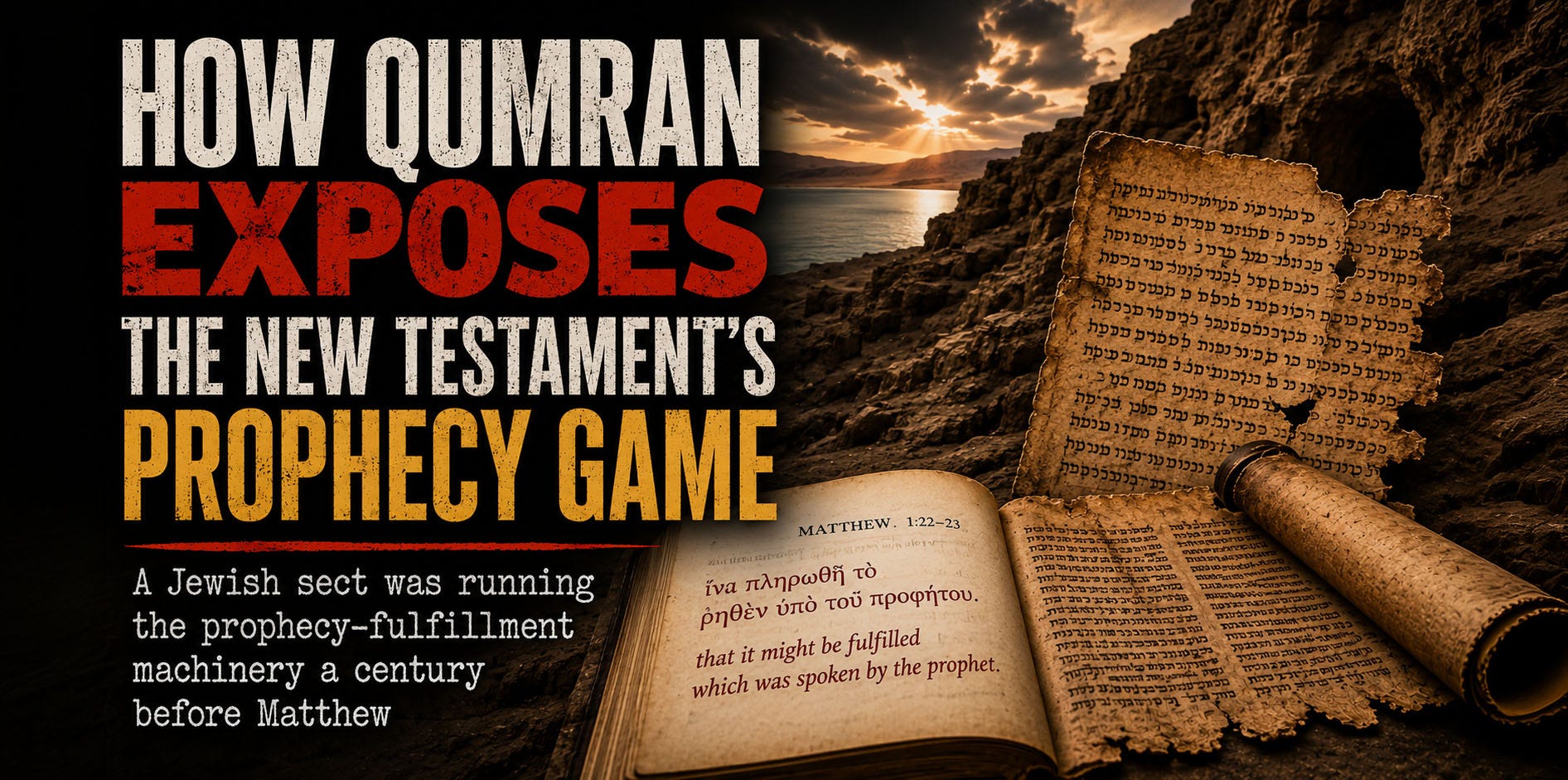
The Qumran sect had a name for that move and a method for doing it. They called it pesher. The Pesher on Habakkuk quotes a line of the prophet, then announces what it “really” means, and what it really means is always the community’s own situation, its own founder, its own enemies. Habakkuk wrote about the Babylonians centuries earlier. The Qumran commentator reads the same words as a coded prediction of the Wicked Priest who persecuted the Teacher of Righteousness in living memory. The prophet didn’t know he was writing about Qumran. The point of pesher is that he didn’t have to, because the meaning was sealed up until God revealed it to the Teacher.
The engine running under Matthew’s “that it might be fulfilled” formula was'n’t any different. Take Hosea 11:1, “out of Egypt I called my son,” which in its original setting is plainly about the Exodus, about Israel as God’s son being led out of slavery. Matthew lifts it out, reattaches it to the infant Jesus being carried back from Egypt, and presents the match as prophecy coming true. He’s doing pesher. He’s reading an old text as a sealed code about a present-day figure, exactly the way the Qumran commentator read Habakkuk.
Once you know the technique was standard equipment in first-century Jewish sectarianism, the evidential weight of Matthew’s fulfillments evaporates. A method that can turn a line about the Exodus into a prediction of a toddler’s travel itinerary can prove anything, which means it proves nothing.
No Fixed Bible for Jesus to Fulfill
The fulfillment claim rests on an assumption people rarely notice: That there was a stable, closed Hebrew scripture sitting on the shelf, and that Jesus walked in and satisfied its predictions. The biblical manuscripts at Qumran torch that assumption. They show that in the period the New Testament reaches back into, the text of scripture itself was still moving.
Among the biblical scrolls you find readings that match the later standardized Hebrew text, readings that match the Greek Septuagint against the Hebrew, and readings that match the Samaritan version, sometimes for the same book in different copies sitting in the same library. The scrolls preserve a copy of Jeremiah a full seventh shorter than the one in your Bible, an earlier and different edition of the entire book. There were expanded editions of Exodus, variant Psalms collections with compositions that never made the final cut, and books like Enoch and Jubilees that this community clearly treated as authoritative scripture and that later Judaism and most of Christianity threw out.
This wrecks the prophecy argument from a second direction. When a gospel writer quotes scripture to prove Jesus fulfilled it, which scripture? The wording the author quotes often follows the Septuagint, and the famous case is Matthew’s “a virgin shall conceive” from Isaiah 7:14, where the Greek reads parthenos, virgin, and the Hebrew reads almah, young woman, with no claim about virginity at all. Matthew built a doctrine on a translation choice. At Qumran we can watch those translation choices and textual variants coexisting in real time, which means the “prophecy” being fulfilled was sometimes an artifact of which manuscript tradition you happened to be reading.
A fulfilled prophecy needs a fixed prophecy. The scrolls prove the prophecies weren’t fixed, that the very words of Isaiah and Jeremiah and the Psalms were in flux during exactly the centuries when the messianic expectation was forming. The target moved, and the New Testament authors got to choose which version of the target to aim at after the fact.
Even the Resurrection Hope Was Standard Issue
Push anyone who believes in the New Testament hard enough on the parallels, and they retreat to the empty tomb. Fine, they’ll say, the titles and the baptism and the beatitudes were all in the air, but the resurrection is the unrepeatable core, the thing that proves it was real and not just another apocalyptic sect talking itself up. Paul stakes everything on it in 1 Corinthians 15. If Christ wasn’t raised, he says, the whole thing is worthless.
Here the scrolls are corrosive, though not as loud. Bodily resurrection of the dead was a live Jewish hope in this period, not a Christian invention. The Pharisees held it, which is why Paul, a former Pharisee, already believed in resurrection before he ever heard of Jesus. And 4Q521, the same Messianic Apocalypse that supplied Jesus’ answer to John, includes the line about God giving life to the dead in its catalog of what happens when the messiah comes. Raising the dead was already on the messianic job description that was circulating before Jesus was born.
So the resurrection of a messiah figure wasn’t a category nobody could have imagined. The category existed. The expectation that the eschaton would bring the dead back to life was sitting in the sectarian literature. What the Jesus movement did was take a general future hope, the resurrection of the righteous at the end of days, and claim it had happened early, once, to one man, as the down payment on the rest.
I can’t help inserting an opinion here. The resurrection is the least convincing of all the messianic credentials, even though it’s the one held up as the strongest. If a man turns up walking around after his supposed execution, anyone in their right mind treats that as evidence that someone else died on that cross, and the investigation becomes a question of identifying the body, not announcing a miracle.
For example, if Saddam Hussein turned up alive today, a man the whole world watched hang, every Christian commentator would be asking how the double fooled everyone. Somehow, I doubt they would immediately bow down to him on the spot and treat it as irrefutable proof of messiahhood.
What I’m saying is that if someone wants to believe in the resurrection, more power to them. They just shouldn't kid themselves that the evidence was strong
Done already? Thank you!
A Movement Can Write Its Founder’s Lines for Him
Arguably, the biggest problem the scrolls introduced is the words now attributed to Jesus.
The Teacher of Righteousness is everywhere in the Qumran self-image and nowhere in his own voice. The community talks about him constantly, credits him with the true interpretation of the prophets, builds its identity around his persecution and vindication, and yet we have no document we can confidently say he wrote and signed. The hymns sometimes attributed to him, the Thanksgiving Hymns, are debated precisely because a community is perfectly capable of composing in its founder’s voice and folding the result into its sacred literature. The figure becomes a character in the movement’s story, and the movement keeps writing him long after he’s gone.
Now look at the gospels with that in mind. They were written decades after the crucifixion, in Greek, by authors who weren't eyewitnesses, for communities with their own fights and their own needs. When Matthew's Jesus delivers a beatitude in the same blessing form a Qumran wisdom text was already using, when John's Jesus speaks in the light-and-darkness dialect of the community's rule book, the simplest reading is that the communities behind those gospels supplied the words their Jesus needed to say, drawing on the Jewish sectarian vocabulary they already shared with Qumran. A Galilean peasant talking in two different sectarian registers depending on which gospel you open is the harder thing to credit. The Teacher of Righteousness shows us that this is exactly what a Second Temple movement does with its founder. It speaks for him.
This is why the scrolls cut deeper than any individual contradiction in the text. They demonstrate, with a real Jewish parallel rather than a skeptic’s hunch, that the sayings of a revered teacher are the kind of thing a community generates and attributes backward. The burden was always on the gospels to show their Jesus material is different in kind from the Qumran community’s literature about its own founder. After the scrolls, that case is a lot harder to make, and the people making it know it.
Church Needs the Scrolls to Stay As a Curiosity
The line you get from apologists since the day the scrolls were made public and from the gentle documentaries is that the scrolls “confirm the reliability of the Bible,” because the Isaiah scroll matches the later Hebrew Isaiah pretty closely and proves the text was copied carefully. It's like reading the biography of a decent, law-abiding man who turns killer halfway through, and citing the first half as proof of his sainthood while pretending the rest doesn’t exist.
The reason for the narrowing isn’t hard to work out. If the scrolls are a story about careful scribes, they’re harmless and even useful. If the scrolls are a story about a Jewish apocalyptic sect that already had the messiah, the Son of God title, the new covenant, the baptism, the dualism, the beatitude form, the resurrection hope, and the pesher technique for manufacturing prophecy fulfillments, then Christianity stops looking like a revelation and starts looking like a competitor that survived. The church can survive the first story. It can’t easily survive the second, so the second gets filed under archaeology and set to dramatic music.
That instinct is the same one that kept most of the sectarian texts unpublished for over forty years while a small committee sat on them. The biblical scrolls, the safe ones, came out fast in the 1950s. The community’s own compositions, the ones that show the Jewish roots of the Christian package, are mostly what stayed locked away until the monopoly broke in 1991. The pattern of what got released early and what got buried is itself a piece of evidence about which texts the custodians found comfortable and which they didn’t.
If you find value here and can afford it, I'd love for you to consider becoming a paid subscriber to keep more posts accessible to everyone. Done already? Thank you!
What’s Left of the Origin Story
Leave out the passages dragged in from the Hebrew scriptures, along with the verses pulled at random from books that had nothing to do with each other just to force him to fulfill some prophecy, and what you have is recognizable and human.
A teacher deeply unhappy with how Judaism was being practiced, who saw the absurdity in thinking that avoiding pork or staying idle on the sabbath was what made a person good. He had things to say about how people should treat each other and how they should live, and some of them were worth hearing. At some point the Romans joined the religious authorities in deciding he was a problem worth solving before he got any bigger, and they solved him the way Rome solved that kind of problem.
Sources and Further Reading
Geza Vermes, The Complete Dead Sea Scrolls in English (Penguin).
John J. Collins, The Scepter and the Star: Messianism in Light of the Dead Sea Scrolls (Eerdmans).
James VanderKam and Peter Flint, The Meaning of the Dead Sea Scrolls (HarperOne), on the biblical text and variant editions.
Timothy Lim, The Dead Sea Scrolls: A Very Short Introduction (Oxford), on pesher and scriptural interpretation.
Bart Ehrman, Jesus Before the Gospels (HarperOne), on oral tradition and the shaping of Jesus material.
Bart Ehrman, How Jesus Became God (HarperOne), on resurrection belief in Second Temple Judaism.
Lawrence Schiffman, Reclaiming the Dead Sea Scrolls (Jewish Publication Society).
Emanuel Tov, Textual Criticism of the Hebrew Bible (Fortress), on the fluidity of the scriptural text at Qumran.
James Charlesworth (editor), The Dead Sea Scrolls and the Christian Faith (Trinity Press International).
Well done, brilliant even!