


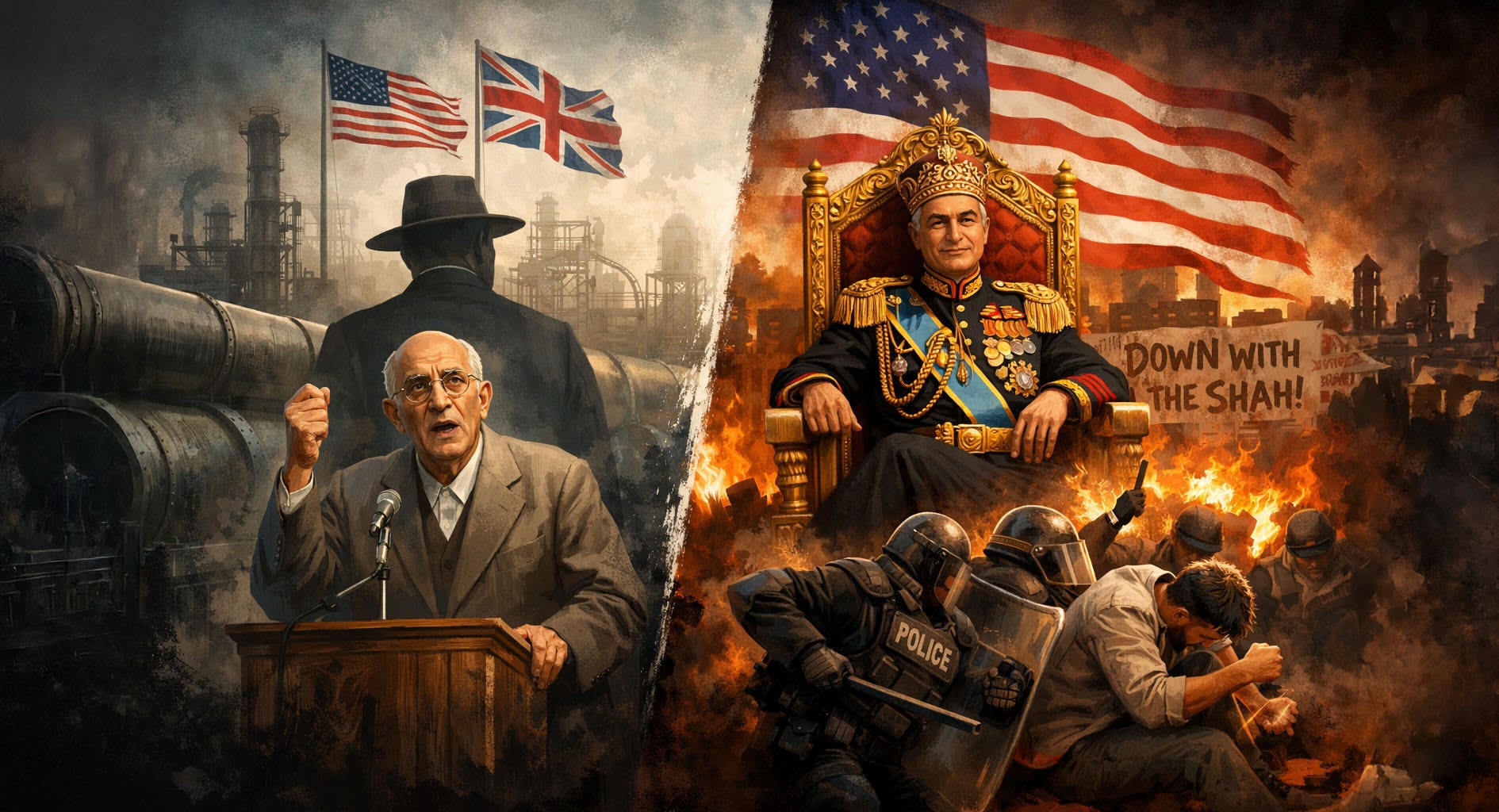
Previously, we looked at how America helped build the very conditions that made the Islamic Republic possible.
The U.S. and Britain overthrew Iran’s democratic government in 1953 to protect oil interests, installed a dictator (the Shah) who tortured and silenced his people, and kept backing him even as the country burned with anger. Instead of supporting democracy, America supported repression — as long as it was good for business and Cold War strategy.
By the late 1970s, that short-sighted policy was crumbling fast. The Shah had lost the people. The protests were unstoppable. And Washington had no idea what to do — except panic.
This part of the story is where things start to spiral. Not because of its inevitability, but because America fumbled the endgame just like it fumbled the setup. The revolution didn’t have to go the way it did. As you’ll see, U.S. policy made sure that, when the dust cleared, the only people still standing were the ones shouting death to America.
Let’s keep going.
5. America Could Have Stopped the Revolution — But Didn’t
By late 1978, things were falling apart. There were massive strikes. The country was grinding to a halt. Iran was done with the Shah. If you think America would read the room and stop propping him up, you have another thing coming.
Washington was busy holding meetings with other Western leaders about how to handle the crisis — meetings that basically told the Shah to get lost. The Guadeloupe Conference in early 1979 suggested that maybe it was time for the Shah to leave Iran. And he did.
One minute, America was backing this dictator. The next, it was effectively telling him to bail. Iranians saw right through that. It wasn’t savvy policy, but pathetic indecision.
6. Enter Khomeini — And America Opens the Door
When the Shah left, Iran wasn’t leaderless. The people who organized resistance and filled the power vacuum weren’t Marxists or pro-Western liberals — they were religious hardliners led by Ayatollah Ruhollah Khomeini.
Khomeini had been preaching against the Shah for years, especially criticizing how he sold out to America. The more America backed the Shah, the more Iranians listened to Khomeini’s message of Islamic government instead of Western puppet rule.
America could have worked with secular groups or moderates. But by the time the Shah left, Islamists were the best-organized, most disciplined group on the ground.
All this wasn’t a coincidence. America had undermined Iran’s democratic institutions, removed its nationalist leader, and enabled a dictator. The only alternative left when the revolt succeeded was the religious faction.
America didn’t directly install Khomeini. But it created the conditions where Khomeini was the only guy left standing.
That’s the textbook definition of paving the way to a historic event.
7. The Islamic Republic Was Not Inevitable
People like to say the Islamic Republic was some ancient destiny. That’s what Islam does to societies. If America had supported democratic reform and genuine self-determination in the 1950s and ’60s instead of coups and secret police, Iran might be a very different place today.
Instead, America:
Overthrew a popular democratic government to protect oil profits and Cold War interests.
Installed and backed a brutal dictator who crushed all dissent.
Failed to manage the revolt in a smart way when the Shah’s days were numbered.
Left a vacuum that religious extremists filled — because they were the only real alternative left.
8. Then America Lost Its Mind
After the revolution, things got even crazier.
Iranian students stormed the U.S. Embassy in Tehran and took American diplomats hostage for 444 days — a revolutionary message: “We remember what you did to our country.”
America responded with sanctions, failed rescue missions, and a complete diplomatic freeze. That only hardened the new regime’s belief that America was the Great Satan.
Instead of trying to fix relations, America doubled down on isolation and hostility. That made the Islamic Republic’s leaders even more paranoid and anti-Western.
Every round of sanctions, every refusal to engage diplomatically, every threat just validated their narrative that the West was the enemy — a narrative rooted in the very actions that helped create this mess in the first place.
9. And Then America Spent Decades Trying to Cover It Up
For the last four decades, America’s policy toward Iran has been sanctions, thuggish rhetoric, military threats, and half-baked diplomacy. It’s like America wrote the problem, then tried to fix it by stepping on the gas and yelling louder.
Iran’s Islamic Republic isn’t a Frankenstein monster that happened by accident. It’s the result of repeated American intervention, misjudgment, oil greed, and ideological arrogance.
What We Don’t Know
We like to assume any sane country wants as many friends as possible. But politics doesn’t work like that. Politicians need enemies. Enemies justify bloated military budgets, new surveillance powers, secret programs, and laws nobody reads — all “to keep you safe.”
So what if America actually found Iran more useful as a permanent enemy than an unstable ally?
Just look at what happened after Russia invaded Ukraine. The U.S. and Europe suddenly pushed through anti‑privacy laws, claiming they didn’t want sanctioned Russians using secure platforms. And nobody blinked. Meanwhile, Russian billionaires still move money around just fine. Sanctions made headlines — not impact.
In London, cameras with facial recognition track people across the city. Sure, they help solve crimes now. British forensics are famous, even though crime rates are relatively low. But later? Those same cameras can be turned on protesters, journalists, or just people the ruling party doesn’t like. There’s a Trump in every country waiting to take over the government.
And if you need a guaranteed way to pass oppressive laws? Say it’s to protect children. Inappropriate images of minors are everyone’s worst nightmare — and rightly so. But the outrage makes it almost too easy. Europe, the U.S., dictatorships — they all pass sweeping surveillance laws using “child protection” as the moral shield. It works every time.
Enemies make control easier. Fear makes laws pass. And Iran — loud, angry, Islamic Iran — gives the U.S. all the excuses it needs, whether by design or as the fallout of decades of bad policy.
All that said, whether America intended to create a permanent enemy or just stumbled into it through decades of bad decisions — that’s open for debate. It’s a valid hypothesis. I’m not pushing a conspiracy theory or blaming America just to rile up its enemies. I’m saying the pattern is worth questioning, and the consequences are real. That’s history with a long shadow, not propoganda.
Last Thoughts
Today, Iran’s government still uses anti-American sentiment as a foundational myth. It’s not because Iranians love theocratic rule — most don’t. But the regime uses the long memories of 1953, the Shah’s repression, and every subsequent insult from Washington to keep the people afraid of the West. That’s how it stays in power.
The alternative (a.k.a. America) is so bad that you should keep supporting us.
All while America keeps acting surprised that Iran is hostile.
“Iranians must be hating our freedom. Bad, bad Muslim people.”
If America really wants a different Iran — one that isn’t an Islamic Republic constantly at odds with the West — it needs to stop pretending the last 70 years didn’t happen.
Real change requires real accountability.
To be honest, only a small portion of subscribers are paid—most of my posts are free for everyone to read, with some exclusives. But reader support buys something priceless: time. Time to research, question power, and hold the powerful accountable. If you can afford it, your support helps keep this work going.
Can’t afford a subscription at the moment? No problem. Just send an email to tanner@theunholytruth.com to gain full access to the full archive and exclusive content that only paid subscribers have. Everyone deserves the ideas, not just the paywall.
If this made you uncomfortable — great. That’s where real thinking starts. Don’t take my word for it — in doubt, fact-check everything I said.
theunholytruth.com
What should the US do now? Is Trump going in a direction you like?