


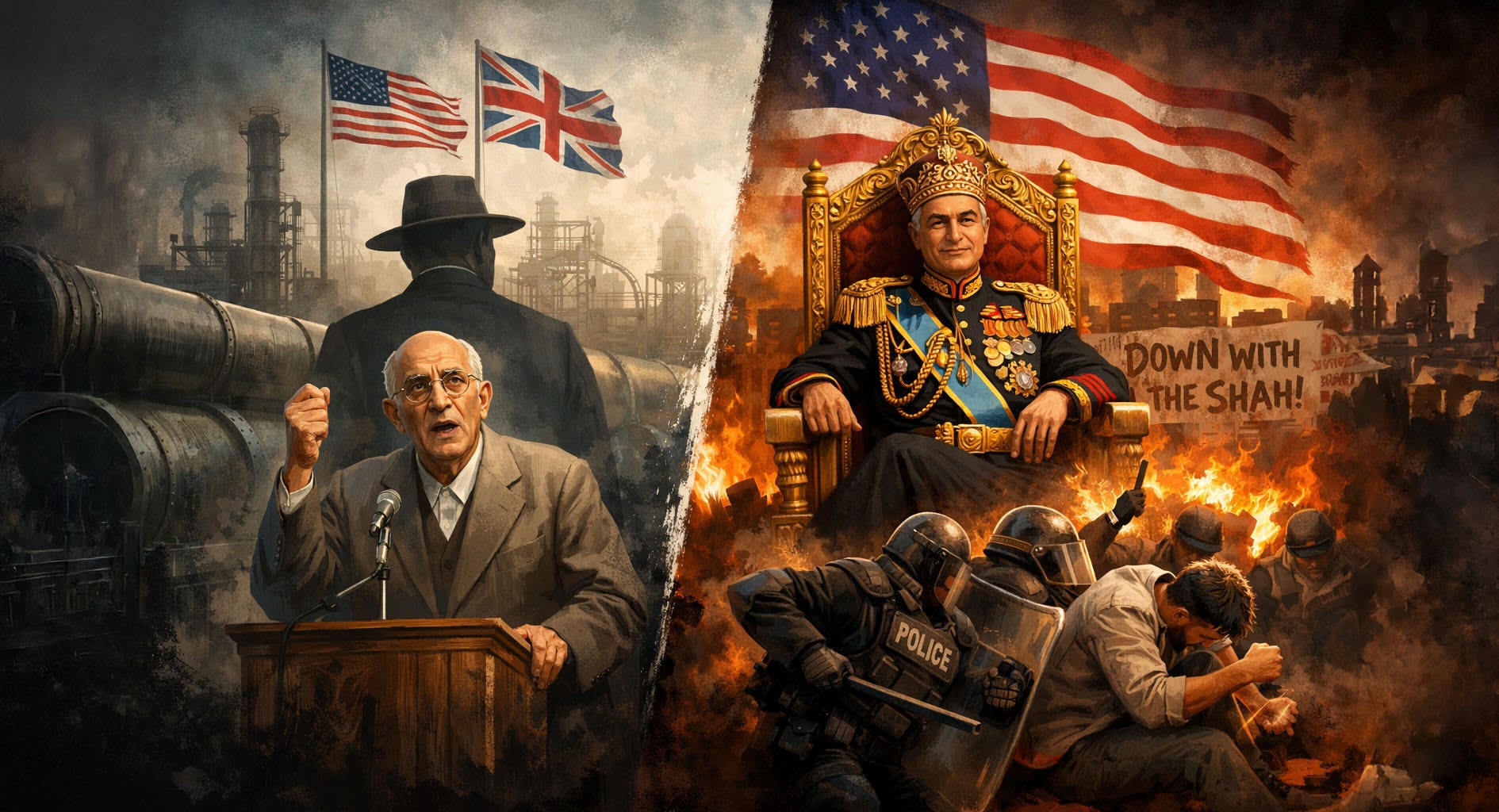
Today we’re talking about something you shouldn’t brush off as a conspiracy theory — because that’s exactly how it sounds, but it’s not. These are facts that the countries involved have publicly acknowledged.
If you go by America’s current rhetoric, it sounds like the Islamic Republic has always existed and that Iran is hostile simply because they’re Muslim. But in reality, Iran’s transformation into one of the world’s most fiercely anti-American states has a long, uncomfortable history — and America played a big role in making it happen.
Before telling that story, I want to point out a few things:
Throughout this piece, when I say “they” — whether I’m talking about America, Europe, or the Middle East — I’m keeping myself out of the story on purpose. This isn’t about my identity, opinions, or politics. It’s about the facts. I get that people don’t like being criticized by someone who sounds like a foreign attack — but in the end, every country is a “they” to someone else.
And second, I know plenty of Americans who despise Trump and don’t believe he represents them. So they don’t feel personally responsible for what he does abroad — which is a very human reaction. But like it or not, the rest of the world sees whatever Trump does as America’s doing — just like Americans see whatever Putin does as Russia’s doing. That’s how nation-state politics works. Representation isn’t about how you feel. It’s about what your government does in your name.
America’s International Policies
Let’s start with the basics: America in the international arena as the “leader of the free world.”
Many Americans believe Iran is inherently an enemy of the United States because “they’re too Muslim” or “they hate us for our freedoms.” This comes from paying too little attention to what the U.S. is doing in other parts of the world. They have absolutely no idea that Iran used to be America’s ally until 1979 — a close strategic partner supported with military aid, economic treaties, and diplomatic backing.
That Iranian government was awful to its own people — decades of repression and corruption under the Shah helped fuel the revolution — nonetheless, it was backed by the U.S. precisely because Washington didn’t care what the regime did internally. What mattered to American policymakers was access to Iranian oil and a strong anti-Soviet bulwark in the Middle East.
Iran’s Islamic Republic emerged as a reaction to that “poison” — a government that many Iranians saw as a symbol of Western domination. When the Shah’s regime collapsed in 1979, a revolutionary movement filled the vacuum, and nationalizing Iran’s oil industry was a core demand. That was something the U.S. absolutely did not want — because oil control, not democracy, is what American foreign policy has historically prioritized.
There’s an uncomfortable parallel here with Venezuela. When Venezuela nationalized its oil industry in the 1970s and later under Hugo Chávez, Washington saw it as a threat to American economic interests, not as a sovereign choice by a country to control its resources. The U.S. responded with diplomatic pressure, sanctions, and political isolation rather than support.
When America talks about democracy and human rights in another country, what it actually means in practice is:
“That country’s regime doesn’t align with America’s strategic or economic benefits.”
If a government does align — even if it represses its people in the extreme sense — Washington will often call it a partner and look the other way. It’s their domestic issue; we can’t interfere. If a government doesn’t align, then everything becomes a “domestic issue” that Washington feels justified to meddle in.
This is not an opinion. This is America’s long-running international policy, embarrassingly public in diplomatic actions and sanctions — yet little known among ordinary Americans. It has no consistent principles beyond advancing U.S. strategic interests.
The Middle East’s distrust has been going on for decades, but Europe used to be somewhat spared from America’s blunt realpolitik because it was closely tied to the U.S. through NATO and economic integration. But recent American behavior — from trade fights to proposals involving Greenland that upset Danish sovereignty — has made sure even Europeans shouldn’t trust America anymore.
But with that out of the way, let’s steer back to our main subject.
1. The U.S. Took Control of Iran
The real turning point in U.S.–Iran relations came decades earlier, in 1953, when the United States and Britain literally overthrew Iran’s democratically elected government.
In August 1953, the U.S. Central Intelligence Agency (CIA) and British intelligence (MI6) orchestrated a coup that removed Iran’s elected Prime Minister, Mohammad Mossadegh, because he dared to do the unthinkable: he tried to take back control of Iran’s oil from a British-owned company. In return, the U.S. and UK responded by toppling him.
The CIA and MI6 ran the whole operation — spreading propaganda, bribing officials, and staging protests. Mossadegh was gone. The Shah, Mohammad Reza Pahlavi, was shoved back into power with full American backing. That wasn’t a partnership — it was puppetry.
This is well-documented history. The U.S. backed a dictator because Washington cared more about Western oil profits and Cold War chess games than Iranian democracy. And Iranians never forgot it.
2. The Shah Was America’s Dictator — Not Iran’s Leader
Once America put the Shah back in charge, they poured weapons, money, and political support into Iran’s new dictatorship. Iran quickly became a pillar of American strategy in the Middle East — the go-to ally against the Soviet Union and any leftist government.
Who cares if the Shah ran Iran like a tyrant? America doesn’t involve itself in the domestic issues of other countries, right?
The Shah banned any political party that wasn’t loyal to him. He used secret police — SAVAK, trained and funded by the U.S. — to torture and silence dissent. He shut down newspapers. He crushed unions. He made sure Iranians could whisper “death to me” in private, but if they dared shout it in public, they disappeared.
Does that sound like someone the Iranian people would love forever and cheer Americans on for making that happen?
3. The Shah Tried to “Modernize” Iran
America loved the Shah’s “White Revolution,” a top-down modernization project that threw cash at roads, big industries, and Western-style reforms. The rich got richer. The Westernized elite got fatter. But for most Iranians, life didn’t improve.
Sure, some women could go to college. But for most people, this so-called modernization looked like Western domination dressed up as progress. It felt like the Shah was just doing America’s bidding.
Westernization doesn’t work when people hate the regime. They’ll just associate the shiny new highways and dress codes with the same brutal dictator holding the whip.
It worked next door in Turkey during the 1920s and 1930s — but that’s because Turks saw their leader, Mustafa Kemal Atatürk, as a miracle worker. The Ottoman army had collapsed, the parliament had been dissolved, and no one thought an independent Turkish republic was possible, let alone one that could control the Bosphorus without even having a navy. Then it did.
After the war, the Turkish public wasn’t furious at Britain or France, who had invaded — they were angrier at the Arabs who had worked with them. That made it easier to throw off Arab customs and embrace Western-style reforms: Romanizing the alphabet, ditching traditional dress, building a secular state. At least in law, men and women were declared equal — to the point that the state banned giving daughters less inheritance than sons. Property had to be shared equally, specifically to prevent males from dominating wealth by default — a problem that still exists today in places like the UK, where primogeniture and male-favored inheritance traditions haven’t fully gone away.
And the America they were dealing with back then? It was the one that helped rebuild Turkey — sending materials, food aid, basic support. It wasn’t yet the empire people feared.
One reason Turkey remains one of the comparatively more stable countries in the region is that it doesn’t have oil — and Europe didn’t carve it up after World War I like it did with the rest of the Middle East. That spared it from the colonial power games that created so much instability elsewhere.
Turks may distrust American policies today, but anything American is still seen as “the best” in many Turkish minds — a leftover admiration for power and dominance, something their own empire once had and lost.
4. America’s “Stable Ally” Became a Powder Keg
By the 1970s, the Shah’s corruption, repression, and blatant Western fixation turned Iran into a tinderbox. People were angry at him as well as what he represented: foreign interference and cultural domination.
Protests started in 1978. Secular students, workers, leftists, bazaar merchants, and religious folks all marched. They didn’t all want the same future, but they all hated the Shah.
Here’s the part where America walked straight into its own disaster.
Instead of telling the Shah to change course, Washington kept telling him not to crack down too hard — because that would make him look bad in front of the world.
It’s like, because you care about women’s rights, you ask that wives not be beaten too badly.
President Carter’s administration was torn between supporting an ally and preaching human rights.
That contradiction made the Shah look weak, confused, and out of touch. The protests got bigger. And America kept backing the wrong horse.
And just when you thought things couldn’t get any worse…
To Be Continued
I don’t usually write posts this long — even Volume I turned into more than I intended. So, let’s take a break.
In Part II: the revolution, the rise of Khomeini, and how America kept making it worse.
To be honest, only a small portion of subscribers are paid—most of my posts are free for everyone to read, with some exclusives. But reader support buys something priceless: time. Time to research, question power, and hold the powerful accountable. If you can afford it, your support helps keep this work alive.

Two simple comments.
1. There is a saying which very adequately describes US and Russia politics: "Russia is interfering with internal US affairs all over the world".
2. While US cares only about its own benefits whenever interfering with local affairs of other countries, occasionally the best interests of people of those countries does align with the interests of US of A, and then the interference is beneficial (this happens, even if rarely): it worked very well for Poland (I know it firsthand) and for other countries which are now members of European Union and used to be subjected to USSR influence and control.
But the same obviously did not work for countries of the Middle East / South Asia, like Afghanistan - although Russian occupation was a tragedy for Afghanis (so Americans fighting them was not bad in itself), the current Taliban rulers (who Americans actively allowed to take over) seem to be perhaps even worse.