

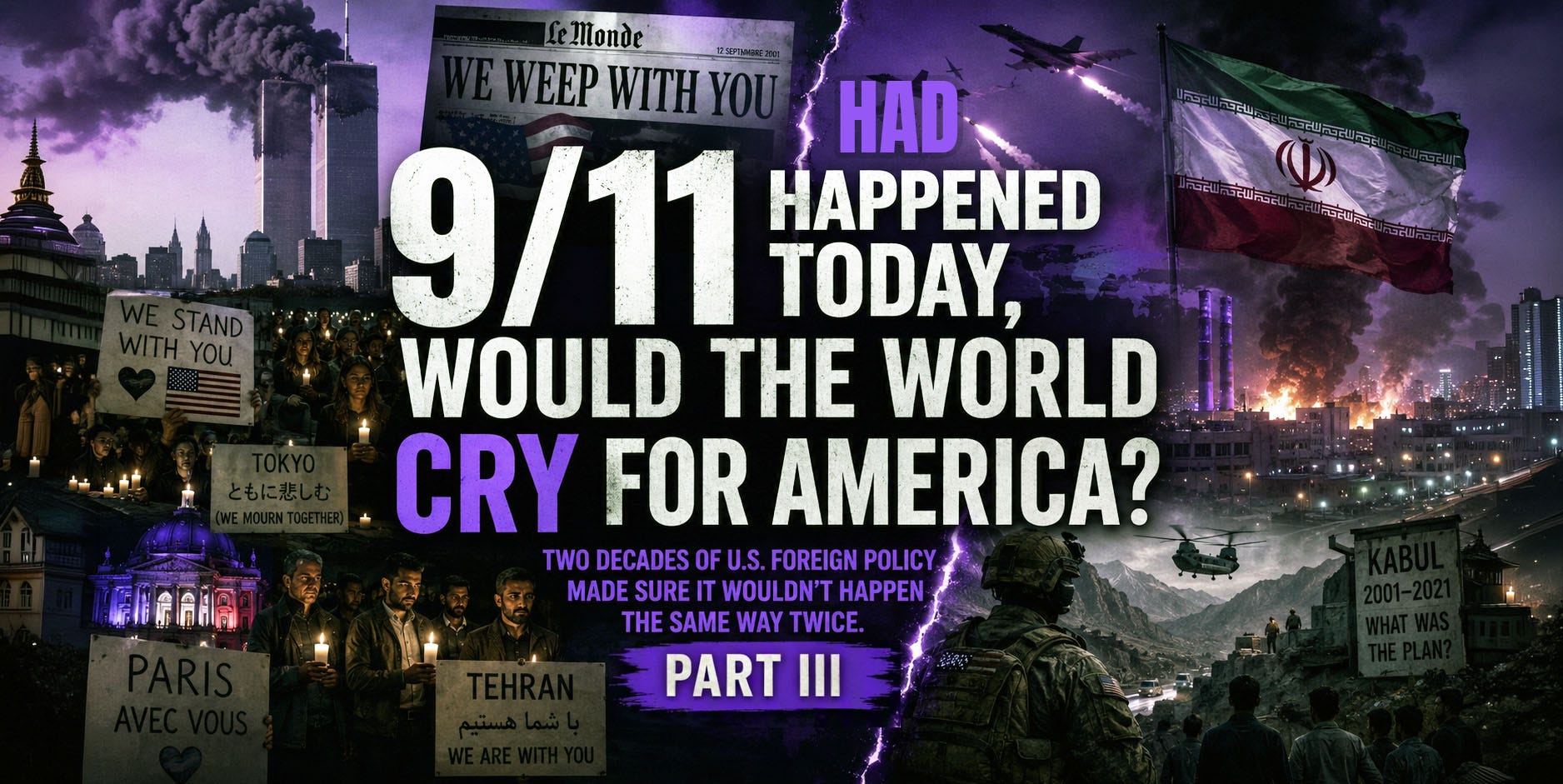
Part II ended with the goodwill gone: Iraq, torture, drones, and a double standard that told the world exactly how selectively America’s concern for Muslim lives ran. By the mid-2000s the sympathy from 2001 had curdled into something closer to a grudge.
What’s left to ask is where all of that went. Who benefited from two decades of wars that killed hundreds of thousands, cost trillions, and left America with fewer friends than it started with?
And the answer isn’t really about Iraq or Afghanistan anymore.
Before We Begin
This is the third and final installment of this series. I hope you enjoy reading it as much as I enjoyed writing it.
For paid subscribers: Stick around for a bonus breakdown at the end: 5 Moments That Shattered America’s Global Standing.
The Unholy Truth is a full-time job, and it can only go on with reader support. If you find value in this work, please consider becoming a paid subscriber today.
And if you’re currently going through a rough patch, don't worry about it—just message me and I'll set you up with a complimentary subscription, no questions asked.
How America Did Bin Laden’s Job For Him
In many ways, America did to itself what bin Laden never could. In fact, no organization on Earth possesses the resources or budget to dismantle America’s global image quite like America has.
The goal of terrorism isn't just to kill people. Bin Laden couldn't care less what religion the victims were, or whether they were Muslim, Christian, or atheist. The aim is always to provoke a reaction, hoping to give the target enough rope to hang itself.
Terrorism works best when it goads a government into an overreaction that erodes its own legitimacy and alienates its allies. Look at the October 7 attack that triggered the war in Gaza: Israel’s severe response destroyed its standing on the world stage and strained key alliances, maybe even irreparably. The aftermath of 9/11 followed the exact same playbook.
Instead of staying focused, targeting the perpetrators, and working with allies who were ready to help, the U.S. went full tilt into wars that had little to do with the original attack. Afghanistan was at least directly tied to al-Qaeda’s base of operations. Iraq wasn’t. The 2006 U.S. National Intelligence Estimate, a consensus document from every American intelligence agency, concluded the Iraq War had become a rallying cause for jihadists that was breeding more terrorists than it killed. U.S. policy was doing recruitment work for the other side.
Al-Qaeda’s long-term strategy was arguably to draw the U.S. into a draining, unwinnable conflict in the Muslim world, echoing the Soviet Union’s experience in Afghanistan during the 1980s. The U.S. walked right into that trap. Toppling Saddam Hussein’s regime shattered Iraq’s state structure and unleashed sectarian chaos that became fertile ground for al-Qaeda in Iraq and eventually ISIS.
It transformed a regional conflict between Arabs and the West into a sweeping war between Islam and the West.
While all of that played out abroad, America was handing terrorism a domestic win too. The Patriot Act, passed in a hurry with minimal debate, gave the government broad power to spy on its own citizens with little meaningful oversight. Legal scholar David Cole put it bluntly: the most enduring legacy of 9/11 isn’t the damage done to buildings or the lives lost, but the damage done to constitutional freedoms.
Then came the security theater: the endless TSA lines, the confiscated shampoo bottles, the color-coded terror alerts. None of it stopped a determined attacker, but it reminded Americans every day to stay afraid, and fear is exactly what terrorists want. Bin Laden bragged in a 2004 video that for every dollar al-Qaeda spent on the 9/11 attacks, the U.S. was spending millions in response. That’s not victory. That’s bleeding yourself dry on purpose.
Drone strikes aimed at “high-value targets” often killed civilians instead, a pattern human rights groups like Amnesty International and Human Rights Watch have documented repeatedly. A 2012 joint Stanford and NYU report, Living Under Drones, found the strikes created a constant state of fear in the communities they targeted, undermining whatever goodwill toward the U.S. remained. Every child killed in a strike became a propaganda gift to extremists, who didn’t need to invent lies about America. They could just point at the rubble.
America didn’t just fail to stop terrorism. It helped the movement evolve, spread, and adapt. Chalmers Johnson warned in Blowback (2000, updated after 9/11) that U.S. military interventions often plant the seeds of future attacks. After 9/11, that warning went from theory to reality fast. By 2014, when ISIS declared its caliphate, the Middle East had become a patchwork of failed states and war zones, many of them shaped or worsened by post-9/11 U.S. policy.
Terrorism is about reshaping the political environment to favor the terrorists’ goals as much as it’s about bombs and bullets. On that front, bin Laden didn’t just succeed on 9/11. America helped him keep succeeding for years afterward.
Trump, Burning Bridges with Allies
If George W. Bush squandered America’s goodwill after 9/11, Donald Trump took the bridges that were left and set them on fire.
Allies who had stood alongside the U.S. in Afghanistan, who had shared intelligence and spilled their own soldiers’ blood, suddenly found themselves treated like freeloaders. Trump’s foreign policy, if it deserves the name, was built on the idea that every relationship was a zero-sum business deal, and the only way for America to win was for someone else to lose.
NATO, the very alliance that had invoked Article 5 in solidarity with the U.S. after 9/11, became one of his favorite punching bags. He called it obsolete in a 2016 interview, then spent years publicly insulting member states over defense spending. NATO had debates over burden-sharing for decades, but previous presidents handled it behind closed doors. Trump blasted allies in public and handed Russia exactly the propaganda it wanted: the image of a divided West.
Then came the trade wars. In 2018 the Trump administration slapped tariffs on steel and aluminum imports, citing national security. That framing didn’t just target China. It hit Canada, the EU, and Japan too, countries that had fought alongside the U.S. in multiple wars, suddenly treated like security threats over metal imports. Former Canadian Prime Minister Brian Mulroney called it insulting and absurd. European leaders were just as blunt.
The Iran nuclear deal went next. The Obama-era agreement, officially the JCPOA, had been signed by the U.S. and Iran along with the UK, France, Germany, Russia, and China, and international inspectors had confirmed Iran was complying. Trump tore it up in 2018 without a serious alternative in hand. That move didn’t just alienate allies. It convinced them the U.S. couldn’t be trusted to stick to its own agreements. Richard Haass, president of the Council on Foreign Relations, warned the move undermined not just that one deal but the credibility of the U.S. in every future negotiation.
Then there was climate. In 2017 Trump pulled the U.S. out of the Paris Agreement, making it the only country in the world to reject the pact. French President Emmanuel Macron mocked Trump’s slogan right back at him with his own: “Make Our Planet Great Again.” In diplomatic terms, that’s a slap in the face.
By the time Trump left office, Pew Research surveys showed U.S. favorability had dropped in most allied countries. In Germany, trust in the U.S. president fell to single digits, lower than it had been during the Iraq War. A 2020 Pew study found confidence in U.S. leadership had hit record lows in key allies like the UK, France, and Canada since the poll began tracking the question.
And all of that covers only the first term. What the second one has done to those same relationships deserves an article of its own.
If 9/11 happened during the Trump years, America would have been asking the world for sympathy with an empty reputation account. Allies would still send condolences, but the mass candlelight vigils in Paris and Berlin would have been long gone.
If you found this useful, consider becoming a paid subscriber. It’s what keeps The Unholy Truth going.
What America Spent the Sympathy On
If 9/11 happened today, the world would still mourn, just not the way it did in 2001.
Raw human empathy for innocent lives lost doesn’t disappear, and most people, regardless of their politics, do not want to see thousands die in a single morning. But today, that grief would come laced with frustration and cynicism. A quiet voice in the back of many minds would whisper that the U.S. brought some of this on itself. After all, hundreds of thousands of deaths in Iraq dwarf the tragedy of a few thousand lives lost in America.
Particularly in Muslim-majority countries, mourning for America, especially with Trump as the president, might even be seen as a political statement best avoided in public.
That is the true tragedy underneath it all. In 2001, the U.S. had the entire world standing behind it. Global unity like that is exceptionally rare, and when it happens, it offers a historic chance to build something meaningful. Instead, America burned through that goodwill in record time. It treated allies like disposable tools, lied its way into wars, dismissed civilian casualties as mere collateral damage, and transformed global sorrow into permanent distrust.
If 9/11 happened today, the vigils would be smaller, the flags fewer, and the condolences shorter. Once the official statements were read, the world would quickly move on, mindful of the long list of countries still living with the fallout from the last time everyone rallied around America, only to watch it waste the moment.
Upgrade to a paid subscription to unlock this exclusive bonus section and get the complete picture.