

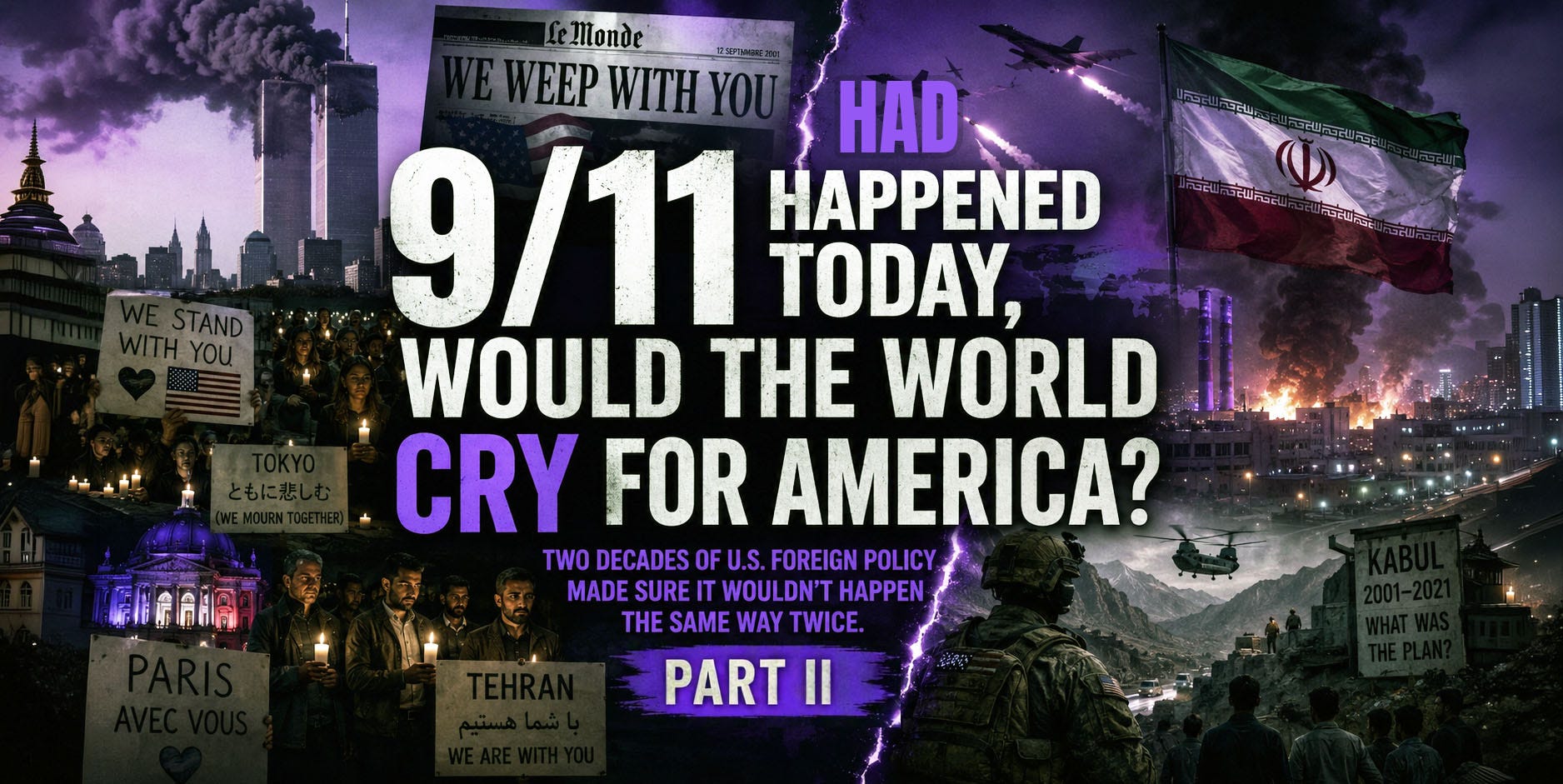
Part I ended with the world lined up behind America: NATO invoking Article 5, Jordan running field hospitals in Afghanistan, Iranians holding candles for people they’d never met. That kind of goodwill doesn’t happen twice in a lifetime, and for a moment it looked like the U.S. understood what it had.
It didn’t last. What follows is the record of how a country with the whole planet’s sympathy managed to spend it down to nothing in under a decade, one bad decision at a time. It started with a war that had nothing to do with 9/11, and it didn’t stop there.
Before We Begin
We’re picking up right where we left off with Part II. Thank you for the incredible response to Part I.
Later in this post, paid subscribers will get access to a bonus breakdown featuring declassified government memos.
The Illegal War in Iraq
Then came Iraq, the moment everything flipped. Iraq had nothing to do with 9/11, no weapons of mass destruction, no links to bin Laden. The Bush administration wanted a war anyway, so it cooked the intelligence, played the fear card, and dragged the UK, Australia, and a handful of others along for the ride.
Most of the world saw through it instantly. Millions protested in the streets of London, Rome, Madrid, Sydney, and New York. America ignored them. The message landed clearly: thanks for the sympathy, now shut up and get out of the way while we bomb whoever we want.
That’s when the goodwill began to rot, and it happened at full speed.
Torture, Drones, and the Death of Moral High Ground
Nothing burns through global credit faster than invading a country on false pretenses, killing civilians, and setting up torture camps. Abu Ghraib. Guantanamo Bay. Secret CIA black sites. The country that claimed to stand for freedom and human rights was running medieval-style dungeons and calling it “enhanced interrogation.”
Then came the drones, sold as precise tools that would only kill bad guys. Precision in theory and precision in practice turned out to be two very different things. Weddings, funerals, kids playing soccer, all hit by missiles at various points. By the time the U.S. government admitted how many civilians had died, the damage was already done. In much of the world, “American drone” became shorthand for a flying death lottery.
By the mid-2000s, that 2001 wave of goodwill had curdled into open resentment. For millions, America played the part of the angry drunk who wrecked the bar and then lectured everyone else about manners.
No Gatekeepers Left to Shape the Story
If 9/11 happened today, you’d still see sympathy in the first hours. People would post condolences, leaders would send formal statements, hashtags would trend. It wouldn’t feel like 2001, though, because the gut-level unity is gone along with the trust that made it possible.
After the original attacks, America didn’t just defend itself. It reshaped the world in ways that made things worse for a lot of people. The wars killed hundreds of thousands and displaced millions. Countries got stuck absorbing floods of refugees. The War on Terror became a convenient excuse for other governments to pass their own surveillance laws and crackdowns. The U.S. told the world it was either with us or against us, and plenty of people decided fine, then we’re against you.
America didn’t just lose friends. It made new enemies, and it taught old ones that all they had to do to bait the U.S. was wave a flag with Arabic writing and yell “terrorism.”
In 2001, news still had gatekeepers. TV anchors and newspapers shaped the narrative, and the story was simply America under attack. Now, if a 9/11 happened, you’d have live streams, conspiracy theories, and amateur analysis pouring out of every corner of the web within minutes. People in countries the U.S. had bombed would be posting “now you know how it feels” before the dust even settled. The story wouldn’t stay contained to the victims in New York or D.C. Every post would drag in Afghanistan, Iraq, Libya, Syria, Yemen. The sympathy would still be there, but it would come with a lot more “but” attached to it than it did in 2001.
Cozying Up to the Hijackers’ Home Country
The same America that demanded the world unite against terrorism had no problem staying close with Saudi Arabia, a monarchy that produced most of the 9/11 hijackers. It scolded other countries over human rights while running its own secret prisons. It claimed to fight extremism while toppling governments and leaving chaos behind that bred more of it.
People notice this pattern, and once they see it, they stop buying the freedom-and-democracy pitch. By now, a lot of the planet hears “U.S. foreign policy” and thinks: what’s in it for them, and how badly is this going to hurt the rest of us?
If you found this useful, I’d love you to consider becoming a paid subscriber to keep The Unholy Truth going.
Blaming Islam, Excusing Budapest
After 9/11, America and much of Europe treated the attacks as something that happened because of Islam, full stop, as if the religion itself were the cause rather than decades of specific political conflicts and Western missteps. That framing was convenient for everyone except the truth. Terrorist organizations wanted it, because it let them sell their fight as Islam under attack rather than a set of grievances tied to specific regimes and specific wars. And Western politicians wanted it too, because it let them skip explaining where their own policies in the region had gone wrong.
The 9/11 hijackers weren’t just Muslims. They were Muslim Arabs, and the roots of their hatred were political and historical, tied to decades of Western intervention in the Middle East, not scripture. But “the West’s problem is with Islam, and Islam is under attack” recruits a lot more people than “the West’s problem is with specific regimes and specific policies.” It lets extremist groups turn a regional grievance into a global one, telling anyone who identifies as Muslim that an attack on Arabs is an attack on them too.
Jordan is the clearest proof that framing was always a lie. In 2005, Abu Musab al-Zarqawi, a Jordanian-born militant running al-Qaeda in Iraq, sent suicide bombers into three hotels in Amman. One of the blasts hit a wedding reception in full swing, killing dozens of guests. The attack killed around 60 people, most of them Jordanians, and Jordanians came to call it their own 9/11. A decade later, ISIS captured a Jordanian pilot named Muath al-Kasasbeh and burned him alive in a cage on camera. Jordan answered with three straight days of airstrikes on ISIS positions in Syria. These groups have spent two decades killing Muslims who work with the West as often as they’ve killed anyone in the West itself. Religion was never the dividing line. It never has been.
And yet plenty of Americans who couldn’t find Jordan on a map are quick to treat a small Arab kingdom that hosts U.S. troops, shares intelligence, and has absorbed more refugees per capita than almost anywhere on earth as some kind of security question mark, purely because it reads as Muslim on a map. Meanwhile Hungary, an actual NATO member with a treaty vote, is run by a nationalist populist who blocks EU aid to Ukraine, cozies up to Moscow, and has been accused of gutting judicial independence and press freedom to keep himself in power. Nobody’s calling for Hungary to be kicked out of NATO. Most Americans have never even heard how bad it’s gotten there. Suspicion, it turns out, tracks with who looks the part more than with who actually causes the alliance trouble.
If you found this useful, consider becoming a paid subscriber to keep The Unholy Truth going.
How America Burned It
By the time you add it all up, the pattern is hard to miss. Iraq torched the credibility. Abu Ghraib and the drone strikes torched the moral high ground. The internet made sure nobody outside America could forget any of it. The Saudi relationship exposed the hypocrisy for anyone still paying attention. And the reflexive suspicion aimed at a country like Jordan, while an actual NATO member gets a pass for doing far worse, showed that a lot of the reaction was never really about security to begin with.
None of this happened to America. America did it, decision by decision, over the better part of a decade, to a world that had shown up for it without being asked. The sympathy didn’t run out on its own. It got spent, and nobody who spent it seemed to be counting the cost until it was gone.
Part III looks at where all that spent goodwill actually went, and makes the case that some of it landed right in bin Laden’s hands.
To see just how avoidable this was, upgrade to read the declassified memos showing U.S. analysts predicted every single step of this collapse before the first bomb ever dropped.
In many ways, the disastrous Bush administration foreshadowed the Trump administration.
And so it seems the same arrogance, the same hubris that sparked feelings of entitlement and propelled American entry into the Middle East is operating again, playing out in eerily similar fashion with the continuous bombing of Iran. Yes, Iran’s nuclear facilities must be destroyed, never to allow capacity for nuclear weapon capability, but that mission has been accomplished, and yet America remains in country.
So what to expect of European reaction should Iran retaliate and let loose terrorists to wreak havoc on American soli? Certainly, the world’s sympathy has moved beyond compassion, and if attacked, America should no longer anticipate a sympathetic response mirroring the empathy that followed 9/11. America’s military might, unleashed across the Arab and Muslim world, its political agenda put forth with bold rhetoric and unchecked aggression, is a recipe for disaster with a foe that will never give in to surrender.
Europe has witnessed the horrific consequences of American involvement in the Middle East. It has witnessed the destruction of ancient sites and civilizations. It has witnessed the countless atrocities perpetrated against civilians. It has witnessed the destabilization of an entire region. And perhaps most unforgivable of all, it has witnessed the worst of the worst when statistics reveal the number of children caught up in the maelstrom of death.
Europe and the world has thus declared, enough is enough.