


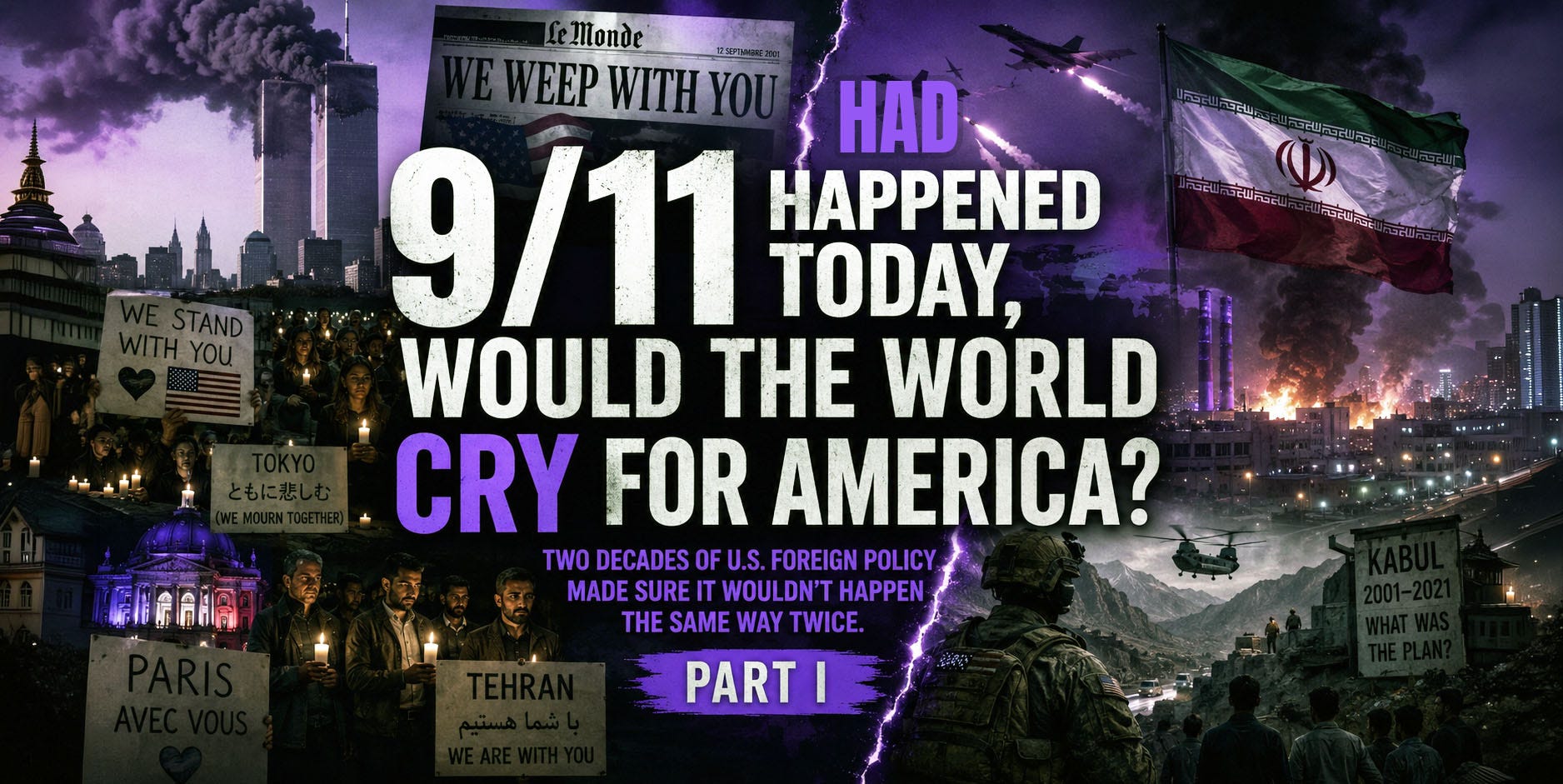
When the towers fell in 2001, the whole planet cried with America. Older generations remember that. Newer ones never heard of it at all. The shock reached Paris cafés, Nairobi markets, Tokyo offices, and villages in Afghanistan that had never had a reason to think about New York. Countries that despised U.S. politics still lit candles, held vigils, and sent condolences. Iran, yes, Iran, held a public moment of silence for the victims. NATO invoked Article 5 for the first time in its history: an attack on one member is an attack on all.
That same Iran is the country the U.S. has been bombing since February 2026. A joint U.S.-Israeli campaign hit Iranian nuclear sites, military leadership, and infrastructure that month, a ceasefire in April didn’t hold, and by late July the U.S. was in its second week of renewed nightly strikes, with Washington and Tehran trading talk of negotiations and talk of further escalation in the same breath. The country that once paused in silence for American dead is now the one receiving American bombs, turning even the Iranians who once mourned with America against it.
It’s hard to explain to anyone too young to remember, but the mood back then was almost surreal. Newspapers across Europe printed the American flag on their covers. Crowds left flowers at U.S. embassies. Moscow’s city hall hung a banner reading We Weep With You. The whole world pressed pause for a moment, like it wanted to say: we’re with you. That early wave of goodwill is exactly what makes the next two decades feel like such a massive, once-in-a-century waste.
Before We Begin
This week we're changing the topic a bit and moving into a trilogy at the intersection of religion, politics, and history.
I’ve already written Parts II and III, but I don’t want to keep a series going if it’s not landing with you. So don’t keep me in the void, let me know you’re interested: like it, comment, tell me if you think I’ve got something wrong. All of it helps me decide whether to continue the series with Part II tomorrow.
The World Moved Fast
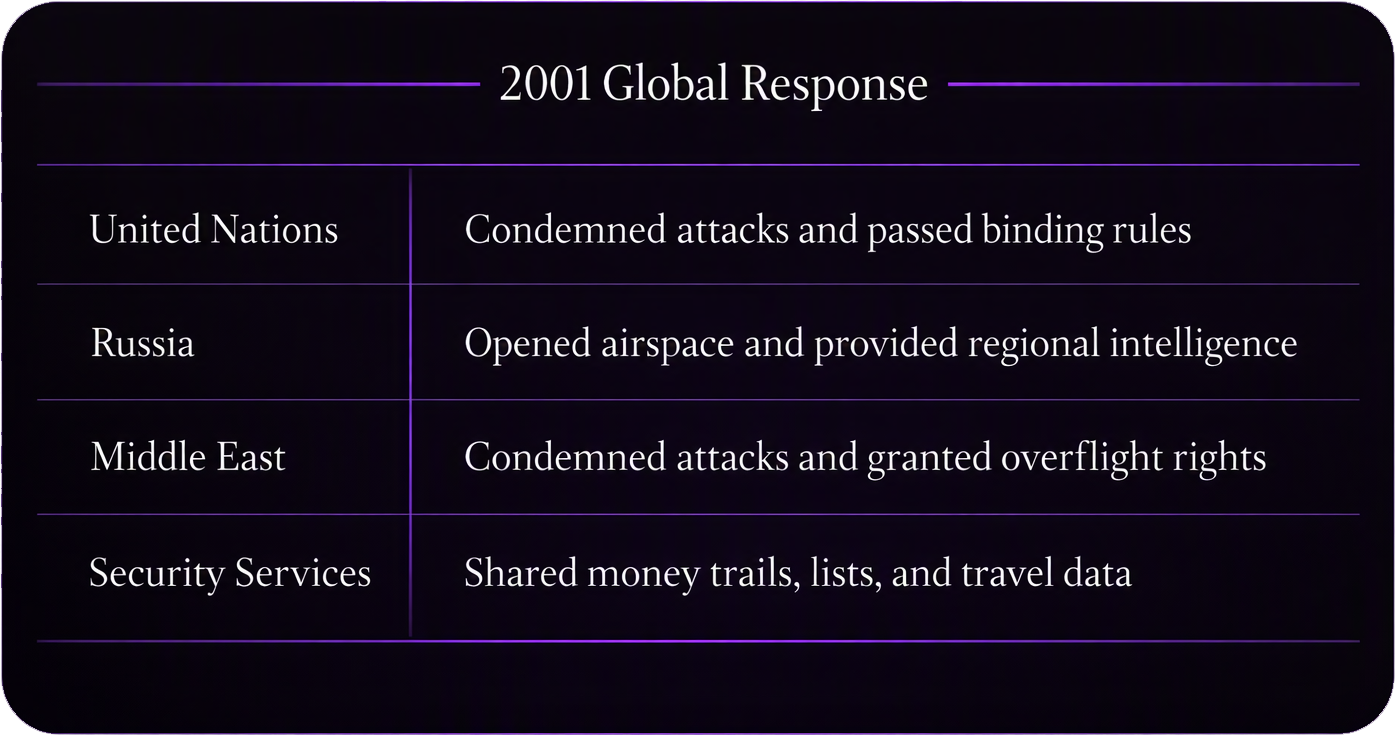
Governments, alliances, and ordinary people showed up in ways that are easy to forget now. NATO backing the U.S. under Article 5 was only the start. European allies tightened airports, shared intelligence, and sent forces once ISAF formed in Afghanistan. Canada diverted hundreds of flights and hosted thousands of stranded passengers in towns like Gander.
The UN Security Council condemned the attacks and pushed new counterterrorism rules. Russia offered intelligence and opened logistics routes through Central Asia. Muslim-majority states across the world publicly condemned the attacks, and many granted overflight rights and cooperation. Pakistan became a key logistics corridor. Gulf partners hosted bases and aircraft. Central Asian states provided airfields that made early operations possible.
Cities well beyond Europe held vigils and moments of silence. Cathedrals, mosques, synagogues, and temples hosted joint prayers, and crowds lined up to donate blood. In Tehran, ordinary Iranians held candlelight vigils while their leaders issued condolences. From Nairobi to Tokyo, flags flew at half-mast, newspapers ran black covers, and radio stations paused their programming. It wasn’t abstract sympathy. People organized, gathered, and mourned.
Allies sent forensic teams, search-and-rescue specialists, air marshals, and port-security advisers. NATO AWACS crews patrolled U.S. skies. Intelligence services shared names, money trails, and travel data that led to arrests far from New York or Washington, and banks tightened rules and froze accounts linked to terror networks. Airports changed screening overnight. Moments of silence took place at football matches in Europe and Latin America, orchestras dedicated performances to the victims, and landmarks lit up in U.S. colors. Even rival states paused the usual rhetoric. For a brief window, the tone worldwide was grief first, politics second.
That early solidarity turned into real commitments: troops for ISAF, trainers for Afghan security forces, development teams, medics, engineers, police mentors. Not every promise held up, and not every country agreed on strategy later. But in the days and weeks after 9/11, the reaction was clear and concrete. Condemn the attacks, stand with the victims, help shoulder the load.
America Had the World’s Sympathy
The U.S. had a golden moment. For a brief window after 9/11, it held near-universal sympathy and support, the kind of goodwill that doesn’t come around often. It could have built lasting alliances, coordinated a global counterterrorism strategy, and even addressed some of the political grievances that fed extremism in the first place. Instead, Washington went full cowboy and decided raw military power would do the job on its own.
Afghanistan came first, and at the start it made sense. The Taliban had sheltered bin Laden and al-Qaeda, and the world accepted that something had to be done. NATO allies sent troops, intelligence agencies shared information, and even countries with frosty relations to the U.S. offered logistical help. The mission’s stated goal was clear enough: dismantle al-Qaeda, remove the Taliban from power, and keep Afghanistan from becoming a terrorist safe haven again.
That mission didn’t stay focused for long. What began as a targeted counterterrorism operation turned into a massive nation-building project the U.S. had neither the patience nor the cultural grounding to pull off. The strategy drifted from fighting al-Qaeda to propping up a deeply corrupt Afghan government and trying to rebuild the country’s institutions from scratch while fighting an insurgency that never let up.
It became a 20-year grind. The Costs of War project at Brown University puts the direct death toll in the hundreds of thousands when Pakistan is included, with estimates ranging from roughly 176,000 to over 240,000, and the financial cost above $2 trillion. The war outlasted multiple presidents and military commanders, each promising a corner was about to be turned. Instead it ended with a chaotic, televised withdrawal in August 2021, the Taliban sweeping back into Kabul before the last U.S. plane had even left the runway. What started with overwhelming global sympathy ended in a humiliating retreat that left behind hard questions about whether the mission had been doomed from the moment it tried to do everything at once.
Jordan’s Support Wasn’t Just Words
Jordan was one of the top non-NATO troop contributors to ISAF, and its help started early and stayed consistent. The Jordan Armed Forces sent a field hospital to Afghanistan in 2002 that treated hundreds of thousands of patients over the years it operated there. Jordanian infantry task forces later deployed to Helmand and guarded coalition bases like FOB Sharana, freeing up American soldiers for other missions. NATO officers who worked alongside them made a point of thanking Jordan specifically for what its troops brought to the mission.
Jordan’s role went beyond boots on the ground. Its Female Engagement Teams worked with Afghan women and children in ways American units structurally couldn’t, given how differently gender and family access work in rural Afghan society. Jordanian troops preached what they called the true, moderate essence of Islam in villages where the Taliban had been the only religious voice locals ever heard, renovating mosques and running Ramadan programs for orphans and struggling families. A small, Muslim-majority kingdom sent doctors, soldiers, and outreach teams into a war zone to counter a Taliban that claimed to speak for their shared religion, and it kept doing it for over a decade.
That mattered on the ground in Afghanistan, and it mattered for the “West versus Islam” storyline extremists were trying to sell.
This is a reader-supported project. If you find value here, I’d love for you to consider becoming a paid subscriber. It’s what keeps The Unholy Truth going.
The World That Cried With America
That’s the world America had in the fall of 2001. NATO allies, Gulf monarchies, European tabloids, Iranian mourners, and a Jordanian field hospital all pointed the same direction at once. Governments that agreed on almost nothing else agreed that what happened in New York and Washington was a crime against everyone, and they backed that agreement with troops, intelligence, airspace, and money. It’s the kind of alignment that historians usually have to reach back generations to find, and the U.S. had it handed to it in a single morning.
None of that goodwill was owed to anyone. It was earned in real time, by an America that had just been hurt and had the world’s sympathy because the world recognized the moment for what it was. What happened to that sympathy over the following two decades is a separate story, and it starts with a choice Washington made about what to do with a war in Afghanistan that still, on paper, made sense.
Part II picks up where the case for war stopped making sense.
When George W Bush held his speech creating the Department of Homeland Security, I shuddered. The word "homeland" made my skin crawl for fear of where this country was headed. That gut feeling turned out to be dead on.
Tanner,
A great thought experiment. I remember 9/11 as the bursting of a bubble. The United States was pax romana - in every sense. And the outpouring of grief was about the end of an era for everyone. For 9/11 and then Uncomfortable Truth exposed the US as empty. Some day the US squandered an opportunity. But it was not in the US to become humble, to be contrite, to relinquish her underserved hegemony.
Congrats on such a thoughtful thought experiment.
Alan