


Fridays are when I try new things, and this week is no exception. Today’s question is whether people get more religious as they age. Most readers of Substack, hence, The Unholy Truth, are American, but more importantly, the US has by far the best statistical data on the subject, so that’s where most of the numbers come from. However, at the end, I’ll pull in the rest of the West too, so nobody reading from elsewhere feels like I think there’s only one country that matters. I love you all. ☺️
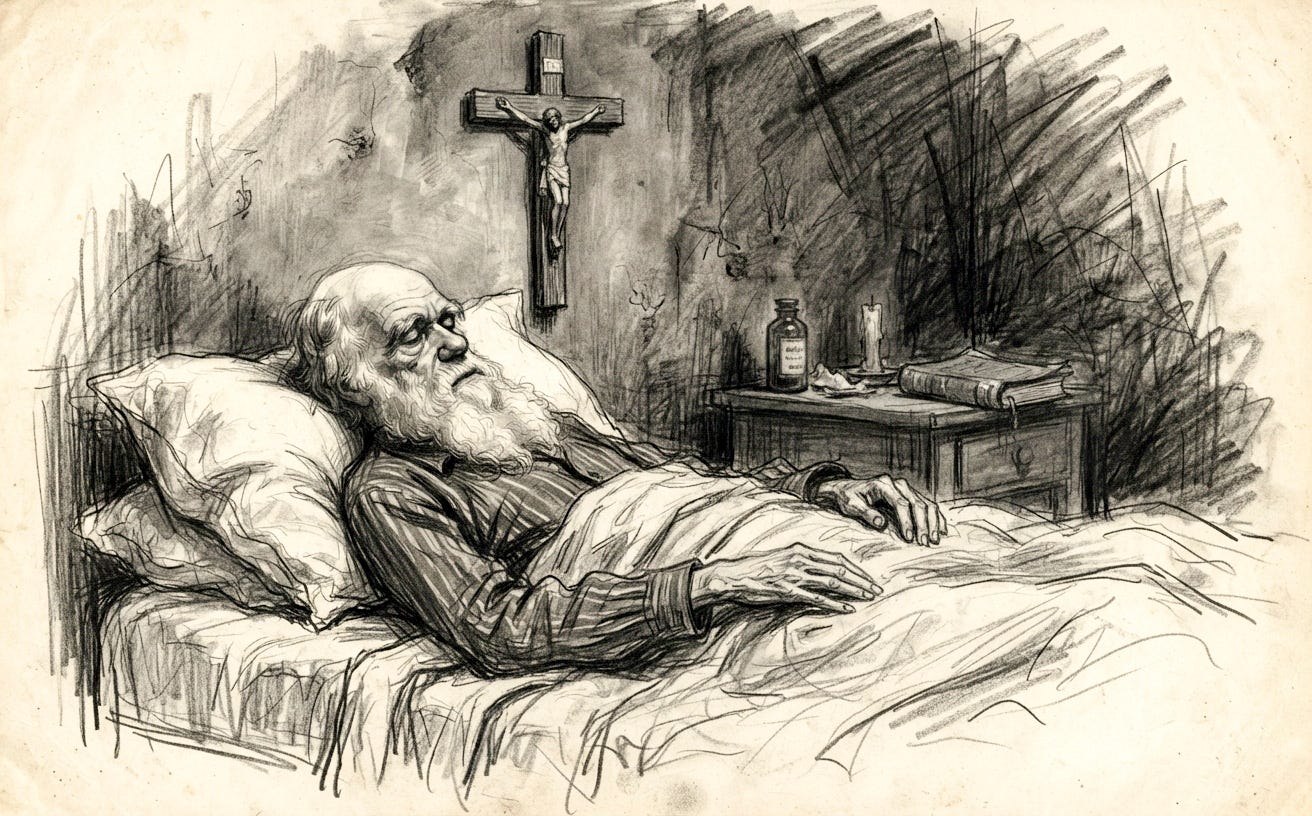
An English evangelist by the name of Elizabeth Cotton, also known as Lady Hope, spoke before an audience in August 1915 about the latter months of Charles Darwin, who had been deceased for thirty-three years.
Addressing the crowd at a summer Bible conference in Northfield, Massachusetts, she claimed to have visited the father of modern biology on an autumn afternoon during the last year of his life. She found him propped up in bed at his Kent home, Down House, dressed in a lovely purple dressing gown adorned with delicate embroidery.
What was he reading, she asked?
“Hebrews, still Hebrews,” he replied. “I call it the Royal Book.”
Then, according to her account, the man who had devoted his entire life to explaining how species emerge without a designer described himself as a young man with undeveloped ideas and publicly wished that he had not presented his theory of evolution in the way he had.
That month, the story appeared in the Watchman-Examiner, a Baptist periodical in Boston, and quickly spread through sermons and church pamphlets before anybody could verify it. As Lady Hope gained popularity on the Christian speaking circuit, audiences who wished to hear it straight from her began to extend invitations.
There was one problem, though. Darwin’s family was still living, and if a conversion had occurred, a household with a pious daughter would have been happy to declare it. In a letter written in 1915, the same year the story was published, his son Francis, a botanist, stated that his father could not have openly and fervently converted to Christianity without the household’s knowledge, and no such transformation had taken place. Henrietta, his daughter, responded in print in 1922, stating that she was present at his deathbed, that she doubted Lady Hope had ever seen him, and that he never changed his scientific beliefs. By 1934, Leonard, the final surviving Darwin child, was denouncing the entire story as completely false. Lady Hope continued to insist that she had made the tour until her death in 1922.
Since the myth never required proof in the first place, none of that has prevented it from appearing in church literature for almost a century. A family’s blatant denial was unable to match the naturalness of an elderly, ill man turning to God.
The majority of discussions regarding religion and age are still predicated on the same premise, and the data seems to support it. Between July 2023 and March 2024, the Pew Research Center polled 36,908 American adults. Of those aged 74 and over, 80% identified as Christians, compared to 46% of the youngest Americans, those born between 2000 and 2006. Only 25% of the younger group attended services at least once a month, compared to 49% of the older group, while 58% of the oldest group reported praying every day compared to 27% of the youngest.
With age doing the conversion, those numbers read like a scaled-up version of Lady Hope’s bedroom scene for an entire nation. However, a single poll cannot differentiate between a 78-year-old who turned religious and a 78-year-old who was born into a religious nation and never left because it lines up people of all ages on a single day.
Two Stories in a Single Survey
According to the aging story, religion grows in people as the years pile up. The generation story, on the other hand, claims people stay roughly where their upbringing and early adulthood put them, so the oldest Americans are more religious because they came of age when church was closer to a default setting.
The aging story has better evidence than its critics usually admit, most of which comes from the people who’d know. When pollsters ask older Americans to describe how they’ve changed over the course of their lives, more say they’ve drifted toward religion than away from it, while younger adults report the opposite. Older people feel themselves moving toward God, younger people feel themselves moving away, and the aging story treats that personal testimony as proof that the pews of the old fill up by age alone.
The way to test it is to find a generation that has already lived through the stretch of life the story describes and count how religious it was then against now. Between Pew’s 2007 survey and its 2023–24 survey alone, one generation moved from its forties and fifties into its sixties and seventies—and that generation is the boomers.
What Thirty Years of Boomer Data Shows
Alan Cooperman, who directs religion research at Pew, said the data shows no evidence that any generation becomes more religious as it ages, whether measured by Christian identity, daily prayer, or belief in God. Ryan Burge, a political scientist who studies religion, put it in plainer terms: boomers are as religious today as they were thirty years ago, Gen X looks the same, and millennials will mostly remain what they are now.
The people who lived through the entire stretch of life the aging story describes, from midlife into their seventies, didn’t drift toward church along the way. The old pews are full because older people grew up in a country where being Christian was closer to the default setting, and they kept what they had. If age itself pulled people toward church, boomers should have shown it, and they haven’t.
A third of Americans aged 65 and older say they’ve become more religious, and those answers came from people describing their own lives. Either the survey numbers are measuring something different from what Pew’s generational comparisons measure, or the boomer average is hiding people moving in both directions at once.
The Word Older Americans Reach For
Pew’s 2023 survey also asked people to describe how they’ve changed over the course of their lives, which gives the aging story its strongest evidence. Across all adults, 41% said they’ve grown more spiritual and 24% said they’ve grown more religious, while 33% said they’ve grown less religious and only 13% said they’ve grown less spiritual.
Among Americans 65 and older, 33% said they’ve become more religious and 24% said less, with the remaining 43% saying theirs stayed the same or went up and down. Among adults under 30 the split runs the other way, with 15% reporting more religion and 42% reporting less.
A third of the oldest group does feel it, and that deserves to be taken at face value, since people know their own lives better than a survey chart does. It also leaves two-thirds who either feel nothing of the kind or feel the reverse, which is a thin basis for a rule about what happens to a person in old age. Every age group Pew analyzed was more likely to say it had grown more spiritual than less, including the under-30s at 30% versus 20%, so the vaguer word keeps winning ground that the word on the church sign can’t hold.
Studies That Followed the Same People for Years
Pew’s generation-by-generation comparison is one method, and researchers have also followed the same individuals across decades, though few studies anywhere have the data to trace religion from adolescence to old age, since that takes the patience to start something whose results arrive a generation later. Those studies muddy the picture in a way worth admitting. A handful find religiosity rising with age, some of them after adjusting for the national drift away from religion, and anyone predicting a late-life revival will quote them.
Whether that rise is big enough to refill a pew, and which people it applies to, depends on what was measured, and the studies disagree with each other about timing more than their headlines let on. Two of the best-known ones are laid out in the paid section below.
The Bet Hiding Inside the Plateau
Pew’s own report says lasting stability in the religious makeup of the country would require young adults to grow more religious as they age, or new generations to turn out more religious than their parents. Neither has happened so far. The religiously unaffiliated grew from 16% of adults in 2007 to 23% in 2014 and 29% in 2023-24, and that growth has leveled off. The Christian share of American adults has hovered between 60% and 64% since 2019, and the youngest adults, born between 2000 and 2006, are about as religious as the group just ahead of them. The slide has stopped without reversing, and Burge, for one, sees no data behind any talk of revival. He expects the country to drift further from religion as older, more religious generations die and less religious ones replace them.
Any congregation counting on the twenty-six-year-old who stopped attending to turn up at fifty-five is holding a bet about biology, and the best evidence from Pew’s three big surveys says that person, on average, stays where he is. The comfortable story survives mostly because the old pews are full, and the old pews are full for reasons that have little to do with how old the people sitting in them are.
Britain, Canada, Australia, and the Rest of Western Europe
The gap between old and young in the pews isn’t an American quirk. Pew’s 2018 study of 106 countries found adults under 40 less likely than older adults to call religion very important in 46 of them, and the reverse in only two. Across 35 European countries, 75% of younger adults identified with a religion in the average country against 85% of older adults. In the United States, 43% of adults under 40 said religion is very important to them, compared with 60% of those 40 and over, while the European averages were 19% and 26%, a smaller gap in points that mostly reflects how little religious commitment there was to lose in the first place.
The British Social Attitudes survey draws a random sample of more than 3,000 adults every year, and its 2024 results show about 61% of people aged 16 to 34 with no religion, against 49% across all ages, according to an analysis by Humanists UK. Identification with the Church of England runs from 20.8% among people aged 65 to 74 down to 2.6% among those aged 16 to 34, and 94% of young adults raised without religion still had none. People raised without church mostly stay without it, which is what the generation story predicts.
In 2025 the Bible Society published a report called The Quiet Revival, built on YouGov polls, claiming that young adults were more engaged with Christianity than their elders. Pew noted that surveys based on random samples didn’t support the revival story, and in 2026 the Bible Society retracted the report after YouGov found fraudulent responses in the data behind it.
Canada’s 2021 census found 34.6% of the population reporting no religious affiliation, up from 23.9% in 2011 and roughly 17% in 2001. Australia’s 2021 census put the figure at 38.9%, and an analysis of the age breakdown found the share with no religion falling steadily with age after the mid-twenties, to under 20% among people over 80.
Pew’s 2018 survey of 24,599 adults in 15 countries found that 71% still identified as Christian while only 22% attended church at least monthly, and in every country except Italy the non-practicing Christians outnumbered the ones who attended. In the UK the split was 55% non-practicing against 18% practicing. The label has outlasted the practice, so a count of who calls themselves Christian understates how far religion has fallen there.
Each of these is a snapshot, so none of them can separate aging from generation alone. A pattern that shows up in countries with different church histories, different politics and different relationships between church and state is hard to credit to something particular about American old age, and it fits the generation story without strain.
The Unholy Truth is a full-time commitment, made possible directly by readers like you. If you find value in these deep dives, consider upgrading your subscription to keep the work going and unlock all exclusive content on the site.
Sources and Further Reading
Pew Research Center, “Decline of Christianity in the U.S. Has Slowed, May Have Leveled Off” (February 26, 2025), findings from the 2023-24 survey of 36,908 U.S. adults.
Pew Research Center, analysis of how Americans say their spirituality and religiosity have changed over their lifetimes, based on a 2023 American Trends Panel survey.
Argue, Amy, David R. Johnson, and Lynn K. White. “Age and Religiosity: Evidence from a Three-Wave Panel Analysis.” Journal for the Scientific Study of Religion 38, no. 3 (1999): 423-435.
“Secularization Trends Obscure Developmental Changes in Religiosity.” Social Psychological and Personality Science (2023).
Pew Research Center, “The Age Gap in Religion Around the World” (June 13, 2018).
Pew Research Center, “Being Christian in Western Europe” (May 29, 2018).
Pew Research Center, “Has there been a Christian revival among young adults in the U.K.? Recent surveys may be misleading.”
Humanists UK, “Non-religion is the new normal: six in ten under-35s have no religion, new analysis finds” (April 2, 2026), analyzing the British Social Attitudes survey 2024.
Statistics Canada, 2021 Census of Population, religion data; Australian Bureau of Statistics, 2021 Census, religious affiliation.
Dillon, Michele, and Paul Wink. In the Course of a Lifetime: Tracing Religious Belief, Practice, and Change. University of California Press, 2007.
Moore, James. The Darwin Legend. Baker Books, 1994.
Litchfield, Henrietta. “Charles Darwin’s Death-Bed: Story of Conversion Denied.” The Christian, February 23, 1922.
Burge, Ryan. The Nones: Where They Came From, Who They Are, and Where They Are Going. Fortress Press, 2021.
I read this rather fast, so I might have missed it, but "more religious" or "less religious" doesn't necessarily address whether you have gone from some degree of religiosity to no degree of religiosity, or vice versa. As one approaches the later years of life it would be expected that you would become more introspective about the meaning (or lack thereof) of it all. Thus if you already have some degree of religious belief, I'd think you'd start getting a bit more invested in it.
Tanner,
Nice job. Fred N observed that God is dead. And now the data support that Jesus is dying. At least the version of him who died for our sins.
But one point. Darwin seems to have noticed that evolution did not operate as a big dice game. And many now agree that strict-Darwinism is contradicted by the evidence.
That is, the Lady Hope story may well be bunk. But that Darwin came to recognize we are not DNA-made accidents finds lots of support. Some oldsters evolve!
Take care,
Alan