


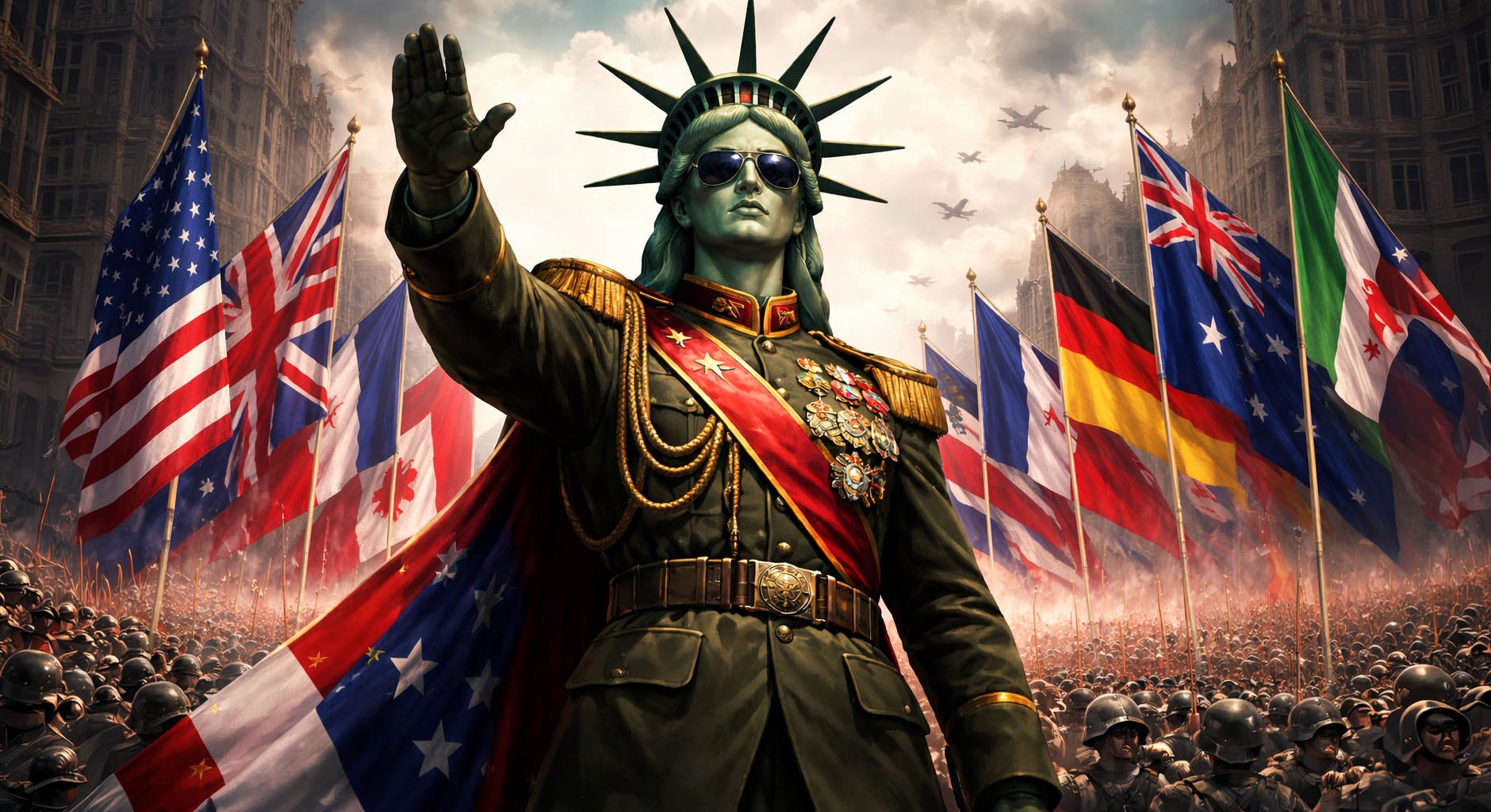
Today we’re talking about emergency powers — the special authorities usually held by a president, monarch, or head of state, sometimes triggered on their own initiative and sometimes on the advice of a prime minister, the powers that appear when something goes wrong: war, terror attacks, natural disasters, civil unrest, public health crises — the moments when leaders insist that extraordinary times require extraordinary measures.
I originally planned to approach this through an American lens because there’s no shortage of material there, but two things stopped me. Not everyone reading this lives in the United States, and there’s only so much appetite for America-focused analysis post after post. More importantly, however, the misuse of emergency powers is not an American problem; it is a democratic problem, a structural vulnerability built into most constitutional systems.
We don’t talk about it enough. We debate elections, corruption, political personalities, and party rivalries, yet we rarely slow down to examine what emergency powers actually are, why they exist, when they are justified, and when they quietly turn into something else.
The fact of the matter is that emergency powers are designed as necessary evils — mechanisms meant to bend normal rules without breaking the system, temporary tools to protect the state when ordinary procedures are too slow or too rigid — but power rarely behaves as if it is temporary.
So what exactly are these emergency powers? Why were they created in the first place? When are they defensible? When do they become dangerous? And why is it impossible to claim you love your country while supporting their misuse?
That is where we begin.
What Emergency Powers Actually Are
Emergency powers are legal authorities written into a country’s constitution that allow the executive branch to act outside normal procedures during a declared crisis. They are not accidental loopholes; they are intentional design features built into modern democracies.
The logic behind them is straightforward. In extreme situations that demand immediate action, the normal legislative process can be too slow, too fragmented, or too constrained to respond effectively. If a country is invaded, if a large-scale terrorist attack occurs, if a natural disaster devastates infrastructure, or if a fast-moving public health crisis spreads, governments may need to mobilize resources, restrict movement, or coordinate security measures without waiting for prolonged debate.
Emergency provisions exist to provide the required speed and flexibility.
Think of it like this: when there is an intruder in your house, you do not organize a family meeting to vote on what to do. You act first and deliberate later.
Emergency Powers Require Serious Justification
Emergency powers temporarily suspend democratic traditions because of an unforeseen serious matter and are non-democratic by nature, which is what makes them a necessary evil.
Democracy depends on debate, delay, checks, balances, judicial review, opposition voices, and public scrutiny. Emergency powers compress that process and concentrate authority. They accelerate decision-making by bypassing parts of the normal system.
Arguably, this “loophole” is one of the biggest threats to democracies because the democratic system itself grants non-democratic powers to individuals under certain conditions.
That is precisely why they require serious justification.
You cannot treat emergency powers as routine policy tools. You cannot invoke them because legislation is inconvenient, because opposition is annoying, or because governing through normal channels is politically difficult. They exist for situations that genuinely threaten the functioning of the state or the safety of the population in ways that ordinary law cannot adequately address.
The Foundation of Authoritarian Rule
Many non-democratic regimes did not begin with coups; they began constitutionally, within systems that had elections, parliaments, courts, and emergency clauses written into law “just in case,” clauses that eventually became the bridge.
The pattern is not chaotic but procedural: a crisis occurs, the executive declares an emergency, rights are temporarily limited, oversight narrows, opposition is restrained “for stability,” and the public accepts it because the threat feels real.
Then the emergency lasts longer than expected, expands beyond its original scope, and gradually reshapes the system — not by abolishing democracy in one dramatic act, but by governing through exceptions until the exception becomes the rule.
Weimar Germany: Emergency as a Fatal Habit
The collapse of the Weimar Republic is often reduced to a single moment in 1933, which is extremely misleading.
Before Hitler consolidated power, Article 48 of the Weimar Constitution allowed the president to suspend civil liberties during emergencies. It was intended as a safeguard against instability. Germany faced hyperinflation, political violence, and economic crisis. Emergency decrees seemed practical.
But they became frequent.
Those in power were short-sighted. They believed the constitutional “back door” was working almost miraculously, failing to consider what constant suspension of democratic traditions would mean in the long run.
Presidents increasingly ruled by decree instead of working through parliament. Legislative paralysis was bypassed through emergency authority. Over time, governing without full parliamentary consent stopped feeling extraordinary.
By the time Hitler came to power, the use of emergency powers had already been normalized. After the German parliament fire in 1933 — an event widely believed to have involved Hitler — emergency powers were invoked again. Few institutional barriers remained strong enough to resist.
Subsequently, civil liberties were suspended, political opponents were arrested, and media freedoms were curtailed.
The decree was presented as temporary.
It never truly ended.
Hitler did not need to abolish the constitution immediately; he conveniently used its emergency mechanism to hollow it out.
Italy: Crisis and Executive Strength
In the first quarter of the 20th century, Benito Mussolini did not seize total power in a single night either.
Italy faced post-war instability, economic tension, and social unrest. Mussolini was appointed prime minister while the country was still a democracy. Soon after, emergency measures followed to “stabilize” the state.
Opposition parties were gradually weakened. Press freedoms narrowed. Security powers expanded. Each measure was framed as necessary to restore order.
The shift from a parliamentary system to a fascist regime did not begin with the open abolition of democracy. It began with emergency responses to instability.
Authoritarian control grew through legal instruments.
Turkey: State of Emergency and Structural Change
After a convenient coup attempt in 2016, a state of emergency was declared, allowing the president to issue emergency decrees that led to sweeping dismissals, arrests, and institutional restructuring, with thousands of civil servants, academics, judges, and military personnel removed and numerous media outlets closed.
But the 24-month-long emergency period did more than neutralize immediate threats; it reshaped the institutional balance, expanded executive authority significantly, and paved the way for constitutional changes that consolidated presidential power.
While the country remained under the state of emergency, the parliamentary system was effectively replaced through a controversial referendum in which courts accepted fraudulent ballots that lacked an official stamp for validation.
And just like that, a presidential system was instituted that granted broad powers to one individual with little institutional accountability.
Hungary: Rule by Decree
Hungary provides another example of how emergency powers can extend executive control without formally abolishing democratic structures, as emergency provisions related first to migration and later to public health allowed rule by decree under specific conditions; parliament continued to exist, elections were still held, yet executive discretion steadily widened.
When emergency authority becomes a recurring instrument rather than a rare safeguard, the line between normal governance and exceptional governance begins to blur, and a democracy that repeatedly operates under emergency logic gradually internalizes centralized control as standard practice.
The transformation unfolds slowly, not dramatically.
Russia: Managed Democracy Through Crisis
In Russia, the consolidation of power occurred over years, often justified through security concerns, counterterrorism measures, and narratives of national stability.
After terrorist attacks in the early 2000s, reforms were introduced that centralized authority, including changes to how regional governors were selected. Media space narrowed, and opposition became increasingly constrained.
Formal democratic structures remained.
But the balance shifted heavily toward executive dominance, justified repeatedly by reference to national security and internal threats.
An emergency did not require a continuous formal state of emergency; it required a sustained narrative of vulnerability.
When threat becomes a constant backdrop, extraordinary measures begin to appear routine.
The U.S.: Abraham Lincoln and the Reach of Emergency Power
Anyone who believes “this could never happen here” should look at the United States during the Civil War under Abraham Lincoln.
In 1861, the Union was breaking apart. Southern states had seceded. War had begun. Lincoln responded fast — and aggressively.
He suspended habeas corpus, allowing detention without immediate court review. Thousands were arrested, including suspected Confederate sympathizers and political critics. He expanded the army without prior congressional approval. He ordered a naval blockade before Congress formally declared war. In some areas, civilians were tried in military courts instead of civilian ones.
Chief Justice Roger Taney ruled in Ex parte Merryman that only Congress could suspend habeas corpus. Lincoln ignored the ruling. His reasoning was blunt: if the government collapses, constitutional technicalities mean little.
That is emergency logic.
The United States did not become a dictatorship. Elections were still held in 1864. Congress later authorized parts of what he had done. The war ended. The extraordinary measures were not made permanent.
But the scope was enormous. Core civil liberties were curtailed. Executive authority expanded dramatically. And it all happened within a constitutional system that prided itself on checks and balances.
In a functioning democracy, Lincoln should have been held accountable for disregarding a court ruling. An investigation should have examined whether the suspension of judicial authority risked becoming normalized and setting a precedent. I’m not saying Lincoln should have been convicted, but the system should have made it clear that what was done was not taken lightly. Unfortunately, victors are rarely required to justify themselves — and that is precisely what Adolf Hitler was betting on.
The precedent remains. Once emergency powers are activated, even compliance with court orders can begin to look optional.
So, What’s Going on?
Emergency powers are not the problem. Their normalization is.
Every democracy builds in emergency authority because crises are real. War, terror, pandemics, collapse — governments must sometimes act quickly. But the same mechanism that allows speed also allows concentration of power. And concentration, once tolerated, rarely shrinks on its own.
History shows a pattern. A crisis occurs. Rights are limited temporarily. Oversight narrows. The public accepts it because the threat feels real. Then the emergency lasts longer than expected. Then it expands. Then it quietly reshapes the system.
Not through a dramatic abolition of democracy, but through governing by exception until exception becomes routine.
If you love your country, you love its limits on power. You love the courts that can block leaders. You love the opposition that can criticize without fear. You love the friction of debate and the inconvenience of checks and balances. Those are not obstacles to stability. They are the structure that makes stability legitimate.
At the very least, invoking emergency powers simply to get things done is a sign of a politician who cares more about their term than the country itself. A patriotic leader knows that normalizing emergency powers weakens democracy.
If you don’t care about the misuse of emergency authority because you approve of the outcome, you are short-sighted. If Trump can stretch emergency powers to bypass resistance, the same door is open for a president you deeply oppose. And you will have no ground to stand on when criticizing it.
Powers normalized today become tools tomorrow.