


If everything you know about the Bible comes from family, school, or church, reading the text for yourself for the first time can be a jarring experience. One thing strikes you almost immediately: the sheer number of deeply incestuous relationships recorded as a simple matter of fact.
Before the laws of Leviticus were carved in stone, the founding figures of the Old Testament were casually breaking almost every single one of them. Patriarchs married their sisters, fathers slept with their daughters-in-law (if not their own daughters), and heroes wedded their aunts, leaving later generations of scribes, translators, and theologians scrambling to edit the family tree.
Today we’re looking at the stories, at why the storytellers never blinked, and at the desperate, often hilarious edits that came afterward to cover them up.
The Patriarchs Broke Leviticus First
Leviticus 18:12 bans sex with a father’s sister. Exodus 6:20 says Moses’ father Amram took Jochebed, his own father’s sister, as his wife, which makes Moses’ parents an aunt and her nephew. The ancient Greek translation of the Hebrew Bible, produced in Egypt around the third century BCE, changes her to Amram’s cousin, an edit that shows the translators recognized the problem.
Leviticus 18:18 prohibits marrying a wife’s sister while the wife is alive. Jacob, whose twelve sons give Israel its tribes, marries Leah and Rachel within a week of each other, and Genesis frames the episode as a swindle by their father Laban, with no suggestion that Jacob sinned.
Leviticus 18:15 and 20:12 forbid sex with a daughter-in-law and set the penalty at death. In Genesis 38, Judah, ancestor of the tribe that produces King David, sleeps with his daughter-in-law Tamar, who has disguised herself as a prostitute to trap him. When he learns she’s pregnant, he declares her more righteous than he is (38:26), and the Gospel of Matthew later lists her among the ancestors of Jesus. Both the story’s verdict and the genealogy side with the lawbreaker.
Reuben, Jacob’s oldest son, sleeps with his father’s concubine Bilhah, and the text gives it a single sentence, noting only that Jacob heard about it (35:22). The punishment waits until Jacob’s deathbed in chapter 49. The count also has to include the children of Adam and Eve, whose spouses can only be their siblings. Genesis 5:4 says Adam had other sons and daughters, and Cain finds a wife in 4:17 without any explanation of where she came from.
Lot’s Daughters Get an Origin Story That Doubles as an Insult to Moab
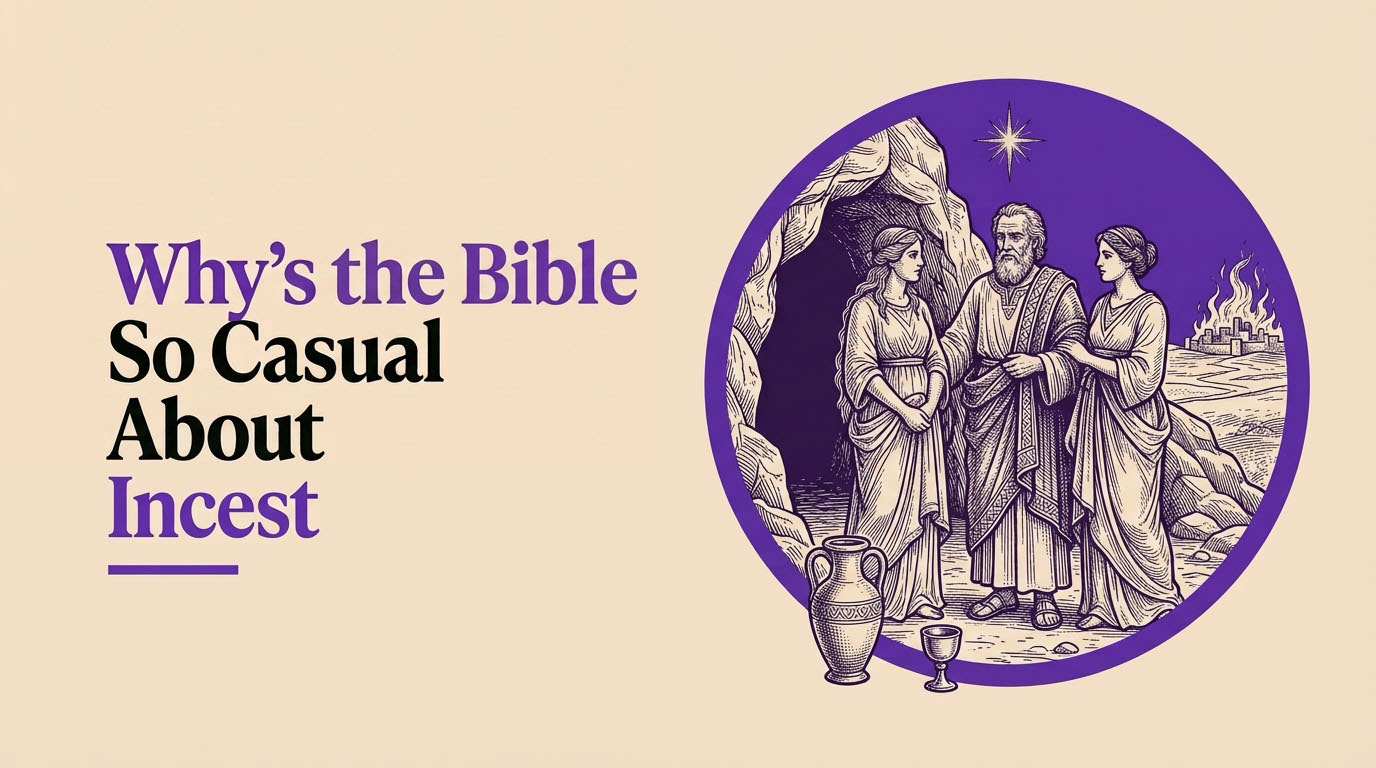
After God burns Sodom, Lot and his two daughters end up in a cave, and Genesis 19:30-38 picks up there. The older daughter tells the younger there’s no man left on earth to give them children, so they get their father drunk on two successive nights and both end up pregnant. The sons are Moab and Ben-Ammi, ancestors of the Moabites and Ammonites, two neighbors Israel spent centuries fighting.
The narrator never condemns the daughters or the father, even though we wouldn’t accept “I was drunk” as a valid excuse. The story just gives the daughters’ motive, which is keeping the family line alive, and moves on. The name Moab sounds like the Hebrew for “from father,” so the story works as an ethnic jab, a way of telling an Israelite audience that their rivals descend from a drunken night in a cave. The sneer is aimed at Moab and Ammon, and the sex that produced them gets treated as a plot device.
Then the story undercuts its own joke. Ruth, a Moabite woman, becomes the great-grandmother of David (Ruth 4:17-22), so the royal line of Israel descends from the people Genesis laughs at.
Tamar Tells Her Half-Brother to Ask Their Father
In 2 Samuel 13, Amnon, David’s oldest son, rapes his half-sister Tamar. Before he does it she tries to talk him out of it, and one of her arguments is that he should ask the king, who won’t keep her from him (13:13). Call it a stall, a plea, or a bargain, it only works as an argument if marriage between David’s children by different mothers was thinkable at David’s court. Leviticus 20:17 leaves no room for that move.
Tamar condemns the rape in strong terms (13:12), and nobody in the chapter, narrator included, mentions a law against the family tie. David gets furious and does nothing (13:21). Two years later his son Absalom has Amnon killed over it.
The Rulebook Arrives After the Cast Leaves
By the Bible’s own chronology, Abraham lives around 2000 BCE and Moses around 1300. The stories about them took shape and circulated for generations during the centuries of the Israelite and Judean kings, and the priestly writers who produced the long lists of banned relatives in Leviticus 18 and 20 worked later still, between the final years of the monarchy and the decades after the Babylonian exile. That leaves hundreds of years between the storytellers and the lawgivers.
The priests who put the Torah together inherited the stories as sacred and kept them, crimes included. Where they noticed a problem, the repairs are small and clumsy. The half-sister explanation in Genesis 20:12 turns up in one of the three tellings of the wife-sister story (Genesis 12, 20 and 26) and nowhere else. Deuteronomy 27:22 curses anyone who sleeps with his sister, and the prophet Ezekiel, a priest writing in exile in the sixth century BCE, was still shouting at Jerusalem’s men for violating their sisters and daughters-in-law (Ezekiel 22:10-11). The rules were still being pushed on a population that hadn’t gotten the memo.
Israel’s neighbors had no uniform ban either. Egyptian kings married their sisters, and census returns from Roman Egypt show ordinary families doing the same, which a historian of Rome named Keith Hopkins documented in a famous 1980 study. In other words, from a historical perspective, there was nothing wrong with the Israelites; the Bible merely gives snapshots in time of the evolution of morality in Hebrew society.
Augustine’s Answer Concedes the Whole Point
Augustine, the father of Original Sin as we know it, addressed the problem in the early 400s CE in his City of God (Book 15). He argued that the first humans had to marry their siblings, and that once the population grew, the ban was introduced to spread family bonds across more households. Modern apologists swap in a genetic argument that harmful mutations hadn’t yet piled up, a claim Augustine never made. Neither answer rescues Abraham, who lived thousands of years after Eden by the Bible’s own count, in a world full of unrelated women, and still married his father’s daughter.
Both answers also hand over the argument. If the rule changes with circumstances and the heroes did what the later law not only forbids but makes it a capital crime, then the Bible reads like the record of a moral code developing over centuries, written down by people who had been living differently before the priests got to it. A book that records a moral code changing can’t also be the work of a single mind issuing unchanging commands.
If you’re getting something out of this, I’d love for you to become a paid subscriber. You unlock the exclusive content of every article and help keep The Unholy Truth alive.
Later Readers Noticed Too, and They Went to Work on the Family Tree
Within a few centuries, Jewish and Christian readers saw everything above and started patching. A translator edits Moses’ mother into a cousin. A rabbi decides Sarah was Abraham’s niece, which contradicts Abraham’s own words in Genesis 20:12. A Jewish book from the second century BCE hands Cain a sister-wife with a name, so nobody has to wonder anymore.
The paid section below goes through those repairs one by one, including the Egyptian court where the Greek translators of Moses were working when they made their edit, and a rabbinic fix that creates a bigger contradiction than the one it solves. If you’re reading this as a free subscriber, that’s the part where the story of how readers handled the Bible’s family tree gets stranger than the family tree itself. Upgrade to get it.
Exclusive Content for Paid Subscribers
How Readers Rewrote the Family Tree to Protect the Heroes
Here’s the bonus.
Once the law against close relatives hardened, the people who read Genesis had a problem on their hands, because the founding families were full of exactly what the law banned. They handled it the way people handle an embarrassing relative, with a mix of editing, renaming, and a straight face.
The Greek translators moved …