
Why You Could Vote for Adolf Hitler Too
How hunger, fear, and bad politics turned a wounded nation into a mob—and why it can happen anywhere.

When I was a kid, the story went like this: Germans somehow lost their minds and voted for a bad man named Adolf Hitler who hated Jews. Then the U.S. dropped two atomic bombs on Japan that somehow saved Europe, the war ended, and the world was saved. Hitler died, America won, and evil was defeated. Neat, simple, heroic.
But something about that story never made sense. How could an entire nation just “decide” to follow a madman? Why would ordinary people, not monsters, cheer him on? The way it was told to me felt too clean, too convenient—and it said nothing about why the Jews. There had to be more. This piece is about those missing and quiet parts of the story.
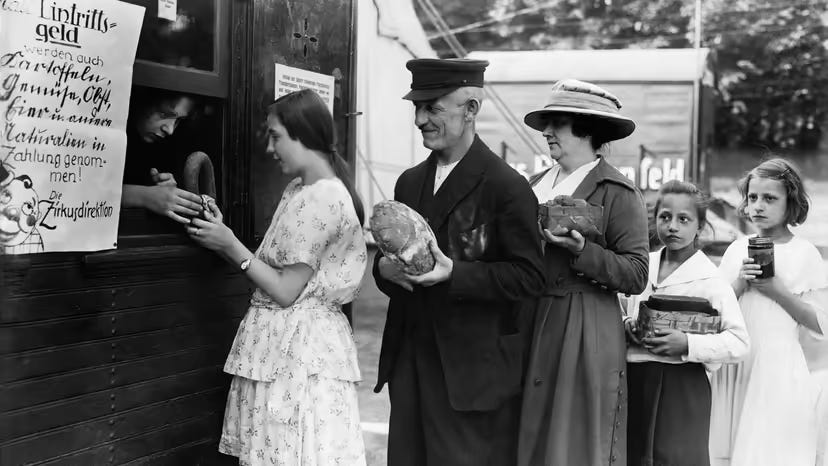
Picture this: starving families in Berlin cutting up a dead horse for food. That’s not exaggeration—it really happened. Germany in 1918 was broken in every way a country can be broken. The Great War had chewed it up and spat it out. Millions were dead, cities wrecked, industries gone. Then came the Treaty of Versailles—an international mugging disguised as peace.
The Allies stripped Germany of its colonies, land, and pride. They demanded impossible reparations, draining what little wealth was left. Inflation went insane. A loaf of bread cost a wheelbarrow of cash. People burned banknotes to stay warm because they were worth less than coal. Imagine watching your life savings vanish before lunch—that’s how you build the kind of rage that makes anything sound better than the present.
The Weimar Mess
The Kaiser fled, and Germany tried something new—democracy. The Weimar Republic. On paper, it looked modern and fair. In practice, it was chaos. Every election brought new parties, new promises, new disappointments. People were arguing about freedom while starving to death.
The old soldiers hated it. The rich hated it. The poor didn’t trust it. And the politicians running it were blamed for everything—the war, the humiliation, the hunger. They signed the Versailles Treaty, after all. The word “Weimar” became a curse.
So when a loud ex-soldier from Austria started shouting that Germany needed strength, unity, and revenge—much to the elites’ surprise, since they saw him as a ridiculous, funny-looking man screaming nonsense—it hit home. People didn’t care if he sounded insane. He sounded sure.
Hitler’s Sales Pitch
Adolf Hitler was sellıng what people were desperate to buy: hope with a side of rage.
He told Germans they weren’t losers; they were victims. He said their suffering wasn’t their fault—it was the fault of the weak government, the greedy bankers, the foreign powers, and, of course, the Jews. It was a story that explained everything in one breath and promised revenge in the next.
He didn’t invent nationalism; he just gave it a new enemy list. He didn’t create hate; he organized it.
When Hunger Meets Fear
When you’re starving, democracy feels like a luxury. When your kids are hungry, you don’t argue about checks and balances. You want action. Hitler’s speeches were full of it—bold, angry action. He’d restore jobs, rebuild the army, make Germany “great” again. Sound familiar?
By the early 1930s, unemployment was sky-high. People were losing homes and dignity. Hitler promised both back. He said, “Give me power, and I’ll fix this.” And people believed him—not because he was convincing, but because no one else had a plan that made them feel something.
It wasn’t his words. It was the relief they brought. Someone finally sounded like they cared.
Blame Makes Things Simple
Complex problems mean complex solutions—things most people can’t fully grasp and that scare them. Hitler simplified everything. The economy was dying? Blame the Jews. The government weak? Blame the communists. Crops failing? Blame foreigners. His genius wasn’t originality—it was packaging hate as patriotism.
Every dictatorship starts with a fairy tale: “We’re the good guys. They’re the problem.” It’s a comforting lie, especially when the truth hurts too much to face.
The German middle class—the teachers, doctors, lawyers—they weren’t stupid. They just wanted stability. They thought Hitler would restore order and then step aside. He never did. They handed him power thinking they could control him. He used that power to control them.
The Power of Repetition
Hitler didn’t invent propaganda either. He just mastered it. The Nazis learned that if you repeat a lie enough times, it stops sounding like one. “Germany betrayed,” “Jews are parasites,” “We need strong leadership.” Posters, rallies, songs, newspapers—constant noise until people started thinking the same thoughts in unison.
He turned politics into performance. His rallies were theater—flags, chants, lights, drums. It felt like religion with uniforms. People didn’t just attend; they worshiped. He made them feel part of something big, something that mattered.
That’s what populism always sells: belonging. You’re not alone. You’re part of the movement. You’re one of the “real people.” Everyone else is the enemy.
How Good People Become Bad Followers
It’s easy to judge Germans now and say, “I’d never fall for that.” But look around. Every generation says that before it happens again.
Good people don’t wake up one day and decide to support a dictator. They drift toward it. They start with “He’s not perfect, but he’s strong.” Then “He’s controversial, but he says what we’re all thinking.” Then “At least he’s fixing things.” Then it’s too late.
You don’t notice the line until you’ve crossed it. And once you do, going back feels like betrayal.
Democracy’s Fatal Flaw: Boredom
Dictatorship sells drama; democracy sells paperwork. Hitler knew people got bored with compromise. Weimar politicians argued, delayed, and negotiated. Hitler shouted, promised, and acted. He gave people a show. He looked like energy after years of exhaustion.
That’s the danger of democracy—it works so slowly that impatient people mistake noise for leadership. Hitler turned impatience into power. Every broken promise from the Weimar Republic made his lies sound more believable.
He told Germans, “Democracy failed you. I won’t.” They believed him until they couldn’t believe anything else.
When “Law and Order” Means Control
One of Hitler’s biggest moves was promising “law and order.” People cheered. They were tired of crime, strikes, protests, and chaos. What they didn’t realize was that “order” meant silencing everyone who disagreed.
He outlawed opposition, censored the press, and filled prisons with anyone who complained. He didn’t create peace; he created silence.
That’s how it always works. First they silence the radicals, then the moderates, then the quiet ones who just want to stay out of trouble. By the time they come for you, there’s no one left to talk.
The Economy Trick
By 1936, Hitler looked like a miracle worker. Unemployment dropped, factories reopened, and highways appeared. But it was all fake prosperity—built on military spending, slave labor, and robbery from the future. Still, people didn’t care. They were working again.
It’s easy to ignore horror when your stomach’s full. That’s how tyrants survive—feed the public just enough comfort to stop them asking questions.
If you wonder how people lived through that without rebelling, remember this: as long as they had bread, jobs, and a sense of pride, most didn’t want to know the truth.
The Normalization of Madness
By the time things turned openly violent, it all seemed “normal.” Jews banned from jobs? Normal. Neighbors disappearing? Unfortunate, but normal. Secret police everywhere? Well, that’s just “security.”
Humans adapt fast. We can get used to almost anything if it happens in small steps. That’s how you boil a frog—slowly turn up the heat until it’s too weak to jump out.
The Big Lie Still Works
Hitler’s biggest legacy isn’t his death or defeat. It’s the manual he left behind—the propaganda blueprint every manipulator still uses.
Step 1: Find an enemy.
Step 2: Blame them for everything.
Step 3: Promise to destroy them.
Step 4: Never stop lying.
Step 5: Call yourself the victim.
You see it everywhere: in modern politics, talk shows, even social media. “They’re ruining our country.” “They’re taking our jobs.” “They’re brainwashing our kids.” Different enemies, same trick.
Why You Could, Too
You might think you’re immune. You’re not. No one is. The ingredients that made Hitler possible are human, not German. Fear, pride, poverty, humiliation—they work anywhere.
If your country ever hits a deep enough crisis—job losses, social collapse, violent polarization—you’ll be shocked how fast people start cheering for “a strong leader.” You’ll see neighbors trading freedom for safety. You’ll see ordinary people nodding when the government blames someone else for their pain.
And you might even find yourself saying, “At least he’s doing something.”
That’s how it starts.
What the Germans Didn’t See Coming
Most Germans didn’t think they were voting for genocide. They thought they were voting for jobs, order, and pride. Hitler didn’t say, “Elect me and I’ll start a world war.” He said, “Elect me and I’ll make you proud again.” He gave them the dream of unity—and then poisoned it.
When democracy fails to deliver, tyranny starts to look efficient. When people lose trust in the system, they’ll follow anyone who says, “I alone can fix it.”
That line should always set off alarms. Because it means he doesn’t plan on sharing power.
Lessons People Keep Forgetting
Hitler rose because enough people stayed silent while others shouted. Because newspapers wanted readers, not truth. Because business owners wanted profits, not morality. Because churches wanted peace, not confrontation.
Every evil needs a crowd of good people doing nothing.
When someone attacks free speech, defends censorship, mocks democracy, or praises “strong men,” remember: that’s how it began. One speech at a time. One excuse at a time. One law at a time.
It Doesn’t Take Much
History isn’t a horror movie that happens once. It’s a warning that keeps repeating itself until someone listens. You don’t need a Hitler for it to happen again. You just need a frightened, divided society and a loudmouth with answers that sound easy.
Then the slogans come back: “Make us strong again.” “Take our country back.” “We’re the real people.” You’ve heard them before. They’re not patriotism—they’re panic wearing a flag.
The people who voted for Hitler weren’t born monsters. They were broken, scared, and tired. The tragedy is that they traded one kind of suffering for another—because someone told them it was strength.
Last Thoughts
If you think you’d never fall for it, prove it. Question loud leaders who promise too much and blame too easily. Watch for politicians who divide the world into “us” and “them.” And when you hear someone say, “It can’t happen here,” remember—it already did once. It started with people who thought the same thing.
Afterword
Today, we call Donald Trump a populist, using the same handbook that far-right authoritarian leaders have relied on for a century. What’s worse is how many still cheer for him. But there’s another side, too—a growing crowd told that Trump supporters are the enemy. They’re called the “far left” only because it’s the opposite of “right,” not because what they’re doing has anything to do with what’s traditionally called the far left.
This crowd has been convinced that to beat Trump, you have to act like Trump. They mock atrocities, excuse hate if it comes from “their side,” and use the same misogynistic language they claim to reject. Some even celebrated the assassination of a man—as if violence suddenly becomes acceptable when it hits the right target. It doesn’t matter that this was a man who once said gay people should be stoned to death. In a democracy, the true colors of people appear when atrocities and injustice happen to their opposition. It’s easy
Nobody seems to ask the real question: what drives so many Americans to a man like Trump? Because if you fix those problems—the anger, the insecurity, the loss of trust—then the problem of men like Trump solves itself.
They’re becoming indistinguishable from the people they say they despise. And if fighting the opposition means dropping your values and copying their tactics, count me out. You should be out too.
Perhaps all this deserves its own article.
Your turn: leave a comment, tell the world what you think, and if you like where this is going, subscribe to support this space. The world doesn’t change because people stay quiet—it changes because they finally speak.


Good article. An interesting tidbit is that only one church in Germany refused to compromise, the Jehovah's Witnesses. I am not a fan of the sect in general, but when Naziism arrived, they drew a line, and paid in the Holocaust.
I am going to disagree with the Left Right equivalency narrative. Sure there are obnoxious people on the left, every political movement has them. But to suggest that overall the left's tactics are at all equivalent with the right is not valid, in my opinion.
Back in 1997, I read a book, "The Fourth Turning", that basically predicted much of what has happened over the last 30 years. Its about cycles of history that repeat over the millennia. Bottom line. When civilization gets to this point, it always devolves to total war, followed by a new beginning of trust and enlightenment. But one side has to win. Its certainly good to recall that the allies/democracies didn't win WW II by being nicer than the Nazis and Japanese. We were just as brutal, perhaps more so, than the other side. Fire bombing cities, nuclear weapons, etc. Millions of innocent non-combatants died. However, it should also be said that we treated prisoners humanely in general, and observed other parts of what is now called the Geneva convention. And after the end of the war, we rebuilt the countries of our former enemies. So its a mixed bag, there was no one with clean hands, but I think we did what we had to do to resolve the crisis. And it will probably be this way again.