


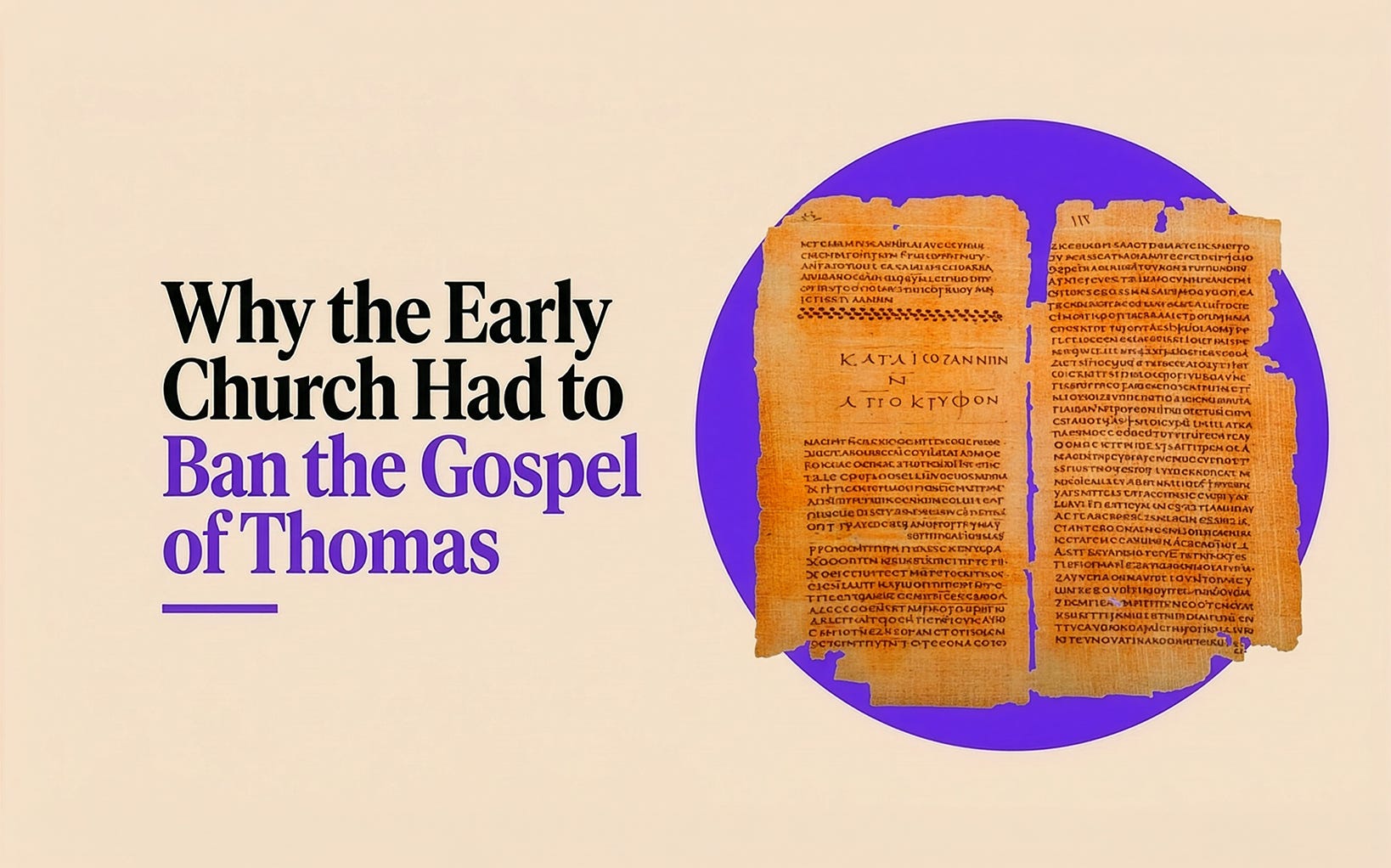
In December 1945, a farmer digging for fertilizer near the town of Nag Hammadi in Upper Egypt hit a sealed clay jar. Inside were thirteen leather-bound books written in Coptic, the language Egyptian Christians used in the fourth century. One of them opens by announcing that these are the hidden sayings the living Jesus spoke, and that Judas Thomas wrote them down.
It’s an easy mistake to assume the church threw this book out primarily because it was weird. It’s got some strange lines, sure, but the Bible has never been short on weird. Ezekiel has wheels covered in eyes, Revelation has a seven-headed beast, and Mark has a young man running off naked during Jesus’ arrest for reasons nobody’s ever explained, and all three made it into the Bible with no trouble at all.
The trouble with Thomas is what it hands to ordinary believers.
A Gospel With No Crucifixion and No Resurrection
Thomas has 114 sayings and almost nothing else. It mentions no birth in Bethlehem, no miracles, no trial, no crucifixion, and no empty tomb. Jesus talks, a disciple asks a question now and then, and Jesus talks some more. About half the sayings have close matches in Matthew, Mark, and Luke, including the mustard seed, the sower, the blind leading the blind, and the prophet with no honor in his hometown.
The first saying lays out the whole deal: whoever finds the meaning of these words won’t taste death. Salvation comes from understanding what Jesus said, and his death doesn’t come into it.
Paul, writing to the Christians in Corinth in the 50s, says the core of what he passed on is that Christ died for our sins, was buried, and was raised on the third day (1 Corinthians 15:3-4). A few lines later he tells them that if Christ wasn’t raised, their faith is worthless and they’re still in their sins (15:17).
Paul's version relies on something that happened once to one man, and the only way to get your share of it is through a church that baptizes you and hands you the bread and wine. Thomas’ Jesus gives out sayings, and whoever works out what they mean has what they came for, which you can do alone with the book open on a kitchen table, with no baptism, no bread and wine, and no empty tomb.
The Kingdom That Doesn’t Need a Priest
Saying 3 opens with Jesus mocking religious leaders who claim the kingdom is up in the sky. If that’s where it is, he says, the birds will get there first, and if it’s in the sea, the fish will beat you to it. The kingdom is inside you and outside you, and once you know yourselves, you’ll be known.
Furthermore, in Saying 113, the disciples ask when the kingdom’s coming, and Jesus tells them waiting for it won’t bring it, because it’s already spread out across the earth and people can’t see it. In Saying 77 he says that if you split a piece of wood or lift a stone, you’ll find him there.
Then there’s Saying 14, where Jesus tells his followers that fasting will bring sin on them, praying will get them condemned, and giving to charity will damage their spirits. That’s a Jesus who looks at the three pillars of organized piety and waves them off.
If you read this the way a bishop would have around the year 200, it’s not hard to see why it's such a problem. His authority rests on sacraments only he can perform, fasts he puts on the calendar, and a collection plate. Thomas tells his congregation the kingdom is already around them, under the rocks in their own yards, and that his fasts are hurting them. Saying 108 finishes the job: whoever drinks from Jesus’ mouth becomes like him, and Jesus becomes that person with no ladder, no ranks, and nobody standing between them and God holding a key.
Doubting Thomas Was a Smear Job
Mark, Matthew and Luke name Thomas in their lists of the twelve and never give him a single line. The Gospel of John, written around 90-100, is the only book in the Bible that gives him a personality, and every trait it hands him is a failure.
In John 11:16, Thomas gloomily tells the disciples they should go die with Jesus, missing the point of the Lazarus story completely. In John 14:5, Jesus tells the disciples they know the way to where he’s going, and Thomas answers that they don’t even know where he’s going, so how could they know the way? Then comes the scene that stuck him with a nickname for two thousand years. In John 20:24-29, Thomas misses the risen Jesus’ first appearance, refuses to believe until he can put his fingers in the nail holes and his hand in the wound in Jesus’ side, and gets scolded when Jesus comes back: blessed are the ones who haven’t seen and believe anyway.
Thomas’ followers taught that you meet Jesus by looking inward, that the kingdom is already here, and that the body is a poor thing next to the spirit (Saying 29 marvels that such great wealth could live in such poverty). John’s answer is a Thomas who can’t know anything until he’s poked a physical body that died and got up again, and who gets corrected to his face by the risen Christ. John also stresses more than any other gospel that the resurrected Jesus had a body you could touch. When the only writer who bothers to develop a character uses him three times as the guy who doesn’t get it, and the third time lands on the exact issue that character’s followers were known for, it’s fair to call it a targeted hit.
The first move against Thomas was made inside the New Testament, generations before any bishop wrote a list.
One Secret Conversation Too Many
In Saying 13, Jesus asks his disciples to tell him who he’s like. Peter says a righteous angel, and Matthew says a wise philosopher, and Thomas says his mouth can’t put it into words. Jesus takes Thomas aside and tells him three things. When Thomas comes back, the others ask what Jesus said, and he tells them that if he repeated even one of those things, they’d pick up stones to kill him, and fire would come out of the stones and burn them up.
In Matthew 16:13–19, Jesus asks the same question, but in this telling, Peter gets it right and consequently Jesus hands him the keys to the kingdom. Matthew’s scene became the charter for church authority, a line of leaders passed down from Peter. Thomas’ scene flips it. Peter gets it wrong, and the one disciple who understands gets private teaching that the rest of the group, the future leadership, couldn’t handle.
Irenaeus, the bishop of Lyon in Gaul around 180, spent five books of his Against Heresies fighting groups who claimed Jesus gave secret teaching to a chosen few. His answer was that the apostles taught everything in the open and handed it to the bishops, whose succession you could trace name by name. He also insisted there could be four gospels and only four, because the earth has four corners and there are four winds. Those two arguments prop each other up. A fixed set of four books, read in public and explained by bishops, makes the bishop the gatekeeper. A fifth gospel saying the best teaching went to one man in private makes the bishop unnecessary.
What makes this dynamic so intriguing is how much weight second-century writers placed on apostolic authority. Yet ironically, it wasn't the original apostles' Christianity that ultimately defined the institutional church, but it was Paul, an outsider who never met Jesus in the flesh.
From Warning Labels to a Sealed Jar
Hippolytus, a church leader in Rome in the early 200s, wrote that a heretical sect called the Naassenes quoted from a gospel under Thomas’ name. Origen, the most prolific Christian scholar of the third century, put the Gospel of Thomas on his list of gospels written by heretics. Eusebius, the bishop of Caesarea who wrote the first history of the church around 325, filed it with the books to be rejected as heretical. Cyril, the bishop of Jerusalem around 350, told people preparing for baptism not to read it and blamed it on a disciple of Mani, founder of a rival religion out of Persia.
In 367, Athanasius, the bishop of Alexandria, sent his yearly Easter letter to the churches of Egypt. It listed the 27 books of the New Testament exactly as Christians have them today, the earliest surviving list that matches, and warned against secret books that heretics had made up and passed off as ancient. That letter went out to every monastery in Egypt, including the network of communal monasteries founded by a former soldier named Pachomius along the Nile, a few miles from where the jar turned up.
Nobody left a note explaining the jar. What we do have is the scrap paper glued inside the book covers to stiffen them, which includes letters and receipts from the 340s. So the books were bound near those monasteries, and someone sealed them in a jar and hid them in the cliffs around the same time Egypt’s most powerful bishop was ordering heretical books out of circulation. Somebody loved those books enough to hide them instead of burning them, and the order that made hiding them necessary came from the top.
The Gospel That Wouldn’t Stay Buried
The church won the argument for sixteen hundred years, but it never managed to erase the book. Between 1897 and 1904, two Oxford researchers digging through an ancient garbage dump at Oxyrhynchus in Egypt pulled out three scraps of papyrus with Greek sayings of Jesus that nobody could place. When the Nag Hammadi copy turned up, scholars realized the scraps were pieces of Thomas, copied in Greek in the 200s. The book was being read and copied in more than one language, in more than one town, for well over a century before Athanasius wrote his letter.
The New Testament came together through choices people made, and those choices tracked what their church needed. A gospel where salvation came through a crucified and risen body, handed out by bishops through sacraments, got in. A gospel where salvation came through understanding, open to anyone willing to split a piece of wood and look, got condemned by name, and the people who treasured it ended up burying it in a jar.
Ironically, condemning Thomas by name is what saved it, because its readers hid it carefully in a jar that kept it until our day. On the other hand, almost nothing survives of the Gospel of the Hebrews, which the church chose to ignore instead of declaring it heretical.
Before anyone starts a Thomas fan club, though, there’s a problem. The book’s final saying is the one its modern promoters quietly skip, and it complicates the story of the enlightened gospel the bishops were too narrow to accept. In this edition’s bonus section, I go through Saying 114, where Peter tries to throw Mary Magdalene out of the group and Jesus’ fix is worse than the problem. If you're a free subscriber who's been thinking about upgrading, today's as good a day as any, and the bonus is waiting on the other side.
Exclusive Content for Paid Subscribers
The Last Saying Nobody Broadcasts
Today, Thomas is marketed as the gospel the patriarchs tried to bury. It’s mystical, accessible to anyone, free from church hierarchy, and filled with scenes where Mary Magdalene and Salome stand among the disciples asking questions. Most of that modern pitch holds up, but it conveniently overlooks the last line of the book.