


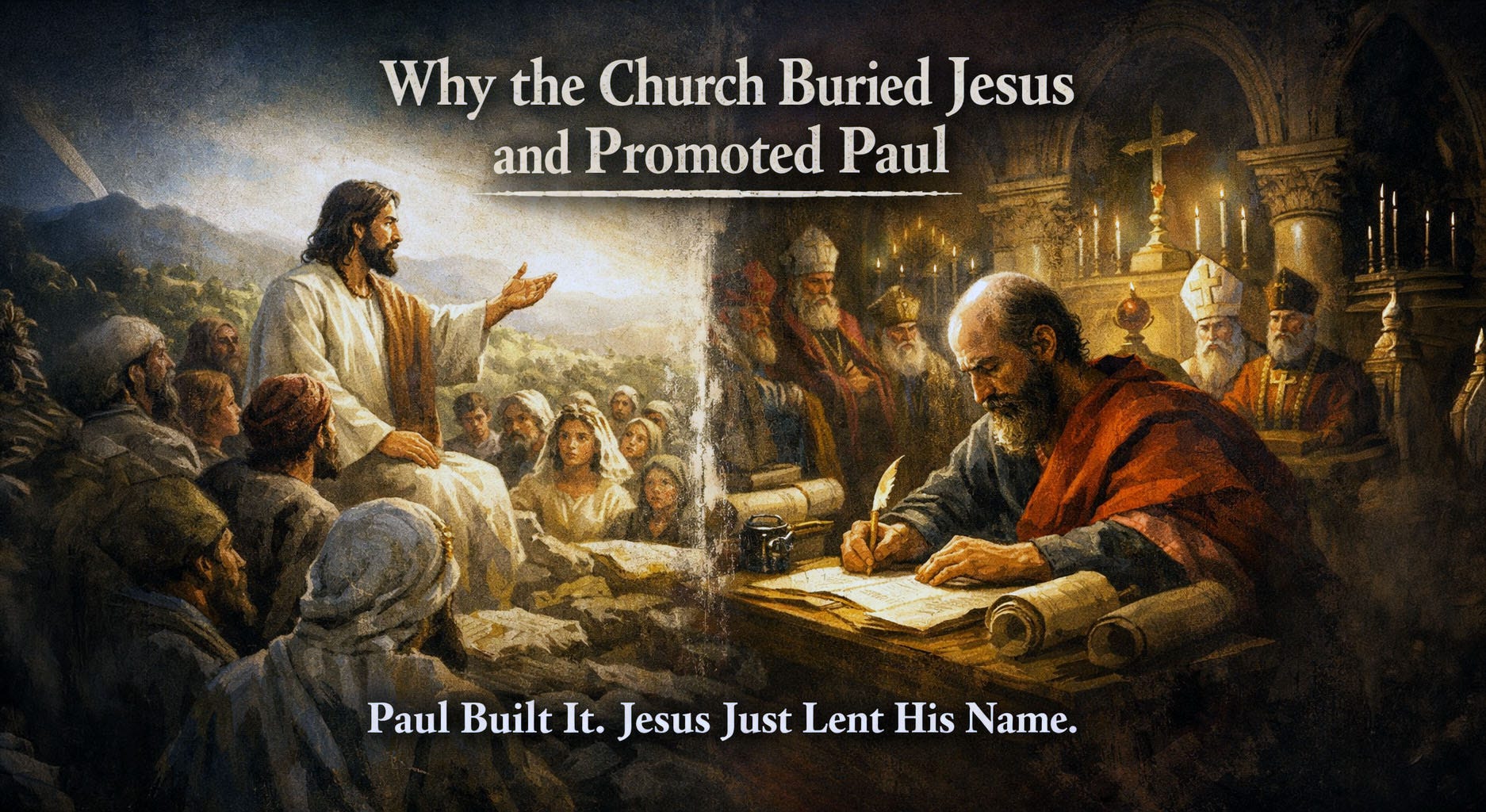
There’s a question that doesn’t get asked in church, or anywhere Christianity gets discussed seriously.
If Jesus founded Christianity, why does it look nothing like what Jesus taught?
Jesus preached in Aramaic to poor Jewish peasants in Galilee. He talked about the Kingdom of God arriving on earth, said nothing about original sin, nothing about his own pre-existence as a divine being, nothing about faith in his death and resurrection being the ticket to salvation. He told people to feed the poor, forgive their enemies, and stop performing piety for an audience.
Paul, writing decades later in Greek to Gentile audiences scattered across the Roman Empire, built something else entirely. Something that became the Christianity you actually recognize.
The Church didn’t follow Jesus. And there’s a “good” reason for that. At least good for the church itself.
Quick clarification before anyone’s blood pressure goes up.
When I write about Jesus, I’m not treating the Gospels as a verified biography or theological claims as historical fact. However, when I look at things from Christianity’s perspective, I sometimes assume those claims are true for the sake of discussion, and that can confuse people. That’s all there is to it.
Jesus Had an Actual Message
If you look into the Synoptic Gospels — Mark, Matthew, Luke — you’ll see what Jesus primarily talks about. The Kingdom of God. That’s the running theme, showing up over 80 times across those three gospels as the center of his parables, his sermons, his whole program.
And what is the Kingdom of God in Jesus’ mouth? Not heaven after you die, but a coming transformation of the present world — a reversal of the social order where the poor inherit the earth, the hungry get fed, and the powerful get knocked off their thrones. It’s thoroughly Jewish, thoroughly apocalyptic, and thoroughly this-worldly.
Jesus wasn’t preaching believe in me and you’ll go to heaven or worship me, not the God of Moses. Instead, he was preaching God is about to fix everything, and here’s how to live in anticipation of that.
That’s a profoundly different religion than the one that would eventually build cathedrals, crown emperors, and burn heretics.
Paul Wasn’t Jesus’ Acquaintance.
Paul is, by his own admission, the most influential figure in early Christianity — and he never met Jesus during his lifetime, not because he wasn’t around when Jesus handpicked twelve disciples. He was, but Jesus didn’t choose him.
It’s entirely a personal claim that his encounter with Jesus was a vision on the road to Damascus, a revelation he received, as he puts it in Galatians. The evidence for it isn’t any stronger than the evidence offered by your typical cult leader who claims to have conversations with Jesus.
Paul’s Jesus isn’t a wandering Jewish preacher from Galilee but a cosmic figure who existed before creation, descended into human flesh, died as a sacrifice for sin, and rose again to become Lord of the universe. Read Romans, Galatians, and 1 Corinthians, and you’ll barely find a single reference to anything Jesus actually said or did during his earthly ministry.
Instead of the historical Jesus, Paul was interested in the theological Christ, a figure he largely constructed through his own visionary theology and creative reading of Jewish scripture.
The scholar E.P. Sanders spent decades on this, as did James Dunn, N.T. Wright, and a dozen others across the ideological spectrum. The consensus, even among scholars who are personally Christian, is that Paul’s theology represents a dramatic transformation of what Jesus was actually teaching.
Paul moved the goalposts. Jesus said the Kingdom was coming. Paul said the Kingdom had already been inaugurated — spiritually, in the risen Christ — and what mattered now was your personal relationship to that event.
Sin. Grace. Faith. Justification. These are Paul’s categories, not Jesus’.
The Church Had a Problem
By the second and third centuries, the Jesus movement had splintered into a dozen directions. Jewish Christians still kept the Torah and saw Jesus as a prophet or messiah — not God. Gnostics thought the material world was evil and that Jesus came to liberate souls from it. Communities were circulating gospels that never made the final cut — the Gospel of Thomas, the Gospel of Mary, the Gospel of Philip.
The emerging orthodox Church — the one that would eventually ally with Rome under Constantine — needed to consolidate, needing a theology that could be systematized, taught, enforced, and used as a foundation for institutional authority.
Paul gave them that. Jesus, frankly, didn’t.
Jesus left nothing in writing, didn’t found an institution, and didn’t lay out a theology of priesthood, sacrament, or ecclesiastical hierarchy. His ethics — love your enemies, give away your possessions, don’t judge — are genuinely radical and resist institutionalization almost by design.
Paul, by contrast, handed them a theological system: salvation through faith in Christ’s atoning death, the Church as the body of Christ, clear language about authority and order in congregations. The later Pauline letters even supplied household codes and a defense of hierarchical structure.
You can build a Church on Paul. It’s very hard to build a Church on the Sermon on the Mount without your institution immediately indicting itself.
They Couldn’t Erase Jesus
The Church didn’t throw Jesus out — the whole claim to legitimacy rested on him. What happened was subtler. They filtered Jesus through Paul.
The gospels themselves were written after Paul’s letters — decades after, in most cases. And while they most likely preserve genuine historical material about Jesus, they also reflect the theological concerns of their authors’ communities and era. By the time the canon was fixed in the fourth century, Jesus had been thoroughly theologized. The Synoptic Jesus, who almost never calls himself divine, had been brought into alignment with the Johannine Jesus, who declares I and the Father are one and identifies himself with the pre-existent Logos.
The Jesus of the Nicene Creed — made binding at the Council of Nicaea in 325 CE — skips almost entirely over what Jesus taught, going from virgin birth straight to crucifixion and resurrection. His actual ministry, his actual message, doesn’t appear. What matters is who he was theologically, not what he said practically.
Look at What Got Emphasized
Want to understand which Jesus the Church actually promoted? Look at the liturgical calendar, the sermon topics, and the theological priorities that shaped two thousand years of Christian history: the Incarnation, the Crucifixion, the Resurrection, and the Second Coming. These are all events, all categories that fit nicely into Paul’s theology, moments where Jesus’ body becomes the central vehicle of doctrine.
By contrast, how often has a mainstream Christian church organized its theology around the Sermon on the Mount, the Parable of the Rich Young Ruler, or Jesus’ instruction to sell everything and give the proceeds to the poor?
Attempts to take those teachings seriously have rarely gone smoothly. Liberation theology tried, and the Church spent decades suppressing it. The Social Gospel movement tried as well and was often dismissed as soft, political, or insufficiently focused on saving souls.
Across the centuries, personal salvation — Paul’s emphasis — has consistently dominated, while social transformation — the emphasis of Jesus’ teaching — has been marginalized, spiritualized, or outright condemned.
The Pauline gospel, whatever its theological merits, fits far more comfortably with existing power structures. It asks believers to hold the correct beliefs and live morally as individuals, while the gospel Jesus preached calls for something far more disruptive: the dismantling of the systems that make people poor in the first place.
Empires have rarely struggled to decide which version to sponsor.
What Would Jesus Think?
Take the historical Jesus — an apocalyptic Jewish prophet, advocate for the poor, and harsh critic of religious institutionalism and the priestly class — and drop him into a modern megachurch, a Vatican press conference, or a prosperity-gospel broadcast, and he would recognize almost nothing.
He was suspicious of wealth, yet the Church accumulated staggering wealth. He was hostile to religious hierarchy performing piety for status, yet the Church built elaborate hierarchies and dressed them in gold. He preached an imminent Kingdom that would overturn the powerful, yet the Church eventually became one of the powerful.
Paul isn’t responsible for all of that. But the theology he articulated — faith over works, grace over law, the spiritual over the material — gave later Christians the tools to turn Jesus’ very concrete demands into something personal, interior, and safely postponed to the afterlife.
In the process, the Kingdom of God became heaven, the reversal of the social order became individual moral transformation, and the poor who were supposed to inherit the earth became souls who would one day go to paradise.
Jesus was elevated to God, but his message was quietly buried.
So, What’s Going On?
Most Christians have never been told that the faith they practice is primarily Pauline, not Jesuanic. That’s not a minor footnote. That’s the whole story.
The theology you inherited — sin, grace, faith, personal salvation, heaven as the destination — comes overwhelmingly from a man who never heard Jesus preach, never saw him heal anyone, and built his theology from a vision on a road and a creative rereading of Jewish scripture.
That might not bother you. Fine. But you should at least know it.
Because when Christians argue today about whether the Church should feed the poor or focus on saving souls, they are not having a new theological debate. They are reenacting a conflict that was settled — politically and institutionally — in the second and third centuries. The Jesus side lost, the Paul side won, and the winners got to write the syllabus.
The Church didn’t suppress the Sermon on the Mount with a memo. It simply kept preaching Romans instead, week after week, for centuries, until most people could no longer tell you what Jesus actually taught — only what later theology said he was.
There’s a word for taking someone’s legacy, replacing it with your own agenda, and keeping their name on the marquee.
The Church has been doing it since before there was a Church.
Ironically, even Paul didn’t have Christianity in mind when he wrote those letters — but that’s for another piece.
This publication exists because readers like you choose to support it.
If you’re already a paid subscriber, thank you. If not, and you’re finding value here, I’d love for you to consider becoming one.
Sources and Further Reading
E.P. Sanders — Jesus and Judaism (1985)
Paula Fredriksen — Jesus of Nazareth, King of the Jews (1999)
James D.G. Dunn — The Theology of Paul the Apostle (1998)
Bart D. Ehrman — Jesus: Apocalyptic Prophet of the New Millennium (1999)
N.T. Wright — Jesus and the Victory of God (1996)
I wonder how much of what the historical Jesus said made it into the Synoptic Gospels. Certainly the Synoptics are heavily influenced by Paul. For example they all feature substitutionary atonement. But there are parts of them that are not Pauline.
Excellent piece. I've believed this on my own for decades now. We are here to serve our brothers and sisters, even the ones who worship Paul.