


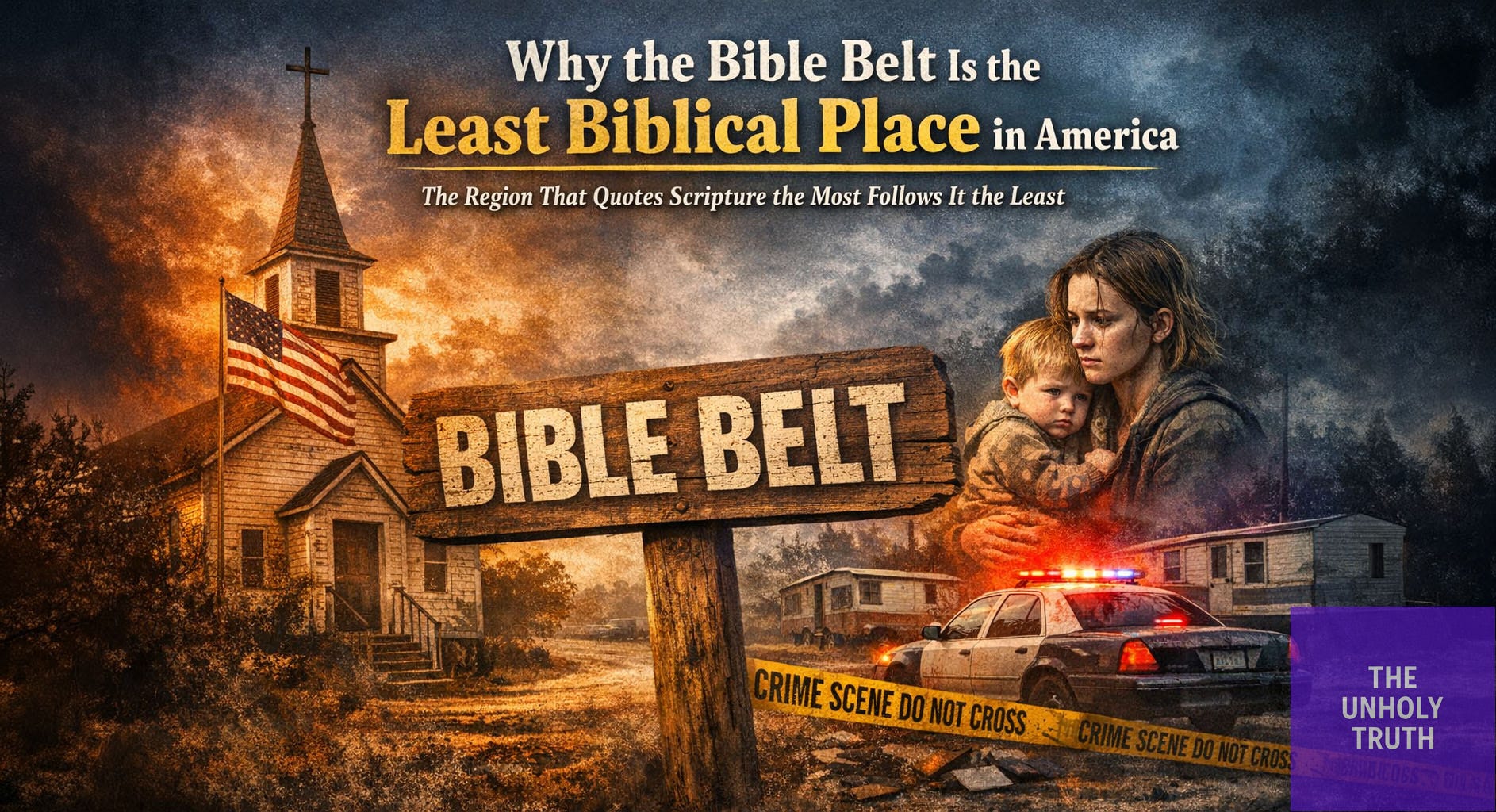
If you want to find the most churchgoing, Bible-thumping, Jesus-praising region in the entire United States, head south. Mississippi, Alabama, Tennessee, Georgia, Arkansas — these are states where Christianity isn’t just a religion. It’s an identity, a culture, but also a political platform. A way of sorting the good people from the bad ones.
And if you want to find some of the highest rates of poverty, violent crime, divorce, teen pregnancy, and infant mortality in the developed world — head to exactly the same place.
The Numbers Don’t Lie (Even When the Preachers Do)
Don’t mistake the Bible Belt for a vague cultural concept — it’s a geographic reality with measurable outcomes. And those outcomes are damning.
Mississippi is the most religious state in America, year after year, by virtually every metric Gallup and Pew can throw at it. It’s also the poorest. It has the highest rate of food insecurity. The worst healthcare outcomes. Some of the highest rates of obesity, diabetes, and preventable death. Its infant mortality rate is closer to a developing nation than a wealthy democracy.
Alabama is neck and neck. Arkansas too. These are states where you can’t drive five miles without passing three churches — and where the social indicators look like something went badly, catastrophically wrong.
Meanwhile, the least religious states in the country — Vermont, Massachusetts, Maine, New Hampshire — consistently rank among the healthiest, most educated, and most economically stable. They also have some of the lowest divorce rates in America. Which is awkward, given that Bible Belt politicians have spent decades telling everyone else how to run their families.
This is not a subtle pattern. It’s a sledgehammer.
What the Bible Actually Says
Here’s the part that should make every Bible Belt pastor deeply uncomfortable. The teachings most emphasized in the region — personal salvation, cultural warfare, sexual purity, national pride, punishment for sinners — are almost entirely absent from the core of Jesus’ message.
What Jesus actually said, repeatedly and without ambiguity, was this: feed the poor, heal the sick, welcome the stranger, forgive the sinner, sell your possessions, give to the needy, don’t accumulate wealth, and stop worrying about everyone else’s sins before you deal with your own.
The Sermon on the Mount isn’t a vague inspirational passage. It’s a direct political and ethical program. Blessed are the poor. Blessed are the meek. Blessed are the peacemakers. It doesn’t say blessed are the well-armed. It doesn’t say blessed are the free market. It doesn’t say blessed are those who cut food stamps so they can give tax breaks to people who don’t need them.
The Bible Belt has built a theology that would be completely unrecognizable to the man it claims to worship.
The Real Religion of the Bible Belt
What the Bible Belt actually worships is a cocktail of nationalism, racial anxiety, nostalgia, and prosperity gospel — dressed up in Scripture and sold as Christianity.
The prosperity gospel deserves special attention here, because it’s the most nakedly dishonest theology in modern American religion, and it has saturated the South. The core claim is that God rewards the faithful with wealth and health. That financial success is a sign of divine favor. That poverty, by implication, is a sign of moral failure.
This is not a fringe view. It’s Joel Osteen filling a stadium in Houston. It’s televangelists with private jets explaining to their congregations that God wants them to give more. It’s the theological justification for why the richest country in the history of the world can look at its poorest citizens and say, with a straight face, that the system is just.
Jesus, for his part, said it is easier for a camel to pass through the eye of a needle than for a rich man to enter the kingdom of God. He didn’t add any asterisks. He didn’t say “unless you tithe.” He didn’t say “unless you vote Republican.” He said it plainly, and the prosperity gospel industry has spent decades trying to explain why it doesn’t mean what it clearly means.
On Divorce, Sexuality, and Other People’s Business
The Bible Belt has made sexuality and marriage its signature political obsession. Anti-LGBTQ legislation, abstinence-only education, battles over bathroom bills, sermons about the sanctity of marriage — this is the culture war the region has chosen to fight, loudly and continuously, for decades.
The results are instructive.
The Bible Belt has some of the highest divorce rates in the country. It consistently outpaces the godless Northeast in teen pregnancy. Its abstinence-only education programs have been studied repeatedly and the conclusion is always the same: they don’t reduce sexual activity, they just reduce the likelihood that young people will protect themselves when they have it.
The obsession with other people’s sexuality is, of course, a very old religious tradition. It’s also one Jesus showed essentially zero interest in. He never mentioned homosexuality. He spoke directly about divorce exactly once — and was considerably stricter than most evangelical churches currently practice. He spent his time with prostitutes, tax collectors, and social outcasts, not because he was making a point about tolerance, but because those were the people he thought actually needed him.
The Bible Belt’s sexual theology has nothing to do with the Bible. It has everything to do with power, conformity, and the very human desire to have someone to look down on.
The Stranger at the Gate
If you want one single issue where the gap between biblical teaching and Bible Belt politics is most catastrophically obvious, it’s immigration.
The Hebrew Bible commands hospitality to the stranger no fewer than thirty-six times — more than any other ethical instruction in the Torah. You shall not oppress a stranger, for you know the heart of a stranger. The New Testament continues this tradition. Matthew 25 — one of the most unambiguous passages in the entire Christian canon — makes it explicit: when you turn away the hungry, the thirsty, the naked, the sick, and the stranger, you are turning away Jesus himself.
This is not a metaphor open to interpretation. Matthew 25 isn’t poetry. It’s a direct moral claim about where God is located — and the answer is: among the most vulnerable people on earth.
The Bible Belt’s political representatives have, almost uniformly, used their Christianity as justification for the harshest possible immigration policies. Family separation. Detention camps. Dehumanizing rhetoric about invaders, criminals, and replacements. This is what their Christianity looks like in practice.
There is no reading of the New Testament that supports this. None. People have tried. They keep pointing to Romans 13 — submit to governing authorities — which is the same passage used to justify chattel slavery, apartheid, and Nazi collaboration. If that’s where you’ve landed, the problem isn’t the immigrants.
The Poverty Problem Nobody Wants to Name
The Bible Belt states receive more federal aid per capita than they contribute in federal taxes. They are, in economic terms, the most subsidized region of the country — kept afloat largely by the tax dollars of the coastal states their politicians spend most of their time vilifying.
This is not a political attack. It’s a budget line.
And yet these same states consistently elect politicians who campaign against the social safety net, against healthcare expansion, against food assistance — against, in other words, the precise mechanisms that are keeping their own constituents alive. In several states, governors refused to expand Medicaid under the Affordable Care Act, which would have cost them essentially nothing and provided health coverage to hundreds of thousands of their poorest residents. They refused on ideological principle. Their constituents paid with their lives.
The Bible has a word for this. It calls it a failure to care for the least among us. Jesus wasn’t subtle about what he thought of people who had the power to relieve suffering and chose not to. The parable of the rich man and Lazarus is one of the most vivid images in the Gospels: the wealthy man who ignored the beggar at his gate ends up in torment. The beggar ends up in paradise. No caveats. No prosperity gospel asterisks.
Why This Happened
The unbiblical nature of the Bible Belt was paved through a deliberate process, over generations, in which Christianity was fused with Southern identity, white identity, and political conservatism in ways that served very specific interests.
After the Civil War, the Southern church faced a reckoning. It had spent decades providing theological justification for slavery — a position so indefensible that it eventually had to be abandoned. But the underlying architecture — the use of Christianity as a tool of social control, racial hierarchy, and political power — never went away. It just rebranded.
The civil rights movement was opposed by the majority of white Southern churches. The Moral Majority and the Christian right emerged in the late 1970s not, as the mythology claims, as a response to Roe v. Wade — but as a response to the IRS threatening the tax-exempt status of racially segregated Christian schools. The movement that now claims to speak for Christian values in America was born out of resistance to racial integration. That’s not a slur. That’s the documented history.
The theology followed the politics, as it usually does. What the Bible Belt calls Christianity is, in most of its political expressions, a justification system for a set of cultural preferences that existed before the Scripture was ever opened.
What’s your take? Have you seen the gap between Bible Belt theology and Bible Belt outcomes up close? Leave a comment below.
Thanks for this excellent piece! I live in Oklahoma, sometimes called the buckle of the Bible Belt, and every problem you describe screams out at us here. If only more people would read and understand your analysis.
Incredible words, Tanner, as always! Thank you!!