


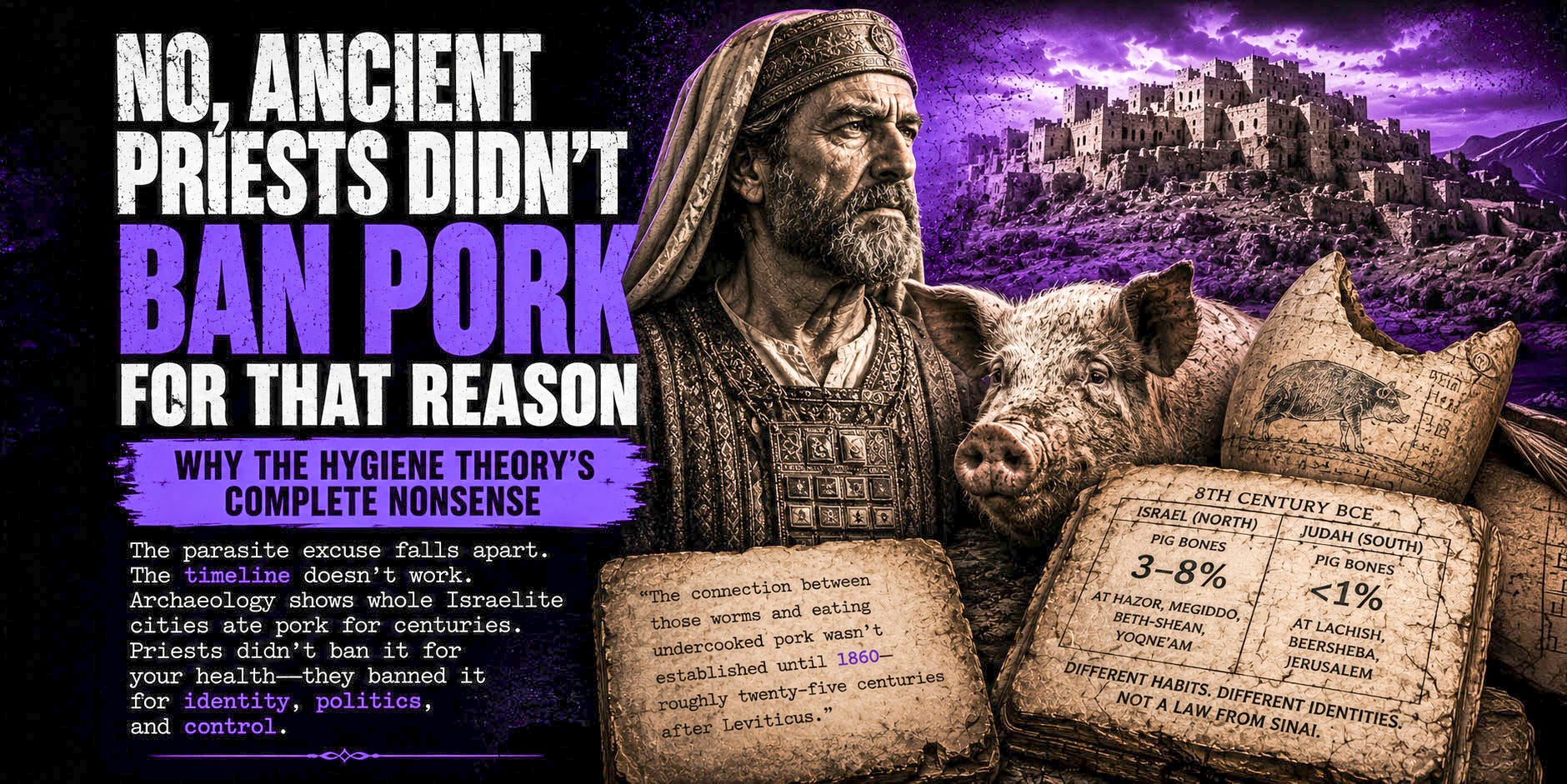
Jews and Muslims will tell you that they don’t eat pork because it gives you parasites. Pigs can carry worms, and ancient people noticed that eating pork sometimes made people sick, so banning it was a way to protect public health. It’s a satisfying answer because it lets everybody keep their dignity. The ancients get credit for being observant, God gets credit for looking out for people, and the modern reader gets to feel gently superior to both.
Yet, the timeline kills the whole idea.
The parasite behind trichinosis wasn’t identified until 1835, and the link between those worms and undercooked pork wasn’t established until 1860, when an autopsy in Dresden turned up the same larvae in a young woman’s muscles and in the salted pork she’d eaten. That’s roughly twenty-five centuries after Leviticus. Nobody in the ancient Near East was tracking infection rates by protein source, and the beef and mutton they ate freely carried tapeworms with no prohibition attached.
So, where does the pork ban come from?
The Northern Kingdom Ate Pork, Judah Mostly Didn’t
The bone record from the ancient Near East is brutal to the version everyone grew up with.
Excavations across Israel have produced enough animal bone to sort by site, region and century, and sorted that way, 78 assemblages from 35 sites turn up an eighth-century pattern. At the lowland sites of the northern kingdom of Israel, pig bones run between three and eight percent of the animals recovered. That holds at Hazor, Megiddo, Beth-Shean and Yoqne’am, cities in the kingdom the Bible calls Israel, whose residents were eating pork in quantity for generations.
If we head south into Judah in the same century, however, the number collapses below one percent at Lachish, Beersheba and Jerusalem alike. Whatever was going on, it was a regional habit that split along a political border, and the side that kept writing the books happened to be the side that stayed off pork. A practice stretching back to Sinai would show up on both sides of that border.
Pig avoidance was a Judahite trait before it was a national law, and the likeliest moment for the promotion is after 720 BC, when the Assyrians destroyed the northern kingdom and refugees from a pork-eating population started arriving in a kingdom that wasn’t. If you’re a Jerusalem scribe trying to fold those people into your version of the faith, a dietary rule that marks the difference is a useful instrument for saying who belongs and on what terms.
Judah wasn’t perfectly consistent either. Excavators published an articulated pig skeleton in 2021, recovered from a wealthy household in Iron Age Jerusalem, which is to say a pig that got eaten inside the city the rule supposedly came from.
The Philistine Explanation Falls Apart on Contact
The hygiene theory isn’t the only one. The older story blamed the Philistines for pork avoidance. They arrived around 1200 BC, they ate pork, so the Israelites defined themselves against them by refusing it.
The urban Philistine sites do indeed produce a lot of pig. Ekron runs near twenty percent, Ashdod around eleven. But the villages inside Philistine territory, populated by people nobody disputes were Philistine, come in between 0.4 and 1.2 percent. If pork consumption were an ethnic signature, it wouldn’t vanish when you walk twenty miles inland to a smaller settlement. What it tracks is city living, where pigs make sense because they eat garbage, breed fast and don’t need pasture.
The same pattern emerges across the whole region. Pork consumption in the ancient Near East fell steeply after about 1600 BC, centuries before anyone wrote a law about it, as herders shifted toward sheep, goats and cattle, which give you wool, milk and traction while a pig gives you one thing. The pig lost an economic argument long before it lost a theological one.
Egypt makes the point from another direction. Herodotus reports that Egyptians held the pig impure and killed it only for particular festivals, yet Egyptian settlements are full of pig bones and the meat stayed popular with everyone who wasn’t a priest or an aristocrat. The temple could hold a position on the pig while the population went on buying it at market.
Antiochus Turned Dinner Into a Loyalty Oath
So how did a Judahite regional preference become the single most recognizable Jewish practice on earth?
The Maccabean crisis of the 160s BC did most of the work in establishing the pork-avoidance custom. When Antiochus IV moved to suppress Jewish practice, the test he applied was forced consumption of pork, and the martyr stories in 2 and 4 Maccabees are built around refusing it. Eleazar the scribe dies rather than swallow it, and so does a mother with seven sons. Once you’ve buried people over a food, that food stops being a dietary matter and becomes the border of the community.
Rome finished what the Maccabean crisis started. Pork was the Roman meat, so common that a Roman writer on farming could ask who among his people kept a farm without pigs, which made abstaining from it the most legible Jewish behavior an outsider could observe. Roman writers reached for it whenever they wanted to describe a Jew. The pig became shorthand for Rome in rabbinic writing and the refusal became shorthand for the Jews in Roman writing, each side confirming the other’s stereotype.
By the time the Qur’an lists swine’s flesh among forbidden foods, which it does in four passages (2:173, 5:3, 6:145, 16:115), Jewish communities in the region had been keeping the rule for the better part of eight hundred years. It arrives as confirmation of an inherited norm, with no explanation offered, because none was needed.
There’s also almost nothing there to forbid. Pigs need water, shade and somewhere to root, and they return no milk, no wool and no traction, which makes them useless to a herding economy running on sheep, goats and camels. Pig farming in seventh-century Arabia was virtually non-existent, so declaring pork forbidden cost about what it would cost Mexico to declare polar bear meat a religious taboo.
What the Bone Record Settles
The most repeated explanation for the ban treats the pig as a category violation, an animal with cloven hooves that doesn’t chew the cud, out of place in the ordered world of Leviticus. It’s elegant, and it accounts for how the law is worded without accounting for where the law came from. The excavation data accounts for the second part. Pig avoidance was a southern habit before it was a rule, it hardened into a rule when Judah needed to mark itself off from a pork-eating north, and it became the emblem of an entire people only when a foreign king made eating pork the test of obedience.
Paid supporters get the next section, which covers what the Hebrew Bible says about pigs outside Leviticus 11 and Deuteronomy 14, including the three passages in Isaiah where pork eating is thrown at a specific group of people for a specific reason, the Gospel scene where two thousand pigs go off a cliff in what should be Jewish territory, and why the New Testament abandoned the rule within a generation while Islam kept it. If you’ve been reading free for a while and this is the kind of thing you want more of, that’s the button.
If even a small fraction of regular readers became supporters, I’d spend less time running the business side of this publication and more time in the archives doing the research this work demands.
If you’re getting something out of these pieces, consider supporting The Unholy Truth. Supporters get the bonus sections, the Friday Editions, and the full archive.
Support the work and unlock exclusive content for the full story.
Sources and Further Reading
Lidar Sapir-Hen, Guy Bar-Oz, Yuval Gadot, and Israel Finkelstein, “Pig Husbandry in Iron Age Israel and Judah: New Insights Regarding the Origin of the ‘Taboo,’” Zeitschrift des Deutschen Palästina-Vereins 129 (2013)
Lidar Sapir-Hen, “Pigs in Space (and Time): Pork Consumption and Identity Negotiations in the Late Bronze and Iron Ages of Ancient Israel,” Near Eastern Archaeology 81 (2018)
Lidar Sapir-Hen, Joe Uziel, and Ortal Chalaf, “Everything But the Oink: On the Discovery of an Articulated Pig in Iron Age Jerusalem,” Near Eastern Archaeology (2021)
Max D. Price, Evolution of a Taboo: Pigs and People in the Ancient Near East (Oxford University Press, 2020)
Jordan D. Rosenblum, “’Why Do You Refuse to Eat Pork?’: Jews, Food, and Identity in Roman Palestine,” Jewish Quarterly Review 100 (2010)
Mary Douglas, Purity and Danger (1966) and Leviticus as Literature (Oxford University Press, 1999)
Marvin Harris, Cows, Pigs, Wars, and Witches (1974)
Moses Maimonides, Guide for the Perplexed, III:48
Herodotus, Histories 2.47
Varro, On Agriculture 2.4
I can give you the Protestant view, and don’t let my Methodism get me expiated.
What is it in Hebrew? mishneh asaret hadevariim?
In cowboy Latin it’s the deuteron decagon. Exodus 34 establishes the sentiment, that going in to the land of Canaan, the boys and girls had been briefed on not eating with the 7 rivals that had to be expiated. That’s a long time from the Maccabee revolt.
Though the Maccabee revolt isn’t in most Protestant bibles. The Bible people were like, “got to cut costs.” And not one Christian or Jew said, did David cut costs? The major controversy there, a Jebusite gives David a threshing floor, and he goes out of his way to pay it.
The claim that it was an original disagreement that happened in the Maccabees sort of it hard to support, since whenever exodus is put into practice would be hundreds of years to thousands of years before that.
Thanks for this article though, it was cool to read all the history the Protestants missed since about 1900. And asharah is 10, that damned pole is a 10 pole.
I’ve always assumed that the Levitical ban on eating pork, like the ban on eating seafood, was part of the overall prohibition against doing business with pagans. Israelites were sheep herders, not swineherds, and lived in the hill country instead of on the coast, so if an Israelite wanted a pork or seafood dinner, they’d have to travel to a pagan village and buy one there.