

People look for Christianity’s best-hidden secrets locked away in the Vatican archives or buried in ancient desert caves, yet they’re perfectly visible to anyone paying attention. Many assume biblical criticism is a modern atheist conspiracy, when for over a century the rigorous historical methods used to take the Bible apart have come from inside the church. The pastors know this, and the Vatican keeps pouring money into studies whose findings contradict its own tradition.
If you want a scholarly look at the ancient Near East, and Mesopotamia in particular, where many of the Bible’s stories have older relatives, check out The Academic Archaeologist.
What Seminary Teaches and the Pulpit Leaves Out
When I talk about the anonymity of the Bible, save for the seven uncontested letters of Paul, many jump to the conclusion that doubts about who wrote it come from atheists and bitter ex-believers sniping from the outside, when most of them came from inside the church’s own schools.
The historical-critical method was built largely by Protestant scholars in German universities during the eighteenth and nineteenth centuries, many of them devout, and it’s been standard coursework at mainline Protestant seminaries in the US since the early twentieth century. Students at Princeton Theological Seminary, Yale Divinity School, Duke Divinity School, and dozens of denominational schools read the same introductions to the Old and New Testaments that secular religious studies majors read at state universities. Often it’s the same textbook.
So the gap between what the pastor knows and what the congregation hears has nothing to do with access. The pastor has the information. In fact, he paid tuition for it, wrote term papers on it, and in a lot of cases, still keeps the books on the shelf behind the desk where he writes his sermons every week.
What happens between seminary and Sunday is a choice about what to share, made over and over by people who know exactly what they’re leaving out.
The Footnote Is Already in Pew Bibles
If you pick the NIV or the ESV, the two most popular translations in American evangelical churches, and turn to the end of Mark, you’ll find a note telling that the earliest manuscripts don’t include verses 9-20. Those twelve verses contain Mark’s resurrection appearances, Mark’s version of the Great Commission, and the line about believers picking up snakes and drinking poison without harm, which a handful of Appalachian churches still take literally. Flip to John 7:53-8:11 and the story of the woman caught in adultery (”let him who is without sin cast the first stone”) comes bracketed with a similar warning.
Evangelical publishers, working with evangelical translators, put textual criticism on the printed page. Millions of copies sit in pew racks every Sunday announcing that two of the best-known passages in the New Testament were added by later scribes. And a pastor can still preach on the adulterous woman for twenty-five minutes without once mentioning that the story wasn’t in John’s gospel when John’s gospel was written. Nobody calls him on it, because the congregation trusts him to tell them what matters, and he’s decided this doesn’t.
The Paycheck Comes From the Pews
The most honest explanation is also the least flattering. In most American Protestant churches, the congregation pays the pastor. Elders or a church board do the hiring and firing, and in congregational systems like most Baptist churches, the members can vote a pastor out. A minister who stands up and explains that 1 and 2 Timothy and Titus were written in Paul’s name by someone in a later generation is handing every unhappy member a reason to call a meeting.
The stakes run past one job. A pastor in his forties with a mortgage, kids, and a degree in a field with exactly one kind of employer has very little to fall back on. A Master of Divinity doesn’t open many doors outside the church. Plenty of pastors live in church-owned parsonages or depend on housing allowances tied to the position, so losing the pulpit can mean losing the house too. Few pastors will say it this bluntly, but the math explains a lot of silence.
Shielding the Flock From Information
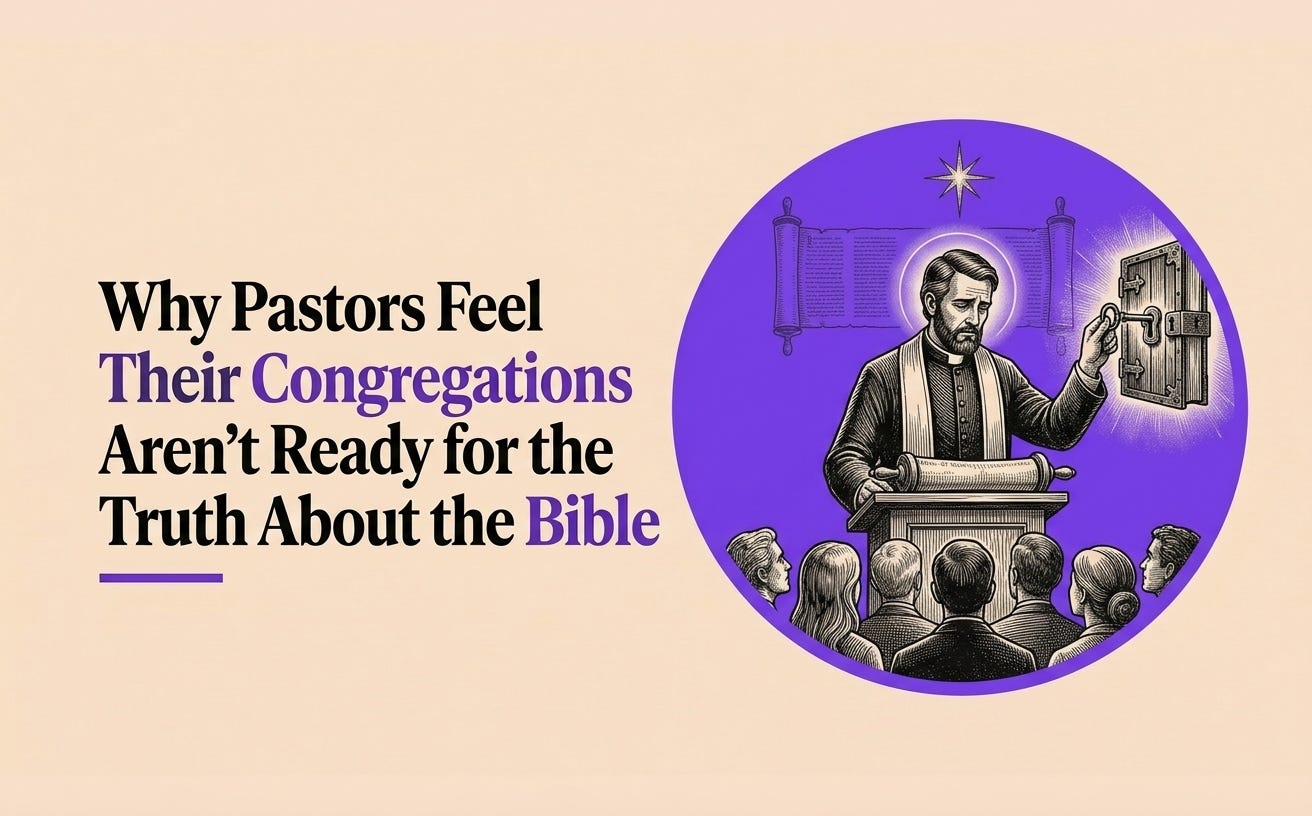
The public explanation sounds much nicer. Pastors talk about meeting people where they are, about not wanting to wreck anyone’s faith, about the difference between the classroom and the parish. The phrase that keeps coming up is that the congregation “isn’t ready.”
In other words, someone with a graduate degree has looked out at a room full of engineers, nurses, accountants, teachers, and small business owners, people who send off their spit for DNA ancestry tests and watch documentaries about Pompeii, and decided they can’t cope with hearing that Genesis has two creation accounts. These same people manage retirement accounts, sit on juries, and raise teenagers. They can handle the idea that a book was edited.
The protective instinct also runs in one direction only. Pastors worry about unsettling believers with accurate information about the Bible, and they rarely worry about what happens when those believers find it on their own. And they do find it. A college freshman takes an intro to religion course to fill a requirement, or a forty-year-old picks up a popular history book on vacation, and learns in a single afternoon what the pastor knew the whole time. The question that follows is almost always some version of “why didn’t anyone tell me?” That’s the moment faith tends to crack, and what cracks it is usually the discovery that someone knew and kept quiet.
The Pastors Who Know Too Much
Some ministers can’t keep the two worlds apart. A philosopher and a clinical social worker spent several years interviewing active clergy who’d stopped believing what they preached, first in a small 2010 study and later in a book-length collection of interviews. A recurring thread in those conversations was seminary itself. Several of the pastors traced their unraveling back to their Bible courses, and they described a working life built on careful wording: sermons phrased so that listeners could hear literal history while the pastor privately meant something closer to metaphor.
A support network called The Clergy Project launched in 2011 to give current and former religious professionals who no longer believe a confidential place to talk, and it’s kept growing since. The fact that such a group needs to exist, and needs to promise its members anonymity, says plenty about how safe it feels to be honest from the pulpit.
Not every pastor who learns criticism loses faith, of course. Many mainline clergy hold a less literal faith and find that the scholarship makes the Bible more interesting to them. That makes the silence even harder to defend. If learning how the Bible was put together didn’t destroy your faith, why assume it’ll destroy your congregation’s?
The Catholic Church Settled This Decades Ago
Catholics might assume this is a Protestant hang-up. Rome formally opened the door to historical-critical study in 1943, when Pius XII issued the encyclical Divino Afflante Spiritu, and in 1993 the Pontifical Biblical Commission (the Vatican’s own panel of Bible scholars) published The Interpretation of the Bible in the Church, which calls the method indispensable and warns against fundamentalist reading in unusually blunt terms. The introductions and footnotes in the New American Bible, the translation read at Mass in US parishes, openly discuss multiple sources behind the first five books and a second-century BCE date for Daniel.
Then you go to Sunday Mass and hear the lector announce “a reading from the Second Letter of Saint Peter,” a letter that the church’s own scholars widely regard as written long after Peter died. The official teaching is more than eighty years old, and the homily still hasn’t caught up with it.
Can a Faith Kept Alive by Silence Still Call Itself Christian?
That leaves the question underneath all of this. If what keeps someone a Christian is a set of claims their own pastor knows are false, can that person be considered a Christian in the first place, or are they just a loyal member of one man’s congregation?
Christianity stakes its case on things it says happened in history. Paul, writing in one of the seven letters nobody disputes, puts it bluntly: if Christ hasn’t been raised, your faith is futile (1 Corinthians 15:17). The gospel of John has Jesus promise that the truth will set you free (John 8:32), a few verses after a story about an adulterous woman that scribes slipped into that same gospel generations later. The religion’s own founding texts put truth ahead of comfort, and a pastor who decides his congregation can’t handle the truth about those texts has quietly ruled against them.
The scholarship itself doesn’t settle whether God exists or whether Jesus rose. Plenty of the scholars who built it were believers, and plenty of mainline clergy stay Christian after learning it. What it does settle is a long list of smaller claims: who wrote the Torah, when Daniel was composed, which letters Paul wrote, and which verses scribes added. When a congregation’s faith depends on those claims, it’s leaning on a version of Christianity the pastor himself gave up somewhere around his second year of seminary.
That puts the person in the pew in an odd spot. They’re devoted to a story the person in the pulpit no longer holds, and the thing they’ve placed their trust in is a man who decided which parts of the truth they were allowed to have. It’s a shaky foundation for a religion whose founder, according to that same gospel of John, called himself the truth (John 14:6).
Paid subscribers get a passage-by-passage guide to the spots in your own Bible where the seams show, plus three questions to ask your pastor this Sunday
Exclusive Content for Paid Subscribers
The Pew-Bench Audit: 5 Passages to Check in Your Own Bible Today
Grab whatever Bible is on your shelf or in the rack in front of you on Sunday. The NIV, ESV, and NASB all work. You don’t need Greek, Hebrew, or a seminary degree, just a pen and about twenty minutes.
Passages 1 and 2: What the Footnotes Leave Out
You’ve already seen …