


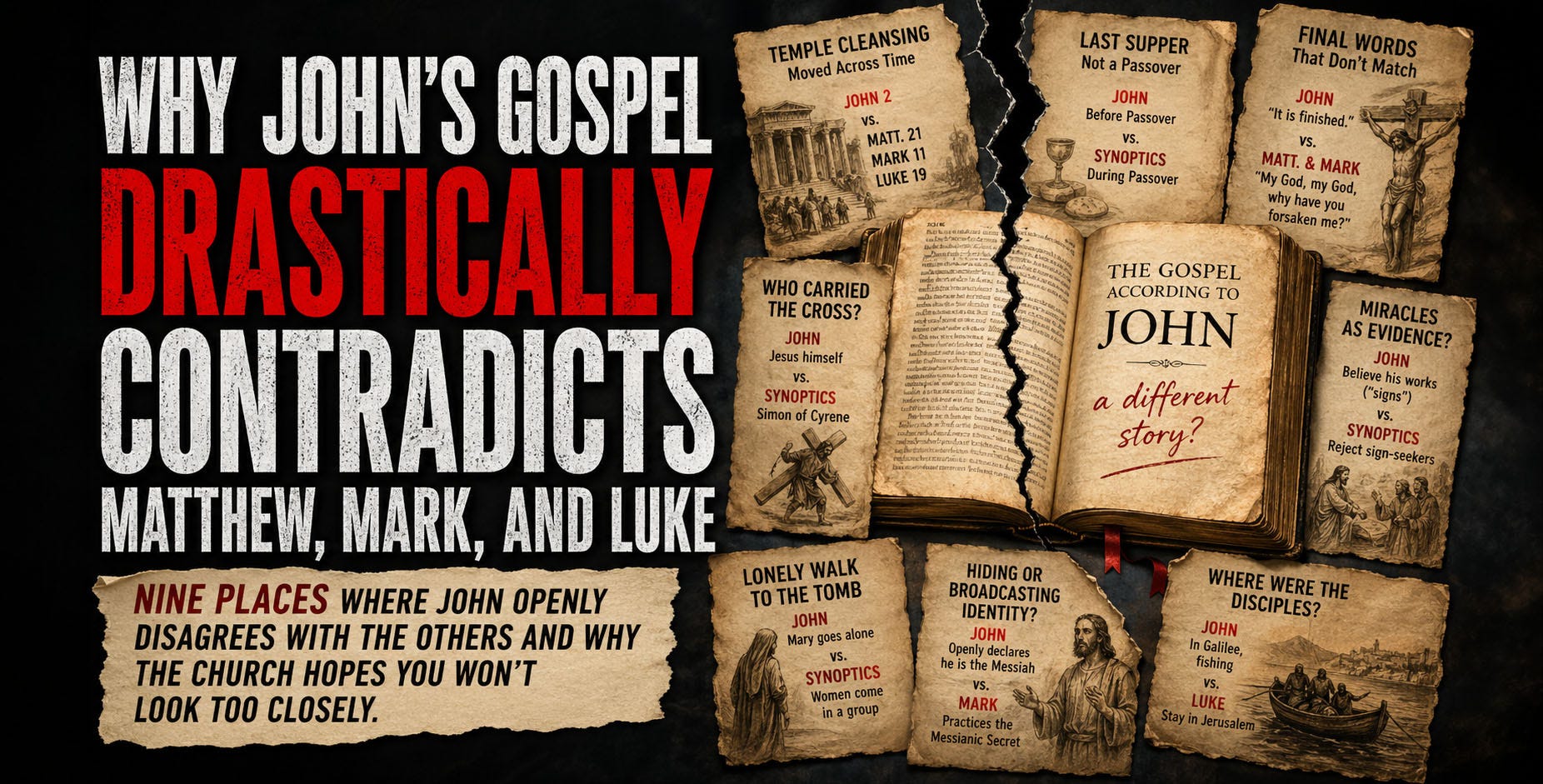
If the writer of John’s Gospel walked into a courtroom and tried to testify, the judge would dismiss him before lunch. It’s what happens when a witness contradicts three other witnesses on the basic chronology, the basic geography, the basic mood, and the basic words spoken by the defendant.
But because this particular witness happens to be a book in the Bible, it doesn’t get cross-examined.
Instead, it gets read at funerals, quoted on coffee mugs, and embroidered on throw pillows. Pastors reach for it whenever they want Jesus to sound cosmic and serene rather than the sweaty, frustrated rabbi the other Gospels keep showing us. John’s Jesus is the well-lit version, the director’s cut, the portrait painted decades after the funeral by someone who’d already decided what the story was supposed to mean.
Read John side by side with Matthew, Mark, and Luke and it sticks out immediately. Not because of any poetic mystery but because of the contradictions. Matthew, Mark, and Luke don’t match perfectly either, but for the most part, their differences are the kind a generous reader can reconcile. With John, generosity runs out fast.
The Temple Cleansing That Moved Across Time
Pick up Matthew, Mark, or Luke. The temple incident, Jesus flipping tables, scattering coins, driving out merchants, happens at the very end of his ministry, and it’s the act that gets him killed. He attacks the economic engine of the religious establishment, and within days he’s hanging from a Roman cross. Cause, effect, dead.
Now open John. The same incident appears in chapter 2, when Jesus has barely started preaching and has just turned water into wine at a wedding. There are no consequences, no arrest, no high priests plotting in the shadows. Life carries on as if nothing happened.
Did Jesus trash the temple twice? No Gospel says that, and no early Christian writer claims it. The simplest explanation is the one apologists hate most: John relocated the event because it served his purposes. He needed Jesus to challenge the religious system from the opening pages, so he yanked the most explosive incident in the story out of its historical setting and pasted it where it suited the message.
The cleansing of the temple is one of the clearest examples where John has moved an event for theological reasons rather than historical ones.
—Bart D. Ehrman
If a single act gets relocated by years, what else got moved? What else got changed? Once you accept that John is editing the chronology of Jesus’ life, every line in the Gospel becomes a question instead of an answer.
“Your Law” — The Phrase That Gives The Author Away
In John 8:17, Jesus says, “In your own Law it is written that the testimony of two witnesses is true.”
Jesus was Jewish, his mother was Jewish, his students were Jewish. He preached in synagogues, observed the festivals, and quoted the Hebrew Bible constantly. Every time he opens his mouth in Mark or Matthew, he treats the Law as his own inheritance, the foundation of his identity, calling it “the Law” or “the Law of Moses,” never something belonging to somebody else.
So why does John’s Jesus suddenly talk like a Gentile critic looking in from outside?
Because the author of John was writing decades after the destruction of the Jerusalem temple, in a community that had already split with the synagogue. Christians and Jews had become two separate, hostile groups by the time this Gospel was composed, and the author projects that hostility backward into the mouth of a man who never lived to see it.
John’s Gospel reflects a community already in conflict with the synagogue, and this tension is projected back into the mouth of Jesus himself.
—Raymond E. Brown
Who Actually Carried the Cross
Matthew, Mark, and Luke all agree on this point: Jesus is too weak to carry his own cross, and a bystander named Simon of Cyrene gets pulled out of the crowd and forced to carry it for him. It’s a small detail with enormous emotional weight. The Synoptic Jesus is exhausted, broken, recognizably human in his suffering.
John won’t allow that.
In John 19:17, Jesus carries the cross himself, all the way to Golgotha. No Simon. No collapse. No weakness. Just a sovereign Christ marching to his appointment with destiny.
That change has nothing to do with memory, it’s a different theology entirely. The Synoptic Jesus is a man crushed under the weight of Roman violence. The Johannine Jesus is a god in human costume, never staggering, never in genuine distress, always in command of his own death.
John consistently reshapes the passion narrative so that Jesus appears sovereign and unbroken, even in suffering.
—Elaine Pagels
This is what theology looks like when it overrides history. The author can’t tolerate the image of his divine Christ stumbling under a crossbeam, so Simon of Cyrene gets cut from the script and the story gets cleaner. The Jesus we end up with is no longer a man who suffered but a celestial actor performing the role of suffering.
A Last Supper That Isn’t a Passover
In Matthew, Mark, and Luke, the Last Supper is a Passover meal. Jesus eats it with his disciples on the night Passover begins, reinterprets the bread and wine as his body and blood, and gets arrested afterward. The chronology is consistent across all three Gospels, the kind of detail you’d expect to be hard to fake.
John throws the schedule out the window.
In John, Jesus eats with his disciples before Passover, and he’s executed on the day of preparation, coincidentally, at the exact hour the Passover lambs are being slaughtered in the temple.
John wants Jesus to be the Passover lamb, literally and not just metaphorically, so he shifts the calendar by a full day to make the symbolism land. Either the Synoptics are wrong about when Jesus died, or John rewrote the timeline to fit his theology. They cannot both be right.
John’s chronology is almost certainly theological rather than historical, designed to present Jesus as the true Passover sacrifice.
— E. P. Sanders
The Lonely Walk to the Tomb
Matthew, Mark, and Luke describe groups of women arriving at Jesus’ tomb on the third day. Mary Magdalene is one of several, sharing the shock and the discovery, supporting each other through what should have been the worst morning of their lives.
In John 20:1, Mary goes alone.
That’s a different scene entirely. A single grieving woman stumbling through pre-dawn darkness creates a more intimate, more cinematic moment than a group walking together, and John picks solitude over communal memory because solitude makes for better theater.
The resurrection narratives are among the most divergent in the Gospels, and John’s version stands noticeably apart from the Synoptic tradition.
— N. T. Wright
You can call this artistic license. Fine, but artistic license is not eyewitness testimony. The moment you admit John is shaping his scenes for emotional effect, you’ve admitted he’s writing a story rather than reporting facts. At the very best, it can be called literature based on “true” events, with no claim to be scripture.
The Final Words That Don’t Match
In Matthew and Mark, Jesus dies screaming, “My God, my God, why have you forsaken me?” He’s quoting Psalm 22, but the choice of psalm matters. The Synoptic Jesus dies in agony, abandoned, doubting, raw. He sounds like a man being tortured to death because that’s what he is.
In John, Jesus says, “It is finished.” Not a cry of anguish but a calm declaration of completion. Mission accomplished, job done, curtain falls.
These aren’t two sides of the same coin; they describe entirely different inner states. One Jesus feels abandoned by God in his final moments. The other never doubts a single thing. If you’d been at the foot of that cross, which version did you actually hear?
John replaces the cry of abandonment with a declaration of triumph, reshaping the meaning of Jesus’ death entirely.
— James D. G. Dunn
This is one of the loudest contradictions in the New Testament, and it’s the one Christians most aggressively try to sweep under the carpet. Of course Jesus said both, they’ll insist. He talked a lot up there. Multiple sayings, multiple Gospels, no problem at all. The texts themselves don’t support that move. Each Gospel presents its final words as the final words. The patchwork “seven last sayings” is a later harmonization invented to paper over cracks the early church found inconvenient.
The Bible never says he said both, and you cannot defend a position with evidence that doesn't exist.
Did Jesus Hide His Identity or Broadcast It?
In Mark, Jesus runs around shushing people. He performs miracles and then orders the recipients to keep quiet, silences demons who try to identify him, and repeatedly avoids public declarations of who he is. Scholars call it the “Messianic Secret,” and it’s woven through Mark from beginning to end.
In John, Jesus walks up to a Samaritan woman at a well, a complete stranger, and casually announces that he’s the Messiah. No secrecy, no caution, no “tell no one.” Within a few chapters he’s giving long monologues identifying himself with God in the most explicit terms imaginable. “Before Abraham was, I am.” That sort of thing.
Two Jesuses, and the first guards his identity like a state secret while the second can’t shut up about it.
The secrecy motif in Mark disappears entirely in John, where Jesus openly declares his identity from the start.
— William Wrede
You can’t reconcile these two characters. One of them is fictionalized, probably both in different directions, but at minimum one. The historical Jesus, whoever he was, can’t have been simultaneously secretive and openly declarative about the most consequential claim a human being could possibly make.
Miracles as Evidence vs Miracles as Distraction
John’s Jesus tells the crowds that if they don’t believe his words, they should believe his works. Miracles function as proof, called “signs” throughout John, demonstrating who Jesus is. Faith follows the spectacle.
In Matthew and Mark, Jesus does the opposite. He refuses sign-seekers, calling them an “evil and adulterous generation” for demanding miracles, and he treats the demand for proof as a moral failure rather than a reasonable request from skeptical people.
So which is it? Are miracles the proper basis for belief or a sign of spiritual sickness in the people who want them?
John’s ‘signs’ theology stands in sharp contrast to the Synoptic skepticism toward miracle-based faith.
— Marcus Borg
This is a disagreement about how a person comes to faith. Either Jesus invited people to verify his claims through wonders, or he didn’t. He couldn’t have done both with a straight face, and the two Gospels tell you opposite things about his attitude toward the question.
Where Were the Disciples After the Resurrection?
Luke ends with explicit instructions: stay in Jerusalem. The disciples obey, and Acts picks up the same thread without missing a beat. Pentecost happens in Jerusalem, the early church begins in Jerusalem, and the geography stays consistent across both books. Luke wrote them both, so this isn’t a coincidence.
John has the disciples in Galilee, fishing, roughly 130 kilometers from where Luke just told them to stay. Did they pack up and ignore Jesus’ direct command? Did they teleport? Did the authors simply not coordinate their endings before the canon got stitched together?
The honest answer is the third. Two early Christian communities preserved two different traditions about where the disciples went after the resurrection, and the New Testament canonized both without resolving the contradiction.
The post-resurrection narratives cannot be harmonized without forcing the texts beyond recognition.
— Bart D. Ehrman
This is the contradiction that should terrify believers most, because it sits at the foundation of the faith. The resurrection is the event Christianity was built on, and the four texts that describe it can’t agree on where the witnesses were when it happened.
This publication exists because readers like you choose to support it.
If you’re not already a paid subscriber and you’re finding value here, I’d love for you to consider becoming one to keep The Unholy Truth alive.
What John Actually Is
John’s Gospel doesn’t read like a witness report but like a closing argument written long after the verdict was decided. Events get relocated across decades, words get swapped between speakers, and entire timelines bend wherever the theology demands. The mess of a real human life gets sanded smooth and replaced with symbolism. Jesus comes out of the process calm, cosmic, sovereign, never confused, never abandoned, never overwhelmed.
That doesn’t make John worthless. Theology has every right to exist, and communities have every right to interpret their founder. What’s dishonest is pretending John is reporting facts when he’s plainly doing something else.
The early church knew this, which is why Clement of Alexandria, writing in the second century, already called John the “spiritual Gospel.” Even the people compiling the canon could see John was up to something different from the Synoptics. They just didn’t have the modern vocabulary to admit what kind of different.
We do. We know this is theological revisionism dressed in narrative clothing. We know the author wasn’t an eyewitness, wasn’t named John, and wasn’t writing within the lifetime of anyone who saw Jesus alive. We know the community that produced this Gospel had already split from the synagogue, already begun deifying its founder beyond what the earliest sources would have recognized, and already developed the theological commitments that the text exists to support.
What you do with that information is your business. Some readers will keep treating John as scripture, others as historical fiction with a sermon stapled on, and a few will close the book entirely and walk away from the whole project.
But pretending all four Gospels say the same thing is no longer an option for anyone who reads them with their eyes open. They don’t, they never did, and the church has spent two thousand years hoping you wouldn’t notice.
Sources and Further Reading
Contradictions and Inconsistencies in the Gospel of John
https://earlychristiantexts.com/inconsistencies-gospel-of-john/Contradictions of John
https://lukeprimacy.com/contradictions-of-john/Contradictions in the Gospels
https://ehrmanblog.org/contradictions-in-the-gospels/Internal Discrepancies in the Gospel of John
https://ehrmanblog.org/internal-discrepancies-in-the-gospel-of-john/Gospel of John
https://en.wikipedia.org/wiki/Gospel_of_John