


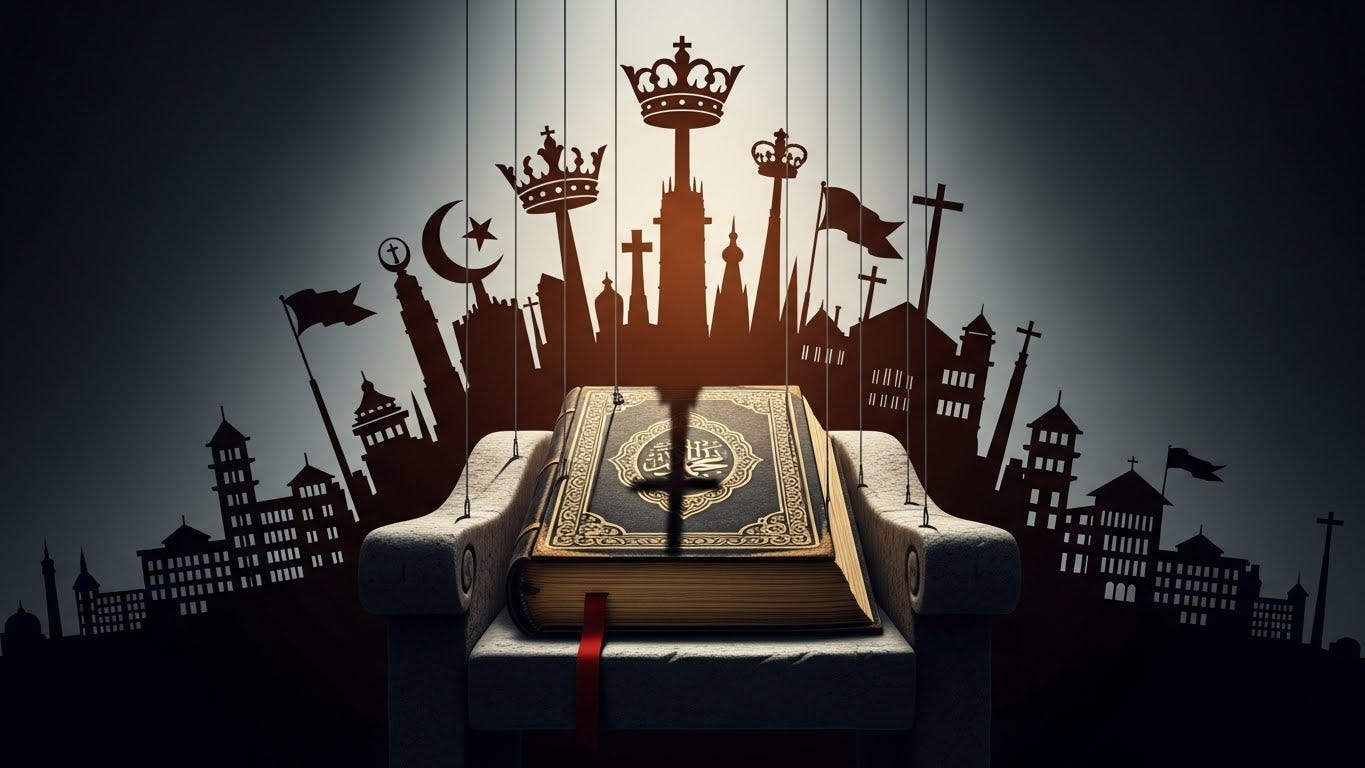
People like to imagine holy books as pure things. Timeless. Above politics. Dropped from the sky to guide humanity toward goodness and truth.
That story does not survive contact with history.
Every major holy book that survives long enough ends up doing the same job. It props up authority. It blesses hierarchy. It tells people to obey. And when it does not say those things clearly enough, powerful people make sure someone explains that it does.
This is not because the books are evil. It is because power does not tolerate ambiguity for very long.
If a text shapes how millions of people think about morality, authority, gender, violence, and loyalty, then power will not leave it alone. It will wrap itself in that text, edit it, interpret it, weaponize it, and punish anyone who reads it differently.
That pattern shows up everywhere. Different cultures. Different gods. Same outcome.
Holy Books Do Not Start as Tools of Power
Most religious texts begin as caotic, local, and unstable.
They come from oral traditions, scattered writings, poems, arguments, laws, stories, and disagreements. They are debated, revised, contradicted, and reinterpreted long before anyone calls them “scripture.”
Early Christianity did not have a Bible. Early Islam did not have a fixed canon with commentaries. Early Judaism did not have one unified theology. These traditions were alive, flexible, and disputed.
That flexibility is dangerous to power.
A text that can be read in multiple ways allows moral debate. A story that questions authority can inspire resistance. A god who sides with the poor can become a problem for kings.
So once a movement grows large enough to matter politically, something changes.
Power steps in and demands order.
“Religions begin as movements of protest and imagination, but once institutionalized they often reverse their original impulse.”
— Elaine Pagels
Canon Is About Control, Not Clarity
The moment a religious tradition starts deciding which texts are “in” and which are “out,” power is already involved.
Canon is not a neutral process. It never was.
Someone decides which books are authoritative, which are heretical, which are inspired, and which are dangerous. Those decisions are made by councils, scholars tied to institutions, or rulers who understand one simple fact: whoever controls the sacred story controls loyalty.
Texts that challenge hierarchy tend to disappear.
Texts that support obedience tend to survive.
This is not a conspiracy. It is a survival mechanism of power. Empires need stable myths. Rulers need divine backing. Institutions need rules that justify their existence.
A holy book that keeps asking uncomfortable questions does not last long without being “explained.”
“The formation of the canon was as much a political process as it was a theological one.”
— Bart D. Ehrman
Interpretation Is Where Power Really Lives
Most holy books are vague, contradictory, and incomplete. That is not a flaw. That is what ancient texts look like.
But vagueness is intolerable to authority.
So power creates interpreters.
Priests, scholars, jurists, bishops, ulema, rabbis, theologians. Entire classes of people whose job is to tell everyone else what the book really means.
Notice the pattern.
The interpreter always outranks the reader.
The interpreter always claims special knowledge.
The interpreter always insists that dissent is dangerous.
This is how control shifts from the text to the institution.
You are no longer allowed to read the book and decide. You must be taught. Guided. Corrected. Disciplined.
At that point, the book no longer belongs to the people. It belongs to power.
“Authority over interpretation is authority over belief, and authority over belief is authority over people.”
— Michel Foucault
Obedience Becomes Holiness
Once power has its hands on a holy book, one theme starts getting louder than all the others.
Obey.
Obey God. Obey rulers. Obey husbands. Obey elders. Obey tradition. Obey the law.
Rebellion gets reframed as sin.
Doubt becomes pride.
Questioning becomes corruption.
Stories that once warned against kings are reread as lessons in patience. Prophets who confronted power get turned into symbols of submission. Moral courage gets replaced with loyalty.
And if the text does not say this clearly enough, commentary fills in the gaps.
Power does not need the book to say everything. It just needs enough ambiguity to insert itself as the final authority.
“Religious obedience has historically been one of the most effective tools for maintaining social hierarchy.”
— Max Weber
Violence Always Finds a Verse
No holy book openly advertises itself as a manual for conquest. But every one of them gets used that way.
Why?
Because once power merges with sacred language, violence becomes righteous by definition.
Wars become holy. Enemies become evil. Killing becomes duty. Resistance becomes heresy.
Verses are selected, emphasized, repeated, and stripped of context. Contradictory passages get ignored. Ethical complexity disappears.
This is not accidental.
A ruler who claims divine backing does not need to argue policy. He needs obedience. A soldier who believes God is on his side does not hesitate.
Holy language turns human violence into cosmic necessity.
That is why it is so valuable to power.
“Religion does not cause violence, but it provides the vocabulary that makes violence feel morally justified.”
— Mark Juergensmeyer
Women Pay the Price First
Whenever holy books serve power, women lose autonomy. Every time.
This is not because religion invented sexism. Patriarchy existed long before scripture. But holy texts are perfect tools for freezing it in place.
Gender roles become divine order.
Male authority becomes sacred structure.
Female independence becomes rebellion against God.
Stories get reread to justify inequality. Laws get interpreted to limit women’s bodies, voices, and choices. Any challenge gets labeled immoral, unnatural, or sinful.
Power understands something very clearly: control reproduction, sexuality, and family structure, and you control society.
Holy books become the language that makes this control feel eternal.
“Sacred texts have repeatedly been used to naturalize gender hierarchies that were socially constructed.”
— Francesca Stavrakopoulou
Dissenters Get Labeled Enemies of God
Once power fuses with sacred text, disagreement is no longer intellectual. It becomes existential.
You are not wrong. You are dangerous.
You are not mistaken. You are corrupt.
You are not disagreeing with people. You are attacking God.
This framing is incredibly effective.
It shuts down debate.
It justifies punishment.
It turns violence against critics into moral duty.
That is why reformers, heretics, skeptics, and critics always get the same treatment across religions and centuries. They are not argued with. They are silenced.
Not because they are weak, but because power cannot afford them.
“Heresy is not merely an error of belief; it is a threat to authority.”
— E. P. Sanders
The Original Message Becomes Irrelevant
Here is the uncomfortable part.
At a certain point, it no longer matters what the original message of the holy book was.
Whether it preached compassion, justice, humility, or equality becomes secondary. What matters is how it functions now.
And function beats intention every time.
A text that once challenged power but now enforces it has changed roles. A book that once inspired moral courage but now demands conformity has been repurposed.
This is why arguing about original intent often goes nowhere.
Power is not interested in origins. It is interested in outcomes.
“Texts survive not because of what they meant, but because of what institutions make them do.”
— Jonathan Z. Smith
Not Unique to Any One Religion
It is tempting to read all this and think of one tradition you dislike.
Do not.
This pattern is universal.
Judaism, Christianity, Islam, Hinduism, Buddhism, Confucianism. Different histories. Same gravity.
Any belief system that gains social influence gets pulled toward power like iron filings to a magnet.
Even secular ideologies do this. Nationalism, communism, capitalism. Replace scripture with slogans and prophets with founders, and the mechanics stay the same.
The problem is not belief.
The problem is authority without accountability.
“Wherever ultimate truth is claimed, power will gather around it.”
— Hannah Arendt
Why People Defend the System Anyway
If this pattern is so obvious, why do people defend it?
Because power wrapped in holiness feels safe.
It offers certainty in a chaotic world.
It tells you who is right, who is wrong, who belongs, and who does not.
It removes moral responsibility. You are not choosing. You are obeying.
For many people, that is comforting.
Questioning sacred authority means standing alone. It means thinking. It means accepting uncertainty.
Power knows this. That is why it frames obedience as virtue.
“Certainty is psychologically comforting, even when it is intellectually false.”
— Daniel Kahneman
Can Holy Books Escape This Fate?
Rarely. But sometimes, briefly.
When people read texts critically.
When interpretation is decentralized.
When authority is questioned.
When moral responsibility stays with individuals instead of institutions.
These moments do not last long. Power pushes back hard.
But they happen. And every time they do, institutions panic.
Because a holy book read without fear is dangerous to power.
“Critical reading is the enemy of authoritarian religion.”
— Richard Horsley
The Real Question People Avoid
The real question is not whether holy books are true.
The real question is who gets to decide what they mean.
As long as that answer is “those with power,” the outcome will not change.
Sacred language will keep serving authority.
And authority will keep calling itself divine.
“Control of meaning is the most effective form of power.”
— Pierre Bourdieu
Final Thoughts
Holy books do not corrupt people.
People in power corrupt holy books.
They always have.
And unless readers reclaim moral responsibility from institutions, they always will.
When a few more readers chip in, it means more time to dig for truth, chase down the powerful, and hold liars accountable. If you can afford it, your support makes a real difference.
Sources and Further Reading
The Battle for God — Karen Armstrong (2000)
A History of God — Karen Armstrong (1993)
The Gnostic Gospels — Elaine Pagels (1979)
Beyond Belief: The Secret Gospel of Thomas — Elaine Pagels (2003)
Lost Christianities: The Battles for Scripture and the Faiths We Never Knew — Bart D. Ehrman (2003)
Misquoting Jesus: The Story Behind Who Changed the Bible and Why — Bart D. Ehrman (2005)
The Sacred Canopy: Elements of a Sociological Theory of Religion — Peter L. Berger (1967)
Economy and Society — Max Weber (1922)
Violence and the Sacred — René Girard (1972)
Terror in the Mind of God: The Global Rise of Religious Violence — Mark Juergensmeyer (2000)
God: An Anatomy — Francesca Stavrakopoulou (2021)
The Politics of Religious Freedom — Winnifred Fallers Sullivan (2005)
Religion Explained: The Evolutionary Origins of Religious Thought — Pascal Boyer (2001)
The Invention of Religion in Japan — Jason Ānanda Josephson (2012)
Power/Knowledge: Selected Interviews and Other Writings 1972–1977 — Michel Foucault (1980)
Language and Symbolic Power — Pierre Bourdieu (1991)