


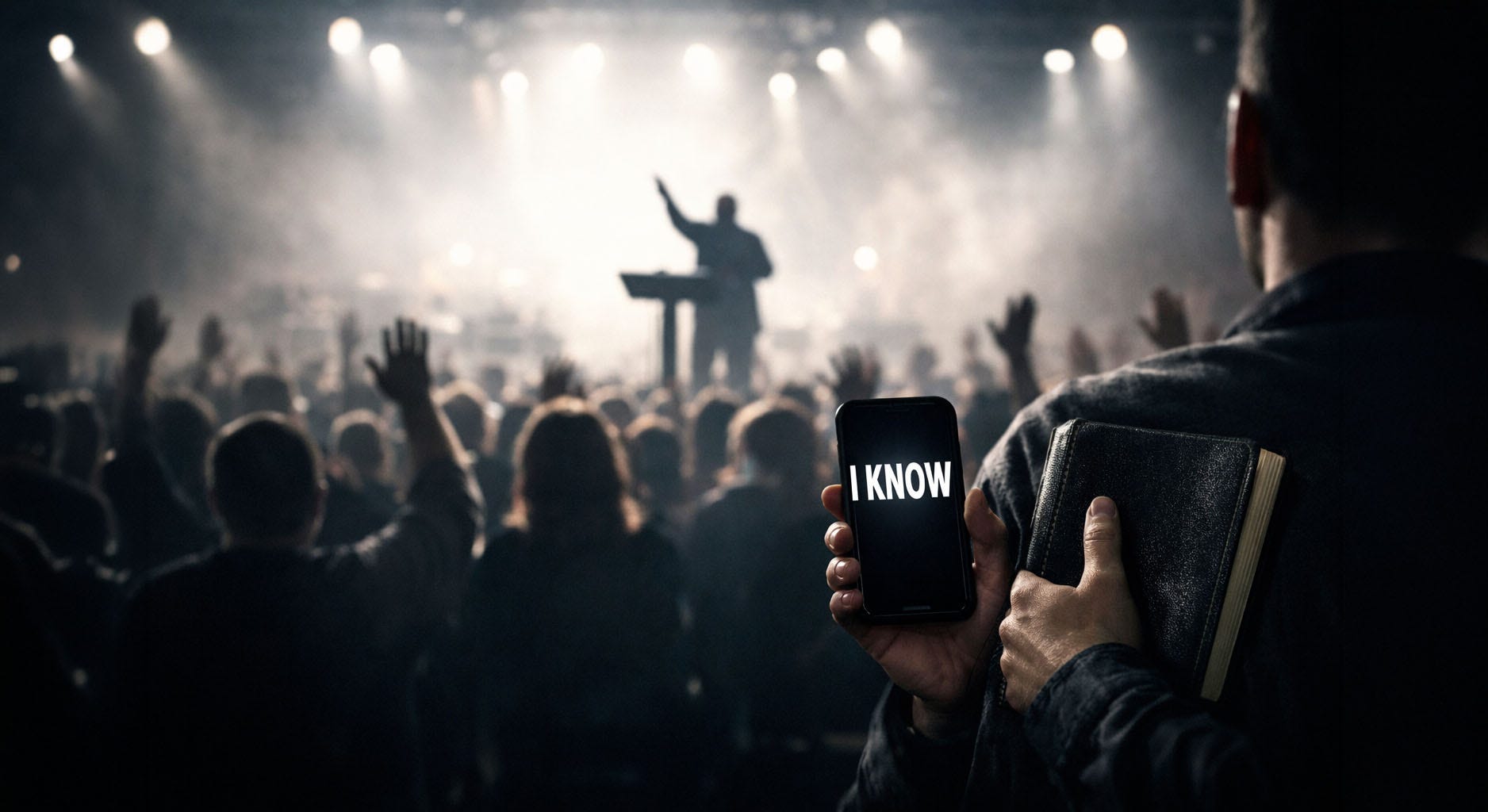
Evangelicals say they believe. But what they usually mean is that they “know.”
And the louder they declare it, the holier they feel. You’ll hear phrases like “I know that I know that I know,” a chant that sounds less like faith and more like self-reinforcement. Ask questions and you’re told, “The Bible says so,” as if repeating a sentence settles an argument.
In their world, admitting doubt feels like admitting defeat. But real life does not care how confident you are. Cancer still hits. People still die. The world still turns. Certainty does not make you right. It just makes you loud.
Democracy, in practice, is not the freedom to believe whatever you want. It is the power to decide which beliefs get treated as facts once elected.
Their Whole Belief System Starts With “We’re Right”
Evangelical theology starts with a loaded gun: We are right. Everyone else is wrong. Not “maybe,” not “we think so.” Just — right. Full stop.
This isn’t just annoying. It’s dangerous. It means every conversation is a battle. Every disagreement is a threat. Every outsider is a project — or a soul to “save.”
That mindset poisons everything. It turns education into indoctrination. It turns science into opposition. It turns religion into war.
When a group is convinced of its exclusive access to truth, violence — physical, social, or intellectual — is never far behind— Karen Armstrong, Fields of Blood
Doubt Is Treated Like Sin
You’re not allowed to wonder in evangelical spaces. Not out loud, anyway. If you do, you’ll get hit with a Bible verse or a prayer request — not real engagement.
“I’m struggling” is heard as “I’m drifting.”
Questions don’t lead to answers — they lead to interventions. You’ll be told you’re under spiritual attack, “giving Satan a foothold,” or “leaning on your own understanding.” The problem isn’t your question — it’s that you asked at all.
So what do people do? They stay quiet. They fake belief. They memorize answers to keep the tribe off their back. And all that pretending? It eats you alive.
Evangelical culture doesn’t teach people how to handle doubt. It teaches them how to hide it— Rachel Held Evans, Faith Unraveled
God Becomes a Set of Flashcards
If your version of God can be summarized in a six-point doctrinal statement and backed up with cherry-picked verses, you’re not worshiping a divine being. You’re worshiping an index card.
Evangelicals flatten God into a theological quiz. And if you get the answers wrong? Eternal hellfire. No pressure.
This makes God less like a mystery to engage and more like a math test to pass. Theology becomes a multiple-choice form: tick the right box, and you’re saved.
When theology becomes certainty instead of exploration, we stop encountering God and start worshipping our own conclusions— Brian Zahnd, Sinners in the Hands of a Loving God
Certainty Gives Them a False Sense of Safety
Let’s face it: the world is terrifying. There’s disease, violence, inequality, climate collapse, and death waiting at the end of it all.
Certainty gives evangelicals the illusion of safety. It’s a warm cocoon — everything’s happening for a reason, Jesus is coming back, and heaven awaits. The cruelty of life becomes tolerable because they think they have the cheat codes.
Even when things go wrong, the narrative still works. Either it’s “God’s plan” or “spiritual warfare.” Never randomness. Never human error. Never bad theology. That’s how they sleep at night — by lying to themselves with confidence.
Certainty is emotional armor. It protects people not from falsehood but from the pain of ambiguity— Brené Brown, The Gifts of Imperfection
Being Loud Means Being Holy
Evangelicals reward people who perform belief.
Preachers shout. Worship leaders weep on cue. Influencers scream into TikToks about how culture is attacking “biblical values.” The more intense the delivery, the more holy you look. No one stops to ask if what’s being said is even true. Volume = virtue.
In that system, the calm and curious are suspect. The nuanced are dismissed. “Humble” gets confused with “weak.” But when everyone’s playing spiritual cosplay, who’s left to think?
In fundamentalist circles, doubt is not just unwelcome — it’s framed as disloyalty— Diana Butler Bass, Christianity After Religion
They’ve Built a Fragile Jenga Tower
Here’s the real reason certainty is treated like gospel: everything depends on it.
If Genesis isn’t literal, what about Jesus? If Paul was wrong about women, what else was he wrong about? If hell isn’t real, do we even need to be saved?
This is what happens when you glue your whole religion to one interpretation of one book in one language. If one card gets pulled, the house collapses. So instead of rethinking, they reinforce.
They become more defensive. More hostile. Because they’re not protecting faith — they’re protecting a system.
A faith built on certainties is always one question away from collapse— Rob Bell, What We Talk About When We Talk About God
Certainty and Morality Get Mixed Up
Ask an evangelical why gay marriage is wrong, and they won’t give you a real argument. They’ll give you a verse.
Ask why women shouldn’t preach? Another verse.
Why is abortion murder? Another verse.
It’s not that they’re deeply moral thinkers — it’s that they’ve memorized which verses to quote. Certainty does the work. It lets them avoid empathy, context, or complexity. And worst of all? They think this makes them righteous.
They’re not being moral. They’re being lazy — and acting smug about it.
Dogma isn’t morality. It’s just obedience with a halo— John Shelby Spong, Why Christianity Must Change or Die
Certainty Feels Amazing — Until It Doesn’t
There’s a rush in being sure.
You feel powerful. You feel chosen. You feel like you’ve got the answers while everyone else is stumbling around in the dark. That feeling is addictive. That’s why evangelicalism markets it so well. The testimonies, the altar calls, the revival meetings — it’s spiritual crack.
But like all highs, it wears off.
Eventually, you hit the hard stuff: pain, loss, inconsistency, betrayal. And if your entire religion was based on never questioning anything — you have no tools left when it all falls apart.
When the certainty dies, many assume the faith must die with it. But it’s only the illusion that’s dying— Richard Rohr, Everything Belongs
It’s Trained Into Them Since Birth
Don’t underestimate how deep this goes.
Most evangelicals were told from childhood: Believe or burn. Think like us or suffer forever. Heaven or hell. No in between. That kind of pressure sticks. It rewires your brain. It turns belief into survival.
By adulthood, they don’t know how to function without certainty. It’s not just theology — it’s trauma. They were raised in a high-control system that punished thinking and rewarded obedience. Is it any wonder they hold on so tightly?
Certainty in fundamentalism is often the product of religious trauma — not genuine conviction— Marlene Winell, Leaving the Fold
The Algorithm Rewards It Too
Let’s not forget the modern twist: evangelical certainty spreads fast because the internet rewards rage, confidence, and simplicity.
Try posting a thoughtful theological essay. Now try shouting “God hates sin and America’s doomed!” Guess which one goes viral?
Evangelicals didn’t invent certainty — but social media monetized it. The louder and angrier they are, the more engagement they get. And once you start getting praise, likes, and dollars for being “bold for Jesus,” you’re hooked.
“The age of the algorithm doesn’t reward nuance. It rewards noise.”
— Jonathan Haidt, The Coddling of the American Mind (2018)
Last Thoughts
Evangelicals worship certainty not because it’s holy, but because it’s comforting. Not because it’s wise, but because it’s easy. Not because it leads to God — but because it lets them avoid change.
But real faith doesn’t need to be sure. Real truth doesn’t panic when questioned. And real growth doesn’t happen in echo chambers.
And if they can’t handle the question, maybe certainty wasn’t strength at all. Maybe it was just a shield they were taught to hide behind.
This space runs on reader support. If you want to keep it going, become a paid subscriber for full access to exclusives and the complete archive.

Why Education Is the Biggest Threat to America As We Know It

America doesn’t fear guns. Doesn’t fear crime. Doesn’t even fear China. What it fears—deep down in its oversized patriotic gut—is a nation full of people who can think. That’s the real threat. Not missiles. Not migrants. But minds. If you want to destroy America
Why America Keeps Mistaking Arrogance for Strength

America likes to think it’s strong because it’s loud. Because it talks big. Because it never stops repeating words like freedom, leadership, and number one.