


The New Testament's table of contents hands you four authors. Two of them are supposed to have walked with Jesus, one traveled with Peter, one traveled with Paul. Those names carry the whole evidentiary weight of Christian origins, because if Matthew and John wrote down what they saw, you're reading testimony. The books themselves never make that claim, and when one of those men turns up inside the story, the text talks about him in the third person, the way you'd write about somebody else.
What the Four Books Say About Their Own Authors
Mark opens with a sentence about good news and then runs 16 chapters without the author ever stepping into the story. No “I was there,” no “we sailed,” nothing.
Matthew tells you about the calling of a tax collector named Matthew in the third person, at 9:9. Mark tells the identical story at 2:14 and calls the man Levi son of Alphaeus. Somebody changed the name while copying, which is the behavior of an editor working with sources rather than a man recalling the afternoon he quit his job.
Luke is the most explicit of the four. The prologue at 1:1-4 tells Theophilus that many people have already undertaken to compile accounts of these events, that those events were handed down by people who were eyewitnesses from the beginning, and that the author has investigated everything carefully so Theophilus can be sure of what he’s been taught. The writer puts himself downstream of the eyewitnesses and says so in his opening paragraph.
John closes twice. The first ending arrives at 20:30-31, and then chapter 21 comes along like a bolted-on appendix, finishing at 21:24 with a line that gives the whole thing away: this is the disciple who is testifying to these things and who has written them, and we know his testimony is true. Somebody else is vouching for the author in the third person plural. Authors don’t write endorsements of themselves in the voice of a committee.
When the Four Books Were Written
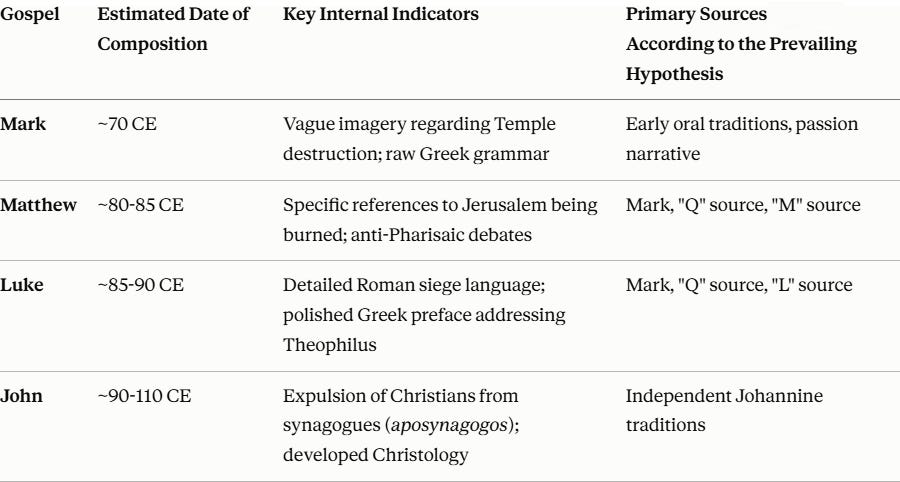
Mark 13 has Jesus predicting that the Temple will come down with not one stone left on another, described with an urgency that reads like recent news. Rome burned the Temple in 70 CE, which puts Mark around that year, give or take a few. Matthew and Luke both used Mark as a written source, so both come later, roughly 80 to 90. Matthew 22:7 slips a detail into a parable about a king who sends troops to burn a city, which Luke’s version of the same parable lacks. John lands somewhere between 90 and 110, with its references to followers of Jesus being put out of the synagogue (9:22, 12:42, 16:2) reflecting a conflict that belongs to the end of the century.
Set that against who the disciples were. Galilean fishermen and village laborers who spoke Aramaic. Acts 4:13 describes Peter and John with the word agrammatoi, meaning unlettered. Literacy across the Roman empire ran somewhere near 10 percent, and it ran lower in rural Galilee, and being able to sign your name sat several tiers below composing extended narrative prose in a second language. Whoever wrote these four books had Greek rhetorical training, access to the Septuagint, and the leisure to compose at length.
Matthew and Luke Copy Mark Word for Word
Of Mark’s 661 verses, roughly 600 turn up in Matthew and about 350 in Luke, frequently with identical Greek vocabulary in identical word order. That level of agreement happens when one writer has another writer’s scroll open in front of him.
Matthew the tax collector, one of the Twelve, present for the ministry, sat down and copied nine-tenths of Mark into his own book, and that borrowed material accounts for more than half of everything he wrote. A secretary of Peter’s working up other people’s stories a generation after the events, the man he was copying from wasn’t an eyewitness either. Then he reached the passage about his own calling, took that over from Mark along with the rest, and changed the name in it to his own. The tradition asks you to believe an eyewitness preferred hearsay to memory.
Then, Where Do the Names Come From?
The first surviving attempt to name gospel authors comes from Papias of Hierapolis around 120 to 130 CE, and it survives only because Eusebius quoted it two centuries later in his Church History (3.39). Papias says Mark served as Peter’s interpreter and wrote accurately but not in order, and that Matthew compiled the sayings in the Hebrew dialect and everyone interpreted them as best they could. Our Matthew is a Greek composition dependent on Greek Mark, so whatever book Papias was describing, it wasn’t the one in your Bible. Papias also admits he got this from an elder, meaning secondhand information about events three generations back.
Justin Martyr writes around 150 to 160 and quotes gospel material constantly. He calls the material “memoirs of the apostles” and doesn’t attach individual names to individual books. A prominent Christian teacher in Rome, using these texts as scripture, apparently had no fixed authorial labels for them.
The four names as a settled set arrive with Irenaeus of Lyon around 180 CE, in Against Heresies 3.1.1. Irenaeus also explains why there must be exactly four gospels, and his reasoning is worth quoting in substance: there are four zones of the world and four principal winds, so four is the fitting number. That’s the argument of a man defending a collection already in his hands against Marcion, who wanted one gospel, and against Valentinian teachers circulating others. The names solved a problem in the second century.
The titles in the manuscripts point the same direction. “According to Matthew,” “according to Mark,” phrased as euangelion kata, is the wording you use to distinguish copies sitting side by side in a collection. Martin Hengel argued the titles must go back to the beginning, since a book in circulation needs identification and the title forms show almost no variation. Uniformity works equally well as evidence of standardization at a single moment, and the earliest manuscripts preserving those titles date to around 200, long after the names had hardened into tradition.
Scribes Who Improved What They Found
Nobody has an original. The earliest substantial copies are third and fourth century, and everything in between was hand-copied by people ranging from professional scribes to bored monks to enthusiastic amateurs. Across roughly 5,700 Greek manuscripts, the count of textual variants runs past 400,000, which is more variants than there are words in the New Testament. The overwhelming majority are spelling slips and word order. A handful changed doctrine.
Mark 16:9-20, the resurrection appearances and the snake handling, is absent from Codex Sinaiticus and Codex Vaticanus, and its vocabulary doesn’t match the rest of Mark. The gospel originally ended at 16:8 with terrified women saying nothing to anyone, which is a difficult ending, and later hands fixed it.
John 7:53-8:11, the woman caught in adultery, is missing from the earliest manuscripts entirely. In the manuscripts that do carry it, the passage wanders: some put it after John 7:36, some after 21:25, some drop it into Luke after 21:38. A story that floats between books wasn’t in either one to start with.
Luke 22:43-44, where an angel strengthens Jesus and his sweat falls like drops of blood, is missing from several of the best early witnesses. At Mark 1:41, Codex Bezae reads orgistheis, moved with anger, where most manuscripts have moved with compassion, and both Matthew and Luke, copying that verse, delete the emotion word altogether. At Luke 3:22, Codex Bezae has the voice at the baptism say “today I have begotten you,” straight out of Psalm 2, which reads as adoption rather than eternal sonship. Later manuscripts smooth it into Mark’s safer wording.
What Survives Once the Names Come Off
These four books remain the earliest connected stories about Jesus, composed within one or two generations of his death, drawing on oral tradition and at least one lost collection of sayings. Nobody serious throws them out. What they can’t do is function as sworn testimony from named witnesses, because they’re anonymous documents of uncertain provenance, built from decades of oral transmission, shaped by writers with theological positions to defend, and copied for centuries by people who occasionally corrected what they read.
That’s an ordinary situation in ancient history, and historians work with it all the time. The problem shows up when a tradition that acquired its author list from second-century bishops fighting heresy gets presented as the reason to believe the accounts in the first place.
And in the exclusive content for supporters, we’ll cover what mainstream Christian scholarship says about this entire ordeal, which is rarely what the readers expect.
If you find value here, become a supporter of The Unholy Truth. Paid subscriptions are what make this work possible.
Sources and Further Reading
Bart D. Ehrman, Jesus, Interrupted and Misquoting Jesus
Bart D. Ehrman, The Orthodox Corruption of Scripture
Bruce M. Metzger and Bart D. Ehrman, The Text of the New Testament: Its Transmission, Corruption, and Restoration
Bruce M. Metzger, A Textual Commentary on the Greek New Testament
Eusebius, Ecclesiastical History, Book 3, chapter 39 (on Papias)
Irenaeus, Against Heresies, Book 3
Martin Hengel, The Four Gospels and the One Gospel of Jesus Christ
Catherine Hezser, Jewish Literacy in Roman Palestine
William V. Harris, Ancient Literacy
Dale C. Allison Jr., The Historical Christ and the Theological Jesus
The Gospels may still tell us something profound about Jesus. But “profound” and “signed eyewitness affidavit” are not the same thing. If your faith collapses when Matthew stops being Matthew, perhaps your faith was resting less on Jesus than on four names added to the covers later. God can survive textual criticism. Biblical inerrancy might need a moment.
The prologue of Luke is similar to the prologue of Acts, which is why the two are linked. It is likely that an early version of Luke, which started with the nativity story of Jesus, was edited by Marcion when he pitched his idea of the Bible to the church in Rome. So the received text was modified after that, adding the nativity of John the Baptist and the prologue. Since Acts isn't mentioned until around 200 CE, and shows signs of extensive edits, the prologue of Luke was likely the last edit of Luke, around 200 CE.