


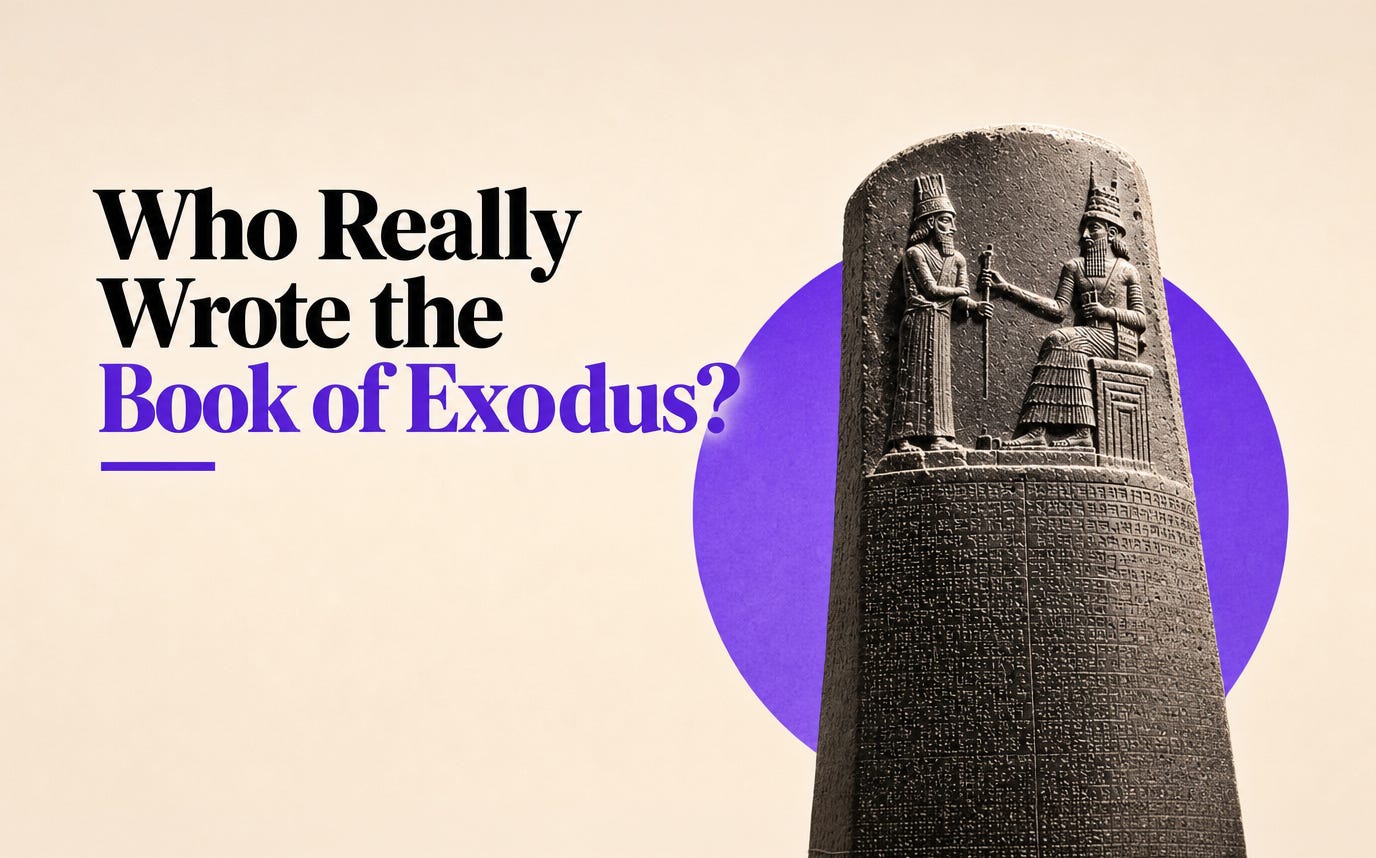
In the winter of 1901 and 1902, a French expedition digging at Susa in what’s now southwestern Iran hauled a seven-foot pillar of black diorite out of the ground in three pieces. An Elamite king had carried it off as war loot roughly six hundred years after it was carved, which is the only reason it survived intact. Carved at the top, a seated sun god hands a rod and a ring to a standing king. Below that, in tight columns of cuneiform, sit about 282 legal rulings issued by Hammurabi of Babylon, who died around 1750 BCE. The stone has been in the Louvre ever since.
The rulings read like the Book of the Covenant in Exodus, the same cases, decided the same way, arriving in the same order. Problem? Hammurabi was a historical king, and he predates Moses, a theological figure, by about 300 years.
The Ox That Gores Twice
Hammurabi’s ruling 250 covers an ox that gores a man to death while walking down the street. Nobody’s liable. It’s a bad day and an animal.
Ruling 251 changes the facts. The ox has gored before, the city ward has told the owner about it, and the owner didn’t blunt its horns or pen it up. Now the owner pays half a mina of silver when the ox kills a free man. Ruling 252 drops the payment to a third of a mina when the dead man was somebody’s slave.
Exodus 21:28 covers an ox that gores a man to death. The ox is killed, the owner walks.
Exodus 21:29 changes the facts. The ox has gored before, the owner was warned, and he didn’t pen it up. Now the ox is killed and the owner is liable for his own life, though verse 30 lets him buy his way out. Verse 32 sets a figure when the dead person was a slave: thirty shekels of silver, paid to the owner.
Three rulings appear in the same sequence and with the same distinctions: the ox that kills without prior warning, the ox with a known record of violence, and the victim who legally counted as property.
And the parallels only keep coming. Both codes handle the man who digs a pit and leaves it open, the deposit left with a neighbor that goes missing, the man who seduces an unmarried daughter and owes her father, the debt slave who serves a fixed term and goes free. Hammurabi’s ruling 117 releases a debt slave in the fourth year. Exodus 21:2 releases him in the seventh.
The Price List Behind “Eye for Eye”
The phrase everybody knows comes out of Exodus 21:23-25, and it reads as savagery to modern ears. Read it against the Babylonian version and it starts looking like a reform.
Hammurabi’s rulings 196 through 200 do run eye for eye and bone for bone, but only between social equals. When a member of the upper class destroys the eye of a commoner, he pays sixty shekels of silver. When he destroys the eye of somebody’s slave, he pays half the slave’s value. The talion formula is a ceiling on revenge for the people at the top and a price list for everybody underneath.
The Exodus version drops the class grading from the formula itself. What it keeps is the property logic underneath: a few verses later, a master who beats his slave and the slave dies a day or two afterward faces nothing, because the slave “is his money” (Exodus 21:21). The Hebrew writers modernized some parts of what they inherited and left other parts standing.
You can watch the same reforms on the ox case. Hammurabi fines the negligent owner. Exodus puts his life on the line, and it kills the animal, which Babylonian law never bothers to do. Somebody working on this material decided a human death couldn’t be settled with silver, and that blood spilled by any creature had to be answered.
If you’re not already a paid subscriber and you’re finding value here, I’d love for you to consider becoming one to keep The Unholy Truth alive.
Whose Name Is on the Document
Hammurabi’s prologue says that the gods called him to bring justice to the land and to keep the strong from oppressing the weak. His epilogue curses anyone who alters his words. The sun god in the carving is handing over the symbols of authority, and the laws that follow belong to the king who commissioned the stone. He signs them.
Exodus takes the same body of case law and places every ruling in the mouth of a god speaking directly to a man on a mountain. There is no king, no legal commission, no signature at the bottom. The rulings about oxen and pits arrive with the same authority as the command against murder, because the text presents them all as a single uninterrupted speech.
The legal content came down through a common Near Eastern tradition that had been in place for a thousand years before Israel existed as a nation, as reflected in the Laws of Eshnunna, Lipit-Ishtar, and Ur-Nammu before it ever reached Hammurabi. What the biblical writers contributed was the claim that the rulings came from outside human authority altogether, which meant they couldn’t be repealed by the next king.
That said, oral traditions didn’t need the next king to evolve and adjust to the times. What slowed that adjustment drastically was writing things down, and what stopped it was the printing press.
Supporters get the next section, where I set Hammurabi’s three ox rulings and the Exodus three side by side in full translation, add the even older ruling from the Laws of Eshnunna that started the sequence, and walk through exactly which words the Hebrew writers changed and what each change bought them. If you want to see the borrowing at the level of the sentence, that’s where it is.
Sources and Further Reading
Martha T. Roth, Law Collections from Mesopotamia and Asia Minor, 2nd ed. (Scholars Press, 1997). The standard English translation of Hammurabi, Eshnunna, Lipit-Ishtar, and Ur-Nammu.
David P. Wright, Inventing God’s Law: How the Covenant Code of the Bible Used and Revised the Laws of Hammurabi (Oxford University Press, 2009).
Raymond Westbrook, ed., A History of Ancient Near Eastern Law, 2 vols. (Brill, 2003).
Bernard M. Levinson, Legal Revision and Religious Renewal in Ancient Israel (Cambridge University Press, 2008).
Joshua A. Berman, Created Equal: How the Bible Broke with Ancient Political Thought (Oxford University Press, 2008). Argues the Hebrew material breaks harder from its neighbors than the parallels suggest.