


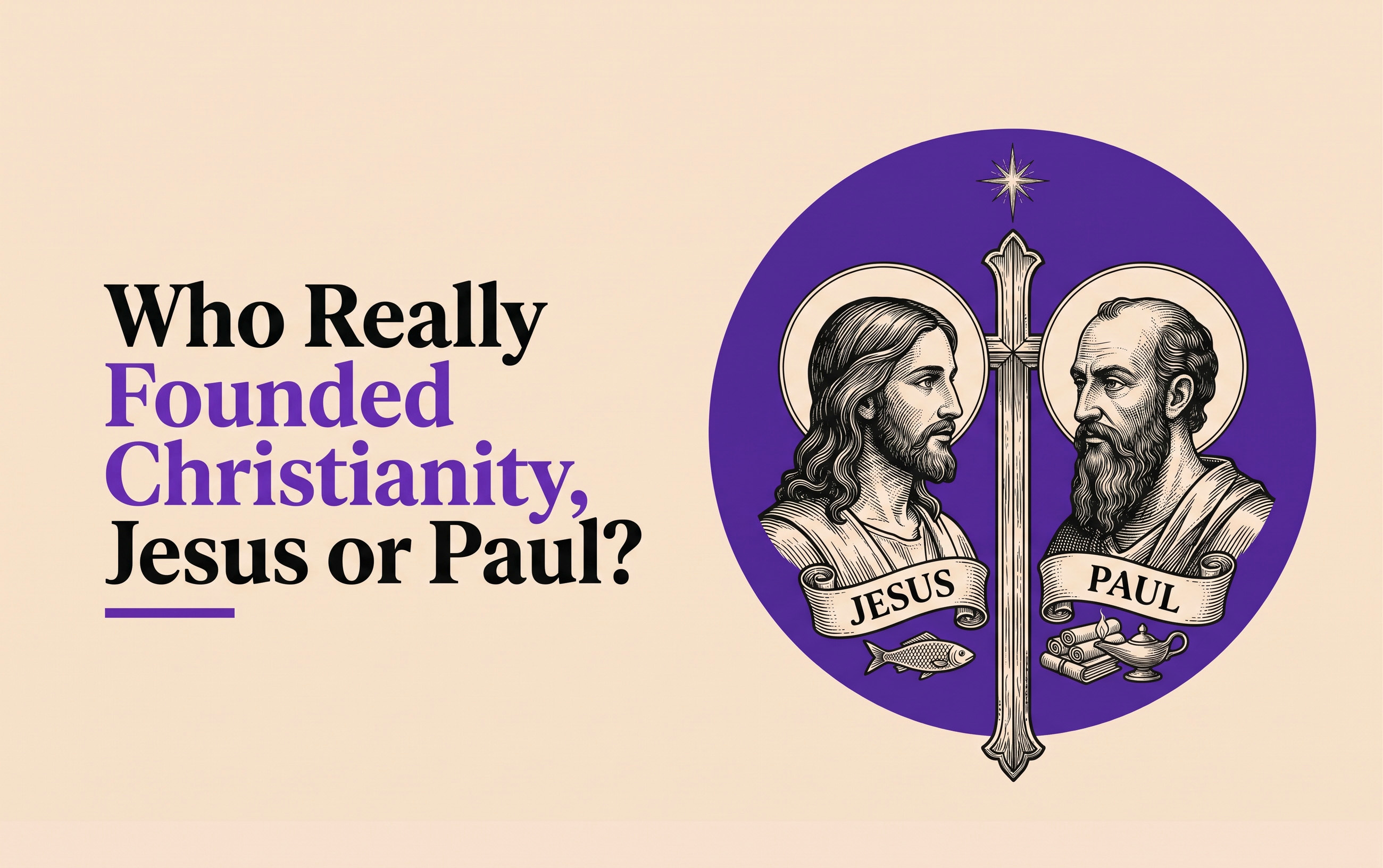
Most people assume Christianity started with Jesus, the way a company starts with whoever’s name is on the building. Jesus preached in Galilee, healed people, picked a fight with the Temple authorities, and died on a Roman cross. A few years later a man who’d never met him started writing letters to small groups of Greeks and Romans, and those letters are the oldest Christian writing we’ve got. If you go looking for whose fingerprints are on the religion that fills churches every Sunday, you’ll find a lot more of Paul’s than anyone told you, and a lot fewer of Jesus’.
A Jewish Prophet With a Deadline
Jesus never set out to start a new religion. He was a Jew preaching to Jews, and the earliest gospel sums up his message in one line: the time is up, God’s kingdom is near, so repent (Mark 1:15). He expected God to step in and set the world right within his followers’ lifetime, and he told the crowd that some of the people standing in front of him wouldn’t die before they saw it happen (Mark 9:1).
Everything else he did follows from that deadline. He kept the Sabbath, and his arguments with the Pharisees were over how to keep it. He worshipped at the Temple. He told his listeners he’d come to fulfill the law, and that not one stroke of a letter would drop out of it until the end came (Matthew 5:17-18). When he sent out the twelve, he told them to stay away from Gentiles and Samaritans and go only to the lost sheep of Israel (Matthew 10:5-6). When a non-Jewish woman begged him to heal her daughter, he compared her to a dog before he gave in (Matthew 15:21-28).
Mark’s gospel does slip in an aside saying Jesus declared all foods clean (Mark 7:19), but that’s the gospel writer talking, in a parenthetical, about forty years after the crucifixion. If Jesus had settled the food question himself, Peter wouldn’t have needed a vision from heaven before he’d eat with Gentiles in Acts 10, and the blowup in Antioch you’ll read about below would never have happened.
As for calling himself God, the earliest gospels never have him say it. That idea comes into focus later, most fully in John, written around the end of the first century.
Paul Never Met Him and Didn’t Think He Needed To
Paul was a Pharisee from outside the Jewish homeland who spent his early years trying to stamp out Jesus’ followers, and he admits it in three separate letters (Galatians 1:13, 1 Corinthians 15:9, Philippians 3:6). Then he had a vision. His own letters describe it in a couple of lines: God revealed his Son to him (Galatians 1:16), and he’d seen the Lord (1 Corinthians 9:1). The famous scene on the road to Damascus, with the blinding light and the voice, comes from Acts, written decades later. Acts tells the story three times and can’t keep straight whether Paul’s companions heard the voice (Acts 9:7) or didn’t (Acts 22:9).
What matters is what Paul did with the experience. He insisted his gospel came to him straight from heaven and that no human being taught it to him (Galatians 1:11-12). After the vision he skipped Jerusalem, where the people who’d walked with Jesus were living, and went off to Arabia. He waited three years before spending fifteen days with Peter and meeting James, Jesus’ brother (Galatians 1:17-19). So a man who’d never heard Jesus speak set himself up as an authority on what Jesus meant, and he put his case in writing before anyone else did. His seven letters that scholars agree are authentic date to the 50s, at least fifteen years before the first gospel. Thirteen of the New Testament’s twenty-seven books carry his name, and around half of those thirteen were written by other people using it.
The Creed Paul Inherited From Jerusalem
Paul gets credit for plenty he didn’t come up with. In 1 Corinthians 15:3-7 he passes along something he says he received from others: Christ died for our sins, was buried, was raised on the third day, and appeared to Peter, then the twelve, then more than five hundred followers, then James. That’s a formula Paul learned within a few years of the crucifixion, and the most likely source is the Jerusalem group itself. The same goes for the words over the bread and cup at the Lord’s Supper (1 Corinthians 11:23-25), and for the prayer “Maranatha,” meaning “our Lord, come” (1 Corinthians 16:22), which Paul hands to Greek-speaking readers in the original Aramaic because that’s how the first followers prayed it. The belief that Jesus’ death dealt with sin and that God raised him from the dead was already in place before Paul joined.
He also shared Jesus’ deadline. Paul told the Thessalonians that some of them, himself included, would still be alive when Jesus came back down from the sky (1 Thessalonians 4:15-17), and he told the Corinthians to think twice about marriage because time was running out (1 Corinthians 7:29). Paul was every bit the end-of-the-world Jew that Jesus was.
Who Gets In, and on What Terms
Paul’s big move was deciding who got into the movement and what it cost them. The first followers were Jews who expected Gentiles to join the way Gentiles had always joined Israel: the men got circumcised, and everybody kept the law. Paul said Gentiles could come in as Gentiles, with no circumcision, no food laws, and no Sabbath. He felt so strongly about it that he told the Galatians he wished the men pushing circumcision would go the whole way and castrate themselves (Galatians 5:12).
To back up that position he built the theology Christians still quote. A person is made right with God through faith in Christ, apart from doing what the law requires (Romans 3:28, Galatians 2:16), and Christ redeemed his people from the curse of the law (Galatians 3:13). In the same breath Paul could call the law holy, just, and good (Romans 7:12), because his fight was over forcing it on Gentiles. Compare that with Jesus telling a rich man that keeping the commandments was the way to eternal life (Mark 10:17-19), and you can see how two men describing the same God ended up pointing people down different roads.
Then there’s what Paul leaves out. Across seven letters he quotes Jesus a handful of times. He never tells a parable, never mentions a miracle, and never gets near the Sermon on the Mount. His Jesus is the one who died and rose, and he told the Corinthians he’d made up his mind to know nothing among them except Christ crucified (1 Corinthians 2:2).
The Shouting Match in Antioch
The disagreement over Gentiles played out in front of witnesses. In Galatians 2, Paul describes a meeting in Jerusalem with James, Peter, and John, whom he calls the “pillars” with an edge of sarcasm you can hear two thousand years later. They agreed Paul would take the Gentiles while they took the Jews, and all they asked was that he remember the poor (Galatians 2:1-10).
The deal fell apart in Antioch. Peter had been eating with Gentile believers until some men arrived from James, and then Peter pulled back and ate only with Jews. The other Jewish believers followed him, and so did Barnabas, Paul’s own traveling partner. Paul confronted Peter to his face, in front of everyone, and accused him of hypocrisy (Galatians 2:11-14). Peter had followed Jesus for years and Paul had a vision, and Paul still lectured him in public. Paul never says he won that argument, and Barnabas drops out of his travels after it.
Acts tells a much tidier story, with a friendly council in Jerusalem that settles everything with a compromise (Acts 15), and it explains Paul’s split from Barnabas as a quarrel over whether to bring along a young man named John Mark (Acts 15:36-40). Paul’s own account, written by someone who was in the room, reads like a family feud.
A Roman Army Settled the Argument
Paul’s version was easier to sell to Gentiles, since it came with no surgery and no new diet, but ease alone didn’t decide it. Rome did. In 62 the high priest in Jerusalem had James stoned to death, according to the Jewish historian Josephus. Eight years later the Romans crushed the Jewish revolt, burned the Temple, and leveled the city, and the Jerusalem community that had been the center of the movement scattered.
Jewish followers of Jesus who kept the law held on for a few more centuries. Later writers called them Ebionites, and they rejected Paul as a traitor to the law. The Gentile church returned the favor by listing them among the heretics. Within a couple of generations, the people deciding what Christianity meant were Gentiles reading Paul’s letters.
Paul never saw any of it. Acts leaves him under house arrest in Rome, and church tradition has him executed under Nero in the 60s. In his lifetime his churches were small, quarrelsome groups that he was constantly scolding by mail. Around 140, a wealthy shipowner named Marcion put together the first Christian scripture collection on record: one gospel, a trimmed version of Luke, plus ten letters of Paul, with the Jewish scriptures thrown out entirely. The church condemned Marcion and then built its own, bigger collection, and Paul’s letters sat at the center of that one too.
The Paul in Your Pew Came by Way of Augustine and Luther
Walk into most churches and the sermon will lean on Paul. Nobody preaches on Jesus’ promise that the law stands to the last stroke of a letter, and you’ve never heard a sermon on keeping kosher. You’ve heard plenty about being saved by faith.
That faith-centered Christianity runs through two later readers of Paul. Original sin as most Christians know it comes from Augustine, the fifth-century bishop of Hippo in North Africa, who read Romans 5:12 in a Latin translation saying all humanity sinned “in” Adam. Paul’s Greek says death spread to everyone “because” everyone sinned. The phrase “faith alone” shows up exactly once in the Bible, in the letter of James, which says a person is justified by works and not by faith alone (James 2:24). Martin Luther, the German monk who started the Protestant Reformation, added the word “alone” to Romans 3:28 in his translation. Paul’s worry was whether Gentiles had to become Jews. The anxious individual conscience asking how a sinner gets right with God belongs to Augustine and Luther, and they read it back into Paul.
So, Which One Founded It?
Jesus founded a movement inside Judaism that expected the world to end soon. His followers in Jerusalem kept that movement Jewish and gave it the conviction that his death and resurrection meant something. Paul took that conviction to the Gentiles, cut away the law, and wrote the letters that outlived everyone who argued with him. Then Rome wiped out Jerusalem, and centuries later Augustine and Luther rebuilt Paul in their own image.
If you need one name, Paul’s has the stronger claim on the church that survived. Jesus would have recognized James’ community in Jerusalem, with its law-keeping and its Temple prayers. He’d have had a hard time recognizing a Gentile congregation in Corinth eating pork, skipping the Sabbath, and singing about a man who’d never met him.
So what do you think, did Jesus start Christianity, or did Paul take over a movement that belonged to someone else? Drop your answer in the comments.
Paul quotes Jesus only a handful of times in all his letters, and in one passage he sets aside a direct command from Jesus and says so in writing. Supporters get the full walkthrough below: every saying Paul attributes to Jesus, everything he tells us about Jesus’ life (it fits on an index card), and the spot where he overrules the man he claimed to speak for. Become a supporter to read it.
Sources and Further Reading
Paula Fredriksen, Paul: The Pagans’ Apostle (Yale University Press, 2017)
Paula Fredriksen, When Christians Were Jews: The First Generation (Yale University Press, 2018)
E.P. Sanders, The Historical Figure of Jesus (Penguin, 1993)
E.P. Sanders, Paul and Palestinian Judaism (Fortress Press, 1977)
Bart D. Ehrman, Jesus: Apocalyptic Prophet of the New Millennium (Oxford University Press, 1999)
Bart D. Ehrman, Peter, Paul, and Mary Magdalene (Oxford University Press, 2006)
Bart D. Ehrman, Forged: Writing in the Name of God (HarperOne, 2011)
James D. Tabor, Paul and Jesus: How the Apostle Transformed Christianity (Simon & Schuster, 2012)
Hyam Maccoby, The Mythmaker: Paul and the Invention of Christianity (Harper & Row, 1986)
Larry W. Hurtado, Lord Jesus Christ: Devotion to Jesus in Earliest Christianity (Eerdmans, 2003)
Krister Stendahl, “The Apostle Paul and the Introspective Conscience of the West,” Harvard Theological Review 56 (1963)
Josephus, Antiquities of the Jews 20.200 (the death of James)