


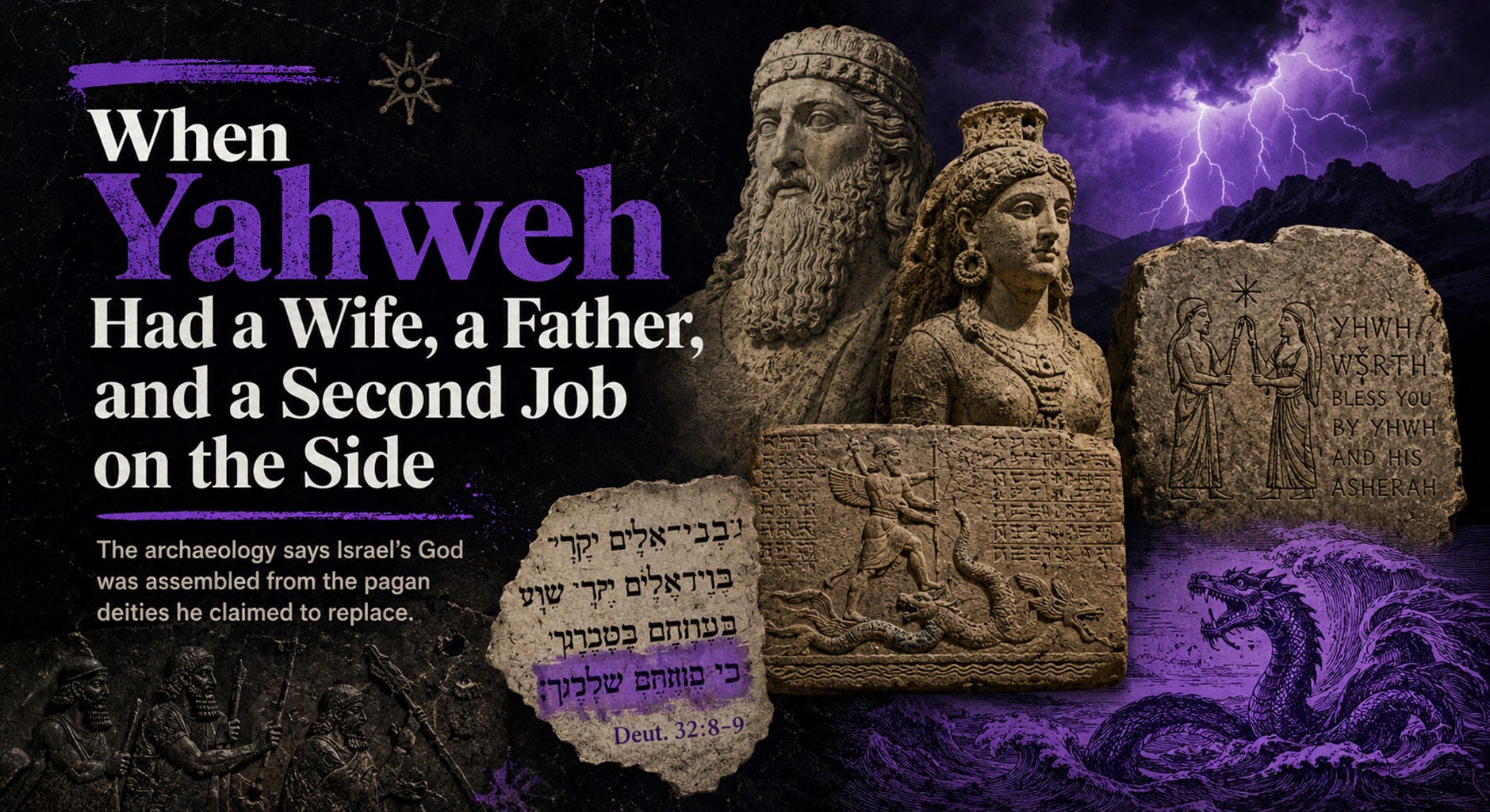
Monotheism was a gradual process, and the God of Israel arrived in the Bible with a résumé, most of his lines belonging to somebody else. His titles, his weapons, his mountain address, even his family tree all came with previous owners: the gods of Canaan, Ugarit, and Mesopotamia.
The evidence for this sits in the ground and in the grammar, and it’s been accumulating for over a century. Israelite religion grew out of the wider West Semitic world, and its high god carried the fingerprints of the gods around him. The inscriptions dug out of the Levant, the clay tablets from the Syrian coast, and the seams left in the biblical text itself all point the same direction. What looks like a clean break from paganism reads, on inspection, more like a hostile takeover.
El, the Father Who Never Left
Elohim in Hebrew, Allah in Arabic, Alaha in the Aramaic Jesus spoke, all mean “god” in the general sense, and they’re all cousins of the word “El.” But “El” hasn’t always been a generic word for “god” that Semitic peoples happened to use. There was a time when El was a specific deity, the gray-bearded head of the Canaanite pantheon, ruling from a tent at the source of the waters. We know him from the clay tablets dug up at Ras Shamra, ancient Ugarit, where he presides over a divine council and fathers seventy sons.
His name is all over the Bible, in El Elyon, El Shaddai, El Olam, and Beth-El (house of El). Genesis 33:20 has Jacob build an altar and call it El, the God of Israel. Deuteronomy 32:8-9 preserves a fossil so old the later editors seem to have missed it: the Most High divides the nations among the sons of God, and Yahweh receives Israel as his allotted share. Take the words at face value and you get El the father parceling out territory to his sons, with Yahweh as one of them, the younger god drawing a portion from the elder.
The merger came later, and Yahweh swallowed El’s identity so completely that the two collapsed into a single figure, the patriarch’s God and the storm god fused into one, with only the seams left showing in the text.
Yahweh Learned to Fight From Baal
If El gave Yahweh his fatherhood, Baal gave him his muscle. Baal was the Canaanite storm god, the rider of the clouds who fought the sea and the god of death to establish his kingship. The imagery is vivid and specific, and it turns up in the Psalms wearing Yahweh’s name.
Psalm 68:4 calls God the one who rides through the deserts, and the older sense of the phrase is “rider of the clouds,” Baal’s own epithet. Yahweh thunders from the heavens (Psalm 18), splits the sea (Exodus 15), and crushes the twisting serpent Leviathan (Psalm 74, Isaiah 27). Leviathan is Lotan, the same sea dragon Baal’s ally slaughters in the Ugaritic texts, the same fight with a different hero standing over the corpse. The scribes handed Yahweh the storm god’s greatest hits and filed off the serial numbers.
The pattern has a shape you can trace across the texts: the powers and titles of several older gods collapsing into one figure over time, until Yahweh alone holds what used to be shared among a pantheon. Yahweh took Baal’s portfolio the way an empire annexes a province, keeping the powers and turning the old god into a name worth cursing.
Asherah, the Wife They Tried to Erase
Yahweh had a wife, and the archaeology couldn’t make it any louder.
At Kuntillet Ajrud, a way station in the Sinai, excavators found inscriptions from around 800 BCE blessing travelers by “Yahweh and his Asherah.” Another turned up at Khirbet el-Qom near Hebron. Asherah was El’s consort in the Ugaritic pantheon, the mother goddess, and for a long stretch of Israelite history ordinary people paired her with Yahweh in exactly this kind of blessing. Whether the inscriptions name the goddess herself or the wooden cult pole that carried her name is argued over, but either way the object points back to her, and the pairing was common enough that the scribes couldn’t ignore it.
The biblical writers hated this, and Kings and Chronicles are full of reformers tearing down her poles and burning her images. The sheer volume of the polemic tells you how popular she was, because you don’t legislate this hard against a practice nobody follows. Editors with an agenda wrote the goddess out of the official story, but the inscriptions were already cut into stone and plaster before the reform reached them, and they’re still legible.
Chaos Monsters on Loan From Babylon
The same pattern runs east into Mesopotamia. The opening of Genesis has the Spirit of God hovering over the deep, and the Hebrew word for that deep, tehom, is a cousin of Tiamat, the saltwater chaos goddess whom Marduk butchers to build the world in the Babylonian Enuma Elish. The flood story runs on the same track as the Epic of Gilgamesh, down to the hero releasing birds to find dry land and the gods sniffing the sacrifice afterward.
Ancient Israel sat at a cultural crossroads, and, as in any culture before and after it, its scribes worked with the materials at hand. The genius shows in how they reworked what they inherited, cutting a crowd of gods down to one and making the result feel inevitable.
Not a paid subscriber yet? If you can afford it, consider joining. It’s what keeps this project open for the people who can’t.
The doctrine of a single, self-existent God who tolerates no rivals ranks among the most consequential ideas in human history, and it arrived at the end of a long process rather than at the start. The scribes built it piece by piece out of the gods around them, keeping El’s fatherhood, Baal’s storms, Asherah’s place at his side until they erased it, and Tiamat’s chaos churning under the first verse of Genesis. Read Deuteronomy 32 slowly and the older arrangement surfaces, a crowded council of gods that generations of editors trimmed down to one. They did the trimming, but they left the offcuts in the text, and the offcuts are what let us reconstruct the family Yahweh came from.
That’s all for now. I’m working on a series called “The Making of Yahweh” that goes into all of this properly, but no date yet. More soon.
Thanks for being there,
—Tanner
Sources and Further Reading
Francesca Stavrakopoulou, God: An Anatomy (2021)
Mark S. Smith, The Early History of God: Yahweh and the Other Deities in Ancient Israel (2nd ed., 2002)
Mark S. Smith, The Origins of Biblical Monotheism (2001)
William G. Dever, Did God Have a Wife? Archaeology and Folk Religion in Ancient Israel (2005)
John Day, Yahweh and the Gods and Goddesses of Canaan (2000)
Tags: biblical criticism, ancient history, Canaanite religion, Yahweh, Asherah, comparative religion, monotheism, archaeology, Hebrew Bible
I might add that Asherah, often referred to in the Bible as the "Queen of Heaven," was El's consort and hence Yahweh's (and Ba'al's) mother! Later when Yahweh absorbed El, Asherah became Yahweh's consort (talk about an Oedipus complex). The reason Asherah had so much staying power is that she protected women and children in childbirth among other powers. I have read that the most common archeological artifact found in the "Holy Land" is small clay statuettes of Asherah, presumably for in home altars (thousands have survived to the present day). The elites in Jerusalem tried to wipe out her presence but the people in the hinterlands weren't buying that. It seems that her worship lasted well into the first millennium.
And the biggest tell in the Bible is that Yahweh is male (He/Him). Why would a solitary, monotheistic god need sexual reproductive organs if there are no other gods to mate with?
Interesting read. I look forward to the full series. Asherah was erased. I guess the same misogynistic forces that reduced Mary Magdalene to a repentant whore who was little more than a side note started early. It gives the whole "Let us make man in our image" a new meaning.