


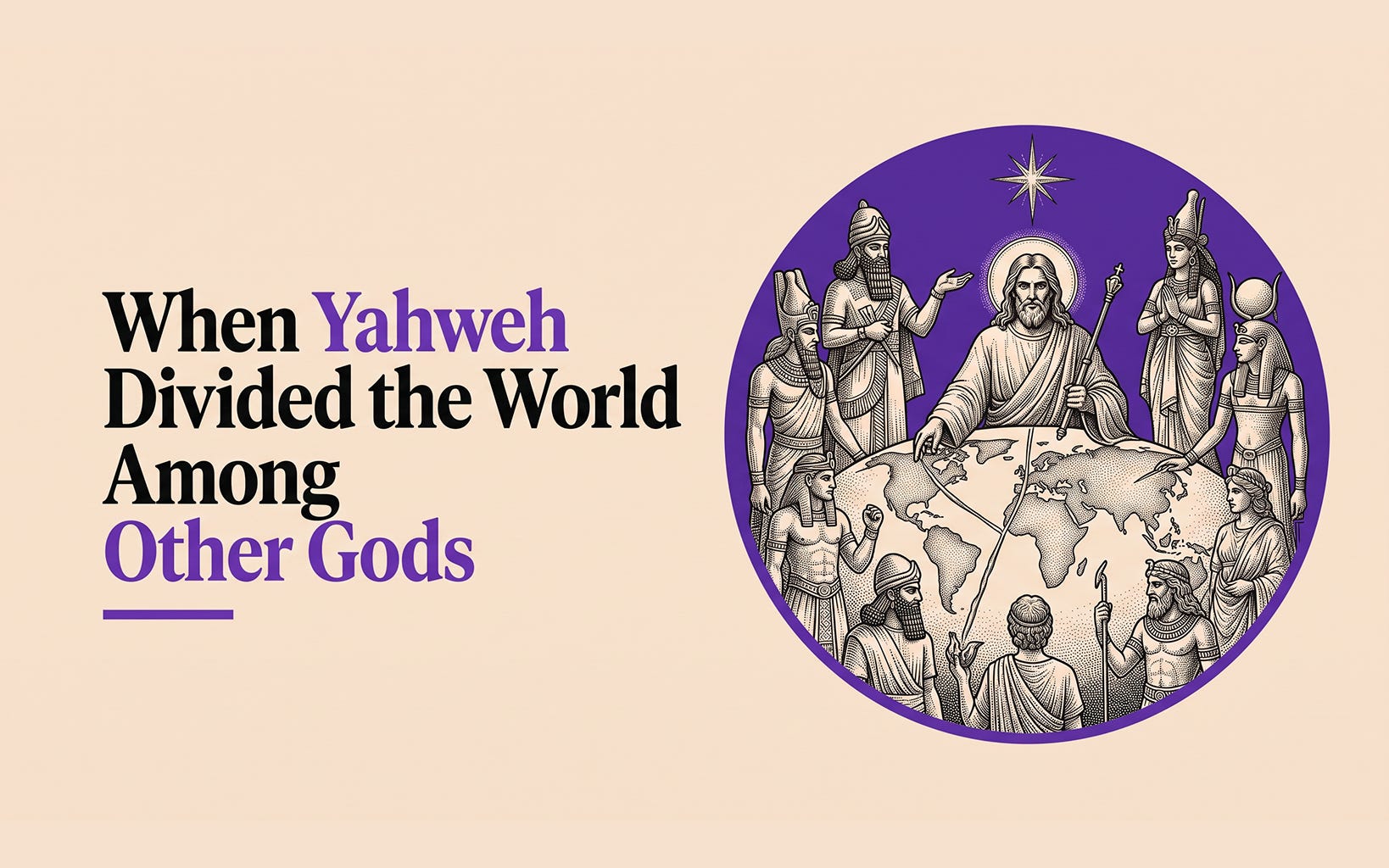
Long before monotheism took hold in the Hebrew Bible, the cosmos was a bustling, high-stakes boardroom, aka divine council. In this ancient cosmic geography, the Most High parceled out the nations of the earth like real estate, assigning a supernatural patron to every single border and keeping Israel as His own personal inheritance.
For centuries, we’ve read these texts through a modern lens, editing out the ghosts of the ancient pantheon. But with the discoveries of the Qumran scrolls and the Ugaritic clay tablets, a fascinating, forgotten narrative roars back to life. The gods of the nations were real to the biblical writers, who just didn’t expect them to rule so poorly.
Here is how a single, radical poem in Deuteronomy opens the door to a lost supernatural worldview where the nations were handed out by number, the managers got fired, and monotheism arrived late to rewrite the story.
Deuteronomy 32:8-9 and the Nations Handed Out by Number
Deuteronomy 32 is a poem usually called the Song of Moses, and it’s one of the oldest pieces of writing in the book. Here’s verses 8-9 in the King James Version:
When the most High divided to the nations their inheritance, when he separated the sons of Adam, he set the bounds of the people according to the number of the children of Israel. For the LORD’s portion is his people; Jacob is the lot of his inheritance.
The poem sets this scene at the moment the human race was split into nations, which in Genesis happens at the Tower of Babel, generations before Jacob was born. As the King James has it, God is carving up the whole world according to the number of Israel’s sons before Israel has any sons to count.
The oldest surviving copies of the verse have the nations divided according to the number of the sons of God. That’s the reading in a Deuteronomy fragment from the Dead Sea Scrolls, and it’s the reading behind the Greek translation Jews made before the time of Jesus, which says “angels of God.” Both are more than a thousand years older than the oldest complete Hebrew Bible (a manuscript from around 1008 CE), which is where “children of Israel” comes from.
With the original wording in place, the verse describes a divine council. The Most High splits humanity into nations, gives each one to a son of God, and keeps back one people as Yahweh’s share, and that share is Jacob. The numbers line up too. Genesis 10 lists seventy nations descended from Noah’s sons, and the Canaanite clay tablets dug up at Ugarit in Syria starting in 1929 give El, the high god, seventy sons with his wife Athirat, which gives every nation a divine patron of its own.
Deuteronomy says the same thing in prose elsewhere. Chapter 4 warns Israel not to worship the sun, moon and stars, “all the host of heaven,” because God allotted them to the other peoples and took Israel for himself (Deuteronomy 4:19-20). Chapter 29 complains that Israel served gods Yahweh hadn’t assigned to them (Deuteronomy 29:26). The people who wrote those lines took the other nations’ gods as existing beings who belonged to somebody else.
That was too much for later readers, and at some point before the Common Era a scribe swapped “sons of God” for “sons of Israel,” which removes the other nations’ gods from the verse. The Masoretes, the medieval Jewish scribes who standardized the Hebrew text and added its vowels, inherited that reading, and English translators followed them for centuries. Some modern translations have put the older reading back, the ESV with “sons of God” and the NRSV with “gods,“ while the King James and the NIV keep “sons of Israel.”
Psalm 82 and the Assembly of El
The first verse of Psalm 82, translated straight from the Hebrew, reads: “God stands in the assembly of El; in the middle of the gods he gives judgment.”
“Assembly of El” is the same phrase the Ugarit tablets use for the gathering of the gods around their high god. And the word for “gods” in the second half of the verse is elohim, which can mean one God or many gods depending on context. Here the context settles it, since you can’t stand in the middle of one.
God then accuses the other gods of ruling badly, of favoring the wicked and ignoring the poor and the orphan. In verses 6-7 he sentences them: “I said, you are gods, sons of the Most High, all of you. Yet you’ll die like humans and fall like any prince.” The psalm ends with a plea for God to rise and judge the earth, “for you shall inherit all the nations.” Put that beside Deuteronomy 32 and you can watch the story move. The nations were handed out to the sons of God, the sons of God made a mess of them, and now the God of Israel is taking the whole map back.
The standard church reading says these “gods” are human judges. So God is threatening human judges that they’ll die like humans? That’s the punchline of the psalm, and it only lands if the ones on trial weren’t expecting to die at all.
Micaiah’s Vision of a Throne Room Meeting That Ends in a Lie
In 1 Kings 22:19-23, the prophet Micaiah tells King Ahab what he saw: Yahweh on his throne with the host of heaven standing to his right and left. Yahweh asks who’ll lure Ahab into a battle where he’ll die. The spirits kick ideas around, and one steps forward and offers to be a lying spirit in the mouths of Ahab’s prophets. Yahweh approves the plan and sends him off.
That’s a meeting with an agenda, a discussion and a vote, and the plan that wins involves deceiving a king through his own prophets. It isn’t a one-off, either. Job opens with the sons of God coming to present themselves before Yahweh, with the satan (a title meaning “the accuser,” with no capital letter or pitchfork yet) arriving among them as a member of the court. Psalm 89 asks who among the sons of God is like Yahweh, “a God feared in the council of the holy ones.” Exodus 15 asks who’s like Yahweh among the gods. Genesis has God saying “let us make humans in our image,” worrying that the man has become “like one of us,” and deciding “let us go down” at Babel.
Other nations’ gods show up doing their jobs, too. In Judges 11 the Israelite leader Jephthah tells the Ammonite king to keep whatever land his god Chemosh gave him, just as Israel keeps what Yahweh gave. In 2 Kings 3 the king of Moab sacrifices his eldest son on the city wall, and “great wrath” falls on Israel’s army, which packs up and goes home. The writer never tells you whose wrath it was, and the ancient reader didn’t need telling.
How the Gods of the Nations Became Angels and Demons
So how did a religion with a heavenly assembly end up with the flat “one God, some angels” picture? The council got demoted. It never went away.
Around the time of the Babylonian exile, writers like the author of Isaiah 40-55 started insisting there was no god besides Yahweh at all. Once that became the official position, the old texts needed new readings. The Greek translators turned “sons of God” into “angels of God.” The Book of Daniel, written in the 160s BCE, has an angel explain that he was held up fighting “the prince of Persia” and will soon face “the prince of Greece,” while Michael is Israel’s prince. Those are Deuteronomy 32’s national patrons again, now filed as angels.
The ones who couldn’t be made respectable went the other way. Deuteronomy 32:17 already complains that Israel sacrificed to shedim, a word usually translated “demons,” and calls them gods their ancestors never knew. Foreign gods slid into the demon column, and that’s the version Christianity inherited.
Paul’s Many Gods and Many Lords
The New Testament never fully shook the older picture. In 1 Corinthians 8:5-6, Paul concedes that there are many so-called gods and lords in heaven and on earth before saying that for believers there’s one God and one Lord. Two chapters later he says pagan sacrifices go to demons, echoing Deuteronomy 32:17 almost word for word. The letter to the Ephesians warns that the fight is against rulers, authorities and cosmic powers “in the heavenly places,” which is the council’s language with the serial numbers filed off.
Jesus quotes the council directly. In John 10:34, when a crowd is ready to stone him for making himself God, he answers with Psalm 82: “Is it not written in your law, I said, you are gods?” The gospel writer treats the line as a trump card, and the crowd doesn’t argue with it.
Monotheism Wrote Over What Came Before
Most Christian scholars working today, conservatives included, accept that "sons of God" is the original wording of Deuteronomy 32:8. In fact, the council passages are all in the Bible you own, and most of them were never edited. What changed was the reading. A faith that started out treating Yahweh as the greatest god among many, and Israel as his private share of a divided world, spent centuries rewriting that into the idea that no other gods exist. Where the text could be touched, like Deuteronomy 32:8, it sometimes was. Where it couldn’t, the gods were renamed judges, angels or demons, and preachers learned to read past them.
Deuteronomy 32:8 wasn’t the only line in that poem to get the treatment. A few verses later, the same song originally called on the gods themselves to bow down to Yahweh, and the Hebrew text behind your Bible cut them out. The New Testament quotes the older version anyway, in a verse your pastor has probably read aloud without knowing where it came from.
That’s in the bonus below, verse by verse, along with two Jewish books from before Jesus that kept the national-patron idea alive. If you’re reading this as a free subscriber, the core of every piece stays free, but supporters get the deeper cut that makes the case airtight. Become a Supporter and it unlocks right now.
Exclusive Content for Paid Subscribers
The Other Verse in the Song of Moses That Got Rewritten
The last verse of the Song of Moses, Deuteronomy 32:43, reads like this in the medieval Hebrew text behind the King James: “Rejoice, O ye nations, with his people: for he will avenge the blood of his servants, and will render vengeance to his adversaries, and will be merciful unto his land, and to his people.”