


If I asked you when Jesus became God, chances are you’d point to the manger. He was born divine, the Son of God from the first breath, and everybody who met him supposedly knew it. The Gospels we read in church, the carols, the creeds, all of it reinforces the idea that the divinity was there from the start and the only question was whether people would accept it.
Today we’re talking about what the Bible says about when Jesus' divinity emerged.
Paul’s Letters and His Unusual Habit
The timeline of Christian scripture runs Paul’s letters, then Mark, then Matthew, Luke, and John, which makes Paul our earliest source. He’s our oldest Christian witness and also our most theologically ambitious one, so it’s worth noticing what he does and doesn’t say.
In Romans 1:3-4, Paul describes Jesus as descended from David according to the flesh and declared Son of God by the resurrection from the dead. Paul here seems to be quoting an older formula, one that locates the moment of divine sonship at the resurrection rather than at birth or before, which implies that Jesus wasn’t always the Son of God in this telling. He became the Son of God when God raised him. The resurrection isn’t proof of a status he already held, it’s the event that confers the status. He gets exalted to divine rank as a reward, lifted up by God after the crucifixion, which means before the crucifixion, he was something less than divine.
Paul himself moves past it. Philippians 2 gives us a hymn, probably older than the letter, about a Christ who existed in the form of God and emptied himself to take human form. According to this account, Jesus doesn't climb up to divinity at the end, he starts divine and steps down into a human life, then gets restored to his rank afterward. One view has a man promoted to God, the other has a God who lowered himself to man. Paul preserves both ideas in the same body of work, they cannot be correct at the same time.
Mark Starts the Clock at the Baptism
The earliest Gospel, written around 70 CE, has no Christmas. Mark opens with a grown man walking out of Galilee to be baptized, and the heavens tear open, and a voice says he’s the beloved Son. That absence isn’t as strange as it looks at first. Greek writers of the period tended to start a biography wherever the noteworthy events began, not at the cradle, so a Gospel that opens with a grown man at a river fits the conventions of the day. What raises eyebrows is the implication. If Mark saw nothing about the birth worth reporting, the simplest explanation is that the story of a miraculous birth hadn’t reached him yet, or didn’t exist for him to report when the oldest Gospel was written around 70 CE.
For a long time readers assumed Mark just skipped the nativity for length. The more careful reading is that Mark’s theology begins where his text begins. The baptism is the moment of divine designation, the public announcement of who this man now is. Mark gives us a Jesus who keeps his identity quiet, silencing demons and swearing disciples to secrecy, which makes sense if the divinity is a new and dangerous fact rather than an obvious one.
Matthew and Luke Bring the Date Forward
A decade later, Matthew and Luke both rewrite Mark and both add birth stories, and the additions move the divine moment earlier. Now Jesus is conceived by the Holy Spirit. The sonship arrives at conception rather than at the Jordan, which is why both writers need a miraculous birth to carry the weight.
The two nativity accounts contradict each other on almost every checkable detail, the genealogies, the timing, the geography, the reason the family ends up in Nazareth. What they share is the instinct to back the divinity up the timeline. Each generation of storytellers seems less comfortable with a Jesus who became divine partway through his life, so each one moves the start date closer to the beginning.
John Runs the Clock to the Beginning of Everything
By the time we reach John, written around 90 to 100 CE, the trajectory completes itself. The Gospel opens before Bethlehem, before Abraham, before creation. In the beginning was the Word, and the Word was with God, and the Word was God. Jesus is divine before the story even starts, before time, before matter.
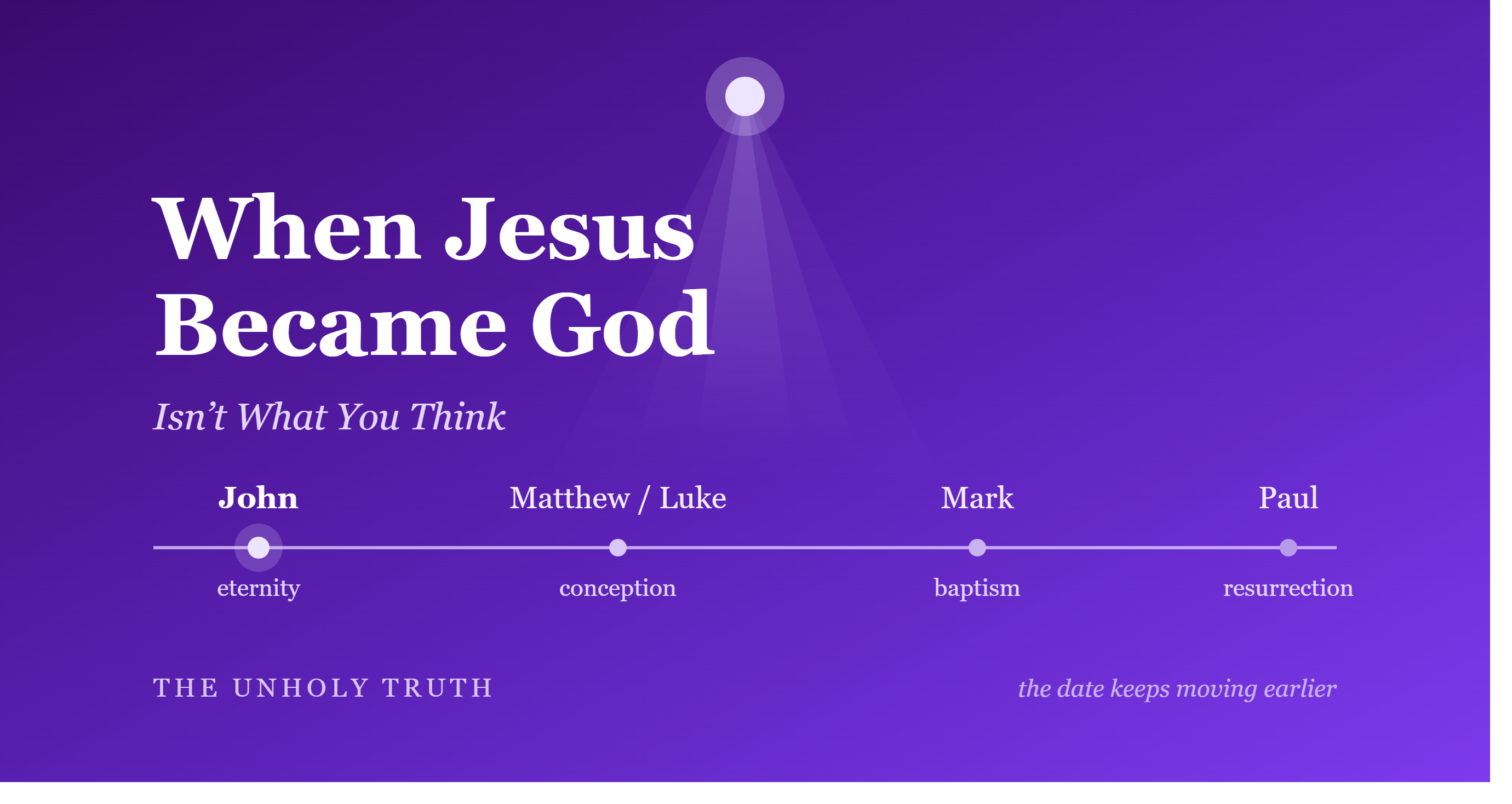
Look at the four Gospels in sequence and you can watch the moment of divinity slide backward in front of you. Resurrection in the oldest formula Paul quotes, then baptism in Mark, then conception in Matthew and Luke, then eternity in John. The later the text, the earlier the divinity. That pattern tracks the work of a community feeling its way toward an answer it didn’t start with.
What Do I Think?
It’s fair to assume the source of Jesus’s divinity is Paul. By the time the Gospels were being written his letters were already in circulation, so the earliest written Christianity we have is his. And the literal “Son of God” idea sits oddly in a Jewish setting. It reads far more Greek than Semitic, so much so that Roman emperors were claiming the same title for themselves, sons of gods walking the earth.
The Hebrew Bible does have sons of God, but never in the sense that God literally fathered them, with or without a human mother. The phrase marks something God made. The same goes for the divine beings scattered through those texts. They aren’t deities in their own right, they’re creatures God brought into existence, members of his court rather than rivals to his throne. Paul’s Greek-speaking audience would have heard the title against a very different background, one where gods fathered children on earth and emperors traced their bloodline to heaven.
Put Paul in context and his motives come into focus. While it’s impossible to know exactly how Paul thought, and I don’t claim I do, we know for a fact that he believed he was racing to save as many souls as he could before Jesus returned and the end of days arrived. He wasn’t sitting down to compose scripture, he was firing off letters to convince people, at any cost, to believe. In that setting, holding the convictions he held, I wouldn’t blame him for stretching things or filling gaps with his own creativity. He all but tells us he’s operating on his own authority. In Galatians he insists his gospel came straight from revelation rather than from the men who had walked with Jesus, and he describes facing Peter down to his face. The implication he wants you to draw is that his line to the truth runs higher than theirs, which conveniently sidelines the people who knew the man.
Think of it like a parent who’d bend any story to keep a child away from danger and never feel a flicker of guilt about it. Paul believed the stakes were eternal. It would be understandable if a little invention in service of saving souls didn’t trouble him.
If you’re not already a paid subscriber and you’re finding value here, I’d love for you to consider becoming one to keep The Unholy Truth alive.
What The Councils Were Doing
Adoptionists were still around in the second century, still reading their Bibles and finding support, because the support sat right there in the text. The fights at Nicaea in 325 and Chalcedon in 451 were institutional attempts to impose a single answer onto texts that had never spoken with one voice.
The version that won, fully God and fully man, co-eternal with the Father, is the one most people now assume was always obvious. It looked nothing like Mark’s Jesus, who enters the story at a riverbank, and nothing like the formula Paul quoted in Romans, where the resurrection does the work. The orthodox answer was one option among several that early Christians lived with, and it became the only option once emperors and councils stood behind it.
Sources and Further Reading
Bart D. Ehrman, How Jesus Became God: The Exaltation of a Jewish Preacher from Galilee (HarperOne, 2014)
Bart D. Ehrman, The New Testament: A Historical Introduction to the Early Christian Writings (Oxford University Press)
Larry W. Hurtado, Lord Jesus Christ: Devotion to Jesus in Earliest Christianity (Eerdmans, 2003)
Raymond E. Brown, The Birth of the Messiah (Doubleday, 1977)
Richard Bauckham, Jesus and the God of Israel (Eerdmans, 2008)
Tags: biblical history, early Christianity, Jesus, Christology, New Testament, Bart Ehrman, Gospel of John, religious history
One of the conventions of that time was to start a story with "In those days...". We see this phrase in Mark 1:9. Mark 1:1-8 appear to be copied from Matthew 3; those verses explain who John the Baptist is.
Matthew 3:1 has the phrase "In those days...". That suggests the genealogy and nativity of Matthew were added later. Luke 2:1 reads "In those days a decree went out...". I think this is the original start of Luke. I think Marcion removed Luke's nativity story when he went to Rome to pitch the idea of the Bible. The church at Rome was so offended that they not only excommunicated Marcion and his church as heretics, but they also added the nativity of John the Baptist.