


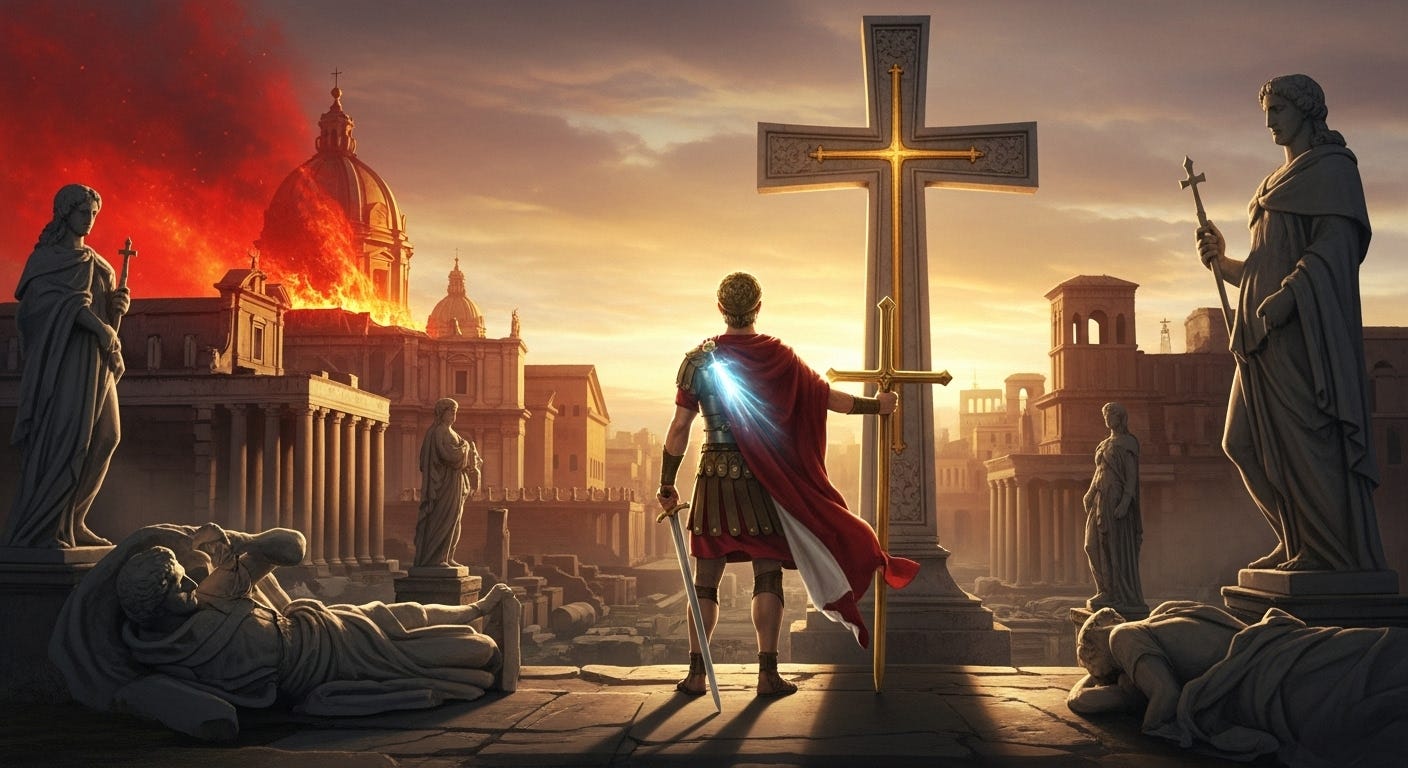
It all started when a Roman emperor decided to make God his running mate. Constantine wasn’t baptized until his deathbed, but he saw that Christianity could do what his legions couldn’t—control people’s minds without raising a sword. When he legalized Christianity in 313 CE and later made it the empire’s favorite religion, he gave it a seat at the political table. From that moment on, God became a political tool, and democracy—what little there was—started rotting from the inside.
As legal scholar Joseph C. Sommer once warned, “Attempts to unite church and state are opposed to the interests of each, subversive of human rights and potentially persecuting in character.” That was as true in Constantine’s empire as it is anywhere power hides behind holiness.
Before Constantine, Rome worshiped dozens of gods. People could pray to whoever they liked—Jupiter, Venus, or the spirit of their favorite river. The emperor didn’t care so long as they paid taxes and didn’t cause trouble. Then Christianity came along with one God, one truth, and one Church. You couldn’t worship other gods anymore. You couldn’t even think differently. Freedom of thought died when faith became law.
The Church Becomes the State
By the time Theodosius made Christianity the official religion of Rome in 380 CE, the idea of religious freedom was gone. Pagan temples were smashed, books were burned, and philosophers were chased out of cities. The same empire that once gave the world libraries and roads now gave it the Inquisition.
The bishops became political bosses. They owned land, collected taxes, and crowned emperors. The church said it was saving souls, but what it really saved was its own power. Whenever someone questioned authority, the answer was the same: “God said so.”
That’s how democracy dies—quietly, wrapped in holy language, while priests and kings bless each other’s power.
The Middle Ages - One Faith, One Chain
The so-called Christian Europe of the Middle Ages wasn’t about love, charity, or peace. It was about control. Every kingdom had its priest, every throne its bishop, and every peasant their fear of hell. The Church told people when to marry, what to eat, how to think, and even how to die.
Dissent was blasphemy, and blasphemy was a death sentence. The Bible wasn’t even in a language most people could read. Latin kept it safely out of reach, so the priests could decide what it “really meant.” That wasn’t faith; it was information control.
The Church didn’t just police thoughts—it collected rents, owned armies, and fought wars. Popes excommunicated kings, kings imprisoned popes, and everyone claimed divine backing. The Crusades were the result of this holy politics: endless wars sold as sacred duty.
Every time religion tried to “save” the world, it burned a piece of it instead.
The Reformation - New Gods, Same Tricks
When Martin Luther nailed his theses to a church door in 1517, he wasn’t just starting a religious debate. He was starting a political earthquake. Suddenly people realized that if you could question the Pope, maybe you could question kings too.
But even that hope turned sour. Protestant leaders promised “freedom of conscience,” but soon they were banning books and killing heretics of their own. In Geneva, John Calvin’s version of Christianity was so strict that dancing, gambling, and even laughter were frowned upon.
The fight between Catholics and Protestants wasn’t about God—it was about control of minds and nations. Europe bled for two centuries while both sides screamed that God was on their side. The real reason was power. Religion wasn’t guiding politics; it was strangling it.
The Enlightenment - The First Escape
The Enlightenment was the first real attempt to get the Church off humanity’s neck. Thinkers like Voltaire, Locke, and Jefferson looked at centuries of blood spilled in God’s name and said, “Enough.” They argued that freedom of belief meant freedom from religious authority.
The Founding Fathers of the United States, many of them Deists, understood this perfectly. They didn’t ban religion—they banned its throne. “Congress shall make no law respecting an establishment of religion.” That wasn’t hostility toward faith; it was protection of freedom.
A true democracy doesn’t need a divine sponsor. It needs citizens who can think without fear of eternal punishment.