


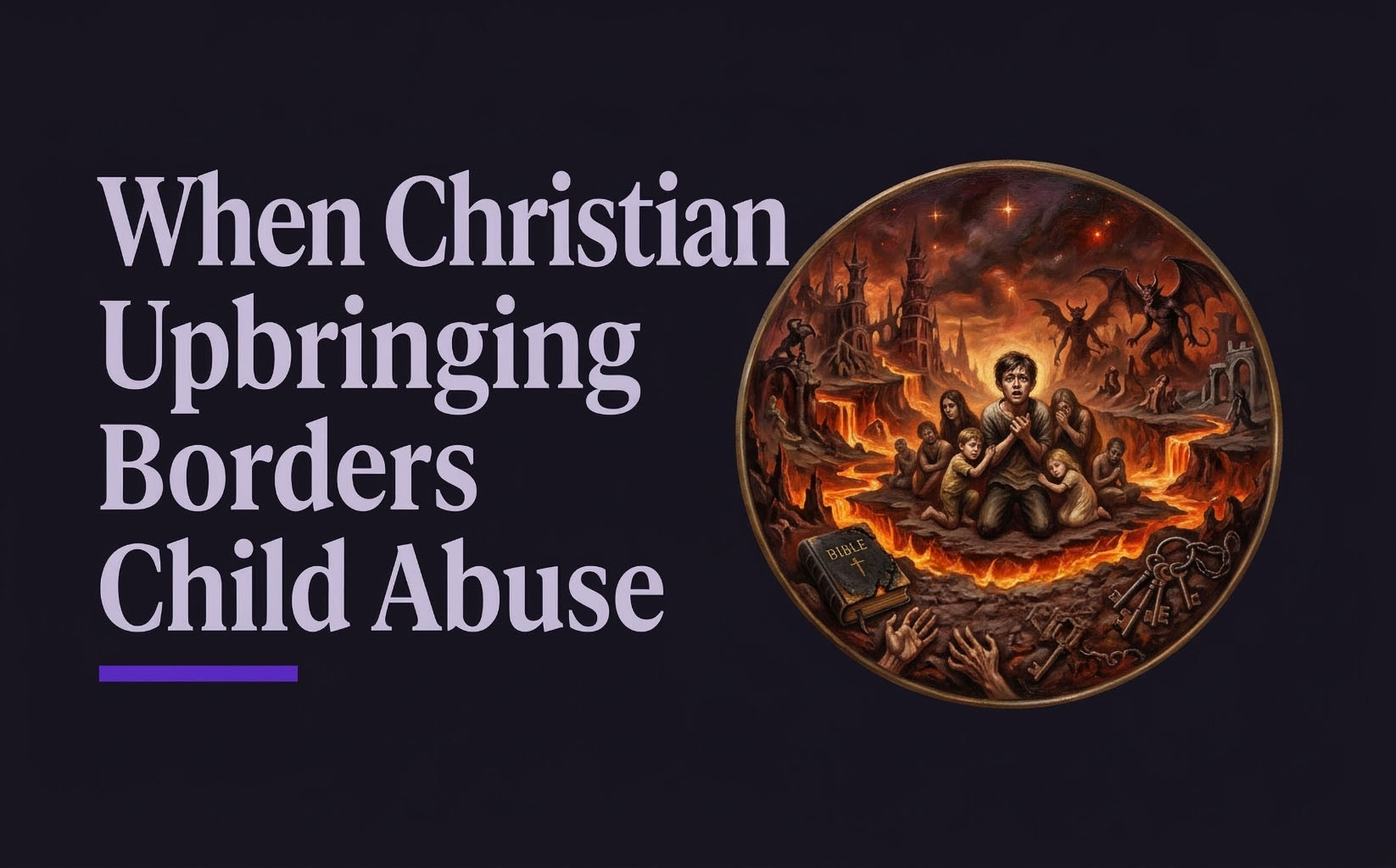
Someone recently told me off for liking a string of comments from people describing their unpleasant Christian childhood experiences and how they came to deconstruct their faith. The charge was that I was approving of the deconstruction of the religion and implying that leaving the church was something great, although my answers to them are carefully constructed not to give any spiritual guidance while still empathizing with them. What readers should do with their beliefs and advising on what’s best for them aren’t in my job description.
I liked those comments because the writers were sincere, because what they described is documented well enough that nobody has to take their word for it, and because a stranger scrolling through the replies at midnight who grew up the same way deserves to see they aren’t the only one.
The complaint rests on an assumption plenty of people share, that naming abuse inside a religious home amounts to an attack on the religion. Naming it attacks the abuse, and anyone who hears an attack on the faith has already decided the two can’t be pulled apart. Meanwhile, a Christian can read those comments and recognize the child abuse in those houses under the cover of their religion. In fact, those mainstream Christians turn out to be the most useful people in the whole argument.
The Unholy Truth posts always deliver the core section the title promises, accessible to everyone.
The extra bonus material is only for paid subscribers.
For the full experience and to support the publication, you know what to do.
Rod as a Parenting Tool
Proverbs 13:24 says that whoever spares the rod hates their child, and an entire parenting industry has been built on reading that line as an instruction manual. James Dobson, who founded the evangelical group Focus on the Family, made Dare to Discipline (1970) a staple of church bookshelves. Michael and Debi Pearl, a Tennessee ministry couple, went further in To Train Up a Child (1994), which tells parents to use switches and plumbing supply line on children and to begin in infancy.
Two deaths show where that advice can end up. Lydia Schatz was seven when her adoptive parents in California beat her for hours with plumbing line in 2010, supposedly over a mispronounced word, and her parents were convicted. Hana Williams was thirteen, adopted from Ethiopia, and died in Washington State in 2011 after being underfed and left out in the cold, and her adoptive parents were convicted too. News coverage of both cases tied the parents to the Pearls’ teaching.
The research on hitting kids points the same direction. A 2016 meta-analysis by Elizabeth Gershoff and Andrew Grogan-Kaylor, pooling decades of studies, found spanking tracks with worse outcomes for children and no better behavior, and the American Academy of Pediatrics told parents to stop doing it in 2018.
Hell as a Parenting Tool
Bruises are the easy part to document. Telling a six-year-old that God will burn him forever if he dies without being saved leaves nothing a doctor can photograph, and Janet Heimlich collected cases of that kind in Breaking Their Will (2011) under the label religious child maltreatment. Young children take a sentence like that literally, and plenty of them hear it at bedtime, in Sunday school, or from a parent who sincerely believes the warning is an act of love. Some churches go further with hell houses, walk-through attractions where actors play damned souls and demons and the tour ends with a choice between salvation and what the last room just showed.
The obvious assumption says a kid outgrows this the way he outgrows Santa Claus. Nobody told him Santa would torture him without end for guessing wrong, though, and nobody added the rule that doubting Santa is itself a sin. That second rule makes the fear stick, because the child can’t test the claim without risking the punishment, so the fear goes in untouched by anything he learns later. Plenty of adults raised on A Thief in the Night (1973), a film that circulated through evangelical churches about the Rapture, tell the same story of coming home to an empty house and panicking that everyone had been taken and they’d been left behind.
Adults who walked away from the faith in their twenties describe the fear outliving the belief. They no longer think hell exists, and their bodies still answer a doubtful thought with dread, nightmares, or panic in the middle of the night. The psychologist Marlene Winell, who works with people leaving strict religious homes, named this religious trauma syndrome in 2011. It isn’t a formal diagnosis, but the symptoms she lists, including anxiety, nightmares, and trouble making decisions, overlap with conditions therapists already treat. Fear of damnation can also harden into a form of obsessive-compulsive disorder that clinicians call scrupulosity, where the sufferer confesses and prays over and over to make sure no sin went uncovered. Kenneth Pargament, a psychologist who has studied religious struggle for decades, has found repeatedly that people who picture God as punishing report more anxiety and depression than people who don’t.
Seeing any of this doesbn’t require disbelief. Christians whose own view of hell leaves no child awake at 2 a.m. are the ones who can tell other parents that the threat was not only required, but and that gives them the standing a pastor has in the next section.
Why a Pastor Gets Heard Where an Atheist Doesn’t
The parents in those homes believe God signed off on the rod. An atheist telling them otherwise gets filed under the world’s hostility to the faithful, which they’ve been taught to expect, so the criticism confirms the lesson. A pastor, a deacon, or the mother two pews up who says Proverbs describes a shepherd’s staff steering sheep gets a hearing, because she’s speaking from inside the same book they trust.
The Southern Baptist Convention, the largest Protestant denomination in the country, shows how reform moves once insiders push. An outside firm, Guidepost Solutions, investigated how its leaders handled sexual abuse allegations and in 2022 documented years of stonewalling survivors. That report came after sustained pressure from within the denomination, including from Rachael Denhollander, a Christian attorney who had already testified against the gymnastics doctor Larry Nassar and then turned to her own church. Nobody outside the denomination could have forced that investigation.
Secular Groups Keep Passing Up the Easiest Allies They Have
You’d expect people who say they care about children to grab every ally on offer. What I see more often in secular circles is reluctance to stand beside a church, even one that wants to help, because a shared stage muddies the message that religion is the problem. That turns the cause into a way of scoring points about God, and a kid in a house with a switch on the kitchen counter gains nothing from points scored.
A congregation willing to tell its own members that striking toddlers isn’t what scripture demands is doing the work the secular critic says he wants done, and it reaches homes no atheist group will ever be invited into. Refusing that help to keep the argument clean costs children something, and the people paying aren’t the ones holding the press conference.
Madalyn Murray O’Hair, Quran Schools, and the Problem With Blaming One Belief
Child abuse also occurs in households and institutions outside Christianity, and documented cases exist in both antitheist and Islamic settings.
Madalyn Murray O’Hair, who founded American Atheists, brought the Baltimore lawsuit Murray v. Curlett, decided in 1963 together with Abington School District v. Schempp. The rulings ended school-led Bible reading and recitation of the Lord’s Prayer in public classrooms. A year earlier, Engel v. Vitale (1962) had struck down a prayer written by New York’s education board. The named plaintiff in Murray was her teenage son William, who later became a Baptist minister and wrote My Life Without God (1982). The book describes a childhood of neglect and cruelty in a household his mother ran with contempt. As a memoir written after he left atheism, it reflects one person’s account, and it remains a firsthand description of a child raised in an antitheist home. Based on Murray’s personal arguments, what we can say for certain is that her motive was personal, driven by her atheism, not really about protecting the Constitution and keeping church and state separate. She wanted to raise atheist children with the same passion that fundamentalist Christians bring to raising their version of Christian ones, and neither side tries to raise children who can think for themselves and make their own choices.
Human Rights Watch reported in 2019 on the talibé, boys enrolled in Quran boarding schools in Senegal. The report documented boys being sent into the streets to beg for money, beaten when they returned with too little, and in some cases chained by their teachers.
The same conditions recur across these cases and the Pearls’ teaching, whatever the theology. One adult holds total authority over the child, outsiders have no recognized right to ask questions, and a sacred justification is available for refusing them. Religion supplies that justification readily, and a committed atheist who treats his own convictions as beyond question can invoke an equivalent one. Comparing which belief system produces more abuse says little about what protects children, while outside oversight, such as reporting requirements and open access for people beyond the household, addresses those shared conditions directly.
Ultimately, it boils down to the fact that many “activist” atheists online and in popular culture seem to care more about presenting Christianity as evil because of the child abuse cases in ultraconservative homes, rather than doing anything useful about it that will change lives today. The same applies to “activist” evangelicals fighting against abortion, who have made it their political mission and love hearing themselves more than they care about doing anything useful to minimize the need for abortions for women while it stays legal, even if they continue to work on outlawing it.
A bonus section for paid subscribers follows on why the fear and panic often continue long after someone leaves the church or Christianity altogether, what PTSD and complex PTSD look like in people raised under the threat of hell, and which treatments have the strongest evidence behind them. If yoy haven’t already, upgrade to read it.
Bonus for Paid Subscribers
Why the Fear Stays After the Faith Leaves
The threat evaporates once the belief does, and “do you fear hell?” becomes an offensively absurd question. That’s what you’d expect, at least, if you look to the atheists online who left the Christian faith, many of whom had a religious upbringing bordering on, or outright, child abuse. If you don’t believe in hell, why would you fear it, right?
Of course, this assertion assumes humans are …