

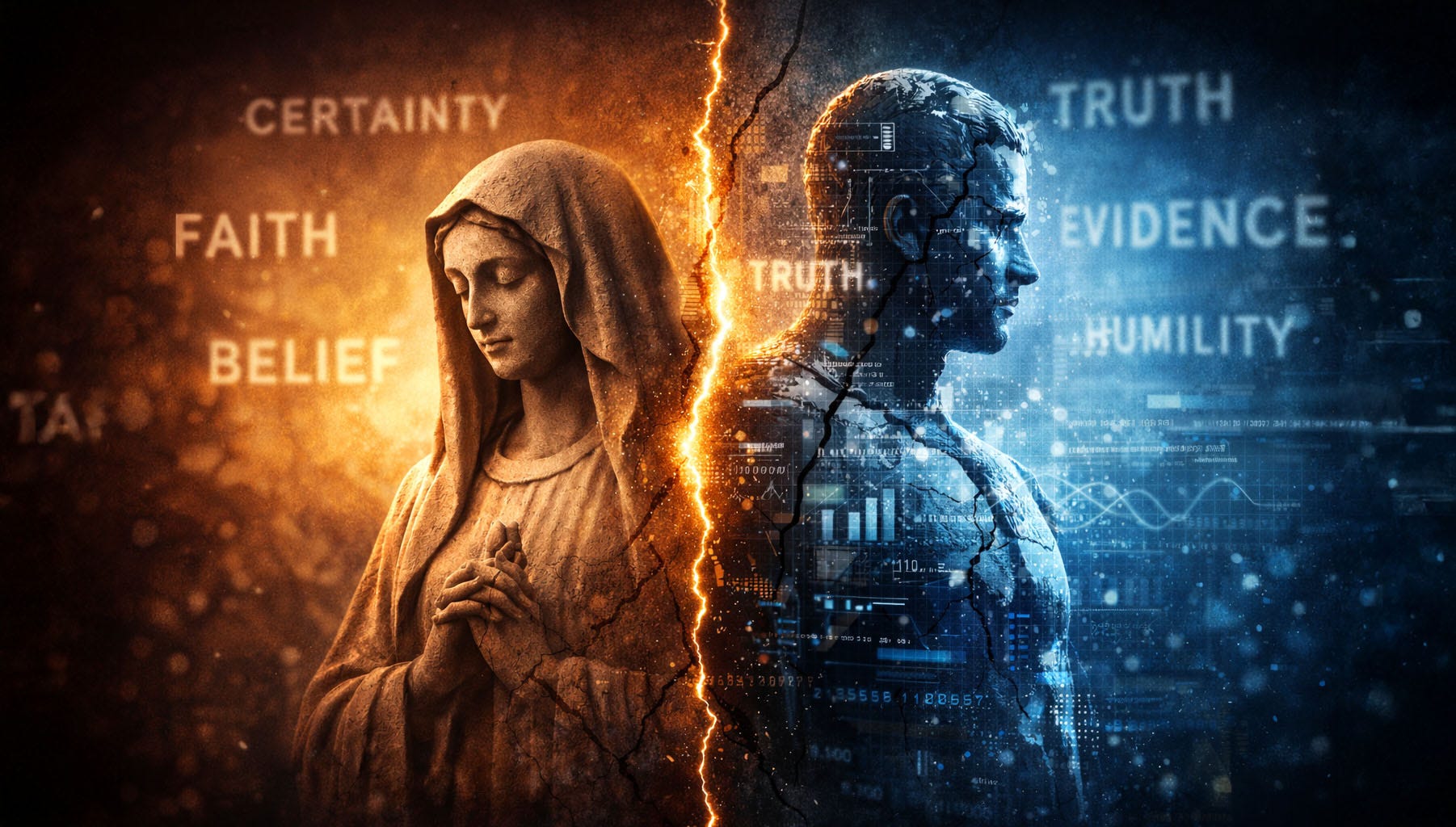
Knowledge is the enemy of faith. And yes, in many ways it is. The more you learn about how the world actually works, the harder it gets to keep believing stories that depend on mystery, authority, and “just trust us.”
But there’s a problem hiding in that idea.
If we’re not careful, knowledge itself turns into a religion.
Not science as it actually works, but science as it’s used online. Science as a slogan. Science as a badge people wear to prove they’re smarter, better, or morally superior. A version of science that promises certainty.
And that’s where things go wrong.
Certainty Kills Science - Faith Needs It to Survive
Faith thrives on certainty, and that’s not meant as an insult—it’s the driving force behind every religion. No priest says Jesus was almost certainly raised from the dead, leaving room for whatever new evidence might suggest. Can you imagine a Muslim saying Muhammad was most likely chosen by God?
Faith says: This is true, it has always been, and it will always be true. You’re not supposed to question it too much. Questions are fine until they aren’t. At some point, doubt becomes a threat and is interpreted as disrespect.
Science works the other way around.
Science starts by admitting ignorance. It says: we don’t know. Then it guesses. Then it tests the guess. Then it tries very hard to prove itself wrong. If it fails, it revises or throws the idea out.
The moment science reaches certainty, it stops being science.
That’s not a bug. That’s the whole point.
Certainty ends inquiry. Certainty kills curiosity. Certainty freezes thinking in place. Science is supposed to stay uncomfortable. Provisional. Temporary.
That’s why every scientific claim comes with an invisible footnote saying “as far as we can tell right now.”
People hate that footnote. So they pretend it isn’t there.
If we go by the Jesus example, in principle, science wouldn’t outright claim, “Jesus didn’t rise from the dead.” Instead, it’d note that it’s improbable for someone to come back to life 48 hours after blood circulation and brain activity have ceased. That probability is essentially zero, as no such confirmed case exists in medical history. Science can even estimate the damage to the brain and body hour by hour after circulation stops, but it would still stop short of declaring the resurrection of Jesus impossible.
The Internet Turned Science Into a Creed
Online, science doesn’t look like a method anymore. It looks like a belief system.
People say “science says” the way religious people say “the Bible says.” Studies get quoted like scripture. Consensus gets treated like divine authority. Disagreement gets treated like ignorance or evil.
That’s not science. That’s theology with better graphics.
Science doesn’t speak. Scientists do. And they disagree all the time. That’s normal. That’s healthy. That’s how progress happens.
But online, science gets flattened into slogans.
“Trust the science.”
“Follow the science.”
“The science is settled.”
Those phrases sound reassuring. They also miss the point.
If something is truly settled, it’s no longer doing active scientific work. And if it’s not being actively questioned, it’s not science anymore. It’s doctrine.
People Don’t Want Truth. They Want Certainty.
Certainty is the morphine of the mind. It numbs you, makes you feel safe. Doubt works like morphine deprivation for an addict, leaving you feeling like you’re standing on thin ice while everyone else pretends it’s concrete. Doubt in the fundamentals of living can be powerful enough to create lifelong wounds in children, who don’t yet have the tools to manage it. It’s this adverse effect of doubt that explains why religion, offering certainty when life falls apart, can help people survive a crisis without losing their minds—especially when they’ve lost the ability to manage doubt.
Religion figured this out a long time ago. It offered answers to scary questions: Why are we here? Why do we suffer? What happens when we die? Why does the world feel unfair?
Science doesn’t offer comfort. It offers probabilities, error bars, and “we’re still studying this.”
For a lot of people, that’s not enough.
So they turn science into something it was never meant to be. A source of emotional security. A moral shield. A replacement god that wears a lab coat.
This has nothing to do with intelligence. Smart people fall into this trap all the time. It’s about fear of uncertainty.
Knowledge Without Humility Turns Into Dogma
There’s a comforting myth that knowledge automatically makes people humble.
It doesn’t.
Knowledge without humility turns into arrogance. It turns into dismissal. It turns into “I’ve read the right things, so I’m done thinking.”
That’s how dogma forms.
Dogma isn’t defined by being religious. It’s defined by being untouchable.
The moment knowledge becomes something you’re not allowed to question, it stops being knowledge and starts being belief.
Real science invites questions. Fake science panics when you start asking them.
Science Isn’t a Worldview. It’s a Tool.
This is where a lot of arguments break down.
Science isn’t a belief system. It doesn’t tell you how to live. It doesn’t tell you what matters. It doesn’t tell you what’s good or meaningful or worth sacrificing for.
Science is a method for investigating reality.
When people turn science into a worldview, they overload it with expectations it can’t meet. They want it to provide certainty, morality, identity, and belonging.
Those are human needs. Science was never designed to fill them.
Forcing science into that role doesn’t strengthen it. It breaks it.
Science has no soul to guide you. It won’t tell you that you shouldn’t jump from the roof of a skyscraper. But it will tell you the speed at which you’d hit the ground and the odds of surviving if you did. What to do with this information is up to you.
Objectivity Isn’t Magic
Another comforting fantasy is the idea that science is perfectly objective and humans are just neutral machines reporting facts.
Humans aren’t neutral.
Scientists bring assumptions, incentives, blind spots, funding pressures, and personal biases into their work. Peer review helps. Replication helps. Transparency helps. But nothing removes human fallibility.
Science works not because people are flawless, but because the system is designed to catch mistakes over time.
That takes patience. It also takes accepting that errors will happen.
People who treat science like religion hate this part. They want clean answers delivered immediately. They want certainty now, not correction later.
That’s faith talking.
Disagreement Isn’t the Enemy
In religion, disagreement threatens authority.
In science, disagreement drives progress.
Conflicting results, competing theories, and uncomfortable data are how understanding moves forward. Without disagreement, science turns into stagnation.
Online, disagreement often gets framed as denial or bad faith. Sometimes that’s true. Often it isn’t.
When every disagreement feels like a moral threat, science has turned into identity.
And when your identity is “I’m on the side of science,” any challenge feels personal. That emotional reaction should set off alarm bells.
Certainty Is Faith’s Language
Faith says: this is true no matter what.
Science says: this seems true given the evidence we currently have.
That difference matters more than people want to admit.
When people demand certainty from science, they’re asking it to betray its own rules. And when science communicators give in, they trade honesty for comfort.
That works short-term. Long-term, it backfires.
Because when evidence changes, and it always does, people feel lied to. Trust collapses. Skepticism turns into bitterness.
Religion survives broken promises by hiding behind mystery. Science can’t do that without destroying itself.
The More You Know, the Less Certain You Should Be
One of the strangest things about learning is that beginners tend to be confident, while experts tend to be cautious.
That’s not an accident.
The deeper you go, the more complexity you see. The more exceptions you notice. The more aware you become of what you don’t know.
That’s not weakness. That’s maturity.
When someone speaks with absolute confidence about complex systems, it’s worth asking how far down the rabbit hole they’ve actually gone.
Science doesn’t reward certainty. It rewards accuracy.
Skepticism Isn’t Cynicism
Skepticism asks for evidence. Cynicism assumes bad faith.
Skepticism is open to being convinced. Cynicism is already done thinking.
When science turns into a religion, cynicism often gets disguised as skepticism. People stop asking whether claims are supported and start asking whether they align with their side.
That’s how inquiry dies quietly.
Why This Actually Matters
We live in a world drowning in information. Studies, charts, expert opinions, counter-experts, and endless hot takes are everywhere.
That makes intellectual humility more important than ever.
If knowledge becomes just another tribal flag, another excuse to stop listening, then we haven’t escaped faith at all. We’ve just changed the language.
Science deserves better than worship. It deserves use.
The Truth People Don’t Like Hearing
Science won’t give you certainty about everything.
It won’t answer every question.
It won’t replace meaning, purpose, or values.
That’s not a flaw. That’s honesty.
Faith promises certainty because certainty feels good. Science offers uncertainty because uncertainty is real.
If you can’t live with that, you’re not rejecting faith. You’re just shopping for a new version of it.
What Respecting Science Actually Looks Like
Respecting science means accepting its limits.
It means letting questions exist without panic.
It means understanding consensus as a snapshot, not a commandment.
It means changing your mind when evidence changes, even when that’s uncomfortable.
It means refusing to turn knowledge into identity.
That’s harder than belief. That’s why so many people avoid it.
Last Thoughts
Knowledge can weaken blind faith. But knowledge without humility creates a new kind of blindness.
Science was never meant to be worshiped and treat facts as unchangable. It was meant to be practiced.
And if this made you uncomfortable, good. That discomfort is where thinking starts.
To be honest, only a small portion of subscribers are paid—most of my posts are free for everyone to read, with some exclusives. But reader support buys something priceless: time. Time to research, question power, and hold the powerful accountable. If you can afford it, your support helps keep this work alive.
Your turn: Now drop a comment, share your holy mess of thoughts, and follow for more brutally honest takes on religion, history, and power
I agree completely. On the other hand there's a lot of dismissal of scientific findings simply because they disagree with political opinions. Science was not meant to be worshiped, but there is an obligation to accept conclusions that are based on solid evidence.