


There are several versions of the story, but one thing they agree on is the panic. Muhammad, in his forties, is doing what a few pious men in Mecca did during the hot months, sitting alone in a cave on a hill outside the city, away from the shrine and the tribes and the family business. Something comes, presses him until he can’t breathe, three times, and tells him to recite, and he recites. Then he runs down the mountain, shaking, and tells his wife to cover him up.
That’s the part later tradition never sanded off. It’s the opposite of what you’d expect from a founding scene. There’s no serene certainty and no voice from heaven announcing credentials. There’s a middle-aged merchant who thinks he might be possessed, in a culture where the poets and the fortune-tellers were understood to be possessed, and who wants his wife to put a blanket over him. The earliest surviving biography has him say it outright: he’s afraid he’s turned into one of those men, the kind Mecca laughed at.
So the question in the room isn’t whether God spoke but whether Muhammad was losing his mind.
Everything that follows comes from Islamic sources, since they’re the only ones we have for how any of this began. What makes some of the details credible is that they’re anything but flattering.
His Wife Ran Her Own Test First
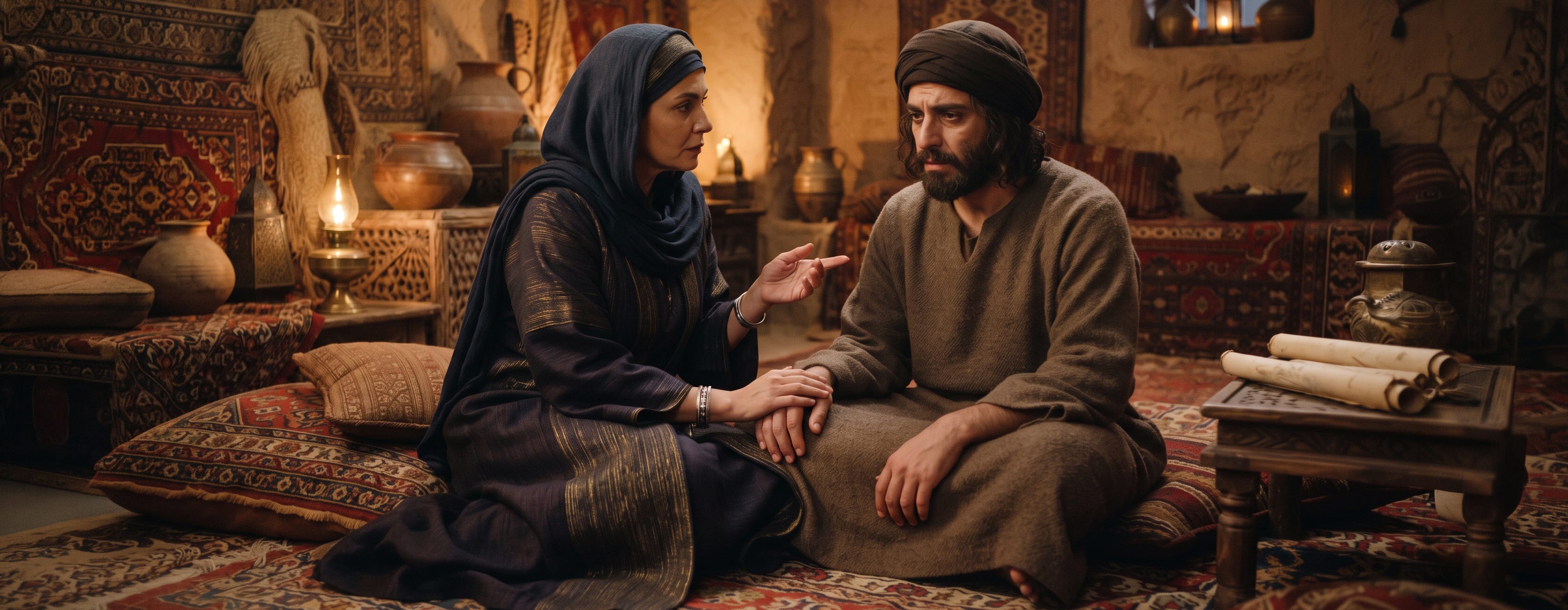
Khadija (kah-TEE-jah) was older, wealthier, and had hired him before she married him. Her first move was practical. She told him to sit on her left side and asked whether he still saw the visitor, then her right, then in her lap, and each time he said yes. Then she uncovered herself, and he said the visitor had gone. Her conclusion was that a demon would have stayed to watch, and something that leaves when a woman uncovers herself has manners, so it was an angel. I hope you're taking notes, you never know when the procedure comes in handy.
So, that’s a diagnosis run in a living room, using a household rule about what spirits do and don’t do, and as far as the sources go it’s the first assessment anyone made of Islamic revelation. It also wasn’t going to hold up outside her own house, and she knew it, so she took her husband to see a specialist.
The Word He Used Came Out of Greek
The specialist was none other than her cousin Waraqa (WAR-kay-ah), an old man by then, blind or nearly so, and a Christian. He could read, he’d learned some Hebrew, and he’d spent years writing out portions of the gospel in Arabic.
He listened to the whole account and delivered his verdict. The thing that came to Muhammad in that cave, he said, was the same one that had come to Moses, and Muhammad was the prophet his people had been waiting for.
The interesting part is what he called the visitor. He named it the namus, and that word isn’t native Arabic. It comes into Arabic through the Aramaic that Christians in the region wrote and prayed in, and into Aramaic from Greek, where nomos means law. It’s the word the Greek Bible uses for the Torah, hundreds of times over, and the word Paul spends whole chapters arguing about. Asked to identify a terrifying experience on a hill in Arabia, a Christian reached into the vocabulary of Greek-speaking Christianity and pulled out the term for the law handed down at Sinai.
What he did there was put Muhammad under a category his own religion already had, the prophet who comes like Moses, and then tell him what happens to men in that category. He said Muhammad would be called a liar, driven out, and fought, and that he wished he were young enough to still be alive to help when it happened.
And notice which God he reached for. A Christian, asked what had visited a man in Mecca, answered with the God of Moses and the law at Sinai, with no mention of the son, the incarnation, or the three-in-one his own church had spent three centuries hammering out. Whatever he meant by it, that’s the direction the whole thing went, back toward the undivided God of Judaism.
When the Old Man Died, the Revelations Stopped
The most authoritative collection of reports in Sunni Islam, the branch that covers something like 87 to 90 percent of Muslims worldwide, ends this episode with a line that reads like an accident of memory nobody thought to remove: a few days later Waraqa died, and revelation paused.
Islamic tradition calls that pause the interval, and its length swings wildly in the sources, from a handful of days to three years. The tradition explains it as a test of patience, and the reports about how Muhammad took it are grim enough that popular retellings tend to skip past them. That’s the part of religion that gets me. Faced with a gap that nobody has a clue about, it almost never says it doesn’t know, and instead supplies a reason, and a few generations later the reason is part of the story.
You can read the sequence however you like, but what you can’t do is pretend the tradition set those two facts side by side by accident. The one man in Mecca with the training to certify what was happening gave his certification, died within days, and the voice went quiet.
A Monk in Syria Does the Same Job Twenty Years Earlier
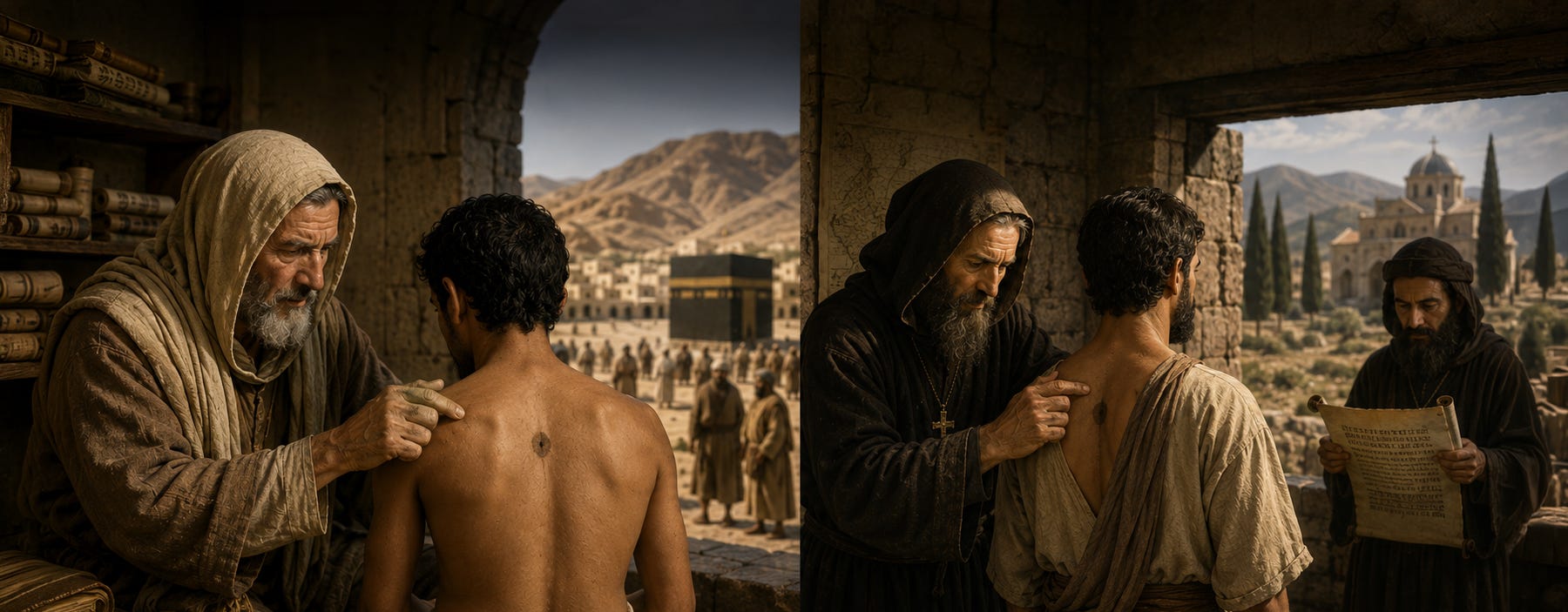
Waraqa isn’t the only Christian in the biography with this function. There’s also the monk in southern Syria who spots the boy Muhammad passing through with a trading caravan, examines his back, finds the mark of prophethood between his shoulders, and warns the boy’s uncle to keep him out of Byzantine sight. That story travelled in Christian versions too, where the monk gets recast as the villain who fed Muhammad his material, which tells you how useful the shape of it was to everyone and how little either side could manage without it.
Two separate episodes, twenty years apart, both with a Christian holding the measuring stick. The pattern is doing work. A movement announcing itself in a world already full of scripture needs its claim validated in terms that world recognizes, and the only people in western Arabia holding those terms were Jews and Christians. The Quran takes this route repeatedly, insisting that people who received the earlier book can confirm what’s being recited, and that the messenger is described in the scriptures they already have.
If even a small fraction of regular readers became supporters, I’d spend less time running the business side of this publication and more time in the archives doing the research this work demands.
A Prophet Certified by the Religion He Came to Correct
Islam’s core claim about Christianity is that the Church took a prophet and made him a god, corrupted their book, and needed correcting. But the founding scene of that correction has a Christian in it, using Christian vocabulary, telling a frightened man in Mecca that the thing visiting him is the same thing that visited Moses, and telling him he’s the prophet his people have been owed.
Later tradition worked hard on this. In the retellings the old man gets promoted, first into one of the seekers who’d given up the Meccan gods before Islam arrived, then into a man who accepted Muhammad and therefore counts as a Muslim, which conveniently makes the first believer a believer. Scholars spent centuries arguing about where he ended up after death. That effort is the tell, because nobody works that hard to explain away a detail that isn’t a problem.
For supporters: below the line I’ve laid out what the earliest sources say about this scene word by word, including the reports about the silent years that don’t make it into the family-friendly versions, why the earliest biography of Muhammad reaches us only through an editor who admits he cut material he found offensive, and how the classical scholars argued over whether the man who identified Muhammad as a prophet died a Christian. If you’ve been meaning to upgrade, this is the section to do it for.
Sources and Further Reading
Sahih al-Bukhari, Book 1 (Revelation), hadith 3, the earliest full report of the first revelation. Available at sunnah.com/bukhari:3.
Ibn Ishaq, The Life of Muhammad, translated by A. Guillaume (Oxford University Press, 1955). The standard English translation, containing the verdict scene, the monk in Syria, and Ibn Hisham’s own note on what he cut.
W. Montgomery Watt, Muhammad at Mecca (Oxford University Press, 1953). Still the reference point for reconstructing the Meccan years from the traditional sources.
Fred M. Donner, Muhammad and the Believers: At the Origins of Islam (Harvard University Press, 2010). The argument that the early movement was an open monotheist coalition before it became a separate religion.
Sean W. Anthony, Muhammad and the Empires of Faith: The Making of the Prophet of Islam (University of California Press, 2020). On how the biographical tradition was assembled and what can be recovered from it.
Barbara Roggema, The Legend of Sergius Bahira (Brill, 2009). On the monk story and the Christian counter-versions of it.
Patricia Crone and Michael Cook, Hagarism: The Making of the Islamic World (Cambridge University Press, 1977). The revisionist case, worth reading even where it’s been overtaken.
With all three of the major religions so interrelated, all three claiming superiority over the other, how to decide the truth of any one of them will be the question that will haunt the faithful now and through all time. The eldest of the three, Judaism, although lending Prophets, and witnessing the takeover of the Son of Man made God, nevertheless it is the one religion most demonized by the other two.
Would that all three, though distinct and uniquely Divine, might come together in praise of each other, could mean the difference between hate and love, war and peace, friend and enemy, and in so doing, perhaps a new chapter in human history might put to rest the chaos so prevalent in the world today. Dream on though, never gonna happen.
The part anti-Muslim polemicists never seem to know what to do with is that the first person to tell Muhammad, “No, you’re not crazy, this sounds prophetic,” was a Christian. Apparently the interfaith dialogue started before Islam even had a name. History is always messier than the people selling us neat little enemy categories would like.