


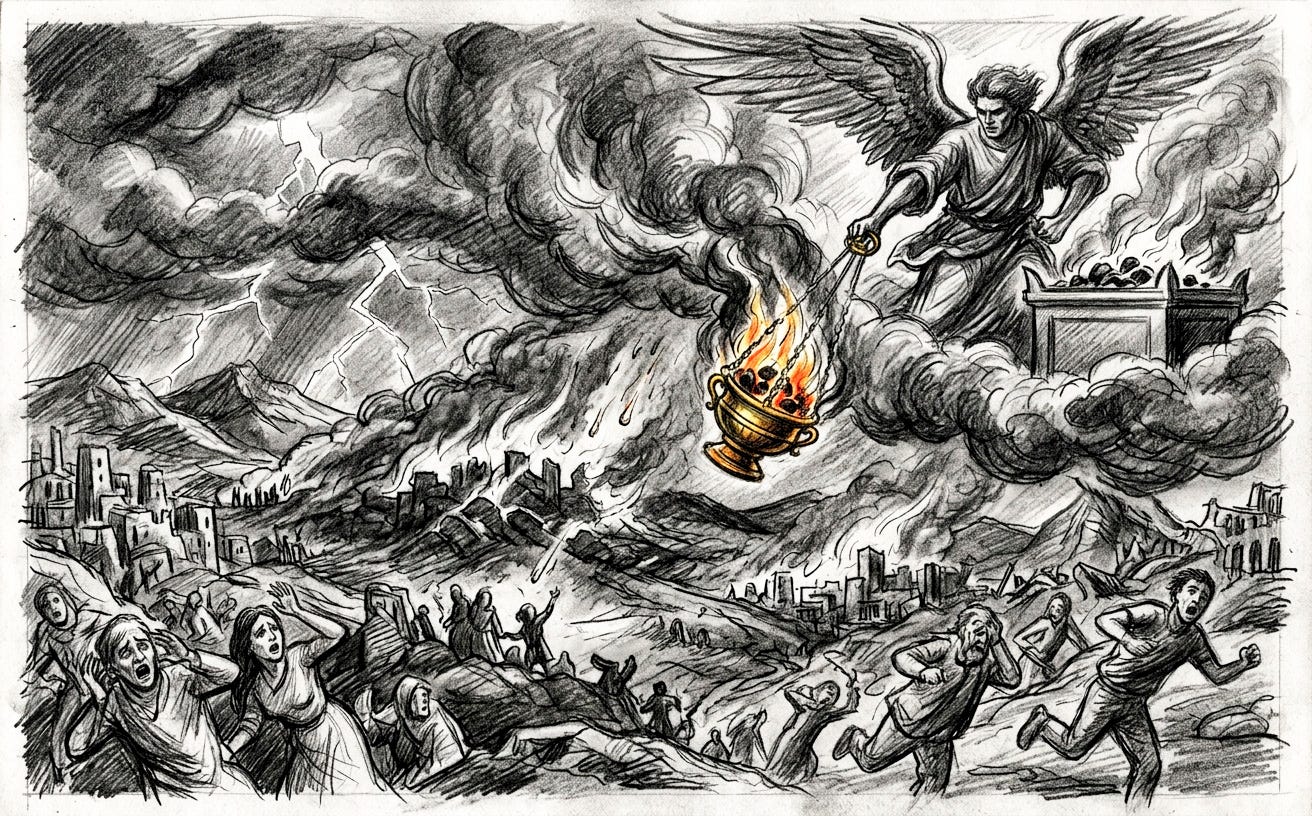
Many people take Revelation as a timetable for a future that hasn’t arrived yet, complete with broken seals, sounding trumpets, and a beast rising from the sea. Preachers have spent generations matching its symbols to the evening news. The beast has been identified as a pope, Napoleon, Hitler, the Soviet Union, the European Union, and even a barcode.
Pew Research Center found in 2022 that 39 percent of American adults believed humanity was living in the end times, even though most of humanity is living through the most peaceful times it’s ever known, because we’ve finally realized war is bad for the economy and a welfare society, and soldiers aren’t disposable peasants. People who think the clock is running out vote, give money and raise children with that clock in mind, so what this book was written to do matters well beyond Sunday morning.
The obvious assumption is that a book full of visions about the end must be trying to tell people what’ll happen centuries from now, giving the Bible a colorful finale to match the creation story it already had.
Subscribe for free to get the next origin story in your inbox, and upgrade whenever you want the bonus sections.
Either way, thank you for being here.
Monsters, Horns and Other Ways to Insult a King
To understand Revelation, it helps to start with the kind of writing that was popular when John picked up his pen. For roughly three centuries, Jewish and then Christian authors produced books in which a visionary is shown secrets from heaven, often with an angel on hand to guide him. History plays out as a drama of beasts, stars, numbers and thrones, and it builds toward the day God steps in and puts the oppressed on top.
At the time, a horn stood for power, frequently a particular king. A wild animal could stand for a whole empire, and its teeth, claws and extra heads told readers what living under it felt like. One book credited to Enoch, the ancient figure who walks with God in Genesis, retells Israel’s history with God’s people as sheep and foreign nations as the predators tearing into them. The book of Daniel turns a series of empires into monsters climbing out of the sea, then adds an arrogant little horn that readers could match to the Greek-speaking king who had desecrated their temple. Around John’s own time, another Jewish author pictured Rome as a many-winged eagle.
Modern readers handle the same sort of code without a second thought. A dove means peace, a bear in a political cartoon means Russia, and a donkey squaring off against an elephant needs no caption in an American newspaper. In Animal Farm, George Orwell’s novel about livestock that overthrow their farmer, the pigs who take charge are the leaders of the Soviet revolution, and watching them slide into tyranny says more than a lecture on Stalin could. Big Brother, the face on the posters in his 1984, has become shorthand for a government that watches everyone. The red cloaks in Margaret Atwood’s The Handmaid’s Tale, a novel about women forced to bear children for a religious regime, turn up at protests where the wearers don’t have to explain a thing. Someone digging up any of these two thousand years from now, with no knowledge of our politics, could easily take them for stories about animals and oddly dressed women.
These pictures were more impactful than a plain accusation could. ever be. Calling a ruler cruel is an opinion he can dispute, but drawing him as a beast with blood on its mouth puts the reader inside the fear and disgust. Old scripture added depth, since a single image could drag in every tyrant God had already brought down.
It also gave the author cover, since the audience understood who was being implied without needing a name. An official who objected would’ve had to step forward and explain why a blasphemous, bloodthirsty monster reminded him of his own government, and no politician is eager to claim that portrait. The insult stayed unmistakable to its audience while the one name that could get someone in trouble never appeared on the page.
John, as well as his well-educated readers, knew these tools, which is why he could bring a seven-headed animal onstage and trust them to know where to look. If John’s intention had been to write literally, then he would’ve been fine with confusing contemporary readers, and the text would only be understood correctly after people forgot about the symbols.
Seven Mailing Addresses and a Deadline
Revelation opens as a letter, and this time it identifies its author as a man named John writing from the island of Patmos and addressing it to seven churches in the Roman province of Asia, in cities such as Ephesus, Smyrna and Pergamum. These were places a messenger could reach by road, one after another. He knows their quarrels, names their troublemakers and tells each congregation what it’s doing wrong.
He also tells them when to expect results, starting with the first verse, which says the visions concern what “must soon take place.” The third verse repeats the time with a similar word: near. The last chapter has Jesus promising three times that he’s coming soon, and it orders John to leave the book unsealed because the moment is so close.
That order reverses one in the book of Daniel, which John mined heavily and which tells its visionary to seal his words until a distant time of the end. Daniel was written in the second century BCE but set some four hundred years earlier, so the seal explained why nobody had heard of these visions before. John had the opposite message for his readers, who were meant to open the thing and act on it now.
A letter promising seven first-century congregations that events were about to break over them can’t have been meant as a coded briefing for Americans two thousand years later. The people in those seven cities had to be able to understand it, and the clues John gave them point to things they could see from their own streets.
What the Number 666 Was Counting
Chapter 13 introduces a beast from the sea with seven heads and ten horns, combining the four beasts from Daniel’s vision, which represented a succession of empires. By merging them into a single monster, John shows that it carries the power and threat of all those empires at once.
The beast rules over every nation, makes war on God’s people, and receives worship from the world. A second beast acts as its spokesman, promoting the worship of the first beast and its image, while also preventing anyone without its mark from buying or selling.
In Chapter 17, the beast carries a woman, and its seven heads are said to be seven mountains. The woman represents the great city that rules over the kings of the earth, and in the first century one city fit that description: Rome. Rome was famous for its seven hills, and it even issued a coin under Emperor Vespasian that showed its patron goddess reclining on them.
Then John presents a riddle. He says the beast’s number is a person’s number, that it is 666, and that anyone with understanding can calculate it. Since Hebrew and Greek letters were also used as numbers, names could be added up numerically. When the Greek name “Nero Caesar” is written in Hebrew letters, the total comes to 666.
Some ancient manuscripts give the number as 616 instead, seemingly contradicting 666. However, both can point to the same man. The 616 version comes from the Latin form of Nero's name, which drops one letter, reducing the total by 50 and producing 616. It also suggests that the people passing the book along thought their job was more than copying it word for word. A reader who knew the Latin spelling could add up the name, miss 666 and lose the trail, so someone appears to have adjusted the total to keep the riddle solvable. That change makes sense if its maker knew whom John was aiming at and wanted the next reader to find him too.
Nero was the emperor who executed Christians in Rome after the great fire of AD 64, but he died by suicide in AD 68. Even so, many people believed he'd return, or expected him to lead an army from the east, and several impostors claimed to be him because he was seen as more than just any mortal human, the son of a god (may sound familiar). John describes the beast as having a head that suffered a mortal wound but was healed, and the world is amazed when it appears to come back to life.
Most scholars date Revelation to the 90s during the reign of Domitian, although some argue for a date in the late 60s. If the book was written in the 90s, John was using the feared memory of Nero to reveal the true nature of Roman power. If it was written in the late 60s, the rumors about Nero’s return were still fresh. Either way, John’s readers would have thought of Rome when they imagined the beast.
Babylon and the Wealth of Rome
John calls the city Babylon, because the original Babylon destroyed the first Jerusalem Temple and Rome destroyed the second Temple in AD 70. Because of this connection, many Jewish and Christian writers used the name “Babylon” for Rome, and the comparison linked Rome to an earlier empire that had already fallen.
In Chapter 18, John describes the fall of Babylon as a funeral, and the people who mourn reveal what the city depended on. Kings mourn, ship captains mourn, and merchants mourn most of all because no one is buying their goods anymore. John then lists those goods: gold, silver, jewels, pearls, fine linen, purple cloth, silk, ivory, marble, cinnamon, incense, wine, oil, fine flour, wheat, cattle, sheep, horses, chariots, and, finally, human beings.
John’s list is based on an earlier passage about the trading city of Tyre in the book of Ezekiel, but the goods he describes match the luxury imports that flowed into Rome from across the empire. The list begins with expensive products and ends with slaves, and by describing them as human bodies and souls, John draws attention to the human cost of the system. The province of Asia benefited from this trade, and many local leaders had good reasons to support it.
John tells his readers to “come out of her,” meaning they should separate themselves from Babylon’s system. For dockworkers, cloth merchants, and others whose livelihoods depended on Roman trade, that would have been a difficult decision and a costly one.
Conflict and Compromise
Many people imagine that Christians were being hunted across the Roman Empire when John wrote Revelation, but there is no evidence of an organized empire-wide persecution at that time, including during the reign of Domitian. John names only one martyr, Antipas of Pergamum, and he warns that greater suffering may be coming. His more immediate concern is that many Christians were living comfortably within the existing system.
Religion was part of everyday public life in these cities, and trade guild dinners, festivals, and civic celebrations often included sacrifices to the gods. The emperors also had temples and priests dedicated to their worship, and Pergamum had built a temple to the first emperor and the goddess Roma more than a century earlier. Refusing to take part could cost a person customers, friends, and a reputation as a loyal citizen.
Some Christian teachers argued that believers could eat meat from these sacrifices without doing anything wrong, and the apostle Paul had allowed it in certain situations a generation earlier. John rejected that position. He attacks a group called the Nicolaitans, compares one teacher to the Old Testament figure Balaam, and calls a female prophet in Thyatira “Jezebel” after the Bible’s most notorious queen. He also warns that her followers will face severe judgment.
When these letters are read alongside the passage about the mark of the beast controlling buying and selling, the meaning becomes clearer. John seems to be condemning participation in the religious and economic practices of Roman society. Other Christians saw compromise as reasonable and necessary, but John saw it as cooperation with a system that opposed God.
What Became of “Soon”
John claimed to write by the Spirit, called his work prophecy and warned anyone against tampering with it, almost like a man hoping to scare people from corrupting the book. Getting its author, no one knows which John it isso but many guesses. Furthemore, nothing suggests, though, that he pictured it inside a Christian Bible, since the list of New Testament books known today took shape centuries after his time.
Its place there was far from guaranteed. Many bishops, especially in the Greek-speaking East, found the book strange and doubted that an apostle had written it, which was one of the main tests a text had to pass. Wide readership and the belief among its admirers that the apostle John was its author kept it in the running. It could easily have gone the way of the Book of Enoch, which most churches leave out of their Bibles (Ethiopia’s Orthodox Church is a notable exception). Support for Revelation eventually won out after a long and uneven argument, and the book became scripture, although some churches and Reformers kept their reservations.
As far as John was concerned, he’d written an attack that made predictions. He believed God would intervene shortly, destroy Rome, throw the beast into a lake of fire, raise the faithful and bring a new Jerusalem down from the sky. He meant all of it, and the forecast was the weapon, because his readers could refuse an empire that was about to lose. The nearest modern echo is the Muslim militant damning the United States, with the difference that John wrapped his target in code.
Rome didn’t fall when John expected it to, and the western empire survived until the fifth century. By then its rulers were Christians, and instead of being destroyed, the empire ended up supporting the church that preserved Revelation.
Modern end-times teaching solves this problem by moving John’s timetable into the distant future. “Soon” becomes God’s definition of soon, Babylon gets reassigned to whatever nation or power people dislike at the moment, and the seven churches become seven periods of church history. Each change takes a message written for specific people and applies it to someone else. It also removes one of John’s main concerns, which was his attack on wealth, trade, and believers who became too close to political power.
That creates an awkward problem. A book with a deadline that had apparently passed, a grudge against a long-dead emperor, and Greek that many educated readers considered poor should have been easy to leave out. Once church leaders started questioning who wrote it, there were plenty of reasons to reject it. So how did it end up as the final book of the New Testament?
.
The Unholy Truth is a full-time commitment, made possible directly by readers like you. If you find value in these deep dives, consider upgrading your subscription to keep the work going and unlock all exclusive content on the site.
Free subscribers: The bonus section below covers the fight to keep Revelation out of the New Testament, including the heretic some critics claimed had really written it and the interpretation that saved the book by removing the pressure of its timetable. Upgrade to a paid subscription to read it.
Exclusive Content for Paid Subscribers
The Book That Nearly Missed the Cut
Thank you for supporting this work. Here’s the part of the story that rarely makes it into a sermon.
Second-century writers, including Justin Martyr, believed …
Sources and Further Reading
Ancient writers
Irenaeus, Against Heresies 5.30
Eusebius, Church History 3.25, 3.28 and 7.24-25
Suetonius, Life of Nero 57
Tacitus, Histories 2.8 and Annals 15.44
Augustine, City of God, Book 20
Modern studies
David E. Aune, Revelation, Word Biblical Commentary, 3 volumes (1997-1998)
Richard Bauckham, The Climax of Prophecy: Studies on the Book of Revelation (1993)
Adela Yarbro Collins, Crisis and Catharsis: The Power of the Apocalypse (1984)
Bart D. Ehrman, Armageddon: What the Bible Really Says About the End (2023)
Steven J. Friesen, Imperial Cults and the Apocalypse of John (2001)
Craig R. Koester, Revelation, Anchor Yale Bible (2014)
Craig R. Koester, “Roman Slave Trade and the Critique of Babylon in Revelation 18,” Catholic Biblical Quarterly 70 (2008)
Elaine Pagels, Revelations: Visions, Prophecy, and Politics in the Book of Revelation (2012)
Leonard L. Thompson, The Book of Revelation: Apocalypse and Empire (1990)
Survey data
Thanks for this. For an especially unhinged interpretation of Revelation, look no further than Jack Chick’s The Last Generation
https://www.chick.com/products/tract