


Ask a white evangelical pastor why he believes what he believes, and you’ll get some version of the same answer. He’s just reading the Bible. No tradition, no philosophy, no politics, no agenda. The text says what it says, and he’s following it wherever it leads.
The mandatory requirement to accept this answer is to know almost nothing about where the text came from, who wrote it, what got added to it, and what it says on the subjects the movement has built its politics around. Seminary-trained pastors know this material. It’s covered in the first semester of any introductory New Testament course, including at evangelical schools. This doesn’t mean it ever makes it into a sermon.
Today we’re going to talk about a few things about the Bible that some may see as an attack on Christianity. However, I’d like you to bear in mind that the historical realities laid out here are openly acknowledged by mainstream Christian scholars, plenty of whom are practicing believers teaching at institutions that train clergy. If you’re a Christian reader, the point isn’t to toss your Bible in the trash (your faith is your business and no one else’s) but to test what you’ve been taught against actual evidence, rather than retreating into denial to keep a fragile theology intact. Intellectual honesty requires looking at history as it exists, not as one wishes it were.
Nobody Has the Original Manuscripts
I don’t want to be the bearer of bad news, but there is no original of any book of the Bible. What we have are copies of copies of copies, the earliest substantial New Testament manuscripts dating to around 200 CE, well over a century after the originals were written, and the oldest complete Bibles dating to the fourth century.
Furthermore, scribes were relaying the meaning of the text they were copying, interpreting things to clarify them and rewording things to improve them. They worked more like modern editors than like photocopy machines, which makes hunting individual words in the Bible for meanings deeper than the text carries at face value a dangerous exercise.
Not surprisingly, the copies don’t always agree with each other. Scholars put the number of variants across the surviving Greek manuscripts somewhere between 200,000 and 400,000, which is, to put things into perspective, more differences among the manuscripts than there are words in the New Testament. Most are trivial, spelling slips and word-order swaps made by tired scribes working by lamplight. Bruce Metzger, the teacher of modern figures like Bart Ehrman and the most respected textual critic of the twentieth century, built his career on cataloging these variants, and he was a believing Christian who saw no conflict between the evidence and his faith.
The doctrine of inerrancy claims the Bible is without error in its original manuscripts. Those manuscripts don’t exist and nobody has ever seen one. The doctrine protects a document that can’t be produced.
Three Most Quoted Passages Aren’t in the Original
There are verses in the Bible that we know were added later by various people at various points in history because they don’t exist in the earliest Greek manuscripts, and some of them miraculously appear in the Latin Bible, which is supposed to be a translation.
Three of the most quoted are worth walking through.
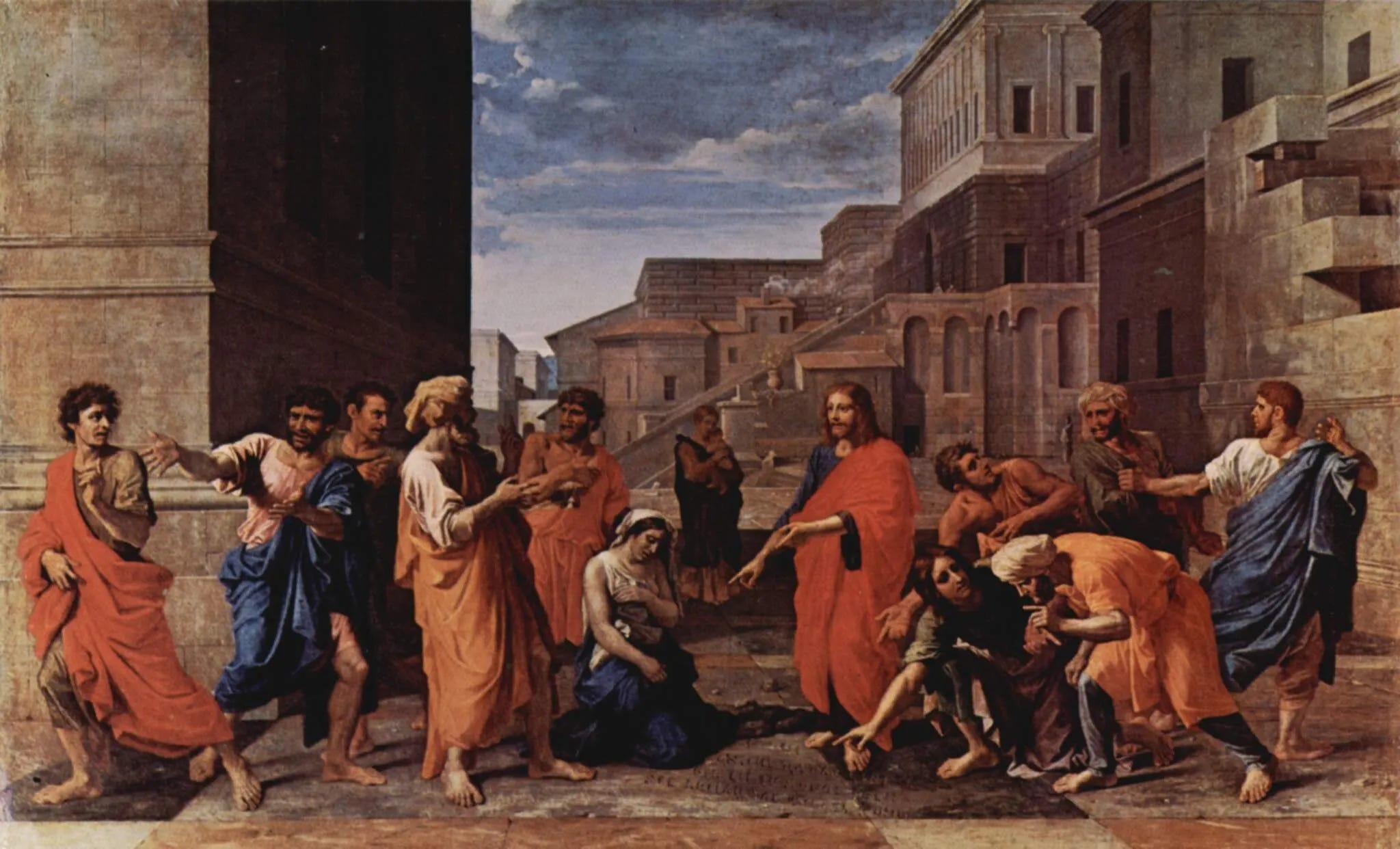
The woman caught in adultery, the story where Jesus tells the crowd that whoever is without sin should throw the first stone, appears in John 7:53-8:11. It isn’t in the earliest and best manuscripts of John. It floats around in the tradition, appearing in different places in different copies, and some scribes parked it in Luke instead. Most modern Bibles now bracket it with a note. Nobody reads the note.
Mark originally ended at 16:8, with the women fleeing the empty tomb and telling nobody because they’re terrified. The twelve verses that follow, including the resurrection appearances and the bit about handling snakes and drinking poison, are missing from the two oldest complete Bibles we have. Whole Appalachian congregations have organized their worship around a passage that a second-century scribe wrote to give the Gospel a more satisfying finish.
Then there’s 1 John 5:7-8, the Comma Johanneum, the one verse in the entire Bible that plainly states the Trinity. It appears in no Greek manuscript before roughly the fourteenth century. It entered the printed Greek text because Erasmus, under pressure, included it in a later edition after a manuscript containing it conveniently surfaced. From there it went into the King James Version and into four hundred years of English-speaking Christianity. The clearest proof text for the central doctrine of the faith is a Latin gloss that worked its way into the margin and then into the page.
Half of Paul’s Letters Weren’t Written by Paul
Thirteen New Testament letters carry Paul’s name. Scholars across the spectrum, including at Catholic and mainline seminaries, treat seven as uncontested: Romans, 1 and 2 Corinthians, Galatians, Philippians, 1 Thessalonians, and Philemon. Nobody can authenticate these against an original, since none survives, so the case rests on internal evidence: vocabulary, theology, how much church organization the letter assumes, and where it sits historically. The seven hang together on all four counts and the rest pull away from them. The Pastorals (1 Timothy, 2 Timothy, Titus) are almost universally regarded as later productions written in Paul’s name, with Ephesians, Colossians, and 2 Thessalonians heavily disputed.
This matters because of which verses land where. The instruction that a woman must learn in silence and submission and may not teach or hold authority over a man comes from 1 Timothy 2:11-12. That’s one of the letters Paul didn’t write. The household code telling slaves to obey their masters comes from Ephesians and Colossians. Even 1 Corinthians 14:34-35, the command for women to keep silent in the churches, sits in different positions in different manuscript families, which is a strong indicator that it started life as a marginal note by a scribe who agreed with the Pastorals.
The uncontested Paul greets Junia as outstanding among the apostles and works alongside Phoebe, a deacon, and Prisca, who taught. The Paul who tells women to sit down and shut up is a man writing under a dead apostle’s name a generation or two later. Every church that bars women from the pulpit is running on the forgeries.
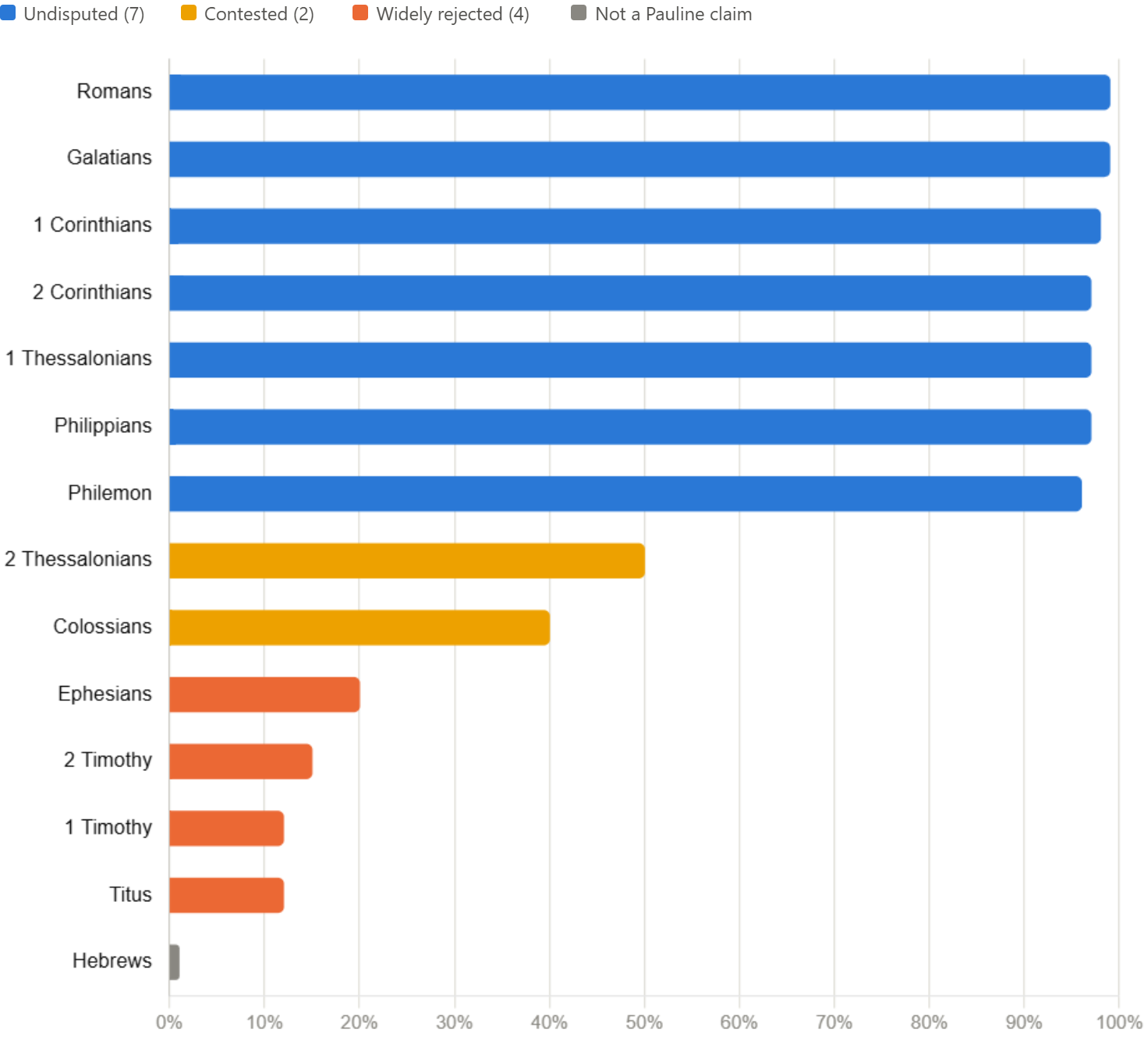
Counting evangelical and confessional scholars in these percentages flatters the theological position, because those numbers include people who reached their conclusion before they read anything. All thirteen letters are Paul’s, and the evidence offered is that the letters say so, which is the claim being tested rather than support for it.
The Bible’s Only Abortion Ritual Is Performed by a Priest
Numbers 5:11-31 lays out what to do when a husband suspects his wife of infidelity. The priest mixes dust from the tabernacle floor into holy water, writes out curses, washes the ink into the drink, and makes her swallow it. If she’s guilty, her belly swells and her thigh falls away, which is Hebrew idiom for a pregnancy ending. God is the operator of the procedure and the temple is the clinic.
Exodus 21:22-25 handles the case of men fighting who strike a pregnant woman and cause her to miscarry. The penalty is a fine paid to her husband. If the woman herself dies, the penalty is life for life. The fetus is property damage and the woman is a person, which is the opposite of the hierarchy preached from evangelical pulpits today.
Southern Baptists knew this. In 1971, two years before Roe, the Southern Baptist Convention passed a resolution calling for legislation permitting abortion in cases including rape, incest, fetal deformity, and damage to the emotional or physical health of the mother. W.A. Criswell, one of the most influential fundamentalists in the country, said publicly after Roe that a baby became a person at birth. Randall Balmer, the historian who has done the most careful work on this, traces the movement’s pivot to the late 1970s and to Paul Weyrich, who spent years looking for an issue that would mobilize evangelical voters and found that the thing lighting up conservative Protestant pastors was the IRS revoking tax exemptions from segregated Christian academies. Abortion arrived later as the respectable version of the grievance.
The Convention Was Founded to Defend Slaveholders
The Southern Baptist Convention split from northern Baptists in 1845 over whether a slaveholder could serve as a missionary. The southern churches said yes and left. They had scripture on their side, which is the part nobody wants to sit with. The Bible regulates slavery in Exodus and Leviticus, sets terms for beating your slave short of killing him, tells slaves to obey their masters in the New Testament epistles, and returns a runaway in Philemon. Mark Noll’s work on the theological crisis of the Civil War shows the pro-slavery preachers winning the proof-text argument comfortably, because the literalist reading was theirs.
The abolitionist case ran on themes, on the arc of Exodus and the ethics of the prophets and the logic of imago Dei, which required reading the Bible as a document with a trajectory rather than a rulebook. Curse of Ham theology, built out of a garbled passage in Genesis 9 about Noah’s drunkenness, supplied the racial justification and outlived slavery by a century in Sunday schools. The SBC apologized in 1995, a hundred and fifty years late.
If you find value here, become a supporter of The Unholy Truth. Paid subscriptions are what make this work possible.
Where This Leaves the Inerrancy Claim
All this comes from the manuscript evidence, from the standard critical editions, and from historians of American religion, much of it produced by Christians working in Christian institutions. The information is available, taught, and published. What’s missing is any incentive to bring it into the sanctuary, because a congregation that knows the Pastorals are pseudonymous is harder to keep quiet, and a congregation that knows its denomination was born defending slaveholders has questions about who decides which verses are timeless.
The movement’s authority rests on the claim that it reads a perfect book plainly. Both halves of that claim fall apart under the evidence, and the people holding the microphone have known it the whole time.
Contrary to what some of the loudest public figures keep insisting, believing in God doesn’t put anyone out of touch with reality, and neither does following a religion. The break comes when someone loses track of the line between what they know and what they believe, at which point the belief stops being answerable to anything outside itself. That’s the condition a lot of white evangelical leadership has cultivated in its people, and it’s why the facts in this piece will bounce off most who were brought up in that environment, no matter how solid the evidence is. The ones it won’t bounce off are the ones who go check.
Sources and Further Reading
Bart D. Ehrman, Misquoting Jesus: The Story Behind Who Changed the Bible and Why (HarperOne, 2005)
Bart D. Ehrman, Forged: Writing in the Name of God (HarperOne, 2011)
Bruce M. Metzger and Bart D. Ehrman, The Text of the New Testament: Its Transmission, Corruption, and Restoration, 4th ed. (Oxford, 2005)
Randall Balmer, Bad Faith: Race and the Rise of the Religious Right (Eerdmans, 2021)
Mark A. Noll, The Civil War as a Theological Crisis (UNC Press, 2006)
Jemar Tisby, The Color of Compromise (Zondervan, 2019)
Gordon D. Fee, The First Epistle to the Corinthians, rev. ed. (Eerdmans, 2014), on 1 Corinthians 14:34-35
Francesca Stavrakopoulou, God: An Anatomy (Knopf, 2022)
Tanner,
So, I was a missionary kid. My parents were lay missionary teachers, not evangelizers. But they believed ... though it's sometimes tough to figure out what.
That said, let me tell you how luminescent your research and writing are for me. Deep down they reveal to me that "faith" is ... a method of control. (For example, I discovered that Thich Nhat Hanh does not use the word.) Thus, to notice where "faith" is foisted on us. From so many directions: faith in the "rule of law" or in Coca-Cola's longing for global unity or .....
By the way, your takeaway sentences carry a punch: "central doctrine of the faith is a Latin gloss that worked its way into the margin and then into the page" / Every church that bars women from the pulpit is running on the forgeries" / "God is the operator of the procedure and the temple is the clinic"
But bear in mind that you're often preaching to the choir. And, as is often the case, you're also preaching and writing to yourself. The latter is the most honest - no?
take care,
Alan
Hmm. I'm a white evangelical and I am aware of each of the things you mention and have no problem with wider awareness of them. I could be mistaken, but many evangelicals of color may hold to the same beliefs you critique. This makes me wonder why white evangelicals are singled out. For what it's worth, evangelicalism is not a monolith. There is a significant subset that has been called "the other evangelicals" by researcher Wes Markofski and spoken of in an article he wrote at The Immanent Frame and his book Good News for Common Goods.