


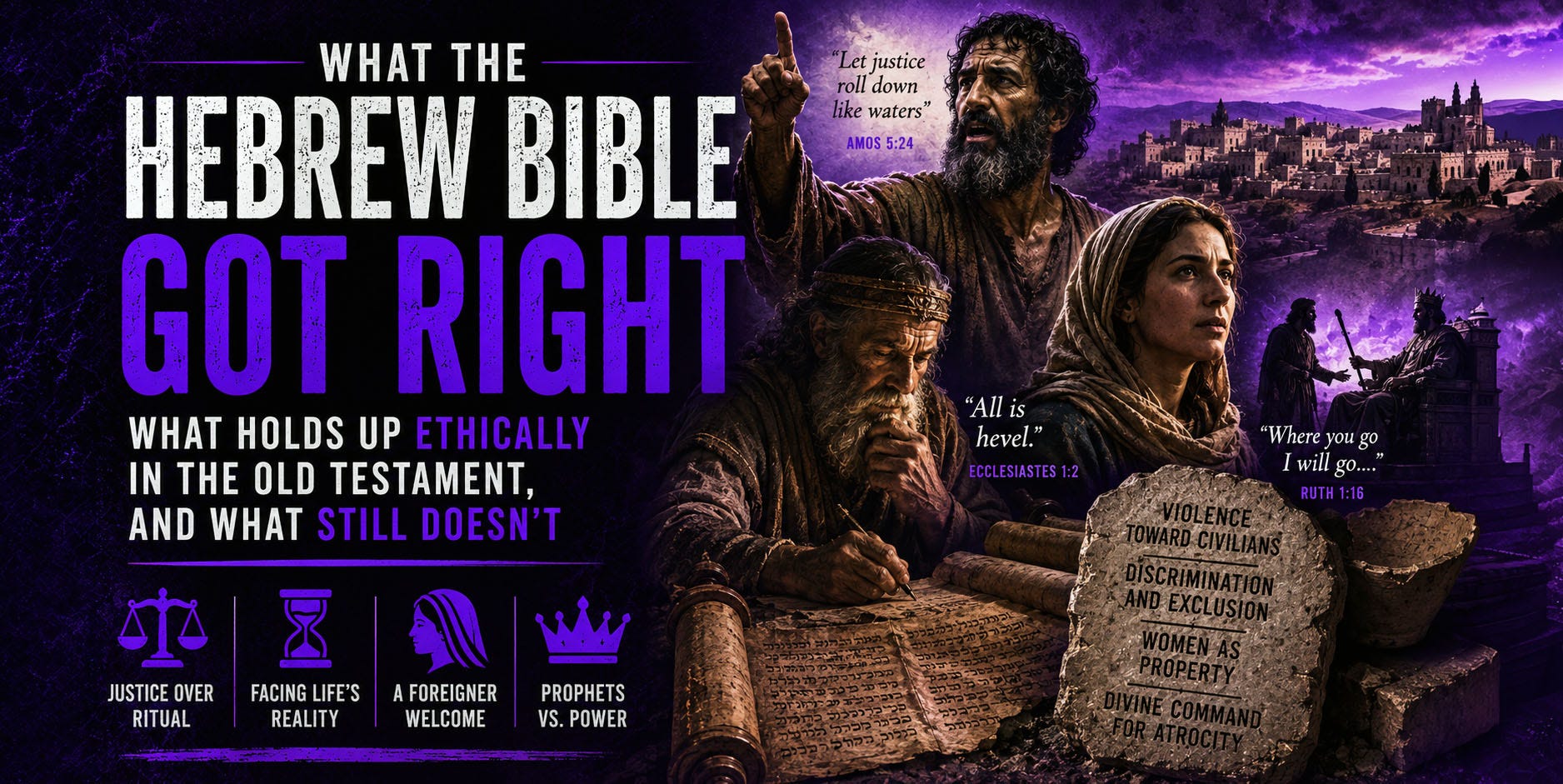
In the latest survey, a reader asked me to grade the Old Testament instead of just prosecuting it. Fair request.
The Hebrew Bible, just like the New Nestament has many teachings and stories that we would get behind regardless of our faith or therelack of.
Amos and the Refusal to Let Religion Excuse Injustice
Amos is an eighth-century BCE shepherd from Tekoa who shows up in the northern kingdom of Israel and tells the wealthy that their religious devotion means nothing while they’re grinding the poor into the dust.
The book’s central move is to sever the connection between ritual correctness and moral standing. Amos has Yahweh say he hates the festivals, takes no delight in the assemblies, and wants no part of the burnt offerings. What he wants instead is to let justice roll down like waters, and righteousness like an ever-flowing stream. That’s Amos 5:24, and it’s one of the few Old Testament lines that has earned its place in modern moral rhetoric. Martin Luther King quoted it because it does something most ancient religious texts don’t bother doing. It tells the people running the temple that their religion is worthless if it coexists with exploitation.
There is more. Amos names specific practices such as selling the needy for a pair of sandals, trampling the head of the poor into the dust, taking garments in pledge and using them as bedding at the altar. He’s describing a specific economic system and calling it out by name, not gesturing vaguely at injustice in general.
What makes Amos worth reading now is the specific claim that ritual and worship can’t substitute for justice, that you can’t buy off a moral debt with religious performance. That claim shows up later in Christian and Islamic ethics too, but Amos got there first, without softening it into something comfortable.
Ecclesiastes and the Refusal to Pretend
Ecclesiastes is arguably the strangest book in the canon, not strange in the negative sense but because it refuses to do what religious texts are expected to do. It doesn’t promise virtue gets rewarded. It doesn’t claim wisdom protects you from death. It looks directly at the fact that the wise man and the fool die the same death, that toil produces nothing you can keep, that everything is hevel, usually translated “vanity” but closer to “vapor” or “breath,” something that dissolves the moment you try to hold it.
The book reads like a crisis of faith written from inside the tradition, not an attack on it from outside. Its narrator, Qohelet, has done everything ancient wisdom theology promised would work. He’s built, planted, accumulated, pursued pleasure and pursued wisdom, and none of it resolved the basic problem, which is that death erases the distinction between the wise and the foolish, and nobody gets to keep score.
What’s remarkable is that this made it into scripture at all. A text this skeptical about divine justice, this willing to say the righteous sometimes get what the wicked deserve and the wicked get what the righteous deserve, survived the editorial process and ended up canonical. The book’s actual conclusion, work with what’s in front of you, eat your bread, enjoy your labor, because that’s what you actually have, is a mature response to mortality. It doesn’t promise an afterlife will fix the unfairness. It tells you to live inside the unfairness without lying about it.
Ruth and Her Vision
Ruth is a Moabite, which is a detail matters more than most people often realize, because Moabites show up elsewhere in the Hebrew Bible as objects of specific ethnic contempt. Deuteronomy 23:3 bars Moabites from entering the assembly of the Lord “even to the tenth generation.” Numbers 25 has Israelite men seduced into idolatry by Moabite women, followed by a plague and an execution spree.
Against that backdrop, the book of Ruth tells the story of a Moabite widow who commits herself to her Israelite mother-in-law Naomi, follows her back to Bethlehem, and eventually becomes the great-grandmother of King David. “Where you go I will go, and where you stay I will stay. Your people will be my people and your God my God.” That’s Ruth 1:16, spoken by a foreign woman choosing loyalty and inclusion over the tribal boundary the rest of the text keeps insisting on.
Katharine Doob Sakenfeld has read Ruth as a deliberate counter-narrative, arguing against the xenophobic strain running through Ezra, Nehemiah, and Deuteronomy. Whether or not that was the author’s conscious intent, the effect holds. Ruth builds its entire plot around a foreigner being folded into the central lineage of Israelite kingship, not just tolerated. The line that produces David runs through a Moabite woman the law technically bars from the assembly. The text seems to know exactly what it’s doing.
The Prophetic Critique of Power, Beyond Amos
Amos isn’t alone. Nathan confronts David over Bathsheba and Uriah with the parable of the stolen lamb. Elijah confronts Ahab over Naboth’s vineyard. Isaiah condemns those who “join house to house” until there’s no room left for anyone else. The through-line across these texts is that the king is not above the law, that political power doesn’t grant moral exemption, and that the prophet’s job is to say so to the king’s face regardless of the cost.
This is not a small thing in the ancient Near East. Most surrounding cultures produced royal ideology that sanctified the king’s authority. The Hebrew prophetic tradition produced a genre whose function was telling the king he’d committed a crime and would face consequences for it. Nathan doesn’t soften the message for David. He traps him into passing judgment on himself first.
If you found this useful, consider becoming a paid subscriber. It’s what keeps The Unholy Truth going.
Where the Ledger Runs the Other Way
None of this excuses what is indefensible — or at the very least seriously problematic — elsewhere in the same corpus. The conquest accounts in Joshua depict ḥerem warfare: the annihilation of Canaanite cities, women and children included, presented as a divine mandate. Deuteronomy 20 formalizes this as policy for cities beyond Israel’s immediate borders. The laws concerning female captives in Deuteronomy 21:10–14, along with the broader treatment of women as property throughout the legal codes, cannot be reconciled with modern ethics no matter how much interpretive generosity one tries to muster. Numbers 31 goes further still, with Moses ordering the killing of Midianite boys and non‑virgin women after battle, reserving virgin girls as spoils.
A text that claims to be God’s word doesn’t get graded on a curve. If anything, the standard rises much higher. Once that claim is made, the question is no longer whether the text contains admirable elements (of course it does). The question becomes why a divinely authored revelation contains material that, by any humane measure, runs the ledger the other way.
What do you think?
Sources and Further Reading
Michael V. Fox, Qohelet and His Contradictions (1989)
Katharine Doob Sakenfeld, Ruth (Interpretation commentary series, 1999)
Robert R. Wilson, Prophecy and Society in Ancient Israel (1980)
Bart Ehrman, God’s Problem: How the Bible Fails to Answer Our Most Important Question (2008)
Francesca Stavrakopoulou, God: An Anatomy (2021)
Wholeheartedly agree, Tanner, the God who demands justice, right action towards both stranger and slave, lectures on the duty to maintain high standards of moral integrity, is the same God who leads His worshippers into the killing fields of outright mayhem and violence.
So go figure. I can’t.
Ecclesiasties essence is much like Buddhism.